India’s tax landscape underwent a historic transformation with the introduction of the Income Tax Act 2025. This landmark legislation replaces the decades-old Income Tax Act of 1961, which had grown unwieldy with over 931 sections, numerous amendments, and layers of complexity that baffled even seasoned tax professionals. The new act, effective from April 1, 2026, is designed to simplify the tax framework, modernise compliance, and reduce litigation between taxpayers and the revenue authorities.
Whether you are a salaried employee, a business owner, a freelancer, or a senior citizen, understanding the Income Tax Act 2025 is essential for managing your finances effectively. This comprehensive guide walks you through everything you need to know — from its structure and chapters to the latest tax slabs and what really changed.
What is the Income Tax Act 2025?
The Income Tax Act 2025 is India’s new comprehensive legislation governing the levy, administration, collection, and recovery of direct taxes. It was introduced in the Union Budget to overhaul the existing Income Tax Act of 1961 and make tax laws more accessible, technology-friendly, and taxpayer-centric.
The new act spans over 600 pages, contains 536 sections, 23 chapters, and 16 schedules. Its primary goal is to eliminate redundant provisions, remove archaic language, and align tax administration with today’s digital economy. One of its most notable changes is replacing the traditional terms ‘Assessment Year’ and ‘Financial Year’ with the unified concept of ‘Tax Year’, making it easier for ordinary citizens to understand their obligations.
Think of it this way: if the Income Tax Act of 1961 was an old government building patched over decades with extensions and workarounds, the Income Tax Act 2025 is a brand-new, well-planned structure built from scratch with modern architecture.
When Does the Income Tax Act 2025 Come Into Effect?
The Income Tax Act 2025 officially comes into effect from April 1, 2026. This means that for income earned from April 1, 2026 onwards, the provisions of the new act will apply. However, for the income earned till March 31, 2026 (which is filed between April and August 2026), the old Income Tax Act of 1961 still governs the assessment.
Practical Example: Rahul, a software engineer in Bengaluru, files his income tax return in July 2026 for salary earned between April 2025 and March 2026. His return will be processed under the Income Tax Act 1961. But from April 1, 2026, any new income he earns falls under the Income Tax Act 2025.
Key Highlights and Features of the Income Tax Act 2025
The new act introduces several forward-looking features that fundamentally change how India’s tax system operates. Here are the most important highlights:
- Tax Year Concept: The confusing dual nomenclature of ‘Assessment Year’ and ‘Financial Year’ is replaced by a single ‘Tax Year’, reducing taxpayer confusion.
- Digital Integration: The act incorporates provisions for digital transactions, electronic records, and crypto-assets, reflecting the realities of the modern economy.
- Simplified Language: Complex legal jargon has been replaced with plain, readable language that taxpayers can understand without a CA’s help.
- Reduced Litigation: Clearer provisions and reduced ambiguity are expected to significantly cut down disputes between taxpayers and the Income Tax Department.
- Streamlined Compliance: Automated filing processes, pre-filled returns, and tech-driven verification are integrated into the law.
- Modernised Penalties: Penalty provisions have been restructured to be proportional and transparent.
Structure: Chapters and Schedules at a Glance
The Income Tax Act 2025 is organized into 23 well-defined chapters, each addressing a specific area of taxation. This structured approach makes it far easier for taxpayers and professionals to navigate the law compared to the piecemeal structure of the 1961 Act.
Key chapters include provisions on income computation, deductions, tax rates, advance tax, TDS (Tax Deducted at Source), assessment procedures, appeals, penalties, and international taxation. The 16 schedules provide detailed tables for rates, deductions, and exemptions — all consolidated in one place for easy reference.
For example, a small business owner in Mumbai no longer needs to cross-reference a dozen different sections to understand their audit obligations. Under the new act, all SME-related provisions are logically grouped, saving time and reducing errors.
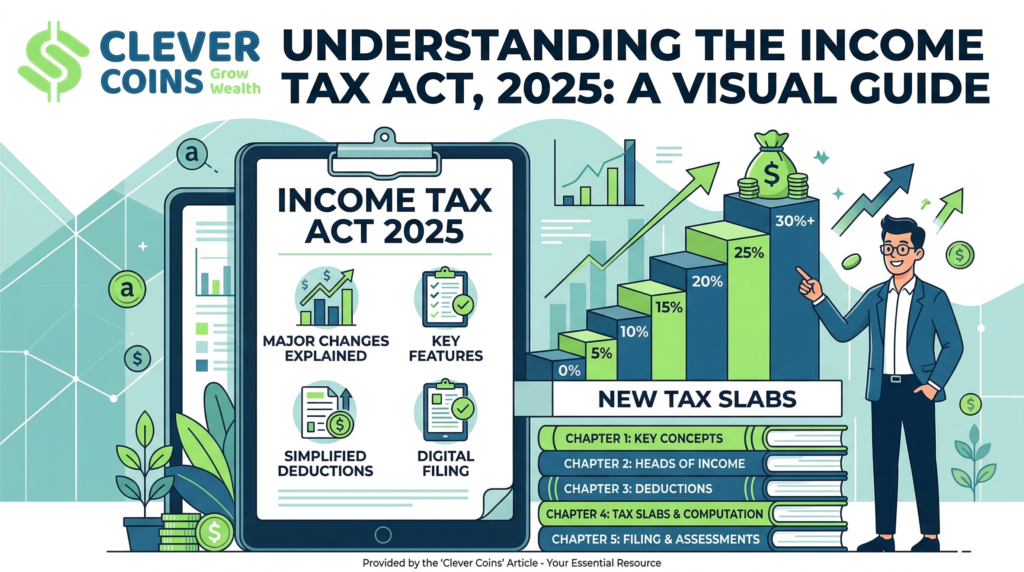
New Tax Slabs Under the Income Tax Act 2025
The Income Tax Act 2025 continues with both the Old Tax Regime and the New Tax Regime, giving taxpayers flexibility. However, the New Tax Regime has been made more attractive with revised slabs and a higher basic exemption limit.
Under the New Tax Regime for FY 2026-27, income up to Rs. 3 lakh is fully exempt. Income between Rs. 3 lakh and Rs. 7 lakh is taxed at 5%, Rs. 7 lakh to Rs. 10 lakh at 10%, Rs. 10 lakh to Rs. 12 lakh at 15%, Rs. 12 lakh to Rs. 15 lakh at 20%, and income above Rs. 15 lakh at 30%.
Importantly, individuals with taxable income up to Rs. 12 lakh enjoy a full tax rebate, meaning their effective tax liability is zero. This is a major relief for middle-income earners.
Real-Life Example: Priya, a teacher earning Rs. 11.5 lakh per year, has zero tax liability under the New Tax Regime thanks to the rebate provision — a significant saving compared to the earlier system.
Key Differences: Income Tax Act 2025 vs Income Tax Act 1961
The most significant difference between the two acts is simplicity and modernisation. The 1961 Act accumulated thousands of amendments over 65 years, making it a maze of provisions. The 2025 Act starts fresh, removing obsolete sections, consolidating scattered provisions, and using technology as a compliance backbone.
The concept of ‘Tax Year’ versus ‘Assessment Year/Financial Year’ is one of the most visible changes. Under the old system, taxpayers often confused which year was applicable for which assessment. The unified Tax Year removes this ambiguity entirely.
Another major change is the treatment of digital assets. The 1961 Act was not designed with crypto-currencies or digital NFTs in mind, leading to interpretive disputes. The 2025 Act directly addresses virtual digital assets with explicit provisions, ensuring clarity.
Compliance has also been made easier. The 2025 Act mandates pre-filled ITR forms with data pulled from multiple sources (employer TDS, bank interest, stock transactions), reducing the burden on individual filers significantly.
Impact on Salaried Individuals, Businesses, and Senior Citizens
For salaried individuals, the Income Tax Act 2025 brings relief through higher exemption limits, simplified deduction rules, and easier return filing. The standard deduction has been enhanced, and the process for claiming HRA, LTA, and other allowances has been streamlined.
Businesses benefit from clearer provisions on depreciation, set-off of losses, and audit thresholds. The presumptive taxation scheme has been simplified, allowing small businesses to opt in without extensive bookkeeping.
Senior citizens receive continued benefits including higher basic exemption limits under the Old Tax Regime (Rs. 3 lakh for those aged 60-80, and Rs. 5 lakh for super senior citizens above 80), and they remain exempt from advance tax if they have no business income.
Example: Suresh, a retired teacher aged 68 in Jaipur, earns pension income of Rs. 4.5 lakh annually. Under the Old Tax Regime, his income falls within the senior citizen exemption limit of Rs. 3 lakh, but the Rs. 1.5 lakh excess is still taxable. He can use Section 80C deductions to bring it down to zero.