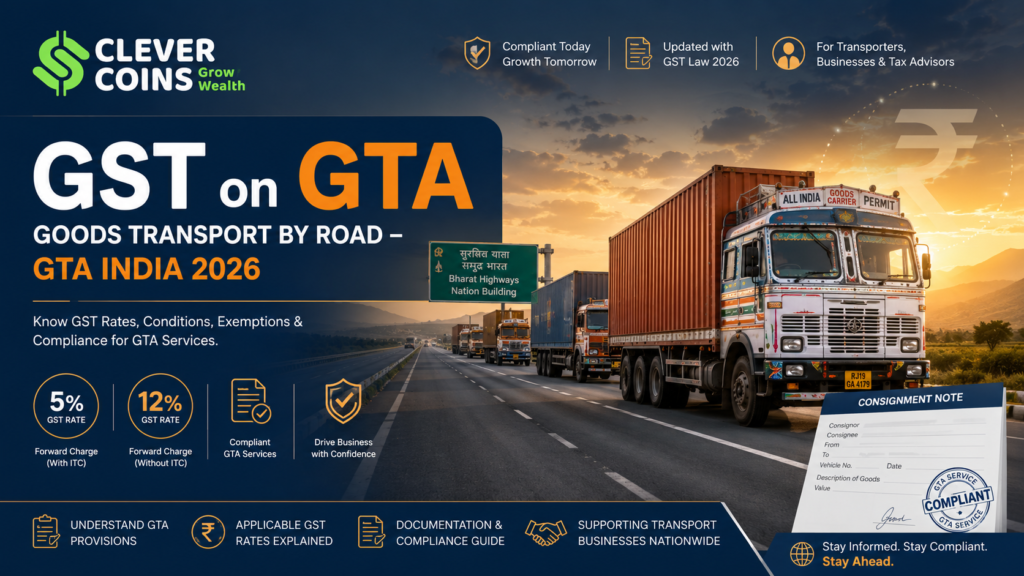
GST on Goods Transport by Road – GTA:
The Ultimate 2026 Guide for Businesses, Transporters & Compliance Teams
India’s logistics and road-transport sector is the circulatory system of its Rs. 300-lakh-crore economy. Every consignment that leaves a factory, warehouse, or port and travels to its destination on a truck or lorry passes through a complex web of taxes, compliance obligations, and regulatory rules. At the heart of this lies the Goods and Services Tax (GST) framework as it applies to Goods Transport Agencies (GTAs) — one of the most nuanced and frequently misunderstood chapters of Indian indirect tax law.
As of 2026, the GST rules governing GTAs have been significantly clarified through a series of notifications, circulars, and GST Council decisions — yet confusion persists among consignors, consignees, transporters, and business owners alike. This comprehensive blog post, produced by our full marketing team (content, SEO, social, AI prompt, and design), covers every angle of GST on Goods Transport by Road in India: what a GTA is, the applicable GST rates, the Reverse Charge Mechanism (RCM), exemptions, Input Tax Credit (ITC) eligibility, e-way bill rules, compliance checklist, and the road ahead.
What Is a Goods Transport Agency (GTA)?
Under GST law, the term ‘Goods Transport Agency’ carries a precise statutory meaning. It is not synonymous with every business that transports goods — the definition is specific and has significant compliance implications.
Statutory Definition of GTA under GST
As per Notification No. 11/2017-Central Tax (Rate) dated 28th June 2017 (as amended), a Goods Transport Agency means any person who provides service in relation to the transport of goods by road and issues a consignment note (also called a lorry receipt or LR), by whatever name called.
|
Key Insight The issuance of a consignment note is the defining element. If a transporter does not issue a consignment note, they are NOT classified as a GTA under GST, and different tax rules apply to their services. |
Who Is NOT Treated as a GTA?
- A person who owns goods vehicles but does not issue consignment notes — classified as a simple ‘transporter.’
- An individual hiring a truck on an ‘own-account’ basis for personal or business use without issuing LRs.
- Courier companies that issue their own delivery documents — treated as courier services (different GST treatment).
- Airlines and railways — governed by their own provisions under the GST framework.
Difference Between GTA, Transporter, and Courier
|
Parameter |
Goods Transport Agency (GTA) |
Simple Transporter |
Courier Service |
|
Consignment Note Issued |
Yes (Mandatory) |
No |
Courier Receipt |
|
GST Applicability |
5% or 12% (specific rules) |
18% (general) |
18% |
|
RCM Applicable |
Yes (in many cases) |
No |
No |
|
ITC Eligibility |
Conditional |
Standard |
Standard |
|
Registration Required |
If turnover > Rs. 20 Lakh |
Standard threshold |
Standard threshold |
GST Rate Structure on GTA Services in 2026
One of the most frequently asked questions is: What is the GST rate on GTA services? The answer is not a single number — it depends on whether the GTA opts to pay GST itself (forward charge) or the recipient pays under the Reverse Charge Mechanism, and whether the GTA claims ITC.
Option 1: GTA Pays GST Under Forward Charge – 12% with ITC
A GTA can voluntarily choose to pay GST under the forward charge mechanism. In this case:
- GST Rate: 12% (6% CGST + 6% SGST/UTGST, or 12% IGST for interstate transport).
- ITC Benefit: The GTA can claim Input Tax Credit on inputs (fuel, tyres, vehicle maintenance, etc.).
- This option must be declared at the beginning of the financial year and applies for the entire year.
- A declaration in a specified format must be submitted — updated GST Council clarifications (effective 18th July 2022 onwards, continued in 2026) require filing of Form Annexure V before 15th March of the preceding financial year.
Option 2: GTA Pays GST Under Forward Charge – 5% Without ITC
Alternatively, a GTA under forward charge can opt for the lower rate:
- GST Rate: 5% (2.5% CGST + 2.5% SGST/UTGST, or 5% IGST).
- ITC Restriction: The GTA cannot claim Input Tax Credit on any inputs or input services under this option.
- This is the default forward charge rate if a GTA opts for forward charge but does not specifically opt for 12%.
Option 3: Reverse Charge Mechanism (RCM) – 5% Paid by Recipient
Under the Reverse Charge Mechanism, the liability to pay GST shifts from the GTA (supplier) to the recipient of the service. The rate is:
- GST Rate: 5% (2.5% CGST + 2.5% SGST/UTGST, or 5% IGST for interstate).
- Who pays? The recipient — being a specified category (see Section below) — pays this GST.
- The GTA does not need to collect or remit GST in this case; however, they also cannot claim ITC.
Summary GST Rate Table for GTA Services (2026)
|
Charge Mechanism |
GST Rate |
ITC by GTA |
Who Remits GST |
Best For |
|
RCM (Default) |
5% |
No |
Recipient |
Small/unregistered GTAs |
|
Forward Charge – 5% |
5% |
No |
GTA |
Large GTAs, low ITC needs |
|
Forward Charge – 12% |
12% |
Yes (Full ITC) |
GTA |
GTAs with high input costs |
Reverse Charge Mechanism (RCM) on GTA – Detailed Analysis
The Reverse Charge Mechanism (RCM) is perhaps the most complex and commonly misunderstood aspect of GST on GTA services. Under Section 9(3) of the CGST Act, 2017, the Government has notified specific services where RCM applies — and GTA services are one of them.
Who Is Required to Pay GST Under RCM on GTA?
As per Notification No. 13/2017-Central Tax (Rate) (as amended up to 2026), any of the following recipients who avail GTA services must pay GST under RCM, provided the GTA has NOT opted for forward charge:
- Any factory registered under the Factories Act, 1948.
- Any society registered under the Societies Registration Act, 1860, or under any other law in India.
- Any co-operative society established by or under any law in force.
- Any person registered under the CGST Act / SGST Act / UTGST Act / IGST Act.
- Any body corporate established by or under any law in India.
- Any partnership firm including Association of Persons (AoP).
- Any casual taxable person.
|
Important Note If the recipient is an individual consumer (non-business), unregistered person not falling in above categories, or if the GTA has opted for forward charge — RCM does NOT apply. The GTA must pay GST under forward charge in such scenarios. |
How Does RCM Work in Practice? – Step-by-Step
- ABC Manufacturers Ltd. (registered under GST) hires XYZ Transport Agency (a GTA) to move goods from Pune to Delhi.
- XYZ GTA issues a consignment note (LR) for the shipment of goods worth Rs. 5,00,000. Freight charges: Rs. 50,000.
- XYZ GTA has NOT opted for forward charge — so RCM applies.
- GST under RCM at 5% on Rs. 50,000 = Rs. 2,500 (IGST, as it is interstate).
- ABC Manufacturers Ltd. must pay this Rs. 2,500 directly to the Government as RCM liability.
- ABC can claim ITC of Rs. 2,500 (subject to conditions), offsetting its output GST liability.
- XYZ GTA does not pay any GST and does not charge GST in its invoice to ABC.
Key GST Provisions Governing RCM on GTA
- Section 9(3) CGST Act – Legal basis for RCM on notified services.
- Notification 13/2017-CT(R) – Specifies GTA as one of the services attracting RCM.
- Section 16 CGST Act – ITC eligibility rules for RCM-paid tax (ITC available on RCM paid, subject to conditions).
- Section 31(3)(f) CGST Act – Recipient must issue a self-invoice when paying under RCM.
- Rule 36 CGST Rules – Conditions for claiming ITC on RCM payments.
GST Exemptions on Goods Transport by Road
Not all freight movements attract GST. The Government has provided several exemptions on GTA services through Notification No. 12/2017-Central Tax (Rate) and its amendments. Understanding these exemptions is critical for accurate GST compliance and cost management.
Complete List of Exemptions on GTA Services (as of 2026)
GTA services are exempt from GST (no tax payable — neither by GTA nor by recipient) in the following cases:
- Transport of agricultural produce — including cereals, pulses, fruits, vegetables, milk, and similar produce.
- Transport of milk, salt, food grains including rice and flour.
- Transport of organic manure and cotton (ginned or baled).
- Transport of relief materials for victims of disasters/calamities — this is an important humanitarian exemption.
- Transport of defence or military equipment.
- Transport of newspaper or magazines registered with the Registrar of Newspapers.
- Transport where the consignor is the Central Government, State Government, or local authority, and the recipient is also such a body.
- Transport of goods where the gross amount charged by a GTA for transportation of goods on a consignment, transported in a single carriage, does not exceed Rs. 1,500.
- Transport of goods where the gross amount charged by a GTA for all goods transported for a single consignee does not exceed Rs. 750.
|
Practical Exemption Threshold (2026) Threshold 1: Single carriage (truck/lorry) carrying multiple consignments — if total freight for ANY ONE consignment ≤ Rs. 1,500 → Exempt. Threshold 2: All goods belonging to one consignee transported in one trip — if total freight ≤ Rs. 750 → Exempt. Note: These thresholds apply per consignment/consignee and have remained consistent through 2026 GST Council decisions. |
Sector-Specific Exemption Impact Table
|
Goods/Sector |
Exempt? |
GST Rate if Taxable |
Key Note |
|
Agricultural Produce |
Yes |
NIL |
Covers fresh produce only |
|
Food Grains (Rice, Wheat, Pulses) |
Yes |
NIL |
Processed grains may differ |
|
Milk & Dairy (Unprocessed) |
Yes |
NIL |
Packaged milk: check separately |
|
Cotton (Ginned/Baled) |
Yes |
NIL |
Cotton yarn: taxable |
|
Newspaper/Magazines |
Yes |
NIL |
Must be RNI registered |
|
General Merchandise |
No |
5% (RCM) or 12% (FCM) |
Most industrial goods |
|
E-Commerce Goods |
No |
5% or 12% |
Subject to all RCM rules |
|
Hazardous/Chemical Goods |
No |
5% or 12% |
Additional compliance may apply |
|
Luxury/Consumer Durables |
No |
5% or 12% |
ITC available for businesses |
|
Relief/Disaster Materials |
Yes |
NIL |
Certificate may be required |
Input Tax Credit (ITC) on GTA – Eligibility & Restrictions
The ITC treatment under GTA is one of the most complex aspects of GST and has direct bottom-line implications for businesses. Whether a company can claim ITC on freight paid under RCM or forward charge determines the effective tax cost of logistics.
ITC for Recipients Who Pay Under RCM
When a registered recipient pays 5% GST under RCM on GTA services, they are eligible to claim this as Input Tax Credit, provided:
- The goods/services are used for business purposes (not personal consumption).
- The recipient is registered under GST.
- A self-invoice has been issued by the recipient under Section 31(3)(f) of the CGST Act.
- The ITC is claimed in the same tax period or within the time limit specified under Section 16(4) of the CGST Act.
- The tax has actually been paid to the Government.
|
Blocked Credit – Section 17(5) ITC on GTA services is NOT blocked under Section 17(5) of the CGST Act — it is fully claimable by businesses for business use. This is unlike motor vehicle expenses for personal travel, which are blocked. |
ITC for GTAs Themselves
Whether a GTA can claim ITC on its own input costs (fuel, vehicle repairs, tyres, etc.) depends entirely on the rate option chosen:
|
GTA Option |
ITC on Own Inputs |
Example Input Cost Savings |
|
RCM (GTA doesn’t pay GST) |
Not Applicable |
No GST paid = No ITC needed |
|
Forward Charge – 5% (No ITC) |
Blocked – Cannot Claim |
ITC on diesel/tyres = Rs. 0 |
|
Forward Charge – 12% (With ITC) |
Fully Claimable |
ITC on diesel/tyres = Rs. 18 per Rs. 100 spent |
Practical ITC Calculation Example (2026 Figures)
Scenario: ABC Logistics Ltd. opts for forward charge at 12% GST rate.
- Revenue from freight services in FY 2025-26: Rs. 1,00,00,000 (Rs. 1 Crore).
- Output GST collected at 12%: Rs. 12,00,000.
- Input costs — Diesel: Rs. 30,00,000 (GST paid @ 0% — fuel is outside GST, so NO ITC on fuel).
- Input costs — Tyres: Rs. 5,00,000 (GST paid @ 28% = Rs. 1,40,000 — ITC claimable).
- Input costs — Vehicle repairs/spare parts: Rs. 3,00,000 (GST @ 18% = Rs. 54,000 — ITC claimable).
- Input costs — Insurance: Rs. 1,00,000 (GST @ 18% = Rs. 18,000 — ITC claimable).
- Total ITC available: Rs. 1,40,000 + Rs. 54,000 + Rs. 18,000 = Rs. 2,12,000.
- Net GST payable: Rs. 12,00,000 – Rs. 2,12,000 = Rs. 9,88,000.
|
Key Observation Diesel/petrol are not under GST — this significantly limits the ITC benefit for GTAs even under the 12% option. However, ITC on tyres, spare parts, insurance, and other business services remains available. |
GST Registration Rules for GTAs in 2026
Understanding whether a GTA needs to register under GST is critical for compliance. The rules are different from standard businesses due to the RCM mechanism.
Threshold for GST Registration
- Normal businesses: Aggregate turnover exceeding Rs. 20 Lakh (Rs. 10 Lakh for special category states — NE states, Himachal Pradesh, Uttarakhand, J&K, etc.) in a financial year.
- GTAs under RCM: If the GTA provides only those services where the RECIPIENT pays GST under RCM, the GTA has ZERO GST output liability. In such cases, the GTA may not need to register even if its turnover exceeds Rs. 20 Lakh — because there is no taxable supply made by the GTA itself.
- GTAs opting for Forward Charge: Must register under GST if aggregate turnover exceeds the applicable threshold (Rs. 20 Lakh / Rs. 10 Lakh).
Voluntary Registration by GTAs
A GTA may voluntarily register under GST even if below the threshold limit — this is advisable when:
- The GTA wants to claim ITC on its input costs (only possible if registered and under forward charge at 12%).
- The GTA’s clients demand GST invoices for their own ITC claims.
- The GTA wants to expand to interstate operations where RCM rules may be complex to handle.
Annual Option Filing – Deadline for FY 2025-26
|
Important Compliance Deadline A GTA wishing to opt for Forward Charge (either 5% without ITC or 12% with ITC) for FY 2026-27 must file Annexure V (declaration) on the GST portal by 15th March 2026. Once opted, the same option applies for the entire financial year — it cannot be changed mid-year. Default position: If no declaration is filed, GTA services fall under RCM at 5%. |
E-Way Bill Rules for Goods Transport by Road (2026)
The E-Way Bill (EWB) system under GST is inseparable from road transport compliance. It is mandatory for the movement of goods and directly impacts GTA operations.
When Is an E-Way Bill Required?
- Movement of goods valued at more than Rs. 50,000 (consignment value including GST) — E-Way Bill is mandatory.
- Applies to interstate movements AND intrastate movements (though states may have higher thresholds for intrastate).
- E-way Bill is required even for transport of exempt goods in certain states — check state-specific rules.
- The E-way bill must be generated BEFORE the commencement of transport.
Who Generates the E-Way Bill for GTA?
|
Scenario |
Who Generates E-Way Bill |
|
Consignor is registered under GST |
Consignor (supplier) generates EWB |
|
Consignee is registered, consignor not |
Consignee (recipient) generates EWB |
|
GTA is registered (and consignor/consignee not) |
GTA generates EWB (Part B) |
|
All parties registered |
Consignor generates Part A; GTA updates Part B (transporter details) |
|
Unregistered transporter (not GTA) |
Recipient generates EWB |
Validity of E-Way Bill (2026 Rules)
- Up to 200 km: 1 day validity.
- For every additional 200 km (or part thereof): 1 additional day.
- Overdimensional cargo (special permits required): 1 day for every 20 km.
- Validity begins from the date and time of generation of EWB.
- Extension of validity: Possible within 8 hours before or 8 hours after expiry — the transporter or consignor can extend online.
|
Penalty for Non-Generation of E-Way Bill Goods detained for non-compliance: Penalty of Rs. 10,000 or the amount of tax evaded — whichever is higher (Section 129 CGST Act). Vehicle can be detained until penalty is paid — causing severe delays to logistics operations. |
Impact of GST on the Road Transport & Logistics Industry in India
The introduction of GST in 2017 and its continued evolution through 2026 has had profound and multi-dimensional impacts on India’s road transport and logistics sector — the world’s second-largest logistics market.
Positive Impacts of GST on Road Transport
- Elimination of Check-Posts: Pre-GST, trucks spent an average of 20-30% of their journey time at state borders waiting for entry tax, octroi, and other clearances. Post-GST, most inter-state check-posts have been eliminated — reducing transit times by 20-40%.
- Faster Turnaround: A Mumbai-to-Delhi truck journey that used to take 3-4 days now averages 2-2.5 days due to seamless interstate movement.
- Reduced Logistics Cost: India’s logistics cost as a percentage of GDP has dropped from approximately 14-16% pre-GST to an estimated 10-12% in 2026 — a significant improvement (though still above the global average of 8%).
- Digital Integration: E-way bills, GST returns, and electronic invoicing have digitalised the previously paper-heavy transport industry.
- Organised Sector Growth: GST has incentivised the shift from unorganised to organised logistics — large fleet operators have gained a competitive advantage.
Challenges and Negative Impacts
- Fuel Outside GST: Diesel — the primary fuel for road transport — remains outside the GST framework. This means GTAs cannot claim ITC on their biggest operating expense, creating an embedded tax cost.
- Compliance Burden: Small truck owners and GTAs (often with limited accounting literacy) face significant compliance challenges — monthly/quarterly GSTR-1, GSTR-3B filings, and E-way bill management.
- RCM Complexity: The Reverse Charge Mechanism, while logically sound, creates working capital challenges for recipients — they must pay GST out-of-pocket before claiming ITC.
- Rate Confusion: The multiplicity of rate options (5% RCM, 5% forward, 12% forward) and the annual option-filing requirement create confusion, especially for multi-modal logistics operators.
- Unregistered Small Transporters: A large portion of India’s 15 million truck fleet is operated by small owners who remain outside the GST net, creating compliance asymmetry.
Industry Statistics: Road Transport & GST in India (2026)
|
Metric |
Pre-GST (2016-17) |
Post-GST (2025-26) |
Change |
|
Logistics Cost (% of GDP) |
14-16% |
10-12% |
Significant Reduction |
|
Avg. Mumbai-Delhi Transit |
3-4 Days |
2-2.5 Days |
~35% Faster |
|
E-Way Bills Generated/Month |
N/A |
~9-10 Crore (2026) |
Full Digital Trail |
|
Organised Logistics Market Share |
~10-12% |
~20-22% |
Growing |
|
GST Revenue from Transport Services |
N/A |
Rs. 45,000+ Crore/Year |
Stable |
GST Invoicing Requirements for GTA Services
Correct invoicing is the backbone of GST compliance. For GTAs, the invoicing requirements differ from standard suppliers and must be strictly followed to avoid disputes and penalties.
What Must a GTA Invoice / Consignment Note Contain?
- Name, address, and GSTIN of the GTA (if registered).
- Consignment note number and date.
- Name and address of the consignor and consignee.
- Registration number of the goods carriage vehicle.
- Details of goods transported — description, quantity, weight/volume.
- Place of origin and destination.
- Person liable to pay GST (either GTA under FCM, or consignee/consignor under RCM).
- Gross weight of the consignment.
- GST Rate and Amount (if GTA is under forward charge and collects GST).
- HSN Code: 9965 (Goods transport services) or 9967 (Supporting services in transport).
Self-Invoice by Recipient Under RCM
When a registered recipient pays GST under RCM, they must issue a self-invoice. Key requirements:
- Issue self-invoice on the day of receiving the service (or the date of payment — whichever is earlier).
- Include all details: Name and address of GTA, description of service, GST amount at 5%, and that it is RCM applicable.
- Report in GSTR-1 (Table 4B — Supplies attracting tax on reverse charge) and GSTR-3B (Table 3.1(d)).
GST Compliance Calendar for GTA – Monthly & Annual Obligations (2026)
GST compliance for GTAs (and their business recipients) involves a series of filing obligations across the year. Here is a structured compliance calendar for the financial year 2026-27:
Monthly Compliance (For GTAs Under Forward Charge)
|
Return |
Due Date |
What to File |
|
GSTR-1 |
11th of next month |
Details of all outward supplies (freight invoices issued) |
|
GSTR-3B |
20th of next month |
Summary return — tax liability & ITC claimed |
|
E-Way Bill |
Before each trip |
Generate EWB for consignments > Rs. 50,000 |
|
GSTR-2B (Auto) |
14th of next month |
Auto-populated ITC statement — review only |
Annual Compliance
|
Activity |
Deadline |
Details |
|
Option for Forward Charge (FY 27-28) |
15th March 2027 |
File Annexure V on GST portal |
|
GSTR-9 (Annual Return) |
31st December 2026 |
For FY 2025-26 (turnover > Rs. 2 Crore) |
|
GSTR-9C (Reconciliation) |
31st December 2026 |
For turnover > Rs. 5 Crore |
|
ITC Reconciliation |
Before Sept 2026 |
Reconcile GSTR-2B vs books |
Special Scenarios and Edge Cases in GTA GST
Real-world logistics rarely fits neatly into standard rules. Here are several important edge cases and special scenarios that businesses encounter with GTA GST:
Scenario 1: GTA Transports Exempt Goods Along with Taxable Goods
If a single consignment contains both exempt goods (e.g., agricultural produce) and taxable goods, the GTA must apportion the freight charges. The GST applies only on the portion of freight attributable to taxable goods. If apportionment is not possible, the entire freight is taxable.
Scenario 2: GTA Services to Unregistered Persons
If a GTA (not under forward charge) provides services to an individual or unregistered entity NOT falling in the specified categories for RCM (e.g., a regular unregistered buyer), RCM does NOT apply. In this case:
- If the GTA has opted for forward charge — GST applies at 5% or 12% (as opted), collected by GTA.
- If the GTA has NOT opted for forward charge and recipient is not in RCM category — the supply may effectively be treated as exempt or the GTA should take expert advice on the correct treatment.
Scenario 3: Sub-Contracting by GTA
Large GTAs often sub-contract transportation to smaller truck operators. In this case:
- The sub-contracted transporter is typically NOT issuing a consignment note — so they are NOT a GTA.
- The sub-contractor’s service to the main GTA is taxable at 18% (general transport service rate), NOT at 5%/12%.
- The main GTA can claim ITC on the 18% GST paid to the sub-contractor (if GTA is under forward charge at 12%).
Scenario 4: Import/Export Cargo
Transport of goods from customs port to warehouse (and vice versa) in connection with import/export may attract specific GST rules. Services provided for international transportation are generally zero-rated (0% GST) if provided to a person outside India or related to export of goods. Domestic leg transport remains subject to standard GTA GST rules.
Scenario 5: GTA Services Between Related Parties
Where a GTA and its customer are related parties (e.g., parent-subsidiary, group companies), the transaction value for GST must reflect the open market value, not an artificially reduced or inflated figure. GST authorities may question transactions at non-market rates under valuation rules.
State-Wise Variations & Additional Levies on Road Transport (2026)
While GST has unified many indirect taxes, road transport continues to face state-level levies that add to the overall cost of logistics. Understanding these is important for accurate freight costing.
Key State-Level Taxes on Vehicles & Transport
- Road Tax / Motor Vehicle Tax: Levied by states on vehicle registration — varies from Rs. 2,000 to Rs. 25,000+ per vehicle per year depending on vehicle class.
- Toll Charges: Collected by NHAI and state road authorities — Toll charges on National Highways are outside GST (no ITC available). Average toll per km for heavy vehicles: Rs. 2 to Rs. 4.50 on major highways.
- State Entry Tax (Residual): Most states abolished entry tax post-GST, but some residual forms of municipal/local body levies remain in certain states.
- Green Tax / Environment Cess: Several states have introduced green tax on older commercial vehicles — typically Rs. 2,000 to Rs. 10,000 per year.
National Permit & Overloading Penalties
- National Permit for All-India operation: Rs. 1,500 per quarter per state (payable to state transport authorities). GST NOT applicable on these fees.
- Overloading penalties have been significantly increased post-Motor Vehicles (Amendment) Act 2019 — penalties of Rs. 20,000 + Rs. 2,000 per additional tonne for first offence.
Future of GST on Road Transport – Proposed Reforms & GST Council Discussions (2026)
The GST framework for road transport continues to evolve. Here are the key discussions and anticipated reforms in the pipeline as of 2026:
Inclusion of Petroleum Products Under GST
The single biggest reform that would transform the road transport industry is the inclusion of petrol and diesel under GST. As of 2026, this remains under discussion at the GST Council. If implemented:
- Diesel at 28% GST slab: GTAs could claim full ITC on fuel — their biggest operating expense.
- Estimated annual diesel consumption by road freight: ~12 crore kilolitres, with an effective tax saving potential of Rs. 25,000–40,000 Crore annually for the transport industry.
- This would dramatically reduce logistics costs and improve GTA profitability without reducing tax revenue (due to ITC chaining).
Simplification of RCM Provisions
Multiple GST Council sub-committees have recommended simplifying the RCM mechanism for GTAs by:
- Reducing the compliance burden on small GTAs through a simplified composition-like scheme.
- Creating a single unified rate for GTA services to eliminate the confusion between 5% and 12% options.
- Possible expansion of the RCM recipient list to include more categories for cleaner tax compliance.
Mandatory E-Invoicing for GTAs
E-Invoicing (electronic invoicing through IRP — Invoice Registration Portal) has been progressively extended to smaller businesses. As of 2026:
- Mandatory for businesses with aggregate turnover exceeding Rs. 5 Crore (from August 2023 onwards, as per Notification 10/2023-CT).
- GTAs above this threshold must generate e-invoices and consignment notes through the IRP portal.
- Smaller GTAs (below Rs. 5 Crore) are NOT yet required for e-invoicing but may be brought under scope in future years.
ONDC and Digital Freight Platforms
The Government’s Open Network for Digital Commerce (ONDC) is being extended to logistics. This will bring millions of small truck operators onto digital platforms — simplifying GST compliance, e-way bill generation, and payment digitisation in the GTA sector.
Top 10 GST Compliance Tips for Businesses Using GTA Services (2026)
Action Checklist for Recipients Paying GTA GST Under RCM
- Verify whether your GTA has opted for forward charge by checking their Annexure V filing status on the GST portal — this determines whether RCM applies.
- Issue a self-invoice for every RCM-applicable GTA payment on the same day of service or payment.
- Ensure the self-invoice contains correct GSTIN, SAC code (9965), and GST amount at 5%.
- Report all RCM supplies in GSTR-1 (Table 4B) and GSTR-3B (Table 3.1d) correctly.
- Claim ITC on RCM paid GST only after actual payment to the government — premature ITC claims are a common audit trigger.
- Maintain proper records of all consignment notes received from GTAs for at least 6 years (statutory retention period).
- Generate E-Way Bills before dispatch for all consignments exceeding Rs. 50,000.
- Reconcile your GSTR-2B with purchase records monthly — mismatches on GTA RCM are common and must be corrected.
- For businesses with GTA expenses above Rs. 1 Crore per year — consider negotiating forward charge arrangements with your GTA for simpler ITC tracking.
- Engage a GST practitioner or CA to review your GTA transactions annually — the penalty for incorrect RCM reporting is Rs. 10,000 or 100% of tax due, whichever is higher.
Conclusion: Mastering GST on Goods Transport by Road in 2026
GST on Goods Transport by Road — through the Goods Transport Agency framework — is one of the most operationally critical tax areas for any business that relies on road freight. With the 5% RCM mechanism, optional 12% forward charge with full ITC, a range of meaningful exemptions, e-way bill compliance, and an evolving policy landscape, the stakes are high for both GTAs and their clients.
The good news is that with proper understanding of the rules — who qualifies as a GTA, when RCM applies, which exemptions protect specific cargo, and how to maximise ITC — businesses can not only ensure full compliance but also optimise their logistics tax costs. As India’s GST system matures in 2026, the focus is shifting from confusion to clarity, from paper to digital, and from fragmentation to seamless interstate commerce.
Whether you are a fleet owner, a freight broker, a manufacturer, an e-commerce company, or a compliance professional, staying updated on GST on GTA is not optional — it is essential to sustainable business operations in India’s Rs. 20-lakh-crore logistics industry.
|
Disclaimer This blog is for informational purposes only and does not constitute legal or tax advice. GST laws are subject to change — always consult a qualified Chartered Accountant or GST Practitioner for advice specific to your business situation. Rates and rules are accurate as of May 2026. |