GST on Electricity in India 2026: The Complete Guide
Electricity is the lifeline of modern India — from powering homes and hospitals to fuelling industries and electric vehicles. Yet, when it comes to the Goods and Services Tax (GST) framework, electricity has always occupied a unique and often misunderstood position. Is electricity exempt from GST? Who bears the tax burden? What about solar energy and EV charging stations?
This comprehensive guide — updated for 2026 — cuts through the confusion and provides every individual, business owner, accountant, and policy enthusiast with a crystal-clear understanding of how GST applies (or doesn’t apply) to electricity in India. From the legal framework to real-world business impact, we cover everything you need to know.
1. What Is GST and Why Does Electricity Need Special Treatment?
Introduced on 1st July 2017, the Goods and Services Tax (GST) is India’s most significant tax reform — a unified, destination-based indirect tax that subsumed over 17 central and state taxes. GST operates on a dual structure: Central GST (CGST) and State GST (SGST) for intra-state transactions, and Integrated GST (IGST) for inter-state transactions.
Electricity, however, is not an ordinary commodity. It is simultaneously a utility, a social necessity, and an industrial input. Taxing it under GST without careful design would create cascading cost pressures on every sector of the economy. This is precisely why the GST Council chose to keep the direct supply of electricity outside the standard GST framework — at least for now.
Why Electricity Is Strategically Kept Outside GST
- Electricity is consumed by all citizens — rich and poor alike. Taxing it would disproportionately affect lower-income households.
- The electricity sector is already subject to state-level electricity duties and cess under the Electricity Act, 2003.
- India’s manufacturing and industrial competitiveness would be impacted if electricity costs rose due to GST without available Input Tax Credit (ITC).
- Bringing electricity under GST would require amendment to the Constitution (Article 246 and Schedule VII), which has not been undertaken yet.
2. Is GST Applicable on Electricity? Legal Framework
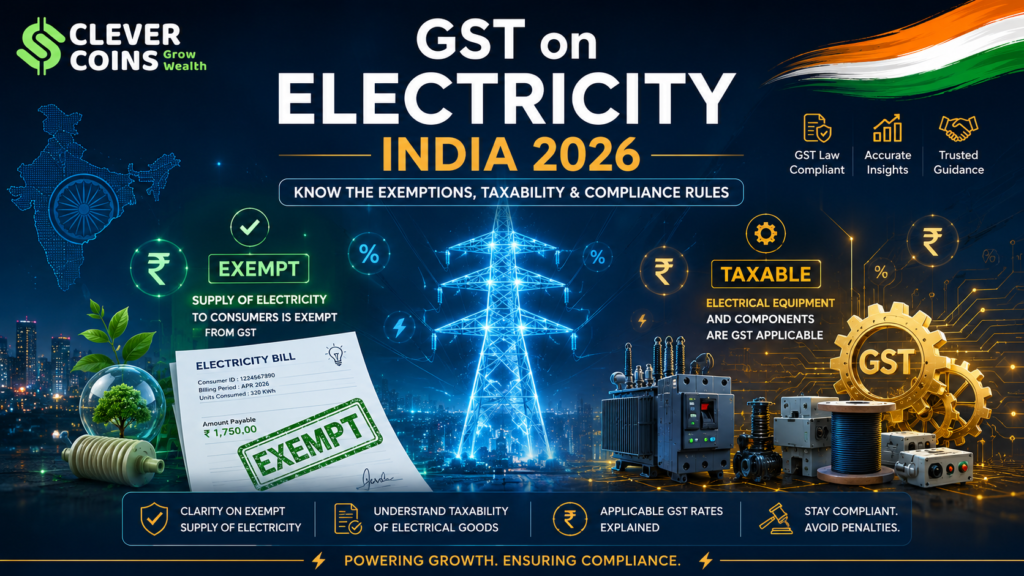
The short and definitive answer is: The direct supply (sale) of electrical energy is EXEMPT from GST under the current Indian tax law as of 2026. This exemption is grounded in multiple statutory provisions.
Legal Basis for Exemption
- Entry No. 104 of the GST Exemption Notification (No. 2/2017-Central Tax Rate): Electrical energy is specified as exempt from GST.
- Schedule II of the CGST Act, 2017: Electricity is classified as goods, but the notification ensures it remains outside the tax net.
- Section 11 of the CGST Act, 2017: Empowers the government to exempt specific goods or services from GST by notification.
- Electricity Act, 2003: State governments levy Electricity Duty and State Electricity Tax, which continue alongside the GST framework.
It is critical to note that this exemption applies specifically to the supply of electricity as a commodity (i.e., electrical energy sold by utilities to end consumers). Ancillary services and equipment related to electricity are treated differently.
3. GST Rate Table: Electricity, Equipment & Related Services 2026
The following table provides a comprehensive, up-to-date overview of GST rates applicable across the electricity value chain in India as of 2026:
Category / Service | GST Rate (2026) | Remarks |
Supply of Electricity (Direct) | EXEMPT | Exempt under Schedule II of CGST Act |
Transmission of Electricity | EXEMPT | Services by Transmission/Distribution utilities exempt |
Distribution of Electricity | EXEMPT | Notified utilities exempt from GST |
Consultancy for Power Projects | 18% | Standard GST rate on professional services |
Installation of Solar Panels | 12% | Composite supply; panels attract 12% |
Solar Energy Devices & Parts | 12% | Reduced from 5% effective Oct 2023 |
Electrical Transformers & Switchgear | 18% | Capital goods for power infrastructure |
Captive Power Generation Equipment | 18% | DG sets, turbines, generators |
Electricity Meters | 18% | Smart & conventional meters |
EV Charging Station Services | 18% | AAAR ruling: supply of electricity via EV charger is service |
Rental of Genset / DG Set | 18% | Treated as service, not goods supply |
Note: Rates are as per the latest GST Council notifications and CBIC circulars as of early 2026. Always verify with a qualified CA or tax professional for transaction-specific advice.
4. Detailed Analysis: What Is Exempt and What Is Taxable?
A. Transmission and Distribution: Fully Exempt
The transmission of electricity through high-voltage lines by entities such as Power Grid Corporation of India Ltd. (PGCIL) and state transmission utilities is fully exempt from GST. Similarly, distribution of electricity by licensed distribution companies (DISCOMs) to residential, commercial, and industrial consumers is exempt. This ensures that the electricity cost for end consumers does not include any GST component.
B. Services Incidental to Electricity Supply: Exempt
The GST exemption for electricity supply extends to services that are naturally bundled with electricity distribution. This includes services like metre reading, billing, and basic repair of electrical connections provided by DISCOMs as part of their regulated utility function. These are treated as naturally bundled composite supplies and are exempt from GST.
C. Captive Power Plants: A Complex Area
Many large industries — particularly in steel, cement, and textiles — operate Captive Power Plants (CPPs) to meet their own electricity needs. The GST treatment of captive power is nuanced:
- Electricity generated and consumed within the same business entity is NOT considered a ‘supply’ under GST and therefore attracts no GST.
- However, capital equipment (turbines, generators, DG sets) used to set up and operate a CPP attracts 18% GST.
- Input Tax Credit (ITC) on equipment purchases for CPPs is NOT available for most manufacturers, since the output (electricity) is exempt.
- This ITC blockage under Section 17(2) of the CGST Act significantly increases the effective capital cost for industries setting up captive generation.
D. EV Charging Stations: An Emerging GST Debate
With India’s rapid push toward electric mobility under FAME II and the National Electric Vehicle Policy 2024, EV charging has become a significant GST question. The Authority for Advance Ruling (AAR) and Appellate Authority for Advance Ruling (AAAR) have consistently ruled that:
- Charging of electric vehicles at a charging station constitutes a ‘supply of service’ (not supply of electricity as goods).
- Accordingly, EV charging services attract GST at 18%.
- This is one of the most debated issues in the electricity-GST space, with industry stakeholders repeatedly requesting a reduction to 5% to boost EV adoption.
- As of 2026, the GST Council has not yet revised the rate on EV charging services, though the issue remains under active review.
E. Solar Energy: Preferential But Not Zero-Rated
India’s commitment to 500 GW of renewable energy by 2030 has brought solar energy under the GST spotlight. Solar-related GST positions as of 2026:
- Solar photovoltaic (PV) cells and modules: 12% GST (reduced from higher rates following GST Council meetings in 2023).
- Solar power generating systems: Composite supply — the dominant element (solar panels) determines the rate, leading to 12% on the package.
- Installation services for solar projects: Where the service component dominates a works contract, it attracts 12%.
- Electricity generated from solar plants and sold: EXEMPT from GST (same as conventional electricity).
- Wind turbines and components: 12% GST.
5. Input Tax Credit (ITC) on Electricity: The Most Painful Block
Perhaps the single biggest pain point for Indian businesses under the GST framework is the denial of Input Tax Credit (ITC) on electricity. Understanding this is essential for CFOs, accountants, and business owners.
The ITC Blockage Rule
Section 17(5)(d) of the CGST Act, 2017 specifically blocks ITC on goods or services used for the construction of immovable property (other than plant and machinery). More critically, since electricity itself is exempt, any tax paid on inputs used to generate or procure electricity cannot be offset against GST output liability.
For example: A manufacturing company pays ₹18,00,000 in GST on capital goods for a captive power plant. Since electricity is exempt, this ₹18,00,000 becomes an absolute cost — it cannot be claimed as ITC, directly impacting the company’s balance sheet.
Who Can Potentially Claim ITC Related to Electricity?
- Businesses where electricity is an input for a taxable output (e.g., cold storage operators whose core service is taxable): May claim ITC on equipment, but NOT on the electricity bill itself since the bill carries no GST.
- EV Charging Station Operators: Since their output service (charging) is taxable at 18%, they can claim ITC on inputs used for the charging service.
- Solar developers selling power under PPA: Electricity supply is exempt, blocking ITC on construction costs.
The ITC Refund Anomaly for Renewable Energy Developers
Renewable energy companies (solar, wind) incur significant GST costs on machinery, civil construction inputs, and services. Since their output (electricity) is exempt, they face an ITC accumulation with no means of utilisation — a structural disadvantage that the industry has repeatedly flagged before the GST Council. As of 2026, no specific refund mechanism has been notified for this specific situation beyond standard Section 54 provisions.
6. GST on Electricity for Different Consumer Categories
A. Residential Consumers
Households receiving electricity from DISCOMs pay no GST on their electricity bills. However, they do pay Electricity Duty (typically 10–25% depending on the state), Fixed/Demand Charges, and Fuel Surcharge Adjustment (FSA). These are separate from GST and are determined by State Electricity Regulatory Commissions (SERCs).
In Maharashtra, for instance, the electricity duty for residential consumers ranges from ₹0.15 to ₹0.90 per unit depending on consumption slab. In Rajasthan, it can be up to 12% of the bill. None of these duties are GST.
B. Commercial and Retail Establishments
Shops, malls, hotels, and commercial establishments similarly pay no GST on electricity consumed from the grid. However, they pay higher tariffs under the commercial slab. If they operate their own DG sets (diesel generators), the rental of such sets from a third party attracts 18% GST as a service. Diesel fuel for the generators attracts state-level VAT/excise (not under GST as petroleum products are excluded).
C. Industrial and Manufacturing Consumers
Large industrial consumers (HT/EHT category) consuming electricity above 1 MW or receiving power at 33 kV and above are major stakeholders in the GST-electricity debate. Key considerations:
- Electricity consumed from the grid: No GST on the electricity component.
- Electricity purchased from open access sources (other than DISCOMs): Still exempt from GST.
- Cross-subsidy surcharges and wheeling charges levied by state utilities: These are NOT for electricity supply per se, and their GST treatment may vary. CBIC has clarified that transmission/wheeling charges levied by state utilities are exempt.
- Demand charges and load management fees: Exempt when charged as part of the electricity supply arrangement.
D. Real Estate: Housing Societies and RWAs
Resident Welfare Associations (RWAs) and Housing Societies have a specific GST provision. An RWA collecting charges from members for common services (including electricity for common areas) is exempt from GST provided:
- The monthly contribution per member does not exceed ₹7,500 (as per current exemption notification).
- If the monthly contribution exceeds ₹7,500, the entire amount (not just the excess) becomes liable to GST at 18%.
This creates a significant compliance burden for large housing societies with extensive common area facilities.
E. Agricultural Consumers
Agricultural use of electricity (for water pump sets, irrigation, etc.) is generally on a highly subsidised or flat-rate tariff basis. These are governed entirely by state tariff orders and attract no GST. Many states provide electricity free of cost to farmers, with the fiscal burden absorbed by the state budget.
7. GST on Works Contracts and Construction in the Power Sector
The power sector involves massive infrastructure investments — building substations, transmission lines, distribution networks, and generation plants. These typically take the form of Works Contracts, which have specific GST treatment.
Works Contract GST Rates in Power Infrastructure (2026)
- Works contract for government entities (power utilities): 12% GST (if related to core civil work or original construction).
- Works contract for power infrastructure by private entities: Generally 18%.
- Turnkey EPC contracts for solar/wind projects: Typically 12% on the composite supply.
- Repair and maintenance contracts for power infrastructure: 18%.
The classification of a works contract as ‘original construction’ versus ‘repair/renovation’ significantly impacts the GST rate and the availability of ITC for the commissioning entity.
8. The Future: Will Electricity Come Under GST?
The question of bringing electricity under the GST framework has been debated since the very inception of GST in India. Proponents argue that including electricity in GST would:
- Allow seamless ITC flow for industries, reducing cascading taxes and making Indian manufacturing more competitive globally.
- Eliminate the complex web of state electricity duties, levies, and surcharges.
- Bring transparency and uniformity to electricity pricing across states.
- Significantly boost renewable energy investments by allowing ITC on capital goods and services.
Arguments Against Immediate GST Inclusion
- States would lose significant revenue from electricity duties (estimated at ₹70,000–₹1,00,000 crore annually across all states as of 2026).
- Constitutional amendment to Schedule VII would be required — a politically sensitive and time-consuming process.
- Risk of increased electricity costs for households and small businesses if ITC benefits are not fully passed on.
- Regulatory complexity: electricity prices are regulated by SERCs, not market-driven — integration with GST would require fundamental restructuring.
GST Council’s 2025–2026 Stance
The 55th GST Council meeting (December 2024) and subsequent deliberations in 2025 have kept electricity’s GST status unchanged. The council’s Group of Ministers (GoM) on Rate Rationalisation did not recommend including electricity in GST in their 2025 report. The consensus view remains that any such inclusion must be revenue-neutral for states and consumer-protective for households. A phased approach — perhaps starting with industrial electricity — has been discussed but not formalised as of 2026.
9. Compliance Tips for Businesses: Navigating GST in the Electricity Ecosystem
For Manufacturers and Large Industrials
- Maintain proper records of GST paid on power infrastructure capital goods — even if ITC is blocked, it is relevant for accounting and potential future claims if law changes.
- Review open access arrangements to ensure wheeling and transmission charges are being correctly treated under GST.
- If operating a captive solar plant, ensure that the installation contractor’s GST invoices are at the correct 12% rate.
For Builders and Real Estate Developers
- GST on transformers, electrical panels, and cabling for buildings: 18% — ensure these are properly accounted for in project costs.
- ITC on electrical equipment used in construction of residential complexes: Blocked under Section 17(5).
- Electrical equipment for commercial complexes or SEZs: ITC may be available depending on the nature of supply.
For EV Charging Station Operators
- Charge GST at 18% on all EV charging services. Issue proper GST invoices with SAC code 998714.
- Claim ITC on equipment, civil works (if not construction of an immovable property), and services used for the charging business.
- Maintain clear segregation between electricity cost (exempt) and service charges (taxable) in your business model.
For Renewable Energy Developers
- File for refund under Section 54(3)(ii) — inverted duty structure — where applicable, particularly for O&M service providers.
- Ensure that power purchase agreements (PPAs) correctly treat electricity supply as exempt and do not inadvertently include a GST component.
- Engage a GST specialist for advance rulings on novel transaction structures (e.g., peer-to-peer energy trading, virtual power purchase agreements).
10. Key GST Case Laws and Advance Rulings on Electricity (2022–2026)
Several important advance rulings and judicial decisions have shaped the understanding of GST on electricity in India:
Important Rulings & Precedents
- In Re: M/s Rajasthan Rajya Vidyut Prasaran Nigam Ltd. (AAR Rajasthan, 2019): Held that transmission charges by state transmission utility are exempt from GST — reaffirmed in subsequent rulings.
- In Re: M/s Wardwizard Innovations and Mobility Ltd. (AAAR Gujarat, 2021): EV charging constitutes service, not supply of electricity — 18% GST applicable.
- In Re: M/s CESC Limited (AAR West Bengal, 2022): Surcharges collected by distribution licensees as part of electricity supply are exempt from GST.
- Union of India v. M/s Mohit Minerals Pvt. Ltd. (Supreme Court, 2022): While primarily on ocean freight, this judgment’s ratio on the GST Council’s recommendatory (non-binding) nature has implications for AAR rulings on electricity.
- CBIC Circular No. 206/18/2023-GST: Clarified that cross-subsidy surcharge and additional surcharge levied on open access consumers are exempt from GST, settling a long-standing dispute.
11. Electricity Duties vs. GST: Understanding the Difference
Many consumers and even some tax professionals confuse Electricity Duty (or Electricity Tax) with GST. These are fundamentally different:
Comparison: Electricity Duty vs. GST
- Electricity Duty: Levied by state governments under Entry 53 of List II (State List) of the Seventh Schedule of the Constitution. Rate varies by state — typically 5% to 25% of the electricity tariff.
- GST: A union-state concurrent tax under the GST constitutional framework. Currently NOT applicable on the supply of electricity.
- Electricity Duty is added to your electricity bill by the DISCOM on behalf of the state government. GST is NOT added to electricity bills of domestic/commercial consumers.
- Electricity Duty paid cannot be claimed as ITC under GST — it is a direct cost.
For example: A Mumbai residential consumer receiving 300 units at ₹8/unit pays ₹2,400 as energy charge. On this, Maharashtra levies an electricity duty of approximately ₹0.30/unit = ₹90. Total bill = ₹2,490 + fixed charges. No GST is charged on any of these components.
12. Summary and Key Takeaways: GST on Electricity India 2026
- Direct supply of electricity (as a commodity) is EXEMPT from GST in India as of 2026 — this covers generation, transmission, and distribution.
- Electricity-related equipment (transformers, panels, DG sets, meters) attracts 18% GST.
- Solar panels and systems attract 12% GST — reduced from earlier rates.
- EV charging station services attract 18% GST — a key concern for India’s EV push.
- ITC on electricity itself is not available since there is no GST on electricity bills; ITC on related capital goods is blocked for most exempt-output businesses.
- Electricity duty continues to be levied by state governments and is a separate, non-GST charge.
- The GST Council has not included electricity in the GST framework as of 2026 — the debate continues.
- Businesses in the power sector must carefully evaluate each transaction: the supply of electricity is clearly exempt, but related services, equipment, and works contracts attract varying GST rates.