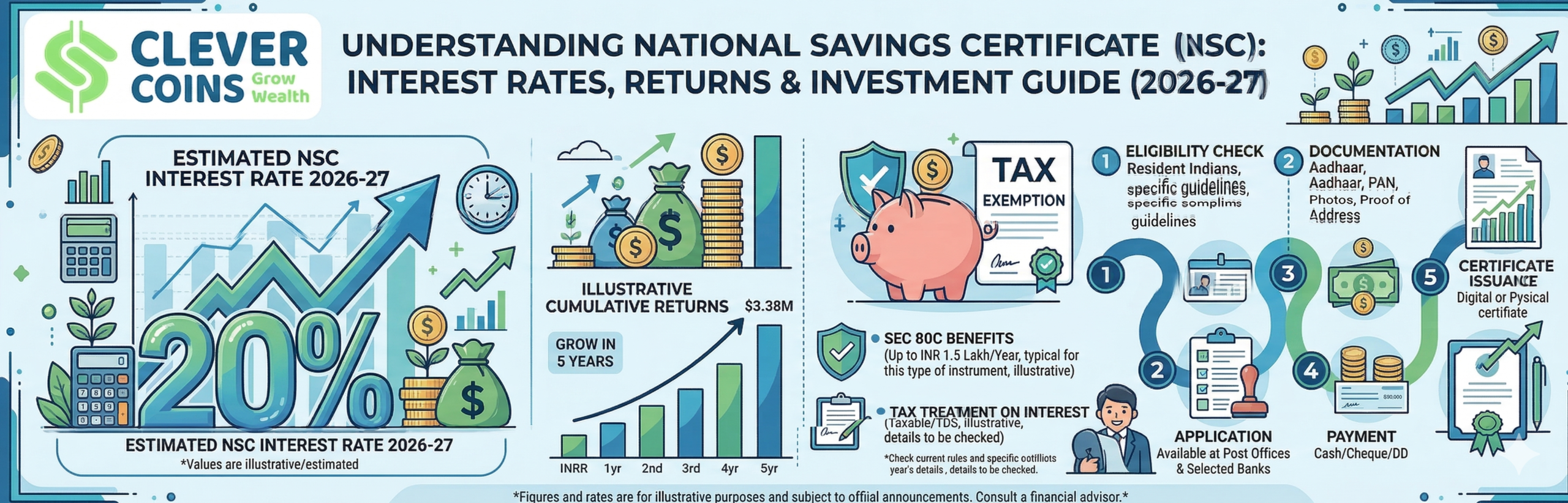
For millions of conservative investors in India, the National Savings Certificate (NSC) has long been a trusted companion — a government-backed savings instrument that combines safety, reasonable returns, and meaningful tax benefits. Whether you are a government employee looking to save taxes, a senior citizen seeking guaranteed returns, or a first-time investor wanting a risk-free option, NSC deserves a serious look.
In this detailed guide, we break down the latest NSC interest rates for 2026-27, how NSC works, who should invest, the tax implications, and how to calculate your returns with real-life examples.
What is a National Savings Certificate (NSC)?
The National Savings Certificate is a fixed-income investment scheme launched by the Government of India and administered through post offices across the country. It is one of the most popular small savings instruments in India, offering a fixed rate of return with a lock-in period of five years.
NSC is backed by the sovereign guarantee of the Indian government, making it virtually risk-free. It is particularly popular among risk-averse investors who want predictable returns without exposing their capital to stock market volatility.
Real-life Scenario: Ramesh, a 45-year-old school principal in Lucknow, invests Rs. 50,000 in NSC every year to save taxes and build a secure retirement corpus. He knows exactly how much he will receive at maturity — no surprises, no volatility.
NSC Interest Rate for Q1 FY 2026-27
The Government of India revises small savings interest rates on a quarterly basis. For Q1 of FY 2026-27 (April to June 2026), the NSC interest rate has been set at 7.7% per annum, compounded annually.
This rate is competitive compared to many bank fixed deposits and provides a guaranteed return over the five-year tenure. The interest is compounded annually but paid out at maturity along with the principal.
It is important to check for quarterly revisions as the government adjusts these rates based on market conditions, government borrowing costs, and macroeconomic factors.
How NSC Returns Are Calculated: A Real-Life Example
NSC interest compounds annually, which means your interest earns interest in subsequent years. Here is a simple illustration:
If you invest Rs. 1,00,000 in NSC at 7.7% per annum for 5 years, at the end of Year 1, your investment grows to Rs. 1,07,700. By Year 2, it grows to Rs. 1,16,009. By Year 3, it is Rs. 1,24,941. By Year 4, it becomes Rs. 1,34,521, and at maturity (Year 5), you receive approximately Rs. 1,44,903.
This means a Rs. 1 lakh investment grows to nearly Rs. 1.45 lakh over five years — a gain of Rs. 44,903 without any risk whatsoever. For a risk-averse investor, this is a compelling proposition.
Tax Benefits of NSC Under Section 80C
One of NSC’s biggest advantages is its tax efficiency. The principal amount invested in NSC qualifies for deduction under Section 80C of the Income Tax Act, up to a maximum of Rs. 1.5 lakh per financial year. This deduction applies under the Old Tax Regime.
Additionally, the interest earned on NSC each year is deemed to be reinvested and also qualifies for Section 80C deduction in subsequent years, except in the final year when it is paid out. This creates a cascading tax benefit that maximises your effective return.
Tax-Saving Example: Sunita, a government employee in the 30% tax bracket, invests Rs. 1.5 lakh in NSC. She saves Rs. 46,800 in taxes (30% of Rs. 1.5 lakh + 4% cess) in the year of investment. Her effective cost of investment is just Rs. 1,03,200 while the NSC corpus grows to over Rs. 2.17 lakh in five years at 7.7% interest — a phenomenal effective return.
Who Should Invest in NSC?
NSC is ideally suited for investors who prioritise capital protection over high returns. It is an excellent choice for salaried individuals who are already using NSC as part of their Rs. 1.5 lakh Section 80C portfolio, conservative investors who are uncomfortable with equity market risk, government employees and pensioners looking for guaranteed post-retirement income, and parents investing for their children’s future education expenses.
NSC may not be the best option for investors in the zero or 5% tax bracket (since the tax benefit is minimal), those with a long investment horizon who can afford equity exposure, or taxpayers opting for the New Tax Regime (as Section 80C deductions are not available).
How to Invest in NSC: Step-by-Step Process
Investing in NSC is straightforward and can now be done both offline and online. To invest offline, visit your nearest post office with your Aadhaar card, PAN card, passport-size photographs, and a cheque or cash for the investment amount. Fill out Form NC-71 and submit it along with the required documents.
To invest online, you can do so through the India Post Payments Bank (IPPB) mobile app or net banking if you have a post office savings account. Online investment is faster and provides digital access to your NSC holdings.
The minimum investment in NSC is Rs. 1,000, with no upper limit. Investments must be made in multiples of Rs. 100. NSC can be purchased individually, jointly, or on behalf of a minor.
Related posts:
No related posts.