Form 16 vs Form 16A vs Form 16B: The Ultimate Tax Certificate Guide for Indian Taxpayers
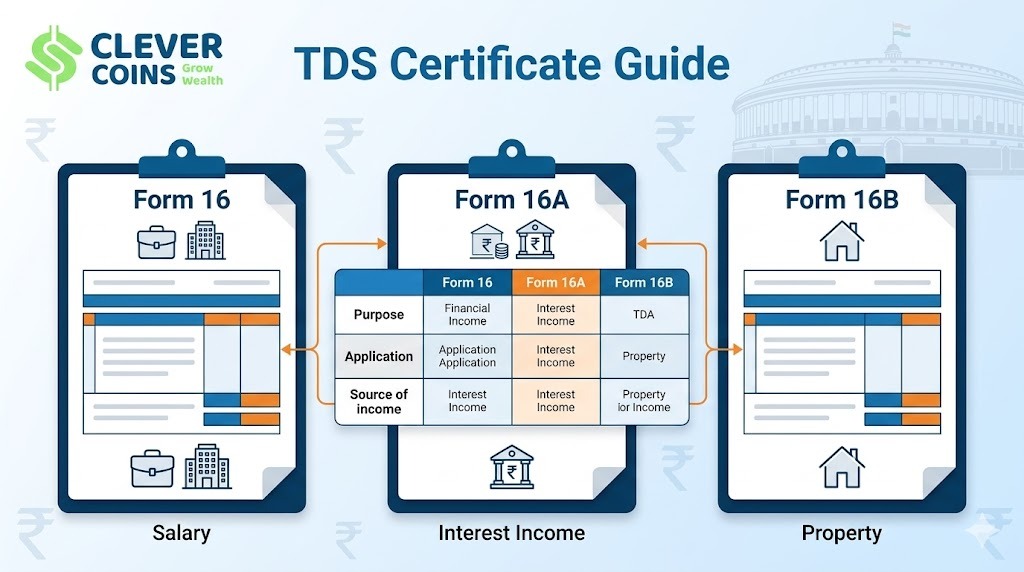
Tax season in India is synonymous with one question that millions of salaried employees, freelancers, and property buyers ask every year: Which Form 16 do I need, and what is the difference between Form 16, Form 16A, and Form 16B? These three documents are critical TDS (Tax Deducted at Source) certificates issued under the Income Tax Act, 1961, but each serves a distinctly different purpose, is issued by different entities, and covers different types of income and transactions.
Whether you are a salaried employee trying to file your Income Tax Return (ITR), a freelancer or contractor receiving professional fees, or someone who recently bought or sold a property, understanding these three forms is non-negotiable. This comprehensive guide breaks down everything you need to know about Form 16, Form 16A, and Form 16B, including their definitions, components, applicability, differences, deadlines, legal provisions, and practical tips for using them effectively.
What is TDS and Why Do These Forms Matter?
TDS stands for Tax Deducted at Source. It is a mechanism introduced by the Government of India through the Income Tax Act, 1961, whereby the payer of income deducts tax at the time of payment itself and deposits it with the government on behalf of the recipient. This ensures that tax revenue reaches the government in a timely manner and reduces the risk of tax evasion.
Whenever TDS is deducted, the deductor is required to issue a TDS certificate to the deductee. This certificate is proof that tax has already been deducted and deposited on behalf of the recipient. There are multiple types of TDS certificates, and Form 16, Form 16A, and Form 16B are the three most commonly encountered ones.
These forms are not just paperwork. They are legally mandated documents that serve as the foundation of your income tax return. They help the Income Tax Department verify that the tax you claim has already been paid is accurately reflected in government records through TRACES (TDS Reconciliation Analysis and Correction Enabling System).
Form 16: The Salaried Employee’s TDS Certificate
What is Form 16?
Form 16 is a TDS certificate issued by an employer to an employee under Section 203 of the Income Tax Act, 1961. It certifies the amount of salary paid by the employer to the employee during a financial year and the amount of TDS deducted on that salary. Form 16 is one of the most important documents for a salaried individual when filing their annual Income Tax Return.
Who Issues Form 16?
Form 16 is issued exclusively by employers to their employees. Any employer whose employee’s salary exceeds the basic exemption limit (currently Rs. 2.5 lakh for individuals below 60 years; Rs. 3 lakh for senior citizens; Rs. 5 lakh for super senior citizens) is required to deduct TDS and issue Form 16.
Who Receives Form 16?
- Salaried employees working in private companies, MNCs, or PSUs
- Government employees (Form 16 issued by the respective government department)
- Part-time employees whose salary income exceeds the basic exemption limit
- Employees who have changed jobs during the financial year (receive Form 16 from each employer)
Structure of Form 16: Two Parts
Form 16 is divided into two distinct parts:
Part A of Form 16
Part A of Form 16 contains details of TDS deducted and deposited by the employer. It is generated and downloaded directly from the TRACES portal by the employer and is unique in that it carries a unique certificate number issued by TRACES. Part A includes the following information:
- Name and address of the employer (deductor)
- TAN (Tax Deduction Account Number) of the employer
- PAN of the employer and employee
- Assessment Year for which the certificate is issued
- Period of employment during the financial year
- Summary of tax deducted and deposited on a quarterly basis
- Acknowledgement numbers of TDS returns filed
Part B of Form 16
Part B of Form 16 is prepared by the employer and provides a detailed breakup of the employee’s salary and the tax computation. While Part A is standardized through TRACES, Part B gives an annual breakup of:
- Gross salary earned by the employee
- Allowances exempt under Section 10 (HRA, LTA, Children Education Allowance, etc.)
- Deductions under Chapter VI-A (Section 80C, 80D, 80E, 80G, 80TTA, etc.)
- Standard deduction (currently Rs. 50,000 for salaried employees)
- Professional tax paid
- Taxable income after all deductions
- Tax computed on taxable income including surcharge and cess
- TDS already deducted and balance tax payable or refundable
When is Form 16 Issued?
Employers are legally required to issue Form 16 to their employees on or before June 15th of the assessment year (i.e., the year following the financial year for which TDS was deducted). For example, for FY 2023-24, Form 16 must be issued by June 15, 2024.
Penalty for Non-Issuance of Form 16
If an employer fails to issue Form 16 within the stipulated time, they are liable to pay a penalty of Rs. 100 per day under Section 272A(2)(g) of the Income Tax Act until the certificate is issued. The maximum penalty is restricted to the amount of TDS deductible.
Form 16A: TDS Certificate for Non-Salary Payments
What is Form 16A?
Form 16A is a TDS certificate issued under Section 203 of the Income Tax Act, 1961, for TDS deducted on income other than salary. It is the TDS certificate applicable for professionals, contractors, freelancers, and individuals who receive income in the form of interest, commission, rent, professional fees, or any other payment where TDS is deducted under sections other than Section 192 (which covers salary).
Who Issues Form 16A?
Form 16A is issued by any deductor who deducts TDS on non-salary payments. This includes banks, companies, LLPs, partnership firms, HUFs, government entities, and any other entity that makes non-salary payments on which TDS is deductible.
Common Scenarios Where Form 16A is Issued
- Bank deducts TDS on interest income on Fixed Deposits (Section 194A) – Bank issues Form 16A
- Company pays commission or brokerage to an agent (Section 194H) – Company issues Form 16A
- Firm pays rent exceeding Rs. 2,40,000 per annum (Section 194I) – Firm issues Form 16A
- Company pays professional fees to a CA, doctor, or consultant (Section 194J) – Company issues Form 16A
- Individual receives dividend from a domestic company (Section 194) – Company issues Form 16A
- Insurance company pays maturity proceeds with TDS (Section 194DA) – Insurance company issues Form 16A
- Winnings from lottery or game shows (Section 194B) – Organizer issues Form 16A
Information Contained in Form 16A
- Name, address, and TAN of the deductor
- Name, address, and PAN of the deductee
- Nature of payment (interest, rent, professional fees, etc.)
- Amount of payment made and TDS deducted
- Dates of payment and TDS deposit
- Challan identification number for TDS deposit
- Unique TDS certificate number from TRACES
- Assessment year and financial year
When is Form 16A Issued?
Form 16A must be issued within 15 days from the due date of filing the TDS return for the respective quarter. The due dates for filing quarterly TDS returns are:
- Q1 (April to June): July 31
- Q2 (July to September): October 31
- Q3 (October to December): January 31
- Q4 (January to March): May 31
So, for Q4, the TDS return is due by May 31, and Form 16A must be issued by June 15.
Key Point About Form 16A
Just like Part A of Form 16, Form 16A is also downloaded from the TRACES portal and carries a unique certificate number. This ensures the authenticity of the certificate and allows the Income Tax Department to verify its genuineness. Banks have a facility to allow customers to download their Form 16A directly from the bank’s net banking portal, which in turn fetches the data from TRACES.
Form 16B: TDS Certificate for Property Transactions
What is Form 16B?
Form 16B is a TDS certificate issued specifically for TDS deducted on the purchase of immovable property under Section 194IA of the Income Tax Act, 1961. When a buyer purchases an immovable property (land or building, excluding agricultural land) for a value of Rs. 50 lakhs or more, they are required to deduct TDS at the rate of 1% of the consideration paid or stamp duty value, whichever is higher, and deposit it with the government using Form 26QB.
Who Issues Form 16B?
Unlike Form 16 and Form 16A which are issued by companies, banks, or other corporate entities, Form 16B is issued by the buyer (purchaser) of the immovable property to the seller. This is a unique aspect of Form 16B that differentiates it from the other two forms.
Who Receives Form 16B?
The seller (deductee) of the immovable property receives Form 16B from the buyer. This certificate is crucial for the seller to:
- Claim credit for TDS in their Income Tax Return
- Reconcile the TDS amount with their Form 26AS / AIS (Annual Information Statement)
- Prove to the Income Tax Department that TDS was deducted on the property transaction
Process of Generating Form 16B
The process to generate and issue Form 16B is as follows:
- The buyer deducts 1% TDS at the time of payment to the seller.
- The buyer deposits the TDS with the government using Challan-cum-Statement in Form 26QB within 30 days from the end of the month of deduction.
- After the TDS is deposited and processed, the buyer can download Form 16B from the TRACES portal.
- The buyer must issue Form 16B to the seller within 15 days of the due date for furnishing Form 26QB.
Information Contained in Form 16B
- Name, address, and PAN of the buyer (deductor)
- Name, address, and PAN of the seller (deductee)
- Property details (address of the property)
- Date and amount of each payment/credit
- TDS deducted and deposited amount
- Challan identification number (CIN) for TDS deposit
- Unique TDS certificate number from TRACES
- Assessment year for which TDS was deducted
When is Form 16B Due?
The buyer must issue Form 16B to the seller within 15 days from the due date for furnishing Form 26QB. Since Form 26QB must be filed within 30 days from the end of the month in which TDS was deducted, Form 16B is generally due within 45 days of the property payment.
Comprehensive Comparison: Form 16 vs Form 16A vs Form 16B
Parameter | Form 16 | Form 16A | Form 16B |
Full Name | TDS Certificate for Salary | TDS Certificate for Non-Salary | TDS Certificate for Property |
Applicable Section | Section 192 | Sections 193, 194A, 194B, 194C, 194D, 194G, 194H, 194I, 194J, etc. | Section 194IA |
Type of Income | Salary Income | Interest, Rent, Commission, Professional Fees, Dividend, etc. | Income from Sale of Immovable Property |
Issued By | Employer | Deductor (Banks, Companies, Firms, etc.) | Buyer of Property |
Issued To | Employee | Deductee (Freelancer, Vendor, Account Holder, etc.) | Seller of Property |
Parts | Part A and Part B | Single Part | Single Part |
Portal for Download | TRACES | TRACES | TRACES |
TDS Rate | As per income tax slab | Varies by section (1% to 30%) | 1% of consideration or stamp duty value |
Minimum Threshold | Income above basic exemption limit | Varies by section | Property value >= Rs. 50 Lakhs |
Frequency | Annually | Quarterly | Per Transaction |
Due Date for Issuance | June 15 of Assessment Year | 15 days from TDS return due date | 15 days from Form 26QB due date |
Form for TDS Deposit | Challan 281 | Challan 281 | Form 26QB |
Property Type | N/A | N/A | Immovable Property (>=50 Lakhs) |
Agricultural Land | N/A | N/A | Excluded |
Legal Provisions and Sections at a Glance
Section 192 – Form 16
Section 192 mandates that every employer who pays salary to an employee must deduct TDS at the time of payment of salary. The rate of TDS under Section 192 is the average rate of income tax computed on the basis of the rates in force for the financial year. There is no fixed percentage; it depends on the employee’s salary and applicable deductions.
Sections Covered by Form 16A
- Section 193: TDS on interest on securities
- Section 194: TDS on dividends
- Section 194A: TDS on interest other than securities (bank FDs, etc.)
- Section 194B: TDS on lottery/crossword puzzle winnings
- Section 194C: TDS on payments to contractors
- Section 194D: TDS on insurance commissions
- Section 194G: TDS on commissions on lottery tickets
- Section 194H: TDS on commissions or brokerage
- Section 194I: TDS on rent
- Section 194J: TDS on fees for professional or technical services
- Section 194K: TDS on income from mutual fund units
- Section 194DA: TDS on life insurance policy maturity payments
Section 194IA – Form 16B
Section 194IA, introduced by Finance Act 2013, requires the buyer of an immovable property (other than agricultural land) to deduct TDS at 1% on the total consideration or stamp duty value (whichever is higher) if such consideration is Rs. 50 lakh or more. The provision applies to individual buyers as well, including non-residents under FEMA.
Role of Form 26AS and AIS in Reconciliation
Form 26AS is a consolidated annual tax statement maintained by the Income Tax Department. It reflects all TDS deducted and deposited on your behalf, including details from Form 16, Form 16A, and Form 16B. After the introduction of AIS (Annual Information Statement) and TIS (Taxpayer Information Summary), taxpayers now have even more comprehensive visibility of all their financial transactions.
It is critically important that the TDS amounts reflected in your Form 16, Form 16A, and Form 16B match the corresponding entries in your Form 26AS / AIS. Any mismatch can lead to:
- Rejection of TDS credit claimed in your ITR
- Income Tax Department notice under Section 143(1)
- Demand for additional tax with interest under Sections 234B and 234C
- Potential scrutiny assessment
If you find a mismatch, you should immediately contact the deductor (employer, bank, buyer) to rectify their TDS return filing, which in turn will update your Form 26AS and AIS.
Practical Tips for Managing Form 16, 16A, and 16B
For Salaried Employees
- Collect Form 16 (both Part A and Part B) from your employer every year before filing your ITR.
- If you changed jobs during the year, collect Form 16 from both employers and combine the income while filing.
- Verify that the TDS in Form 16 Part A matches your Form 26AS.
- Use Form 16 Part B to ensure all your deductions under 80C, 80D, etc. are correctly accounted for.
- If your salary is below the basic exemption limit and no TDS was deducted, your employer need not issue Form 16.
For Freelancers and Professionals
- Collect Form 16A from every client who deducts TDS on your professional fees.
- Download Form 16A only from the TRACES portal or verify its TRACES certificate number for authenticity.
- Consolidate all Form 16A certificates and reconcile with your Form 26AS before filing your ITR.
- Even if TDS is deducted, ensure you report your full income in your ITR – TDS is not the final tax.
For Property Buyers
- Deduct TDS at 1% and file Form 26QB within 30 days of the month of payment.
- Generate and issue Form 16B to the seller within the prescribed timeline.
- If the property is purchased in installments, TDS must be deducted on each installment.
- Keep proof of TDS payment (challan) and Form 16B for future reference.
For Property Sellers
- Ensure you receive Form 16B from the buyer before completing all formalities.
- Verify the TDS amount in Form 16B against your Form 26AS.
- Claim the TDS credit in your ITR under the capital gains section.
Common Mistakes and How to Avoid Them
Mistakes with Form 16
- Not collecting Form 16 from previous employer when switching jobs
- Ignoring Part B of Form 16 and missing legitimate deductions
- Not verifying Form 16 against Form 26AS before ITR filing
Mistakes with Form 16A
- Accepting handwritten or self-generated Form 16A (must be from TRACES)
- Not collecting Form 16A from banks for FD interest TDS
- Forgetting that multiple Form 16As may be applicable for multiple income sources
Mistakes with Form 16B
- Buyer not filing Form 26QB on time and delaying Form 16B generation
- Deducting TDS on the registered value instead of the actual consideration if higher
- Seller not verifying Form 16B against Form 26AS before filing ITR
Frequently Asked Questions (FAQs)
Q1. Can I file my ITR without Form 16?
Yes, you can file your ITR without Form 16. You can use your salary slips, bank statements, Form 26AS, and AIS to compute your taxable income and file your return. However, Form 16 simplifies the process significantly.
Q2. What if my employer refuses to issue Form 16?
If your employer refuses to issue Form 16 or delays it beyond June 15, you can file a complaint with the Income Tax Department. The employer is liable to pay a penalty of Rs. 100 per day for each day of default.
Q3. Is Form 16A mandatory for everyone who pays TDS?
Yes, any deductor who deducts TDS on non-salary payments is legally required to issue Form 16A to the deductee within the prescribed time. Failure to do so attracts penalties under Section 272A(2)(g).
Q4. What is the TDS rate on a property purchase of Rs. 80 lakhs?
The TDS rate under Section 194IA is 1% of the total consideration. For a property purchased at Rs. 80 lakhs, the TDS deductible would be Rs. 80,000 (1% of Rs. 80,00,000). However, if the stamp duty value is higher than Rs. 80 lakhs, TDS is calculated on the stamp duty value.
Q5. Can I claim a refund if excess TDS has been deducted?
Yes, if TDS deducted is more than your actual tax liability, the excess amount will be refunded by the Income Tax Department after you file your ITR. The refund is processed after the department processes your return.
Q6. Does Form 16B apply to NRIs selling property in India?
When an NRI sells property in India, TDS is governed by Section 195 and not Section 194IA. The TDS rate under Section 195 for NRIs is higher (20% on long-term capital gains or 30% on short-term capital gains plus surcharge and cess). The relevant TDS certificate in such cases is Form 16A, not Form 16B.
Q7. How many Form 16As can I receive in a year?
There is no limit to the number of Form 16As you can receive. You can receive separate Form 16A certificates from each deductor for different payment types. For example, you may receive Form 16A from your bank for FD interest, from a company for professional fees, and from another entity for rent payments.
Q8. What happens if the buyer fails to deduct TDS on property purchase?
If the buyer fails to deduct TDS under Section 194IA, the buyer is treated as an ‘assessee in default’ and is liable to pay the TDS amount along with interest at 1% per month from the date on which TDS was deductible to the date of actual deduction, and an additional 1.5% per month from the date of deduction to the date of deposit. Additionally, a penalty equal to the TDS amount may be levied.
Recommended Next Blog Topics
The following five blog topics are strategically chosen to complement this blog, form a content cluster around TDS and income tax, and drive continued organic traffic through internal linking:
Blog 1
How to Download Form 26AS and AIS Online: A Step-by-Step Guide for Indian Taxpayers
This blog will explain how taxpayers can access and interpret their consolidated tax statement, reconcile TDS certificates, and use AIS for accurate ITR filing. It directly complements this blog by addressing the next logical step after receiving Form 16/16A/16B.
Blog 2
TDS on Salary Under Section 192: Everything an Employer and Employee Must Know
A deep dive into how TDS on salary is calculated, the responsibilities of employers, how employees can submit Form 12BB to declare investments, and how errors can be corrected. This creates a detailed companion piece to the Form 16 section of this blog.
Blog 3
Complete Guide to Section 80C Deductions: Maximize Your Tax Savings in 2024-25
Since Form 16 Part B reflects 80C deductions, this blog will guide readers on all eligible investments under Section 80C (PPF, ELSS, NSC, LIC, EPF, home loan principal), helping them optimize deductions before the financial year end.
Blog 4
How to File Form 26QB Online for TDS on Property Purchase: A Complete Step-by-Step Guide
This blog will provide a practical walkthrough of filing Form 26QB on the TIN-NSDL portal, common mistakes to avoid, and how to generate Form 16B after successful filing. It serves as a natural follow-up for property buyers who read this blog.
Blog 5
Income Tax Return (ITR) Filing for Salaried Employees: Which ITR Form to Use and How to File
This blog will guide salaried employees through the ITR filing process, including how to use Form 16, Form 16A, and Form 26AS to file ITR-1 or ITR-2, common errors, and tips to avoid income tax notices.