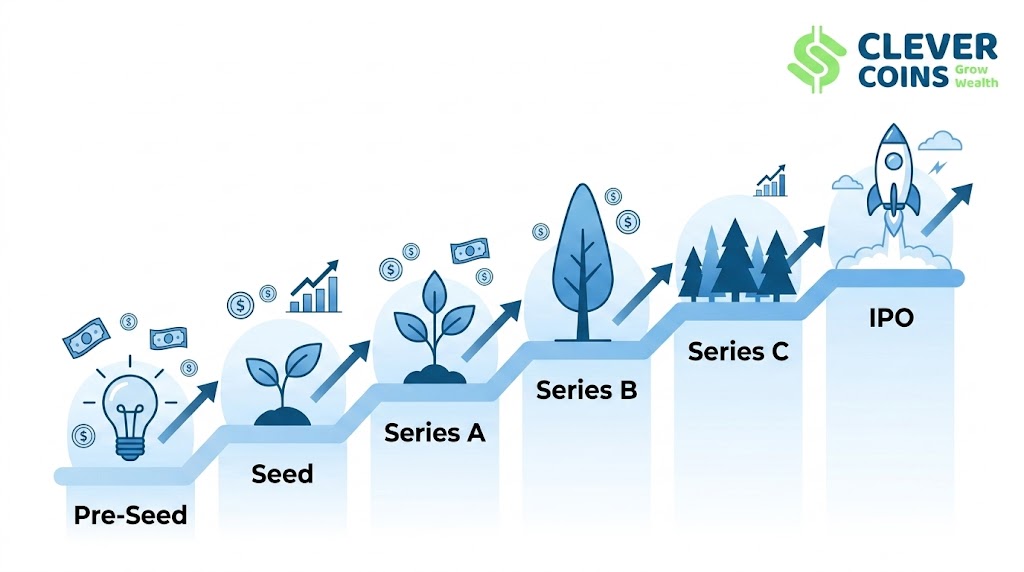
Why Startup Funding Stages Matter
Building a startup is one of the most exhilarating — and challenging — journeys an entrepreneur can take. From the first spark of an idea scribbled on a napkin to ringing the bell at a stock exchange, the road is long, complex, and capital-intensive. At the heart of this journey lies one critical question that every founder eventually faces: How do I fund my startup?
Understanding startup funding stages is not just useful — it is absolutely essential. Each stage of funding comes with its own set of expectations, investor profiles, dilution considerations, and strategic milestones. Founders who understand these stages can raise smarter, negotiate better, and scale faster.
In this comprehensive guide, we will walk you through every major startup funding stage — from bootstrapping and pre-seed all the way to IPOs and beyond. Whether you are a first-time founder or a seasoned entrepreneur looking to brush up on your fundraising knowledge, this blog has everything you need.
What Is Startup Funding?
Startup funding refers to the capital a startup raises to launch, grow, and scale its business. This money can come from a variety of sources — personal savings, friends and family, angel investors, venture capital firms, government grants, corporate investors, or public markets.
Funding is typically raised in stages or ’rounds,’ with each round corresponding to a new phase of the company’s development. As the startup grows and de-risks itself, it becomes eligible for larger amounts of capital at higher valuations.
Key Terms to Know Before We Begin
- Equity: Ownership stake in the company given to investors in exchange for capital.
- Valuation: The estimated worth of a company at the time of a funding round.
- Dilution: Reduction in existing shareholders’ ownership percentage as new shares are issued.
- Cap Table: A spreadsheet that shows the equity ownership structure of a company.
- Term Sheet: A non-binding document outlining the key terms of an investment deal.
- Lead Investor: The primary investor who anchors a funding round.
- Due Diligence: The investigation process investors conduct before committing capital.
- Runway: The number of months a startup can operate before running out of cash.
- Burn Rate: The rate at which a company spends its available capital.
- SAFE Note: Simple Agreement for Future Equity, a common instrument for early-stage investing.
- Convertible Note: A short-term debt instrument that converts to equity at a future funding round.
Stage 0: Bootstrapping — Self-Funding Your Startup
Before any external investor enters the picture, most startups begin with bootstrapping — the process of funding the company entirely from personal resources and early revenues.
What Is Bootstrapping?
Bootstrapping means building and growing your business using your own money, reinvesting early revenues, and keeping expenses lean. It is the most common starting point for startups worldwide.
Sources of Bootstrap Funding
- Personal savings and income
- Credit cards and personal loans
- Early customer pre-orders and deposits
- Revenue from consulting or freelance work
- Bartering services or skills
Pros and Cons of Bootstrapping
Advantages | Disadvantages |
Full ownership and control | Limited capital for growth |
No investor pressure or dilution | Personal financial risk |
Forces lean, efficient operations | Slower growth trajectory |
Builds financial discipline | May miss market opportunities |
No need to pitch or negotiate | Hard to attract top talent |
Stage 1: Pre-Seed Funding — Turning Ideas into Reality
Pre-seed funding is the earliest formal stage of startup fundraising. It typically occurs when founders have validated their idea conceptually but have not yet built a full product or achieved meaningful traction.
Typical Funding Range
Pre-seed rounds generally range from $10,000 to $500,000, though in competitive markets like Silicon Valley or London, pre-seed rounds can sometimes reach $1 million or more.
Who Invests at Pre-Seed?
- Friends, Family & Fools (the 3 F’s)
- Angel investors with domain expertise
- Founder-focused micro VCs
- Startup accelerators (e.g., Y Combinator, Techstars)
- Government grants and innovation programs
What Do Investors Look For at Pre-Seed?
- A compelling founding team with relevant expertise
- Evidence of a real problem and market need
- Early validation (user interviews, surveys, landing page signups)
- A clear vision for the product and business model
- Founder commitment and coachability
Common Instruments Used
- SAFE Notes (most common in the US)
- Convertible Notes
- Equity (less common at this stage)
Key Milestones to Achieve Before Raising
- Proof of concept or MVP in development
- Identified target customer segment
- Clear articulation of the problem being solved
- Initial market research completed
Stage 2: Seed Funding — Planting the Foundation
Seed funding is the first official priced equity round for most startups. It is called ‘seed’ because it is meant to help the startup plant the seeds for future growth — hiring initial team members, building the product, and acquiring first customers.
Typical Funding Range
Seed rounds typically range from $500,000 to $3 million, though in high-growth sectors like fintech, healthtech, and AI, seed rounds can reach $5 million or more.
Who Invests at Seed?
- Angel investors and angel networks
- Early-stage venture capital funds (seed stage VCs)
- Accelerators and incubators
- Strategic corporate investors
- Crowdfunding platforms (equity crowdfunding)
What Do Investors Look For at Seed?
- A launched MVP or beta product
- Early traction: users, sign-ups, or initial revenue
- A clear path to product-market fit
- A scalable business model
- A strong founding team with complementary skills
Typical Equity Given Away
At the seed stage, founders typically give away between 10% and 25% of the company equity, though this varies based on valuation and deal structure.
Post-Seed Milestones
- Product launch to target customers
- Initial customer acquisition and retention
- Product iteration based on user feedback
- Team expansion (engineering, sales, marketing)
- Preparation for Series A fundraise
Stage 3: Series A — Scaling What Works
Series A is the first major institutional funding round. At this stage, the startup has proven its product-market fit and is ready to scale its user base, revenue, and operations.
Typical Funding Range
Series A rounds typically range from $2 million to $15 million. The median Series A in the US as of recent years has been approximately $10 million.
Who Invests at Series A?
- Institutional venture capital firms
- Corporate venture arms
- Existing seed investors participating in follow-on
- Strategic investors aligned with business verticals
What Do Investors Look For at Series A?
- Demonstrated product-market fit
- Consistent monthly recurring revenue (MRR) growth
- Strong customer retention and engagement metrics
- A clear and scalable go-to-market strategy
- A seasoned leadership team
- A large total addressable market (TAM)
The Series A Crunch
Many seed-funded startups fail to raise a Series A — this phenomenon is known as the ‘Series A Crunch.’ Only about 10-15% of seed-funded startups successfully raise a Series A round. The key to beating the crunch is demonstrating clear, consistent traction and a compelling growth story.
Stage 4: Series B — Growth at Scale
Series B funding is about taking a startup that has found its footing and accelerating growth rapidly. By this stage, the company has proven its model and is now focused on scaling aggressively.
Typical Funding Range
Series B rounds range from $10 million to $50 million, with the median often exceeding $25 million depending on the sector and market conditions.
What Series B Capital Is Used For
- Expanding sales and marketing operations
- Entering new geographic markets
- Scaling customer success and support
- Investing in technology infrastructure
- Making strategic acquisitions
- Building out executive leadership team
Investor Profile at Series B
Series B typically attracts larger VC firms, growth equity funds, and sometimes hedge funds or mutual funds that invest in private companies. Lead investors often take a board seat and expect significant governance influence.
Stage 5: Series C and Beyond — Pre-IPO Growth
Series C and later rounds (D, E, F, etc.) represent mature startup financing. Companies raising at these stages are typically highly valued, generating significant revenues, and preparing for either an IPO, acquisition, or continued private growth.
Typical Funding Range
Series C rounds typically start at $50 million and can exceed $500 million for high-growth unicorns. Some companies raise multiple rounds before going public.
Types of Investors at Series C+
- Late-stage venture capital funds
- Private equity firms
- Investment banks
- Sovereign wealth funds
- Hedge funds
- Family offices
What Does a Company Need to Raise Series C?
- Strong and predictable revenue streams
- Market leadership position in core segments
- Clear unit economics and path to profitability
- Expansion into multiple markets or products
- A leadership team capable of running a public company
Stage 6: Bridge Rounds — Filling the Gap
Sometimes startups need additional capital between major rounds. These are called bridge rounds, extension rounds, or mezzanine financing. Bridge rounds are typically smaller, faster to close, and designed to extend a company’s runway until it hits milestones for the next major round.
Common Instruments in Bridge Rounds
- Convertible notes with a discount to the next round
- SAFEs with valuation caps
- Short-term debt facilities
- Revenue-based financing
Stage 7: Mezzanine Financing — The IPO Bridge
Mezzanine financing occurs in the late stages before a company goes public. It combines elements of debt and equity financing and is used to bridge the company’s needs from private growth to public offering.
Key Features
- Typically involves subordinated debt with equity warrants
- Used to finance specific growth initiatives or acquisitions
- Investors expect to be paid back upon IPO or acquisition
- Often includes preferred returns or dividend payments
Stage 8: Initial Public Offering (IPO) — Going Public
An IPO is the process by which a private company offers its shares to the public on a stock exchange for the first time. It is often seen as the ultimate milestone in the startup funding journey, though it is by no means the end.
Types of IPO Processes
- Traditional IPO: Underwritten by investment banks, shares priced through bookbuilding
- Direct Listing: Company lists shares without raising new capital or using underwriters
- SPAC Merger: Special Purpose Acquisition Company merges with a private company
- Regulation A+ Offering: Mini-IPO for smaller companies raising up to $75 million
What Happens During an IPO?
- The company selects investment banks as underwriters
- Due diligence and SEC filing (S-1 Registration Statement)
- Roadshow: Management presents to institutional investors
- Book building and pricing of shares
- Shares begin trading on the public exchange
- Lock-up period for early investors and employees (typically 180 days)
Post-IPO Considerations
- Ongoing SEC reporting requirements (10-K, 10-Q filings)
- Investor relations management
- Quarterly earnings calls
- Stock-based compensation management
- Potential follow-on offerings for additional capital
Alternative Funding Paths
Not every startup follows the traditional VC-backed funding path. Here are some important alternative funding mechanisms:
Revenue-Based Financing (RBF)
In RBF, investors provide capital in exchange for a percentage of ongoing revenue until a predetermined multiple of the principal is paid back. Ideal for businesses with predictable recurring revenue.
Venture Debt
Venture debt is a form of debt financing for startups that have already raised equity. It is typically used to extend runway without additional dilution and is repaid through revenue or the next equity round.
Government Grants and Programs
Many governments offer non-dilutive funding through grants, innovation challenges, and subsidized loan programs. Examples include the SBIR/STTR programs in the US, Innovate UK in the UK, and Startup India grants.
Corporate Venture Capital (CVC)
Large corporations often invest in startups through CVC arms to access innovation, acquire potential acquisition targets, or enter new markets. Examples include Google Ventures (GV), Intel Capital, and Salesforce Ventures.
Crowdfunding
Equity crowdfunding platforms like Republic, Wefunder, and Crowdcube allow everyday investors to invest in startups for equity. Reward-based crowdfunding platforms like Kickstarter and Indiegogo can validate products and raise pre-order revenue.
Startup Funding Stages Summary Table
Stage | Typical Range | Investor Type | Key Milestone | Avg Equity % |
Pre-Seed | $10K–$500K | Friends, Angels | Idea / MVP concept | 5–15% |
Seed | $500K–$3M | Angels, Seed VCs | MVP launched | 10–25% |
Series A | $2M–$15M | Institutional VCs | Product-market fit | 15–25% |
Series B | $10M–$50M | Growth VCs | Scaling operations | 10–20% |
Series C+ | $50M+ | PE, Late-stage VCs | Market leadership | 5–15% |
IPO | $100M+ | Public investors | Profitable / high growth | Varies |
How to Prepare for a Funding Round
Successfully raising funding requires careful preparation. Here is what you need to have in order before approaching investors:
Essential Documents for Fundraising
- Pitch Deck (10–15 slides covering problem, solution, market, traction, team, and financials)
- Financial Model with 3–5 year projections
- Cap Table (current ownership structure)
- Data Room with due diligence documents
- Term Sheet (understanding what you will sign)
- One-Pager / Executive Summary for initial outreach
Tips for a Successful Fundraise
- Start networking before you need money — investor relationships take time.
- Know your numbers inside and out — investors will test your financial literacy.
- Tell a compelling, data-backed story about your startup’s growth.
- Target the right investors for your stage, sector, and geography.
- Create FOMO (Fear Of Missing Out) by running a structured, time-boxed process.
- Always have a lead investor lined up before announcing the round.
- Understand your valuation and justify it with market comps.
- Keep your team focused on operations while you fundraise.
Common Mistakes Founders Make When Fundraising
- Raising too early before achieving key milestones
- Pitching to wrong-stage investors
- Over-diluting early with poor valuations
- Neglecting to negotiate terms beyond valuation
- Failing to check investor references from other founders
- Not having a clear use of funds breakdown
- Ignoring secondary terms like liquidation preferences
- Underestimating the time it takes to close a round (typically 3–6 months)
Conclusion: Navigating the Funding Journey
The startup funding journey is as much about strategy and preparation as it is about the quality of your product. Each stage — from bootstrapping to IPO — represents a new chapter in your company’s story, with its own challenges, opportunities, and critical decisions.
By understanding the expectations at each stage, identifying the right investors, and building your company to meet the milestones that unlock the next round of capital, you dramatically increase your chances of building a successful, venture-scale business.
Remember: funding is a tool, not the destination. The best founders raise capital strategically, deploy it efficiently, and always keep their focus on building something customers love. The rest — including the next funding round — will follow.