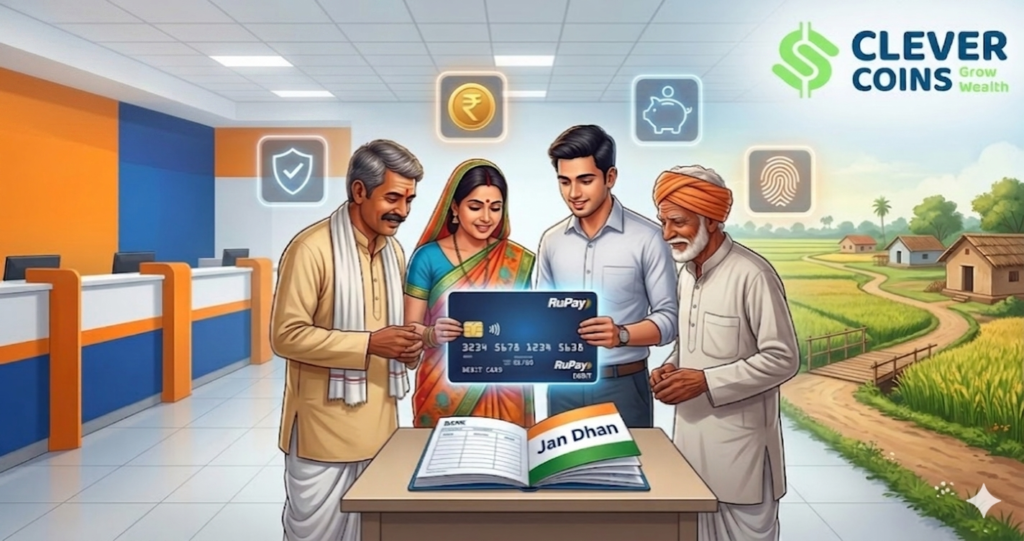
On August 28, 2014, Prime Minister Narendra Modi launched one of the most transformative financial inclusion initiatives in independent India’s history — the Pradhan Mantri Jan Dhan Yojana (PMJDY). With the simple yet powerful vision of “Mera Khata — Bhagya Vidhata” (My Account — My Fortune), this scheme set out to bring every unbanked household in India under the formal banking umbrella.
More than a decade since its launch, PMJDY stands as a Guinness World Record holder for the largest number of bank accounts opened under a financial inclusion initiative — over 53 crore (530 million) accounts as of 2025. But what exactly makes this scheme so impactful? What are its core features, who is eligible, and how can you benefit from it?
This comprehensive guide answers every question you may have about PMJDY — from its key features and benefits to eligibility criteria, account types, overdraft facilities, insurance coverage, and much more.
What Is Pradhan Mantri Jan Dhan Yojana (PMJDY)?
Pradhan Mantri Jan Dhan Yojana (PMJDY) is a National Mission for Financial Inclusion launched by the Government of India on August 28, 2014. The scheme ensures access to financial services — savings accounts, remittance services, credit, insurance, and pension — in an affordable manner for weaker and low-income sections of society.
The scheme operates under the Department of Financial Services (DFS), Ministry of Finance, Government of India, and is implemented through all public and private sector banks, Regional Rural Banks (RRBs), Small Finance Banks, cooperative banks, and payment banks.
PMJDY is built on six pillars:
- Universal access to banking facilities
- Providing basic banking accounts with overdraft facility
- Financial literacy programme
- Access to credit
- Access to insurance and pension
- Interoperability of accounts across financial institutions
Key Features of Pradhan Mantri Jan Dhan Yojana
The PMJDY scheme offers a rich set of features designed to make banking truly inclusive. Here is an in-depth look at each feature:
1. Zero Balance Savings Account
One of the most defining features of PMJDY is the zero-balance savings account. Beneficiaries can open a PMJDY account without any minimum balance requirement. This removes one of the biggest barriers for the rural poor who often cannot afford to maintain the minimum balance mandated by regular savings accounts.
- No minimum balance required at any time
- If the account holder wishes to avail a cheque book, a minimum balance condition may apply
- Account can be opened at any designated bank branch or Business Correspondent (BC) outlets
2. RuPay Debit Card — Free of Cost
Every PMJDY account holder receives a RuPay Debit Card — India’s own domestic card payment network, developed by the National Payments Corporation of India (NPCI). This card enables:
- ATM withdrawals from any ATM in India
- Point of Sale (PoS) transactions at merchant outlets
- Online and e-commerce transactions
- Interoperable transactions across banks and payment systems
The RuPay card comes bundled with accidental insurance cover of Rs. 2 lakh (for accounts opened after August 28, 2018), making it one of the most value-added debit cards available at zero cost.
3. Accidental Insurance Cover of Rs. 2 Lakh
All PMJDY account holders who have been issued a RuPay debit card are eligible for accidental insurance cover. Here are the detailed terms:
- Accounts opened between 28 August 2014 and 28 August 2018: Rs. 1 lakh accidental death & permanent disability cover
- Accounts opened after 28 August 2018: Rs. 2 lakh accidental death & permanent disability cover
- The cover is provided by National Payments Corporation of India (NPCI) through the RuPay card scheme
- The account holder must have performed at least one successful financial or non-financial transaction within 90 days preceding the date of accident
- The nominee or legal heir must file the claim within 90 days of the accident
4. Life Insurance Cover of Rs. 30,000
Under the PMJDY scheme, eligible beneficiaries also receive a life insurance cover of Rs. 30,000 through the Life Insurance Corporation of India (LIC). This benefit was applicable for those who opened accounts between August 28, 2014 and January 26, 2015.
- One member per household (preferably the female member) is eligible
- Applicable for those aged 18–59 years at the time of account opening
- Cover is for a term of 5 years after the pilot launch period
- In case of death due to natural or accidental causes, the nominee receives Rs. 30,000
Note: This particular cover was part of the initial launch phase. The Government continues to review and extend insurance benefits for PMJDY account holders.
5. Overdraft Facility Up to Rs. 10,000
One of the most empowering features of PMJDY is the overdraft (OD) facility. After satisfactory operation of the account for 6 months, an account holder becomes eligible for an overdraft of up to Rs. 10,000. This is essentially a small emergency credit line extended by the bank.
Key details of the overdraft facility:
- Basic OD up to Rs. 2,000 — available without conditions to all PMJDY account holders
- Full OD up to Rs. 10,000 — available after 6 months of satisfactory operations
- No collateral security required
- Only one member per household (preferably the lady of the house) is eligible
- For senior citizens aged above 65 years, the OD limit is reduced proportionately
- Interest charged as per bank’s prevailing rates (generally around 10–12% per annum)
6. Direct Benefit Transfer (DBT) — Seamless Government Transfers
PMJDY accounts serve as the primary conduit for Direct Benefit Transfer (DBT). All government subsidies and benefits — including LPG subsidies, MGNREGS wages, PM-KISAN payments, scholarships, and social security pensions — are directly credited to PMJDY accounts.
- Eliminates middlemen and leakages in welfare delivery
- Faster and more transparent transfer of benefits
- Linked with Aadhaar for seamless verification
- Enabled under the JAM Trinity (Jan Dhan, Aadhaar, Mobile)
7. Access to Micro-Credit and Microfinance
PMJDY serves as a gateway to formal credit for previously unbanked citizens. Once a customer has a transaction history, they become eligible for:
- Micro-credit through Kisan Credit Card (KCC) and General Credit Cards (GCC)
- Mudra Yojana loans for small enterprises
- MSME credit linkage
- SHG (Self-Help Group) linkages and credit
8. Interoperability and Mobile Banking
PMJDY accounts support full interoperability across banking channels:
- Access via IMPS (Immediate Payment Service) for real-time money transfer
- UPI (Unified Payments Interface) linkage — send and receive money digitally
- Mobile banking through *99# USSD service — works on any mobile without internet
- Aadhaar-enabled Payment System (AePS) — biometric-based transactions at BC outlets
- NEFT and RTGS transfers supported
9. Financial Literacy and Awareness
The scheme is backed by a robust financial literacy programme. Banks and Business Correspondents (BCs) educate beneficiaries on:
- Importance of saving money regularly
- How to use debit cards and ATMs safely
- Basics of insurance and pension products
- Safe borrowing and credit management
- Avoiding fraud and phishing
10. Pension Scheme Access
PMJDY account holders are eligible to be enrolled in government pension schemes such as:
- Atal Pension Yojana (APY) — guaranteed pension of Rs. 1,000 to Rs. 5,000 per month after the age of 60
- National Pension System (NPS) — for systematic retirement savings
- PM Shram Yogi Maandhan — pension for unorganised sector workers
Eligibility Criteria for PMJDY
The PMJDY account is designed to be as inclusive as possible. The eligibility criteria are:
- Age: Any Indian citizen above the age of 10 years (minors can open a joint account with a guardian)
- Residency: Must be a resident of India
- Bank account: Should not already have a bank account (or may not have a savings account in the formal banking system)
- Documents: Valid KYC (Know Your Customer) documents such as Aadhaar card, voter ID, driving licence, PAN card, NREGA job card, or letter from a Gazetted Officer
- Small Account: Even those without KYC documents can open a ‘Small Account’ with self-certification and photograph
How to Open a PMJDY Account — Step by Step
- Visit your nearest bank branch, Business Correspondent (BC) outlet, or bank mitra
- Fill in the PMJDY Account Opening Form (available at banks, online, or via PM Jan Dhan website)
- Submit KYC documents — Aadhaar card is preferred for instant account opening
- Provide passport-size photographs (if Aadhaar is not available for biometric verification)
- Mention nominee details in the form
- Receive your account number, passbook, and RuPay Debit Card instantly or within 10–14 working days
- Link your mobile number and Aadhaar for full benefits including DBT
Types of PMJDY Accounts
There are two main types of accounts under PMJDY:
a) Regular PMJDY Account
Opened with full KYC documentation. Provides all benefits including overdraft facility, RuPay card, accidental and life insurance covers.
b) Small Account (Limited KYC)
For those who cannot produce standard KYC documents. Opened with a self-declaration and photograph. Features include:
- Maximum balance: Rs. 50,000 at any point of time
- Maximum total credits in a year: Rs. 1,00,000
- Maximum total withdrawals and transfers in a month: Rs. 10,000
- Valid for 12 months — can be extended if the holder shows proof of application for KYC documents
PMJDY and the JAM Trinity
PMJDY forms the foundational ‘J’ in India’s JAM Trinity — Jan Dhan, Aadhaar, and Mobile — a transformative framework that digitally links citizens to government services.
Letter | Stands For | Role in Financial Inclusion |
J | Jan Dhan (PMJDY) | Bank account for every citizen |
A | Aadhaar (UIDAI) | Unique identity for every resident |
M | Mobile | Digital connectivity to access services |
PMJDY Statistics & Achievements (as of 2025)
The scale of PMJDY’s success is reflected in the data:
Metric | Figure |
Total Accounts Opened | Over 53 Crore (530 Million+) |
Total Deposits in PMJDY Accounts | Over Rs. 2.3 Lakh Crore |
RuPay Cards Issued | Over 36 Crore |
Zero Balance Accounts | Reduced from 76% (2015) to under 8% (2025) |
Female Account Holders | Over 55% of total accounts |
Rural/Semi-Urban Accounts | Over 66% of total accounts |
Accounts Linked to Aadhaar | Over 90% |
DBT credited through PMJDY (cumulative) | Over Rs. 34 Lakh Crore |
Benefits of PMJDY for Different Stakeholders
For the Common Citizen:
- First-ever access to formal banking for crores of Indians
- Safe place to deposit savings
- Emergency credit via overdraft facility
- Insurance coverage at zero premium cost
- Receive government benefits directly without delays
For Women:
- Financial empowerment and independence
- Priority for overdraft facilities
- Access to SHG credit and micro-enterprise finance
- Direct receipt of subsidies under PM Ujjwala Yojana, PM Matru Vandana Yojana, etc.
For Small Businesses & Farmers:
- Gateway to formal credit via Mudra and KCC
- PM-KISAN direct transfer to PMJDY account
- Digital payment infrastructure through UPI and RuPay
For the Government:
- Reduced cash dependency and leakage in welfare delivery
- Enhanced digital payment ecosystem
- Broader tax base and formal economy participation
- Guinness World Record recognition for scale of implementation
PMJDY vs Regular Savings Account — Key Differences
Feature | PMJDY Account | Regular Savings Account |
Minimum Balance | Zero | Rs. 500 – Rs. 10,000 |
Debit Card | RuPay (Free) | Visa/Mastercard (may have charges) |
Accidental Insurance | Rs. 2 Lakh (Free) | Optional/Paid |
Life Insurance | Rs. 30,000 (eligible period) | Not included |
Overdraft | Up to Rs. 10,000 | No (generally) |
DBT Eligibility | Yes (Primary channel) | Yes (if Aadhaar-linked) |
Interest Rate | Same as regular SB accounts | Same as PMJDY |
Cheque Book | On request (minimum balance may apply) | Included by default |
Challenges and the Road Ahead
Despite its remarkable success, PMJDY faces ongoing challenges:
- Dormant accounts: A segment of accounts remains dormant or inactive — continuous awareness drives are needed
- Last-mile connectivity: Internet and banking infrastructure in remote areas still needs improvement
- Digital literacy: Many beneficiaries are unfamiliar with digital payment tools
- Fraudulent transactions: Phishing and SIM-swap fraud targeting PMJDY account holders
The Government of India continues to address these challenges through upgraded PMJDY 2.0 features, integration with DigiLocker, increased focus on mobile banking, and expanding the network of Business Correspondents (BCs) to the village level.
Frequently Asked Questions (FAQs) About PMJDY
Q1. Can I open a PMJDY account if I already have a savings account?
Technically, PMJDY is meant for those who are unbanked. However, existing bank account holders may also open a PMJDY account by declaring that this will be their primary account under the scheme.
Q2. Is there any charge for opening a PMJDY account?
No. PMJDY accounts are completely free to open. There are no account opening charges, no annual maintenance fees, and no minimum balance penalties.
Q3. How do I claim the accidental insurance under PMJDY?
The nominee or legal heir must submit the claim form along with the FIR, medical reports, death certificate (if applicable), and other documents to the NPCI or the relevant insurance company within 90 days of the accident.
Q4. Can NRIs open a PMJDY account?
No. PMJDY accounts are exclusively for Indian residents. Non-Resident Indians (NRIs) are not eligible for this scheme.
Q5. What happens if a PMJDY account becomes dormant?
A PMJDY account becomes inactive if no transactions are conducted for 24 months. To reactivate the account, the account holder must visit the bank branch with valid KYC documents and submit a re-activation request.
Q6. Can I convert my PMJDY account to a regular savings account?
Yes. Once you fulfill the KYC requirements and meet the bank’s criteria, you can request a conversion to a regular savings account. However, you will then no longer be eligible for PMJDY-specific benefits.
Conclusion
The Pradhan Mantri Jan Dhan Yojana is far more than just a bank account scheme — it is a socio-economic revolution that has redefined what financial inclusion means in a country as vast and diverse as India. By giving hundreds of millions of citizens their first bank account, a debit card, insurance cover, and access to credit and government subsidies, PMJDY has genuinely changed lives.
Whether you are a student, farmer, homemaker, daily-wage worker, or a small business owner — if you do not already have a bank account, PMJDY is the gateway to a more financially secure future. Walk into your nearest bank or Business Correspondent outlet today, and take the first step toward financial freedom.