Advance Tax in India: Who Must Pay, Due Dates & Penalties Explained
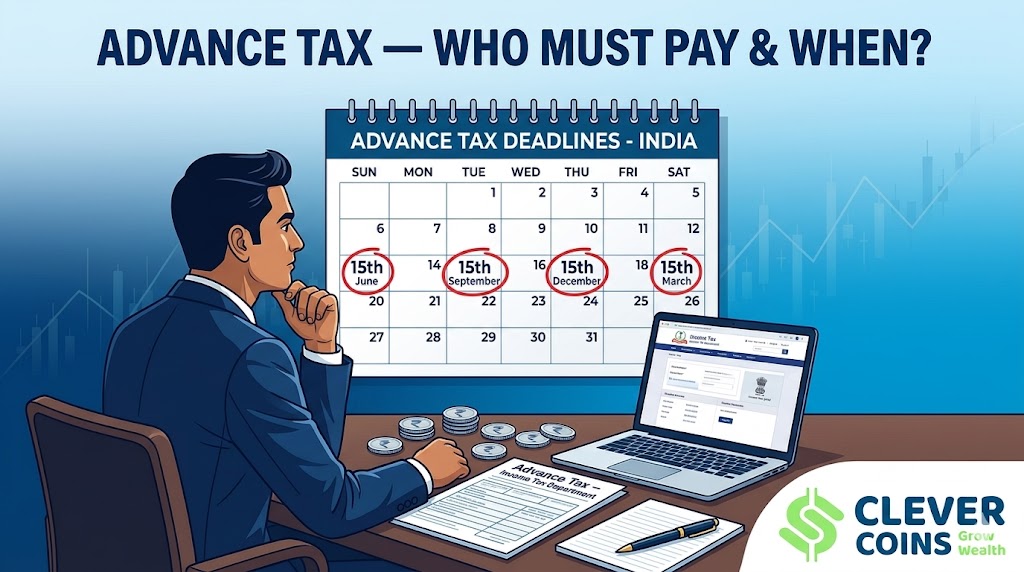
If you are earning income in India — whether from salary, business, profession, capital gains, or investments — you may be required to pay your income tax in advance, before the financial year ends. This system is called Advance Tax, and missing its deadlines can attract heavy interest penalties.
In this comprehensive guide by CleverCoins, India’s trusted tax consultancy, we will explain everything you need to know about advance tax — from who needs to pay it, how to calculate it, all due dates, and consequences of non-payment.
What is Advance Tax?
Advance Tax, also known as ‘pay-as-you-earn’ tax, is the income tax payable in installments during the financial year itself, rather than as a lump sum at the end. This system was introduced under Sections 207 to 219 of the Income Tax Act, 1961, to ensure a steady flow of tax revenue to the government throughout the year.
Simply put: instead of paying all your taxes after March 31st, you estimate your annual income and pay taxes in four installments across the financial year — in June, September, December, and March.
Who Must Pay Advance Tax?
Under Section 208 of the Income Tax Act, every taxpayer (individual, HUF, firm, company, AOP, BOI) whose estimated tax liability for the financial year is Rs. 10,000 or more after TDS must pay advance tax.
The following categories MUST pay Advance Tax:
- Salaried individuals with other income sources (rental, FD interest, capital gains, freelancing)
- Self-employed professionals such as doctors, lawyers, CA, architects, consultants
- Freelancers and independent contractors earning income without TDS deduction
- Business owners including proprietors, partners in firms, and directors
- Traders in stocks, equity, derivatives, commodities, or cryptocurrency
- Companies and LLPs regardless of their income level
- Individuals earning high rental income not fully covered under TDS
- NRIs having Indian-sourced income exceeding Rs. 10,000 tax liability
Who is EXEMPT from Advance Tax?
- Senior citizens (aged 60 years or above) who are NOT having income from business or profession are exempt under Section 207.
- Individuals whose estimated tax liability after TDS is less than Rs. 10,000 for the year.
- Taxpayers under the Presumptive Taxation Scheme under Sections 44AD, 44ADA, and 44AE are required to pay the entire advance tax in ONE installment by 15th March only (not in 4 installments).
Advance Tax Due Dates for FY 2025-26
The advance tax installments and due dates for Financial Year 2025-26 (Assessment Year 2026-27) are as follows:
|
Installment |
Due Date |
Cumulative % of Tax |
Who Pays |
|
1st Installment |
15th June |
15% of advance tax |
All taxpayers (non-presumptive) |
|
2nd Installment |
15th September |
45% of advance tax |
All taxpayers (non-presumptive) |
|
3rd Installment |
15th December |
75% of advance tax |
All taxpayers (non-presumptive) |
|
4th Installment |
15th March |
100% of advance tax |
All taxpayers including presumptive |
Important Note: Taxpayers opting for Presumptive Taxation under Section 44AD (business) or 44ADA (professionals) are required to pay 100% advance tax in a single installment on or before 15th March of the financial year.
How to Calculate Advance Tax?
Calculating advance tax is a step-by-step process:
Step 1 — Estimate Total Income for the Year
Add up all sources: salary, business profit, capital gains (both STCG and LTCG), house property income, interest income, freelance earnings, dividends, and any other income.
Step 2 — Deduct Eligible Deductions
Reduce your gross total income by applicable deductions under Chapter VIA: Section 80C (up to Rs. 1.5 lakh), 80D (health insurance), 80G (donations), 80CCD (NPS), etc.
Step 3 — Calculate Tax on Net Income
Apply the applicable income tax slab rates (old regime or new regime) on your net taxable income. Add surcharge and health & education cess of 4% if applicable.
Step 4 — Deduct TDS Already Deducted / Expected
Subtract the TDS already deducted by your employer, bank, or any other deductor. The remaining amount is your net tax liability.
Step 5 — Check the Rs. 10,000 Threshold
If the net tax liability (after TDS) is Rs. 10,000 or more, you are liable to pay advance tax in installments as per the schedule.
How to Pay Advance Tax Online?
Paying advance tax online is quick and easy through the Income Tax e-Filing portal. Here’s how:
- Visit the official Income Tax portal: incometax.gov.in
- Go to ‘e-Pay Tax’ or use Challan ITNS 280
- Select Assessment Year (AY 2026-27 for FY 2025-26)
- Select Tax Type: ‘(100) Advance Tax’
- Enter your PAN, address, and payment amount
- Choose your preferred payment mode: Net banking, Debit card, UPI, NEFT/RTGS
- Complete the payment and download the challan receipt
Pro Tip by CleverCoins: Always save your advance tax payment challan. It will be required during ITR filing to claim credit for taxes paid.
Consequences of Not Paying Advance Tax — Interest Under Sections 234B & 234C
Failure to pay advance tax or paying less than the required amount attracts interest liability under two sections:
Section 234C — Deferment of Advance Tax (Installment-wise)
If you fail to pay any installment of advance tax on time, or pay less than the required percentage, interest at the rate of 1% per month (simple interest) is charged for a period of 3 months on the shortfall for the first three installments and 1 month for the March installment.
Section 234B — Default in Payment of Advance Tax
If the total advance tax paid during the year is less than 90% of the assessed tax liability, interest is charged at 1% per month or part thereof from April 1st of the Assessment Year until the date of actual payment or assessment.
|
Section |
Scenario |
Interest Rate |
Period |
|
234B |
Tax paid < 90% of assessed tax |
1% per month |
April to assessment month |
|
234C |
Installment short / not paid |
1% per month |
3 months per installment (1 month for March) |
Special Cases in Advance Tax
Capital Gains
Capital gains income is unpredictable and may arise at any point. If capital gains arise AFTER a due date, the advance tax on such gains can be paid in subsequent installments without attracting Section 234C interest, subject to conditions. However, any unpaid balance by March 15th will attract interest under Section 234B.
Dividend Income
Since dividend income is declared by companies at various points, advance tax on dividend can be paid in the installment immediately following the quarter in which the dividend is received, without 234C interest.
Winnings, Lottery, and Gambling
Any income by way of winnings from lottery, crossword puzzles, races, games, gambling, or betting is to be included in income and advance tax paid accordingly.
Presumptive Taxation Scheme
Taxpayers who opt for presumptive taxation under Section 44AD (8% / 6% of turnover), 44ADA (50% of gross receipts for professionals), or 44AE (transporters) are required to pay 100% of their advance tax in one shot by 15th March. They are NOT required to pay installments in June, September, or December.
Advance Tax vs TDS — Key Difference
TDS (Tax Deducted at Source) is deducted by the payer from the amount paid to you — such as your employer deducting TDS from salary, or bank deducting TDS on FD interest. Advance Tax, on the other hand, is self-assessed and self-paid directly by you to the government. Both serve the same purpose — pre-payment of tax — but the mechanism is different. You can use TDS credits to reduce your advance tax liability.
Common Mistakes Taxpayers Make Regarding Advance Tax
- Not considering capital gains or freelance income while estimating advance tax
- Forgetting to include dividend income, FD interest, and rental income
- Missing the 15th September and 15th December installment deadlines
- Not using ITR/Challan 280 for advance tax — using wrong challan type
- Underestimating income and subsequently attracting 234B & 234C interest
- Senior citizens assuming they are fully exempt (exemption only for non-business income)
Advance Tax Planning Tips by CleverCoins
- Start estimating your annual income at the beginning of the financial year itself
- Maintain a quarterly income tracker for all sources — salary, business, investments
- Check TDS certificates (Form 16, 16A) to accurately compute TDS credits
- Consider hiring a professional tax consultant for accurate advance tax computation
- Set reminders for 15th June, 15th September, 15th December, and 15th March each year
- Keep all advance tax payment challans safely for ITR filing
Advance Tax for Traders and Investors
If you actively trade in stocks, futures & options, or cryptocurrency, your income profile changes every quarter. You must estimate your trading profit and capital gains every quarter and pay advance tax accordingly. This is one of the most complex areas — and CleverCoins specializes in tax planning for traders, helping you calculate correct advance tax, avoid interest penalties, and file accurate ITRs.
Conclusion — Stay Ahead, Pay Advance Tax on Time
Advance tax is not a burden — it is a disciplined approach to tax compliance that keeps you financially organised throughout the year. By paying advance tax on time, you avoid interest penalties, reduce last-minute stress, and build a credible tax profile.
If you find advance tax calculations complex, CleverCoins is here to help. Our team of tax experts will estimate your tax liability accurately, remind you of due dates, and ensure complete compliance — all at an affordable consultation fee.
Contact CleverCoins Today for Expert Tax Guidance
www.clevercoins.org | DM us on Instagram @clevercoins