The dream of owning a share of Apple, a slice of NVIDIA, or a piece of the S&P 500 is no longer reserved for Americans. Today, millions of resident Indians are investing directly in US stocks and ETFs — driven by the aspiration to participate in the world’s largest, most liquid, and most diversified equity market from the comfort of their homes in Bengaluru, Mumbai, Delhi, and beyond.
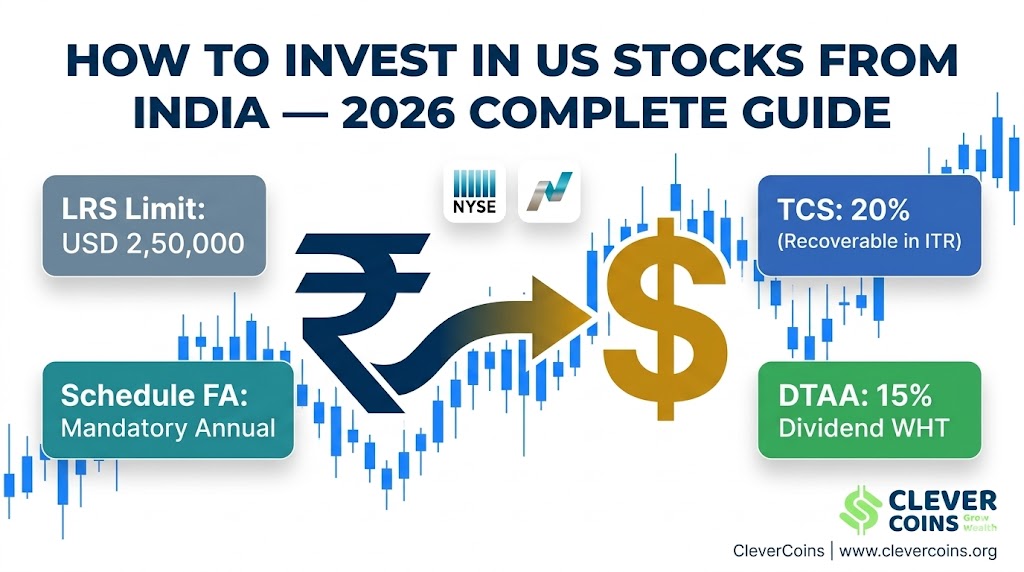
US market investing from India has become significantly more accessible — with platforms like Vested Finance, Winvesta, INDmoney, and international brokers like Charles Schwab offering fractional share investing from as little as USD 1. However, the regulatory, tax, and compliance landscape is complex: LRS (Liberalised Remittance Scheme), TCS (Tax Collected at Source) at 20%, Schedule FA disclosure, ITR reporting of foreign income, DTAA benefits, and the often-overlooked US estate tax risk.
This comprehensive 2026 guide by CleverCoins — India’s trusted tax consultancy — covers everything you need to know before buying your first US stock from India: the legal route, platform comparison, step-by-step account opening, LRS and TCS implications, direct stocks vs Indian feeder funds, tax treatment, ITR compliance, and expert strategies to optimise your US investment journey.
Why Indian Investors Are Flocking to US Stocks
The case for US stock investment from India is compelling on multiple dimensions:
- Diversification Beyond India
India’s stock market, despite its impressive growth, remains concentrated in banking, IT, FMCG, and energy. The US market offers unparalleled access to sectors that India lacks: pure-play semiconductor companies (NVIDIA, AMD, Intel), global SaaS leaders (Salesforce, Adobe, ServiceNow), biotech giants, aerospace, and consumer brands that dominate worldwide.
- Currency Hedge — USD Appreciation vs INR Depreciation
The Indian Rupee has depreciated against the US Dollar at an average rate of approximately 3-4% per year over the past decade. By holding US Dollar-denominated assets, Indian investors automatically benefit from this currency trend — their USD investments are worth more in INR terms even without any stock price appreciation.
- Access to the World’s Most Liquid Market
The US stock market has a daily trading volume of over USD 400 billion. It is open 5 days a week, offers near-instant settlement (T+1), has some of the deepest options markets, and provides access to REITs, MLPs, BDCs, and structured products unavailable in India.
- Fractional Share Investing — Own Apple for $1
A full share of Amazon or Google costs hundreds to thousands of dollars. Fractional investing — available on Indian platforms like Vested and INDmoney — allows Indian investors to own 0.001 of a share in any US company, making the most expensive stocks accessible.
- India’s Growing IT Class and Tech Awareness
India has the world’s second-largest developer community. Millions of Indian engineers work on products of Apple, Microsoft, Google, and Meta daily. This creates natural familiarity with and conviction in these companies — making US stock investment a logical portfolio extension.
💡 CleverCoins Market Context: The Nasdaq Composite has delivered approximately 15% CAGR over the last 10 years. Combined with a 3-4% annual INR depreciation — an Indian investor holding a Nasdaq 100 ETF could have effectively earned 18-19% CAGR in rupee terms over the decade. No Indian index has matched this consistently.
Legal Route — How Indians Can Invest in US Stocks
Resident Indian individuals can invest in US stocks through the Liberalised Remittance Scheme (LRS) under FEMA, which allows each individual to remit up to USD 2,50,000 per financial year for capital account transactions — including investment in foreign equity.
The Two Main Routes
Route 1: Direct Investment via LRS
- Open an account with an Indian platform (Vested, Winvesta, INDmoney) or directly with a US broker
- Remit USD from your Indian bank account to the brokerage account via LRS
- The remitting bank collects TCS at 20% on the investment amount (no Rs. 7 lakh threshold for investments)
- Buy US stocks, ETFs, or fractional shares
- Income (dividends, capital gains) is taxable in India; disclose in Schedule FA annually
Route 2: Indirect Investment via Indian Mutual Funds (FOF / Feeder Funds)
- Invest in INR via SIP or lumpsum in Indian mutual fund schemes that invest in US stocks/ETFs
- Examples: Mirae Asset NYSE FANG+ ETF FOF, Motilal Oswal Nasdaq 100 FOF, Franklin Feeder Funds
- No LRS, no TCS, no Schedule FA, no US broker account needed
- Returns tracked in INR; taxed as Indian mutual fund (equity or debt depending on structure)
- Limited to index/thematic exposure — cannot pick individual US stocks
✅ CleverCoins Recommendation: For investors starting out (below Rs. 3-4 lakh annual US investment), Indian feeder funds / FOFs are simpler, no-TCS, and tax-efficient. For experienced investors who want direct stock ownership, control over portfolio, and exposure to specific US companies — direct LRS route with proper compliance is the way.
Step-by-Step Guide: How to Open an Account and Start Investing in US Stocks
Step 1 — Ensure LRS Eligibility
You must be a resident Indian individual under FEMA. NRIs follow a different route (PIS account route). Minors can participate through natural guardians. The USD 2,50,000 LRS annual limit applies per person per financial year — combining all LRS purposes (travel, education, investment).
Step 2 — Choose Your Platform
Select the platform based on your needs — see the complete comparison table below. Key factors: fractional shares availability, TCS handling by the platform, expense charges, and whether you want an Indian or direct US broker experience.
Step 3 — Complete KYC on the Platform
- Submit PAN card — mandatory
- Submit Aadhaar card (address proof)
- Submit passport copy (for international transactions)
- Submit income proof for large investments in some cases
- FATCA self-declaration — you are an Indian resident, NOT a US person
- W-8BEN form — required by all US brokers; declares you are a non-US person; reduces dividend withholding tax
Step 4 — Remit Funds via LRS from Your Indian Bank
Initiate the foreign remittance from your Indian bank account:
- Log in to your bank’s net banking — use the ‘Foreign Remittance’ or ‘LRS Outward Remittance’ section
- Select purpose: ‘Investment — Foreign Securities’ (or equivalent)
- Enter the beneficiary details as provided by your investment platform
- Fill Form A2 — the bank processes it online or requests the physical form
- The bank collects TCS at 20% on the full investment amount — this amount is debited from your account in addition to the investment amount
- Get the TCS certificate (Form 27D) from the bank — save it for ITR filing
- Funds reach your brokerage account within 1-5 working days via SWIFT transfer
Step 5 — Start Buying US Stocks and ETFs
Once funds are credited to your brokerage account:
- US markets are open from 7:00 PM to 1:30 AM IST (9:30 AM to 4:00 PM US Eastern Time)
- Pre-market (8:30 PM IST) and after-market hours trading available on most platforms
- Place market orders or limit orders
- For ETFs like VOO, QQQ, SCHD — can also set up automatic regular investment plans on some platforms
- Keep track of acquisition cost in USD — needed for accurate capital gains computation later
Step 6 — Annual Tax and Compliance Tasks
- Download annual transaction statement from your US broker
- Compute capital gains on sold positions — short-term (<24 months) and long-term (≥24 months) for foreign assets
- Compute dividend income received — net of US withholding tax
- File ITR-2 declaring foreign income (Schedule FSI) and foreign assets (Schedule FA)
- File Form 67 to claim DTAA credit for US withholding tax on dividends
- Claim TCS credit collected during the year as advance tax
Platform Comparison — Indian and Global Options for US Stock Investment
Platform | Type | Fractional Shares? | Min Investment | Annual Charges | Key Features & Notes |
Vested Finance | Direct US Broker Platform (India-focused) | YES — from $1 | No min ($1) | Nil (standard); Premium plans available | SIPC-insured, FINRA-regulated DriveWealth broker; 4000+ US stocks + ETFs; India-focused support |
Winvesta | Direct US Broker Platform | YES | No min | $2.99/month for premium features | DriveWealth-backed; ETFs, stocks, fractional shares; UK FCA regulated entity |
INDmoney | India + US Investing App | YES — from $1 | No min | Free tier available; paid upgrades | One app for Indian + US stocks, MF, NPS; AutoInvest feature; tax report generation |
HDFC Securities GlobalInvest | Bank-backed platform | NO | Full share price | Currency conversion fees apply | Backed by HDFC Bank; high trust factor; primarily for HDFC customers; desktop-focused |
ICICI Direct US Stocks | Bank-backed platform | NO | Full share price | Conversion charges + annual fees | ICICI Bank-backed; limited stock selection; suitable for existing ICICI customers |
Charles Schwab (direct) | Direct US Full-Service Broker | Partial — some products | None for stocks | No commission on US stocks (Schwab policy) | Premium full-service US broker; suitable for large portfolios; requires US compliance; slower account opening for Indians |
Interactive Brokers (IBKR) | Direct International Broker | YES — via IBKR Lite | No min | Activity fees may apply; IBKR Lite is commission-free | Advanced trading tools; options, forex, bonds; suitable for experienced investors; used by HNIs |
Indian MF — US Feeder Funds | Indirect route via Indian Mutual Fund | N/A — Indian MF units | Rs. 500 SIP | 1% to 1.5% expense ratio | No LRS hassle; no TCS; invest in INR; no foreign account; tax as Indian MF; no direct stock access |
Indian MF — US ETF FOF | Fund of Funds investing in US ETFs | N/A — Indian MF units | Rs. 500 SIP | 0.5% to 1.2% expense ratio | E.g., Mirae Asset NYSE FANG+, Motilal Oswal Nasdaq 100 FOF; INR investment; no LRS/TCS |
💡 W-8BEN — The Most Important Document When Investing in US Stocks: The W-8BEN (Certificate of Foreign Status of Beneficial Owner) is a US tax form that you submit to your US broker or the Indian platform’s US broker partner. It certifies that you are an Indian resident (not a US person) — which enables the DTAA-reduced withholding tax rate of 15% (instead of 25-30%) on dividends. Always submit this form and update it every 3 years.
LRS and TCS — The Financial Impact of Investing in US Stocks
The 20% TCS (Tax Collected at Source) on investment remittances is the biggest practical challenge for Indian investors in US stocks. Here is everything you need to know:
How TCS Works for US Stock Investment
- TCS Rate: 20% on the ENTIRE investment amount — from Re. 1 (no Rs. 7 lakh threshold for investment remittances)
- Who Collects: The AD Bank that processes your LRS remittance
- When Collected: At the time of the wire transfer from India to your US brokerage
- Example: You remit Rs. 5,00,000 to invest in US stocks. The bank debits Rs. 5,00,000 (investment) + Rs. 1,00,000 (TCS at 20%) = Rs. 6,00,000 from your account
- The Rs. 1,00,000 TCS is NOT lost — it is credited as advance tax in your ITR for that financial year
⚠️ TCS is NOT a tax on investment returns — it is an advance collection of your potential income tax. If you are a tax-paying individual, TCS simply means you pay your tax earlier. If you are below the taxable threshold — file a NIL ITR and claim the entire TCS as a refund. The real impact is the 3-6 month working capital blockage while waiting for ITR filing and refund.
Scenario | Annual Investment | TCS @ 20% | TCS Recovered in ITR? | Net Cost Impact |
Resident Indian investing $5,000 in US stocks (₹4.2L approx) | Rs. 4,20,000 | 20% × Rs. 4.2L = Rs. 84,000 TCS | YES — full Rs. 84,000 credited in ITR | Nil for tax-paying investors; 3-6 month working capital block |
Resident Indian investing $10,000 (₹8.4L approx) | Rs. 8,40,000 | 20% × Rs. 8.4L = Rs. 1,68,000 TCS | YES — Rs. 1,68,000 ITR credit | Large working capital block; use Indian FOF instead if cash flow is tight |
Combined travel + US stock investment in same year | Rs. 7L travel + Rs. 5L stocks | Travel: 20% above Rs.7L = 0 (if exactly Rs.7L). Stocks: 20% × Rs.5L = Rs.1,00,000 | YES — entire TCS is ITR credit | Plan travel first (uses Rs.7L threshold); invest balance in stocks |
Young investor, below taxable income — no ITR tax due | Rs. 3,00,000 in US stocks | 20% × Rs. 3L = Rs. 60,000 TCS collected | YES — file NIL ITR; full Rs.60,000 refund from IT Dept | Refund takes 30-90 days; track on IT portal |
Using Indian Feeder Fund instead (no LRS) | Rs. 5,00,000 SIP in Nasdaq 100 FOF | ZERO TCS — no LRS transaction | N/A — no TCS collected | Zero working capital impact; only expense ratio 0.5%-1% p.a. |
📌 LRS Annual Limit Alert: The USD 2,50,000 LRS limit is AGGREGATE across ALL purposes for the year. If you spend Rs. 7 lakh on an overseas vacation and then invest Rs. 3 lakh in US stocks — your total LRS for the year is approximately Rs. 10 lakh (USD ~12,000). You still have USD ~2,37,000 remaining for the year. Track your aggregate LRS utilisation carefully — your bank can tell you the current year-to-date LRS used.
Direct US Stocks vs Indian Feeder Funds / FOF — Complete Comparison
This is the most strategic decision for Indian investors wanting US market exposure. Both routes have significant advantages and disadvantages:
Feature | Direct US Stocks via LRS | Indian MF / FOF with US Exposure |
Investment Currency | USD — remit via LRS | INR — invest in Indian MF |
LRS / TCS Applicable? | YES — 20% TCS from Re. 1 (no threshold) on investment category | NO — invest in INR through SIP/lumpsum; no LRS, no TCS |
Minimum Investment | From $1 (fractional shares) | Rs. 500 SIP minimum |
Flexibility | Buy/sell individual stocks; full control over portfolio | Fund manager decides portfolio allocation; limited control |
Access to Specific Stocks | YES — directly hold Apple, Google, Tesla, NVIDIA etc. | INDIRECT — hold units of a fund that holds these stocks |
US Estate Tax Risk | YES — holdings above USD 60,000 attract 40% US estate tax at death | NO — Indian MF is an Indian asset; no US estate tax |
Capital Gains Tax (India) | LTCG 12.5% (> 24 months); STCG at slab rate (< 24 months) | Equity MF: LTCG 12.5% (> 1 year); STCG 20% (< 1 year) |
Dividend Tax | 25% US WHT + India slab tax; DTAA credit available | Dividends from MF taxed as income in India at slab rate |
Schedule FA Disclosure | MANDATORY — foreign asset; ITR Schedule FA every year | NOT required — Indian MF unit is a domestic asset |
FATCA Compliance | Required — FATCA self-certification with US broker | NOT required — Indian MF handles it |
Currency Risk | Exposed to USD/INR exchange rate — gain or loss on conversion | Indian MF NAV reflects USD/INR movement; some hedged funds available |
Expense / Cost | Brokerage (often free), currency conversion (0.5%–1.5%), TCS 20% | Expense ratio 0.5%–1.5% annually on AUM |
Exit / Liquidity | US market hours (7:00 PM to 1:30 AM IST); instant settlement (T+1) | Indian market hours (9:15 AM to 3:30 PM IST); T+2/T+3 settlement |
Best Suited For | Investors wanting direct stock ownership, portfolio control, dividend income; HNIs with USD 60K+ planning estate protection | Beginners and SIP investors who want US market exposure without complexity; those below LRS threshold |
💡 CleverCoins Decision Framework: Choose DIRECT US STOCKS if you want to own specific companies (Apple, NVIDIA, Tesla), if you are a tax-paying individual who can recover TCS, and if your investment amount is above Rs. 5 lakh annually (making TCS recovery efficient). Choose INDIAN FOF/FEEDER FUNDS if you want passive Nasdaq/S&P 500 exposure, want to avoid TCS and Schedule FA complexity, have smaller amounts (SIP from Rs. 500), and don’t want to manage international compliance.
Tax Treatment of US Stock Investments for Indian Investors
Understanding the complete tax picture is essential — both for planning your returns and for ITR compliance.
Income / Gain Type | Holding Period | US Tax Treatment | India Tax Treatment | DTAA Benefit Available? |
Dividends from US Stocks | Any holding period | 25% US withholding tax (or 15% for Indians under India-USA DTAA) | Taxable at slab rate in India after DTAA credit | YES — India-USA DTAA Art. 10 reduces to 15% |
Short-Term Capital Gains (STCG) — US Stocks | Held < 24 months | 0% US tax for Indian non-residents (usually) | Taxed at applicable slab rate in India | DTAA may eliminate US tax; India taxes at slab |
Long-Term Capital Gains (LTCG) — US Stocks | Held ≥ 24 months (24 months for foreign assets) | 0% US tax for Indian non-residents (usually) | 12.5% LTCG (Finance Act 2024) without indexation | DTAA may reduce/eliminate; India taxes at 12.5% |
Dividends from US ETFs (equity ETF) | Any holding period | 25% US WHT (or 15% with DTAA) | Taxable at slab rate after DTAA credit | YES — DTAA applies to ETF dividends too |
Interest / Distributions from US Debt ETFs | Any | US WHT may apply at 30% (bond interest) | Taxable at slab rate in India | India-USA DTAA Art. 11 — may reduce US WHT |
US Estate Tax (on death of Indian investor) | N/A — at death | 40% on US assets above USD 60,000 (non-resident threshold) | Not applicable in India on estate | India-USA DTAA does NOT cover estate tax — US estate tax applies |
Capital gains on sale of Indian MF / FOF with US exposure | Per Indian MF rules | Not applicable — Indian fund structure | Equity MF: 12.5% LTCG (> 1 year); 20% STCG (< 1 year) | N/A — taxed as Indian asset |
Currency gain (INR appreciation when converting USD back) | Part of overall capital gain | N/A | Currency component is part of the capital gain amount — no separate treatment | N/A |
The US Estate Tax — India’s Most Overlooked Investment Risk
This is the single most important risk that Indian investors in US stocks are unaware of: The US imposes a 40% federal estate tax on US-situs assets held by non-US persons (non-resident aliens) at the time of their death — with only a meagre USD 60,000 exemption (vs USD 12.92 million for US citizens and residents).
This means: If you hold USD 5,00,000 (approximately Rs. 4.2 crore) in US stocks at your death — your heirs face a US estate tax of 40% on USD 4,40,000 (the excess above USD 60,000) = USD 1,76,000 (approximately Rs. 1.5 crore) in US estate tax — BEFORE the assets can be transferred to your family.
⚠️ US Estate Tax Action Plan for Indian Investors: (1) Keep direct US stock holdings below USD 60,000 per person to stay within the US estate tax exemption. (2) For larger US investments, use Indian mutual funds that invest in US markets (FOFs, feeder funds) — these are Indian assets and not subject to US estate tax. (3) Consult a US-India cross-border tax specialist for sophisticated strategies if US portfolio exceeds USD 1 lakh.
Dividends from US Stocks — Complete Tax Treatment
Dividends from US companies are a major income source for long-term investors. Understanding the layered tax treatment is important:
- Step 1 — US Withholding Tax: The US company deducts withholding tax (WHT) before paying the dividend. Default rate: 25-30%. With India-USA DTAA (W-8BEN filed): Reduced to 15%.
- Step 2 — Net Dividend to Indian Investor: You receive the dividend MINUS the US WHT (85% of gross dividend if DTAA rate applies)
- Step 3 — India Income Tax: The GROSS dividend (before US WHT) is taxable in India as ‘Income from Other Sources’ at your applicable slab rate (20% or 30%)
- Step 4 — DTAA Credit via Form 67: File Form 67 before your ITR to claim credit of the 15% US WHT paid. This credit offsets your Indian tax liability on the dividend.
- Step 5 — Net Tax Burden: If Indian slab rate is 30%, you effectively pay 30% total. If slab rate is 20%, you pay 20% total — with Form 67 credit recovering the difference.
✅ Example: US company declares $10 per share dividend. DTAA rate = 15%. Net dividend received = $8.50. Indian slab rate = 20%. Indian tax on $10 = $2 (20% of $10). DTAA credit = $1.50. Net Indian tax payable = $0.50. Total tax burden = $1.50 (US WHT) + $0.50 (India additional) = $2 on $10 = 20% total.
ITR Filing for US Stock Investors — What You Must Declare
If you have invested in US stocks — whether directly or via an Indian feeder fund — your ITR filing requirements change significantly.
Schedule FA — Foreign Assets (MANDATORY)
Every Indian resident who holds ANY foreign financial asset — bank accounts, stocks, ETFs, bonds, US broker accounts — must declare them in Schedule FA of ITR-2. This includes:
- Every US brokerage account (Vested Finance, Winvesta, Charles Schwab, IBKR, etc.) — even if balance is zero at 31st March
- Individual US stocks and ETFs held — company name, ISIN, acquisition cost, closing price, income earned
- US cash in brokerage (uninvested USD in the account)
⚠️ The penalty for failing to disclose foreign assets in Schedule FA is Rs. 10,00,000 (Rs. 10 lakh) per assessment year under the Black Money Act, 2015 — irrespective of the value of the undisclosed asset. This is NOT negotiable. Even a $100 balance in a US brokerage account must be declared. File Schedule FA every year, even for zero-income accounts.
Schedule FSI — Foreign Source Income
- Dividends from US stocks: Declare gross dividend + US WHT in Schedule FSI; claim DTAA credit
- Capital gains from sale of US stocks: Report short-term or long-term gains in Schedule FSI
- Interest income from US broker cash account: Declare as foreign income
Form 67 — DTAA Credit Claim
- File Form 67 on the ITR portal BEFORE filing ITR
- Attach foreign tax payment certificate / dividend tax statement from your US broker
- Claim credit for US withholding tax paid — reduces Indian tax liability
- Form 67 must be filed before the ITR due date — late filing = loss of DTAA credit for the year
Which ITR Form?
- ITR-2: Mandatory for individuals with foreign income or foreign assets — even one US stock requires ITR-2
- ITR-1 (Sahaj) and ITR-4 (Sugam): Cannot be used if you have foreign income or assets
- ITR-3: If you also have business or professional income alongside US stock income
📌 ITR-2 is the correct form for all Indian residents with US stock investments. ITR-1 (which many salaried individuals use) cannot accommodate foreign assets or foreign income. Filing ITR-1 when you have US stocks is an incorrect filing and can result in a defective return notice from the IT Department.
Top US Stocks and ETFs Popular with Indian Investors
For reference and inspiration — here are the most popular US stocks and ETFs among Indian individual investors:
Stock / ETF | Ticker | Category | Why Indian Investors Choose It | Key Risk for Indians |
Apple Inc. | AAPL | Technology | World’s most valuable company; iPhone brand loyal to India; consistent buybacks + dividend | High valuation; USD exposure; US estate tax if large holding |
Microsoft Corp. | MSFT | Technology | Azure cloud + AI dominance; consistent dividend grower; defensive tech stock | High P/E; premium priced; dividend yield low |
NVIDIA Corp. | NVDA | AI / Semiconductors | AI boom beneficiary; Indian engineers well-aware of GPU dominance; explosive growth | Extreme volatility; semiconductor cycle risk; high valuation |
Alphabet (Google) | GOOGL | Technology / Advertising | Google services used daily by Indians; dominant search + YouTube + cloud | Regulatory risk; ad revenue cyclical |
Amazon | AMZN | E-Commerce / Cloud | AWS market leader; India operations; e-commerce + streaming combo | Thin margins on e-commerce; regulatory scrutiny |
Tesla | TSLA | EV / Technology | Aspirational brand; Elon Musk following in India; volatile but high-interest stock | CEO-driven extreme volatility; EV competition; no dividend |
Meta Platforms | META | Social Media / AR/VR | Facebook / Instagram / WhatsApp used by billions of Indians | Privacy concerns; regulatory risk; metaverse investment uncertainty |
S&P 500 Index ETF (Vanguard) | VOO | Index ETF | Low cost; diversified; tracks 500 largest US companies; passive wealth building | USD exposure; no individual stock alpha; low yield |
Nasdaq 100 ETF (Invesco) | QQQ | Index ETF (Tech-Heavy) | Tech-heavy index; amplified growth exposure to big US tech | Higher volatility than S&P 500; concentration in tech |
Dividend Aristocrats ETF (ProShares) | NOBL | Dividend ETF | 25+ years of consecutive dividend increases; stable income investing | Lower growth vs growth stocks; moderate dividend yield |
SCHD (Schwab US Dividend ETF) | SCHD | Dividend ETF | High quality dividend stocks; excellent dividend growth history; popular with income investors | Sector concentration; lower in tech rally |
iShares MSCI India ETF | INDA | India-Focused ETF (US-listed) | Indians investing in their own market via US route; international portfolio diversification | Expensive to buy US ETF to invest in India; just use Indian MF instead |
✅ Investment Strategy for Indian US Stock Investors: Consider building a CORE-SATELLITE portfolio. Core (60-70%): Broad index ETFs like VOO (S&P 500) or QQQ (Nasdaq 100) for steady long-term wealth building. Satellite (30-40%): Individual high-conviction stocks like NVIDIA, Apple, or Microsoft. This approach balances diversification with targeted stock selection — and is tax-efficient as ETFs typically have lower dividend distributions than individual stocks.
Currency Risk — INR vs USD: Managing the Exchange Rate
Every Indian investor in US stocks faces two layers of return: the stock price return (in USD) and the currency return (INR/USD movement). Understanding this is critical for managing real returns.
Historical INR Depreciation
- 10-year average: INR has depreciated approximately 3-4% per year against USD
- This depreciation has historically been a TAILWIND for Indian investors in USD assets — your USD holdings become more valuable in INR terms
- Example: If USD appreciates from Rs. 80 to Rs. 85 in a year (6.25% move), your US stock portfolio earns 6.25% more in INR — even if the stock price stays flat in USD
Currency Risk Management
- Do NOT convert large amounts of INR to USD at once — use periodic conversion (similar to SIP approach) to average your exchange rate
- Consider some FCNR(B) deposits if you have a surplus INR savings goal — lock in USD rates
- Some Indian FOFs offer ‘hedged’ versions that neutralise USD/INR movement — suitable for investors who want US market returns without currency exposure
- When exiting (converting USD back to INR), check the USD/INR rate at multiple banks — there can be 0.5-1% spread difference
Important Concepts: Fractional Shares, ADRs, and US ETFs Explained
Fractional Shares
Fractional shares allow you to buy a PORTION of a single US stock. Instead of buying 1 full share of Amazon at ~$200, you can buy 0.5 shares for $100. Platforms like Vested Finance, Winvesta, and INDmoney offer fractional shares — enabling Indian investors to start with as little as $1. Capital gains on fractional shares are calculated the same way as full shares.
ADRs — American Depositary Receipts
ADRs are US-listed securities that represent shares in foreign (non-US) companies. Several Indian companies trade as ADRs in the US — Infosys (INFY), Wipro (WIT), HDFC Bank (HDB), ICICI Bank (IBN). For Indian investors, buying an ADR of an Indian company through LRS creates an odd double-taxation complexity — you are investing abroad to own an Indian company — generally not recommended.
Broad US Market ETFs — The Investor’s Best Friend
- S&P 500 ETFs (VOO, SPY, IVV): Track the 500 largest US companies; diversified; low expense ratio (0.03%-0.09%); the most recommended starting point
- Nasdaq 100 ETFs (QQQ, QQQM): Track 100 largest Nasdaq-listed companies; heavy tech weighting (35%+ in Apple, Microsoft, NVIDIA); higher growth but more volatile
- Total Stock Market ETFs (VTI): Track the ENTIRE US market including small and mid-caps; widest diversification
- Dividend ETFs (SCHD, VYM, NOBL): Focus on dividend-paying companies; suitable for income-seeking investors; generate regular dividend income (which is taxable in India)
- Sector ETFs (XLK for Tech, XLV for Healthcare, XLE for Energy): For targeted sector bets
⚠️ Indian investors should prefer ACCUMULATING (or growth) ETFs over DISTRIBUTING (dividend) ETFs where possible — or at least be aware that dividend ETFs generate regular dividend income that is taxable in India at slab rates. Capital gains are not taxable until you sell — making growth-oriented ETFs more tax-efficient for Indian investors.
US Options, Bonds, and Advanced Products for Indian Investors
Exchange-Traded Options (Call and Put Options)
Some platforms (notably Interactive Brokers — IBKR) allow Indian investors to trade US exchange-traded options. Options on US stocks and ETFs allow sophisticated investors to generate income (covered calls, cash-secured puts) or hedge positions. However, options are complex financial instruments — tax treatment in India involves speculative business income classification which attracts slab rates — and are suitable only for experienced investors.
US Corporate Bonds and Government Bonds (T-Bills)
Indian investors can also invest in US Treasury Bills (T-Bills) and corporate bonds through platforms like IBKR. T-Bills are considered risk-free USD-denominated savings — effectively a US ‘Fixed Deposit’. Interest from US bonds is taxable in India at slab rates. US WHT may apply — DTAA reduces it.
REITs — Real Estate Investment Trusts
US-listed REITs (like Realty Income, Simon Property Group) pay high dividend yields (often 4-6%). For Indian investors, REIT dividends are taxable in India at slab rates after DTAA credit. REITs are an excellent way to get US real estate exposure without directly buying property.
💡 For most individual Indian investors — stick to broad index ETFs (VOO, QQQ) and a few quality individual stocks as the core strategy. Complexity breeds compliance errors and tax inefficiency. Simple, diversified, long-term US stock investment through a reliable platform with annual ITR compliance is the most effective approach.
Common Mistakes Indians Make When Investing in US Stocks
- Not filing Schedule FA — penalty is Rs. 10 lakh per asset per year. The most serious compliance error.
- Not submitting W-8BEN form — paying 25-30% US WHT instead of 15% DTAA rate on dividends
- Not filing Form 67 before ITR — losing the DTAA credit for dividends; paying more tax than required
- Treating TCS as a final tax — not claiming it as advance tax credit in ITR
- Investing large amounts (above USD 60,000) in direct US stocks without considering US estate tax risk
- Crossing USD 2,50,000 LRS limit unknowingly — combining travel, education, and investment remittances without tracking
- Using ITR-1 instead of ITR-2 when holding US stocks — defective return notice
- Not tracking acquisition cost in USD — needed for precise capital gains computation
- Currency conversion timing errors — not recording the exact exchange rate at the time of investment
- Buying US-listed Indian ADRs thinking it’s a local investment — still foreign asset requiring Schedule FA
- Not updating W-8BEN every 3 years — it expires and the broker reverts to 25-30% WHT
- Investing large lumpsum just before financial year end — triggering large TCS close to year-end when working capital is tightest
How CleverCoins Helps US Stock Investors with Tax Compliance
- TCS Credit Tracking: Collecting Form 27D TCS certificates, computing TCS credits, claiming them correctly in ITR
- Schedule FA Filing: Annual preparation of Schedule FA with all US brokerage accounts, stocks, ETFs, and cash balances — accurate reporting to avoid Rs. 10 lakh penalties
- Capital Gains Computation: Detailed computation of STCG and LTCG on US stocks in INR — with accurate exchange rate conversion, cost basis tracking, and FIFO/LIFO method advisory
- Form 67 — DTAA Credit: Filing Form 67 with US broker’s dividend tax statement to claim maximum DTAA credit on US withholding tax
- ITR-2 Filing: Complete preparation and filing of ITR-2 including Schedule FSI (foreign income), Schedule FA (foreign assets), and all DTAA claims
- US Estate Tax Planning: Advising on portfolio restructuring to stay within US estate tax exemption threshold; recommending Indian FOFs for larger portfolios
- LRS Planning: Annual LRS budget advice — optimising between investment, travel, and education remittances within the USD 2,50,000 limit
- Platform Compliance Check: Reviewing your brokerage platform’s FATCA / W-8BEN setup to ensure correct withholding tax rates
Invest in US Stocks Confidently — CleverCoins Handles All the Tax Work!
www.clevercoins.org | Instagram @clevercoins
Frequently Asked Questions — US Stock Investment from India
Q1: Is investing in US stocks from India legal?
Yes, completely legal. Resident Indians can invest in US stocks through the LRS (Liberalised Remittance Scheme) under FEMA — up to USD 2,50,000 per individual per financial year. The investment must go through an RBI-authorized AD Bank, and all income and foreign assets must be disclosed in the ITR.
Q2: Can I invest in US stocks with just Rs. 500?
Yes. With Indian platforms like Vested Finance and INDmoney, you can start with as little as $1 (approximately Rs. 85). Fractional shares allow you to own a portion of any US stock regardless of its per-share price. However, the TCS of 20% applies from the first rupee for investment remittances — so even a Rs. 500 remittance would attract Rs. 100 TCS (recoverable in ITR).
Q3: What happens if I don’t file Schedule FA?
The penalty under the Black Money (Undisclosed Foreign Income and Assets) and Imposition of Tax Act, 2015 is Rs. 10,00,000 (Rs. 10 lakh) per assessment year per undisclosed foreign asset. This applies regardless of the value of the asset — even a $1 brokerage account balance must be disclosed.
Q4: Can NRIs invest in US stocks through the same route?
NRIs cannot use the LRS route (which is for resident Indians). NRIs can invest in US stocks through their NRE account or directly maintain US brokerage accounts (they are not subject to FEMA resident restrictions). NRIs with existing US stocks acquired before becoming NRI can continue to hold them.
Q5: What is the benefit of investing in Indian FOF vs direct US stocks?
Indian Feeder Funds and FOFs (Fund of Funds) investing in US stocks offer: no LRS, no TCS, no Schedule FA, no foreign account compliance, invest in INR, and are taxed as Indian assets. The trade-off is no control over individual stock selection and a small expense ratio. For passive investors wanting Nasdaq or S&P 500 exposure — Indian FOFs are simpler and tax-efficient.
Q6: How do I compute capital gains on US stocks in Indian ITR?
Capital gains on US stocks are computed in USD first (sale price minus purchase price), then converted to INR at the RBI exchange rate on the respective dates. Short-term capital gains (held < 24 months for foreign assets) are taxed at slab rates. Long-term capital gains (held ≥ 24 months) are taxed at 12.5% without indexation benefit as per Finance Act 2024. CleverCoins helps you compute this accurately using your broker’s trade history.
Conclusion — US Stocks: The Most Exciting Investment Frontier for Indians in 2026
Investing in US stocks from India is no longer a luxury reserved for HNIs and the ultra-wealthy. With fractional shares, accessible platforms, and the LRS framework — every earning Indian can own a slice of the world’s most dynamic equity market.
But with the opportunity comes responsibility. TCS management, Schedule FA disclosure, Form 67 for DTAA, ITR-2 filing, US estate tax planning — these are not optional. They are legal obligations that, if ignored, can turn a profitable investment into a legal and financial nightmare.
At CleverCoins, we believe that every Indian investor deserves access to global wealth-building opportunities — with complete legal compliance and tax optimisation. Our team handles the entire compliance lifecycle for US stock investors — from the first LRS remittance to annual ITR filing to DTAA credit claims. Invest confidently. We’ll handle the rest.