Every year, millions of Indians send money abroad — for their children’s education at foreign universities, for overseas vacations, for investing in US stocks and global ETFs, for maintaining relatives living abroad, or for medical treatment overseas. All these foreign remittances by Indian resident individuals are governed by one comprehensive framework: the Liberalised Remittance Scheme, commonly known as LRS.
Since its introduction by the Reserve Bank of India (RBI) in 2004, LRS has undergone significant changes — most recently with the Union Budget 2023’s sweeping revision of TCS (Tax Collected at Source) rates, the inclusion of international credit and debit card transactions under LRS from May 2023, and subsequent Budget 2025 modifications. These changes have made LRS compliance more complex and more financially impactful than ever before.
This comprehensive 2026 guide by CleverCoins — India’s trusted tax consultancy — covers every dimension of LRS: the legal framework, USD 2.5 lakh annual limit, complete purpose-wise TCS rate table, eligible vs prohibited transactions, step-by-step remittance process, income tax implications, ITR foreign asset reporting, FATCA, and common mistakes. Whether you are a student going abroad, a frequent traveller, or an investor in US stocks — this is your definitive LRS reference.
What is LRS — Liberalised Remittance Scheme?
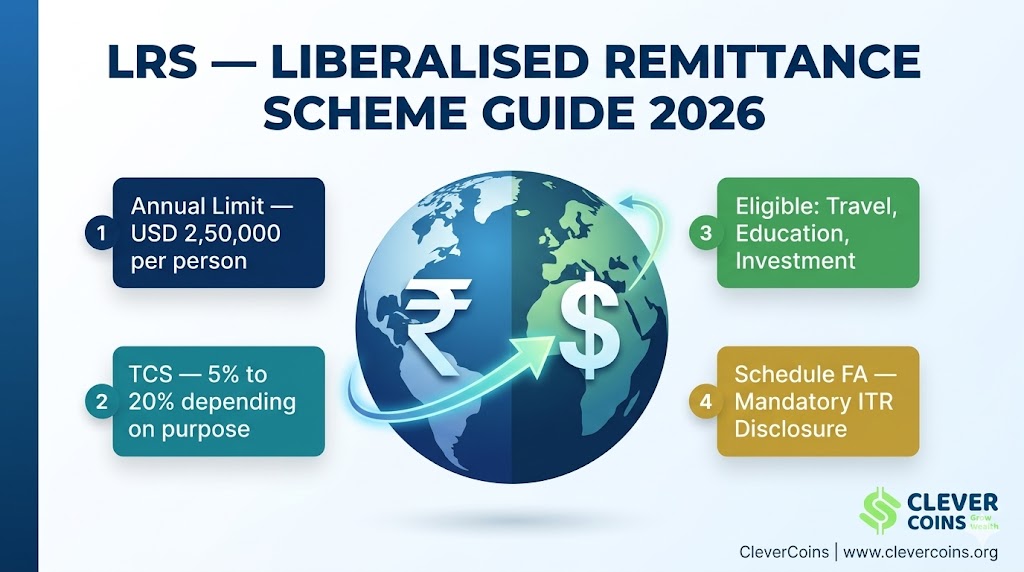
The Liberalised Remittance Scheme (LRS) is a facility provided by the Reserve Bank of India (RBI) under the Foreign Exchange Management Act, 1999 (FEMA) that allows resident Indian individuals to freely remit (send) foreign exchange abroad for any permissible current or capital account transactions — up to a maximum of USD 2,50,000 (US Dollars Two Lakh Fifty Thousand) per financial year.
‘Liberalised’ in the name means that the scheme has progressively made it easier to remit money abroad — removing the earlier requirements for case-by-case RBI approvals and replacing them with automatic permissions subject to compliance with FEMA and Income Tax provisions.
Key Features of LRS at a Glance
- Annual limit: USD 2,50,000 per resident individual per financial year (April to March)
- Applicable to: ALL resident individuals — including minors (through natural guardians), NRIs temporarily in India, HUF members individually
- Excludes: Companies, partnerships, LLPs, trusts — LRS is ONLY for INDIVIDUALS
- Covers: Both current account transactions (travel, education, medical, maintenance) AND capital account transactions (investment, property, bank accounts abroad)
- Currency: Can be remitted in any freely convertible foreign currency — USD, EUR, GBP, AUD, etc.
- Authorized Dealers: All remittances must go through an RBI-authorized Authorised Dealer (AD) Bank — not through unauthorised channels
- TCS applicable: Tax Collected at Source by the AD Bank at the time of remittance — claimable as credit in ITR
📌 The USD 2,50,000 LRS limit applies PER PERSON, PER FINANCIAL YEAR. A family of four (husband, wife, and two children) can collectively remit up to USD 10,00,000 in a single financial year — if each member independently meets their own LRS.
History and Evolution of LRS — From 2004 to 2026
LRS was introduced in 2004 with a modest limit of USD 25,000 per year. Over the years, it has been revised multiple times:
- 2004: Introduced at USD 25,000 per year — limited to current account transactions only
- 2006: Limit raised to USD 50,000 — capital account transactions added
- 2010: Limit raised to USD 2,00,000 as forex reserves strengthened
- 2013: Limit temporarily reduced to USD 75,000 amid forex pressure
- 2015: Limit restored and raised to USD 2,50,000 — the current limit
- 2020: COVID-era restrictions temporarily limited certain categories
- 2023 (Budget): Sweeping TCS revision — rates for most categories raised significantly; international card transactions brought under LRS from May 2023
- 2023 (Post-Budget): Government deferred TCS on cards and clarified thresholds after industry pushback — revised rules introduced
- 2024-25 (Budget 2025): TCS rates rationalised for travel packages (reduced from 20% back to 5% for tour operators up to Rs. 7L); investment category TCS maintained at 20%
- 2026: Current framework applies revised Budget 2025 TCS rates with Rs. 7 lakh threshold for most categories
💡 The LRS framework is dynamic — TCS rates and eligible categories have changed multiple times in the last 3 years. Always verify the current rates with your AD Bank or CleverCoins before making large remittances.
Who Can Use LRS? — Eligibility
LRS is available ONLY to resident Indian individuals. The term ‘resident individual’ under FEMA is defined differently from the Income Tax Act — it is based on physical presence in India, not domicile or citizenship.
Eligible to Use LRS
- Adult resident Indian individuals (Indian passport holders residing in India)
- Minor resident Indians (through their natural guardians — parents)
- Indian citizens temporarily working abroad who maintain resident status under FEMA
- OCI/PIO card holders residing in India and considered FEMA residents
- Foreign nationals residing in India and classified as FEMA residents
NOT Eligible to Use LRS
- Non-Resident Indians (NRIs) — they have separate FEMA channels (NRE/NRO account routes)
- Indian companies, LLPs, partnerships, trusts — separate FEMA/RBI routes
- Persons of Indian Origin (PIO) not residing in India
- Entities — only INDIVIDUALS can use LRS
⚠️ FEMA Residency vs Income Tax Residency: A person can be an Income Tax resident and a FEMA non-resident simultaneously — or vice versa. FEMA residency is based on more than 182 days of physical stay in India in the current financial year. Income Tax residency is determined under separate rules including 60-day and 120-day tests. Always confirm your FEMA residency status before using LRS.
The USD 2,50,000 Annual Limit — How It Works
The LRS annual limit of USD 2,50,000 per individual per financial year is a cumulative AGGREGATE limit — meaning it covers the TOTAL of ALL remittances made under ALL LRS purposes combined in that financial year.
Understanding the Aggregation
- If you send USD 50,000 for your child’s university fees, USD 20,000 for a vacation, and USD 1,80,000 to invest in US stocks — your total LRS for the year = USD 2,50,000. You have exhausted the limit.
- The financial year runs from 1 April to 31 March — the counter resets every new financial year
- There is NO separate limit per purpose category — all purposes share the same USD 2,50,000 pool
- International credit/debit card spends abroad are now included in the aggregate (from May 2023)
- Multiple remittances in different currencies are converted to USD equivalent for the aggregate calculation
Bank Tracking and PAN Linkage
AD Banks are required to report all LRS transactions to the RBI and the Income Tax Department, linked to the remitter’s PAN. The IT Department maintains a consolidated LRS utilisation record per PAN across all banks. If you use multiple banks for LRS remittances, the AGGREGATE across all banks counts towards the USD 2,50,000 limit.
⚠️ Do not attempt to circumvent the USD 2,50,000 limit by splitting transactions across family members if the ultimate purpose/beneficiary is the same. Structuring transactions to evade the LRS limit is a FEMA violation and can attract penalties under Section 13 of FEMA — up to three times the amount remitted or Rs. 2 lakh, whichever is higher.
TCS on LRS — Tax Collected at Source: Complete 2026 Guide
Tax Collected at Source (TCS) on LRS is collected by the Authorised Dealer Bank at the time of remittance. It is NOT a tax — it is an advance tax collection mechanism. The TCS can be CLAIMED AS CREDIT in your income tax return (ITR) for the financial year — effectively reducing your tax liability or resulting in a refund.
Why Was TCS on LRS Introduced?
TCS on LRS was introduced (and subsequently enhanced) to:
- Capture data on high-value foreign remittances by Indian residents
- Ensure that individuals remitting large amounts abroad are filing ITRs and disclosing foreign assets
- Create a deterrent against use of LRS to park undisclosed funds abroad
- Align with FATCA (Foreign Account Tax Compliance Act) reporting obligations
Nature of Remittance | TCS Rate | Threshold | TCS from Rs. 1? | Credit Mechanism |
Education remittance — from OWN FUNDS | 5% | Nil TCS up to Rs. 7 lakh; 5% above Rs. 7L | NO — first Rs. 7L exempt | Claimed as credit against tax liability in ITR |
Education remittance — via EDUCATION LOAN from bank/NBFC | 0.5% | Nil TCS up to Rs. 7 lakh; 0.5% above Rs. 7L | NO — first Rs. 7L exempt | Claimed as credit in ITR |
Medical treatment remittance | 5% | Nil TCS up to Rs. 7 lakh; 5% above Rs. 7L | NO — first Rs. 7L exempt | Claimed as credit in ITR |
Overseas travel packages (tour operator) | 5% | Nil up to Rs. 7L; 5% above (as of Budget 2025-26 update) | NO — first Rs. 7L exempt | Claimed as credit in ITR |
Overseas travel — self-booking (not via tour operator) | 20% | Nil TCS up to Rs. 7 lakh; 20% above Rs. 7L | NO — first Rs. 7L exempt | Claimed as credit in ITR |
Investment in foreign stocks, mutual funds, ETFs | 20% | NO threshold — 20% from Re. 1 | YES — from first rupee | Claimed as credit in ITR |
Gifting foreign currency / maintenance of relatives | 5% (up to Rs. 7L); 20% above | First Rs. 7L: 5%; above Rs. 7L: 20% | NO — 5% from Rs. 1 (below 7L); 20% above | Claimed as credit in ITR |
International credit/debit card transactions > Rs. 7L | 20% | Rs. 7 lakh per year aggregate | NO — above Rs. 7L only | Claimed as credit in ITR — tracked by AD Bank |
Opening foreign bank account / other LRS purposes | 20% | NO threshold for investment-type | YES (for investment categories) | Claimed as credit in ITR |
✅ KEY POINT: TCS is NOT a FINAL TAX. It is an ADVANCE TAX COLLECTION. The AD Bank collects TCS and deposits it with the government. You claim it as a credit against your total tax liability when you file your ITR. If your total tax payable is less than the TCS collected — you get a REFUND. If you have significant other income — TCS just reduces your final tax payment.
International Credit and Debit Cards Under LRS — 2026 Position
One of the most impactful and contentious changes to the LRS framework was the May 2023 notification that brought international credit and debit card transactions under the LRS umbrella. Here is the current 2026 position:
Current Rule (FY 2025-26)
- International credit card and debit card transactions abroad are included in the LRS aggregate limit (USD 2,50,000)
- TCS of 20% is applicable on the cumulative international card spend exceeding Rs. 7 lakh per year
- The AD Bank (card-issuing bank) is responsible for tracking and collecting TCS
- Transactions via international cards for purely business purposes may be excluded — subject to documentation
- Small transactions — individual purchases below prescribed thresholds — may be exempt in practice
⚠️ PRACTICAL IMPACT: If you regularly use international credit cards on foreign trips or for subscriptions to foreign services (Netflix US, Coursera, AWS, Apple subscriptions billed in USD) — your cumulative international card spend across the year may exceed Rs. 7 lakh, triggering 20% TCS on the excess. Track your international card spend carefully through the year.
What is Excluded from LRS Card Transactions?
- International card transactions for import of goods (where customs duty is applicable) — these follow the trade route
- Transactions for registered business expenses by a company employee — if clearly company-reimbursed
- Payments for INR-denominated transactions (Indian merchants processing in rupees even for foreign card)
- Government-to-government transactions
Master LRS Purpose and TCS Rate Table — All Categories
The following comprehensive table covers every major LRS purpose with the applicable TCS rate and key conditions for FY 2025-26:
Purpose of Remittance | Allowed Under LRS? | Annual Limit | TCS Rate (FY 2025-26) | Key Conditions & Notes |
Private overseas travel / tourism / vacation | YES | USD 2,50,000 | 20% (on amount above Rs.7L threshold) | Threshold of Rs. 7 lakh: first Rs. 7L = 5% TCS; above Rs. 7L = 20% |
Business travel (company purpose) | NO (not under LRS — use corporate account) | N/A (corporate) | TCS may apply depending on structure | LRS is for RESIDENT INDIVIDUALS only — business travel on company A/c |
Education abroad — direct remittance | YES | USD 2,50,000 | 5% (above Rs. 7L threshold) | Lower TCS if financed via education loan from financial institution |
Education abroad — via education loan from bank | YES | USD 2,50,000 | 0.5% TCS (on amount above Rs. 7 lakh) | Special concessional TCS rate for bank-funded education remittances |
Medical treatment abroad | YES | USD 2,50,000 | 5% (above Rs. 7L threshold) | For medical tourism — original Rs. 2.5L override allowed if doctor certified |
Investment in foreign stocks / equities | YES | USD 2,50,000 | 20% TCS (no threshold — from Rs. 1) | No Rs. 7L threshold for investment remittances — 20% from first rupee |
Investment in foreign mutual funds / ETFs | YES | USD 2,50,000 | 20% TCS (no threshold) | ETFs listed abroad, Feeder funds, FOFs — 20% TCS applies |
Sending money to a relative abroad (maintenance) | YES | USD 2,50,000 | 5% (above Rs. 7L threshold) | Maintenance of close relatives abroad — standard 5% TCS applies |
Purchase of immovable property abroad | YES | USD 2,50,000 | 20% TCS (no threshold) | Foreign real estate acquisition — 20% TCS on full amount from Re. 1 |
Gifting foreign currency to another resident | YES — from one individual to another | USD 2,50,000 per person combined | 20% TCS on amount sent as gift abroad | Subject to gift tax implications on recipient |
Opening and maintaining a foreign bank account | YES | USD 2,50,000 | 20% TCS on transfers to foreign bank account | Foreign currency account abroad — 20% TCS applies |
International credit / debit card transactions abroad | YES (treated as LRS) | Aggregate limit: USD 2,50,000 | 20% TCS (if aggregate exceeds Rs. 7L per year) | From May 2023 — international card spends included in LRS limit |
Emigration (moving abroad permanently) | YES | USD 2,50,000 | 20% TCS | One-time transfer for emigration purpose |
Maintenance of an overseas branch or WOS by a company | NO (not LRS — company route) | FEMA / RBI regulations | Not TCS — covered under FEMA outward remittance for companies | LRS is for INDIVIDUALS only |
Import payments (goods or services from abroad) | NO — not under LRS | Separate FEMA route | Not LRS TCS — separate mechanism | Trade-related outward payments are through the AD Bank trade channel |
📌 CleverCoins Key Takeaway: The most important distinction is TRAVEL/EDUCATION/MEDICAL (5% TCS above Rs. 7L threshold) vs INVESTMENT/FOREIGN ASSETS/FOREIGN BANK ACCOUNT (20% TCS — NO threshold — from Re. 1). Planning your LRS composition carefully can significantly reduce your TCS outflow and working capital impact.
Eligible and Prohibited LRS Transactions
Not all foreign remittances are permissible under LRS. The following table provides a clear green/red comparison:
Private foreign travel and tourism abroad | Purchase of lottery tickets, banned/proscribed magazines |
Education at foreign universities / institutions | Remittance to countries identified as non-cooperative (FATF list) |
Medical treatment at foreign hospitals | Margin trading / speculation in foreign markets |
Investment in foreign company stocks (listed/unlisted) | Remittance for trading in foreign exchange markets abroad |
Investment in foreign mutual funds, ETFs, bonds | Carrying foreign exchange above prescribed limits (Customs Act) |
Purchase of property abroad | Payment for call back services / premium phone lines |
Maintenance of close relatives residing abroad | Any transaction requiring prior approval and not under LRS |
Gift remittances to individuals abroad | Remittance under capital account transactions (except as specified) |
Opening and maintaining a foreign bank account | Purchase of goods subject to import duty without customs clearance |
Emigration purposes | Any transaction violating FEMA or PMLA provisions |
Employment abroad (carrying initial expenses) | Transactions with entities under RBI Special Watch list |
International credit card transactions abroad (now under LRS) | Remittance to Nepal and Bhutan in foreign currency (Indian Rupees only allowed) |
Studying abroad with or without education loan | Multiple remittances designed to circumvent the USD 2.5L limit |
⚠️ PROHIBITED TRANSACTIONS: Any remittance for a prohibited purpose — even if made through an AD Bank — is a violation of FEMA and may also constitute money laundering under PMLA. Penalties can be severe — up to three times the remitted amount or imprisonment. Never attempt to disguise a prohibited purpose as a permissible LRS category.
Step-by-Step LRS Remittance Process
The following table walks you through every step of making a compliant LRS remittance from India:
Step | Action | Documents Required | Where to Submit |
1 | Identify the purpose of remittance and ensure it is an eligible LRS transaction | None at this stage — research and confirm eligibility | Self-verification / consult CleverCoins |
2 | Calculate TCS applicable on the remittance amount (based on purpose and amount) | None — use RBI/IT Act TCS rate chart | Calculated by your AD Bank |
3 | Approach your Authorised Dealer (AD) Bank — where you hold your savings account | None at this stage — initial enquiry | Any scheduled commercial bank with FEMA authorisation |
4 | Submit Form A2 — Application for foreign exchange remittance | Completely filled Form A2 with purpose, amount, beneficiary details | AD Bank — physical or net banking portal |
5 | Submit KYC and identity documents | PAN card (mandatory), Aadhaar card, passport copy, address proof | AD Bank compliance department |
6 | Provide purpose-specific supporting documents | See list below for purpose-wise documentation | AD Bank — varies by purpose |
7 | Declare self-assessment of LRS limit — certify aggregate LRS for the year | Self-declaration on Form A2 that cumulative LRS for FY does not exceed USD 2,50,000 | Signed on Form A2 itself |
8 | Bank verifies documents, checks PAN-linked LRS utilisation (IT portal integration) | Bank cross-checks against PAN — verifies prior year LRS | Internal bank compliance |
9 | TCS collected by bank on remittance amount (as applicable) | TCS certificate issued by bank (Form 27D) — use to claim credit in ITR | AD Bank generates TCS certificate |
10 | Swift / Wire transfer executed — FIRC / FIRA issued | Foreign Inward Remittance Certificate (for inward) — for outward: bank advice / SWIFT copy | Bank issues transaction advice |
11 | Declare income/gains from foreign investments in ITR (if applicable) | Foreign Asset Schedule in ITR — mandatory for any foreign asset acquired via LRS | ITR filing — Schedule FA |
✅ Most major banks (SBI, HDFC, ICICI, Axis, Kotak, YES Bank) have online LRS portals where you can initiate the entire process from net banking — including Form A2 submission, document upload, and SWIFT initiation. CleverCoins can guide you through the process for complex remittances involving large amounts or investment purposes.
Documents Required for LRS Remittance — Purpose-Wise
For All LRS Remittances (Mandatory)
- PAN card (mandatory — no LRS without PAN from April 2010)
- Aadhaar card (for KYC update)
- Passport copy (identity proof)
- Form A2 — completely filled and signed
- Self-declaration on LRS aggregate utilisation for the financial year
Additional Documents — Education
- Offer letter / admission letter from the foreign university or institution
- Fee invoice / demand letter from the institution
- Education loan sanction letter (if claiming 0.5% TCS rate via bank loan)
- Proof of student’s enrollment (if mid-year payment)
Additional Documents — Medical Treatment
- Medical certificate from a registered medical practitioner in India recommending treatment abroad
- Estimate of treatment cost from the foreign hospital (where available)
- Appointment letter or admission confirmation from foreign hospital
Additional Documents — Investment (Stocks / MF / ETF)
- Broker / investment platform account statement or proof of account opening
- Investment platform’s terms confirming receipt of funds from India
- KYC documents submitted to the foreign broker/platform
Additional Documents — Property Purchase
- Sale agreement / purchase agreement for the foreign property
- Bank statement of foreign real estate account
- Property registration documents (where available at the time of remittance)
Additional Documents — Maintenance of Relatives
- Relationship proof (passport copy of relative, birth certificate, marriage certificate)
- Proof of relative’s residency abroad (foreign resident certificate, foreign bank account)
- Letter explaining the purpose of maintenance
Income Tax Implications of LRS — ITR Filing Requirements
Using LRS has significant income tax implications beyond the TCS collected at the time of remittance. Every Indian resident who uses LRS must ensure complete and accurate income tax reporting.
Schedule FA — Foreign Assets Mandatory Declaration
The Income Tax Act requires every resident Indian who holds ANY foreign asset — whether acquired through LRS or otherwise — to declare it in Schedule FA (Foreign Assets) of their ITR. This is a statutory obligation under Section 139 read with the Black Money Act, 2015.
- Foreign bank accounts (even with zero balance)
- Foreign equity investments (stocks, ETFs, mutual funds, bonds)
- Foreign immovable property (residential or commercial)
- Foreign financial interests (partnership, company interest)
- Trusts abroad in which the taxpayer is a beneficiary
⚠️ PENALTY FOR NOT FILING SCHEDULE FA: Under the Black Money (Undisclosed Foreign Income and Assets) and Imposition of Tax Act, 2015 — failure to disclose foreign assets in Schedule FA can result in a FLAT PENALTY of Rs. 10,00,000 (Rs. 10 lakh) per assessment year per undisclosed asset — IRRESPECTIVE of the value of the asset. This applies even if the asset has zero income. This is one of the most severe penalties in Indian tax law.
Taxation of Income from Foreign Investments
- Dividends from foreign stocks: Taxable in India as ‘Income from Other Sources’ at applicable slab rates
- Capital gains on sale of foreign stocks: Taxable as STCG (< 24 months) or LTCG (> 24 months) — at applicable rates (20% LTCG on foreign stocks without indexation benefit; STCG at slab rates)
- Interest on foreign bank account: Taxable in India as ‘Income from Other Sources’
- Rental income from foreign property: Taxable in India under ‘Income from House Property’
- All foreign income must be converted to INR at RBI reference rate on the relevant date
DTAA — Double Taxation Avoidance Agreement Benefits
India has DTAA (Double Taxation Avoidance Agreements) with over 90 countries. If tax is paid on foreign income in the source country — you can claim credit of foreign taxes paid in India through Form 67 (Foreign Tax Credit) in your ITR, avoiding double taxation.
- File Form 67 before the due date of ITR filing (31st July for non-audit cases)
- Attach foreign tax payment certificate / tax return acknowledgement from the foreign country
- DTAA benefit must be specifically claimed — it is NOT automatic
💡 CleverCoins specialises in cross-border tax compliance — including Schedule FA reporting, DTAA benefit claims, Form 67 filing, and FATCA compliance for Indians with foreign investments and remittances.
FATCA — Foreign Account Tax Compliance Act — India’s Obligations
FATCA is a US law that requires foreign financial institutions to report information about US account holders to the IRS. India signed an Inter-Governmental Agreement (IGA) with the US under FATCA in 2015, making it mandatory for:
- Indian financial institutions (banks, mutual funds, insurance companies) to identify and report US persons holding accounts in India
- Indian residents with US financial interests (US bank accounts, US stocks, US property) to be reported by US financial institutions to the IRS
- Indian banks to collect FATCA self-certification from account holders and transmit data to the Income Tax Department
FATCA Impact on LRS Users
- If you invest in US stocks or open a US brokerage account through LRS — the US broker is required to collect your FATCA declaration
- If you are a US person (US citizen or green card holder) living in India — your Indian accounts are reportable to the IRS
- India’s tax authorities and the IRS exchange financial account information under CRS (Common Reporting Standard) and FATCA — ensuring global visibility of foreign assets
📌 The FATCA/CRS framework means there is NO effective way to hide foreign assets from the Indian tax authorities. Any attempt to hold undisclosed foreign assets — even through LRS — will eventually surface through automatic information exchange between India and the country where the assets are held.
TCS Impact Calculation — Practical Examples
Understanding the actual financial impact of TCS on LRS remittances is critical for financial planning. The following table shows real-money examples:
Scenario | Remittance Amount | TCS Rate | TCS Collected | Net Impact After ITR Credit |
Foreign vacation — self-booking (FY 2025-26) | Rs. 10,00,000 | 20% above Rs. 7L threshold | 20% × Rs. 3L = Rs. 60,000 | Rs. 60,000 credited in ITR — no tax loss if tax is due; refund if tax < TCS paid |
Study abroad — own funds | Rs. 25,00,000 | 5% above Rs. 7L | 5% × Rs. 18L = Rs. 90,000 | Rs. 90,000 ITR credit — refund if student has no income |
Study abroad — bank education loan | Rs. 25,00,000 | 0.5% above Rs. 7L | 0.5% × Rs. 18L = Rs. 9,000 | Rs. 9,000 ITR credit — minimal impact |
Investment in US stocks via foreign broker | Rs. 5,00,000 | 20% from Re. 1 (no threshold) | 20% × Rs. 5L = Rs. 1,00,000 | Rs. 1,00,000 ITR credit — effectively interest-free advance tax |
Medical treatment abroad | Rs. 8,00,000 | 5% above Rs. 7L | 5% × Rs. 1L = Rs. 5,000 | Rs. 5,000 ITR credit — minimal impact |
Maintenance sent to son living in UK | Rs. 12,00,000 | 5% up to Rs. 7L; 20% above | 5% × Rs. 7L (Rs.35K) + 20% × Rs.5L (Rs.1L) = Rs. 1,35,000 | Rs. 1,35,000 ITR credit — parent claims credit; send in tranches if possible |
International credit card spend aggregate for FY | Rs. 9,00,000 (cumulative) | 20% on excess above Rs. 7L | 20% × Rs. 2L = Rs. 40,000 | Rs. 40,000 ITR credit — tracked across all card transactions by bank |
✅ CleverCoins TCS Planning Strategy: TCS is a WORKING CAPITAL issue — not a permanent tax cost. For taxpayers with significant income (who already pay income tax), TCS simply converts into an advance tax credit in the ITR. The real impact is the INTEREST COST of having money locked with the government for 3 to 12 months. For large investment remittances, plan your cash flow accordingly.
LRS for Foreign Investment — Indian Investors in US Stocks & Global Markets
One of the fastest-growing uses of LRS in India is investment in foreign stocks, ETFs, and global markets. The platforms enabling this include Vested Finance, Winvesta, HDFC Securities Global, ICICI Direct US Stocks, INDmoney, and direct accounts with US brokers like Charles Schwab.
Key Tax Implications for Foreign Stock Investors
- 20% TCS from Re. 1 on all investment remittances — no Rs. 7 lakh threshold
- Dividends received on US stocks: 25% withholding tax in the US (reduced to 15% via DTAA for qualified Indians); balance taxable in India
- Capital gains on sale of US stocks: LTCG at 20% (without indexation) if held > 24 months; STCG at slab rate if held < 24 months
- Annual declaration in Schedule FA — even for accounts with zero balance at year-end
- Dividend income must be declared in ITR as ‘Income from Other Sources’ — converted to INR
- US estate tax implications for Indian residents holding US stocks exceeding USD 60,000
US Estate Tax — Critical Risk for LRS Investors
An often overlooked but serious risk: The US imposes a 40% estate tax on US assets (stocks, ETFs, US property) held by non-US persons at the time of death — with only a USD 60,000 exemption for non-residents (compared to USD 12.92 million for US citizens). This means an Indian resident holding USD 5,00,000 in US stocks faces potential US estate tax exposure.
⚠️ US Estate Tax Warning: If you are investing in US stocks through LRS and your US holdings exceed USD 60,000 — you have a US estate tax exposure of up to 40% of the value above the exemption. Consider holding US ETFs through Indian feeder funds or international mutual funds registered in India as an alternative to avoid direct US estate tax exposure.
LRS for Education Abroad — Complete Guide
Education is one of the most significant and growing categories of LRS remittances in India — driven by the aspiration of Indian families to send their children to universities in the US, UK, Canada, Australia, and other countries.
TCS Rates for Education
- Remittance from OWN FUNDS (without education loan): 5% TCS above Rs. 7 lakh threshold
- Remittance financed via EDUCATION LOAN from a bank or specified financial institution: Only 0.5% TCS above Rs. 7 lakh — a significant concession
- The lower 0.5% rate is only for loans from ‘specified’ financial institutions — scheduled banks, RBI-approved NBFCs with NHB/NABARD classification
Maximising Education Remittance Tax Efficiency
- If your child’s annual university fees are Rs. 25 lakh — taking an education loan from an Indian bank for Rs. 18 lakh of that reduces TCS from 5% to 0.5% on the loan portion (saving Rs. 81,000 in TCS on the Rs. 18 lakh financed amount)
- Education remittance is aggregated with all other LRS for the year — so plan the sequence of remittances
- Students can INDEPENDENTLY remit up to USD 2,50,000 per year under their own PAN — parents and students can collectively access USD 5,00,000 per year
- Hostel fees, living expenses, travel to attend the institution — all qualify under the education purpose at the lower TCS rates
LRS for Travel Abroad — The Tourist’s Guide
Travel TCS — Current Rules FY 2025-26
- Overseas travel package purchased through a Tour Operator/Travel Agent: 5% TCS on amount above Rs. 7 lakh threshold (Budget 2025 restored the lower rate)
- Self-booked travel (hotel, flight, activities directly) — not via a tour operator: 20% TCS on amount above Rs. 7 lakh
- International travel insurance: Included in travel remittance — covered under same TCS category
- Foreign exchange (forex) purchased for travel: Counted in LRS aggregate — applicable TCS based on category and amount
💡 Travel Tax Planning Tip: For large family vacations abroad (Rs. 10 lakh+), booking through a registered Indian tour operator allows you to benefit from the 5% TCS rate (instead of 20% for self-booking on the excess above Rs. 7 lakh). On Rs. 5 lakh excess, this saves Rs. 75,000 in TCS (15% difference × Rs. 5L). However, always compare overall value — tour operator packages vs self-booking flexibility.
LRS Compliance Checklist — Before You Remit
- Verify you are a FEMA-resident individual — confirm LRS eligibility
- Identify the purpose — confirm it is a PERMISSIBLE LRS category
- Calculate the TCS applicable — based on purpose, amount, and year-to-date LRS utilisation
- Ensure your aggregate LRS for the year will not exceed USD 2,50,000
- Gather all required documents — PAN, Aadhaar, purpose-specific documents
- Approach an authorised AD Bank — initiate with Form A2
- Collect TCS certificate (Form 27D) from the bank after remittance
- Record the transaction in your books — note date, amount (in USD and INR), purpose, beneficiary
- Add the foreign asset/account to your ITR Schedule FA in the same year
- File Form 67 (if DTAA credit is claimed) before filing ITR
- Declare all income from foreign assets in your ITR — dividends, interest, rental income, capital gains
- Claim TCS credit in your ITR to reduce/refund advance tax collected
Common Mistakes and Violations in LRS
- Not declaring foreign assets in Schedule FA — most severe penalty (Rs. 10 lakh per asset per year under Black Money Act)
- Splitting LRS across family members for a single purpose — structuring to evade FEMA limits
- Using someone else’s PAN or LRS limit for your own remittance — violation of FEMA
- Remitting for a prohibited purpose under the guise of a permitted one (e.g., routing gambling money as ‘travel expenses’)
- Not tracking cumulative LRS including international card transactions — breaching USD 2,50,000 limit
- Missing Form 67 filing deadline — losing DTAA credit for the year
- Not collecting TCS certificate (Form 27D) from bank — losing ability to claim TCS credit in ITR
- Treating TCS as a final tax — not claiming it back in ITR (especially for students with low/no income)
- Not maintaining documentation for purpose of remittance — required for any FEMA enquiry
- Using hawala or unofficial channels instead of AD Banks — FEMA violation + potential PMLA implications
- NRIs using LRS (NRIs are not eligible — must use NRE/NRO account routes instead)
- Aggregating family members’ LRS into one remittance without individual Form A2 — non-compliant structure
LRS Violations and Penalties — What Can Go Wrong?
Violations of FEMA’s LRS provisions attract penalties under Section 13 of FEMA:
- Standard penalty: Up to three times the sum involved in the contravention OR Rs. 2 lakh — whichever is higher
- Continuing contravention: Additional penalty of Rs. 5,000 per day until compliance
- Adjudication: Violations are adjudicated by the Enforcement Directorate (ED) after investigation
- Compounding: Minor violations can be compounded (settled with a payment) before adjudication
- Criminal prosecution: In cases of wilful evasion or money laundering — prosecution under PMLA with imprisonment
⚠️ The Enforcement Directorate (ED) actively investigates suspected LRS violations — particularly large remittances to countries with low-tax regimes, undisclosed foreign accounts, and round-tripping of funds. With FATCA and CRS exchange, the IT Department and ED receive automatic information about foreign accounts of Indian residents.
How CleverCoins Helps You Navigate LRS Compliance
- LRS Planning: Pre-remittance consultation to determine TCS liability, optimal structure, and documentation requirements
- TCS Minimisation: Advice on how to structure education, travel, and investment remittances to minimise TCS impact
- ITR Schedule FA Filing: Complete preparation and filing of Schedule FA for all foreign assets acquired through LRS
- Form 67 — DTAA Credit: Filing Form 67 and maximising foreign tax credit claims to avoid double taxation
- Foreign Investment Tax: Computation of taxable income from foreign stocks (dividends + capital gains), ITR reporting, and DTAA benefit claims
- FATCA Compliance: Self-certification and FATCA reporting guidance for Indians with US investments
- Repatriation Planning: Advice on bringing funds back to India from foreign investments — tax-efficient repatriation through LRS reverse remittance
- Notice Response: If you receive a notice from the Income Tax Department or ED regarding LRS transactions — CleverCoins prepares technically sound responses
- Annual LRS Review: Ongoing monitoring of LRS utilisation, TCS tracking, and ITR compliance for individuals with regular foreign remittances
Planning a Remittance or Foreign Investment? CleverCoins Guides You Every Step!
www.clevercoins.org | Instagram @clevercoins
Frequently Asked Questions — LRS 2026
Q1: Can I send more than USD 2,50,000 in a year for my child’s education if fees are higher?
The standard LRS limit is USD 2,50,000 per individual per year. If your child’s actual fees exceed this limit, the additional amount requires special RBI approval under the capital account route. However, since parents and the student are separate individuals, each with their own USD 2,50,000 limit — together they can access USD 5,00,000 per year through combined LRS. In extreme cases (medical emergency overseas), additional amounts can be sanctioned by the RBI.
Q2: Is TCS on LRS a loss? How do I get it back?
No. TCS on LRS is NOT a final tax. It is an advance tax collection. You must claim the TCS as credit in your Income Tax Return (ITR) for the financial year. If your total tax liability is less than the TCS collected — you receive a refund from the IT Department. The refund is typically processed within 30 to 60 days of ITR filing.
Q3: I am a student studying abroad. Do I need to file ITR to get TCS refund?
Yes. To claim the TCS refund, you (the person in whose PAN the TCS was collected) must file an ITR for the year. If you (or your parents — if TCS was collected on their PAN) are below the taxable income threshold — file a NIL ITR and claim the TCS refund. The refund will be credited to the bank account linked to your PAN.
Q4: Are foreign credit card transactions tracked under LRS?
Yes. Since May 2023, international credit card transactions are included in the LRS aggregate limit. Your AD Bank (credit card-issuing bank) is required to track your aggregate international card spend. If your cumulative international card transactions exceed Rs. 7 lakh in a financial year — the excess attracts 20% TCS.
Q5: I invested in US stocks and earned dividends. Where do I declare this in ITR?
Dividends from US stocks must be declared in Schedule FSI (Foreign Source Income) and also in Schedule FA (Foreign Assets) of your ITR. The dividend income is taxable in India at your applicable slab rate after claiming DTAA credit (15% US withholding tax can be claimed via Form 67). Use ITR-2 if you have foreign income or foreign assets.
Q6: Can a minor send money abroad under LRS?
Yes. A minor can remit under LRS through their natural guardian (father or mother). The guardian acts on behalf of the minor. The USD 2,50,000 limit applies per individual — so the minor has their own separate limit. The guardian signs Form A2 on the minor’s behalf. All compliance obligations (Schedule FA, ITR) apply to the minor’s PAN — typically reflected in the guardian’s ITR until the minor turns 18.
Conclusion — LRS is Powerful, but Compliance is Non-Negotiable
The Liberalised Remittance Scheme gives every resident Indian the freedom to participate in the global economy — studying at world-class universities, investing in US tech giants, owning property abroad, and supporting family members living overseas. This freedom is genuinely transformative — and the USD 2,50,000 annual limit is generous enough to accommodate most individual needs.
However, LRS comes with significant compliance obligations: TCS tracking, Schedule FA disclosure, DTAA credit claims, and FATCA/CRS alignment. The penalties for non-compliance — particularly the Rs. 10 lakh per year per asset penalty under the Black Money Act — make careful compliance not just advisable but financially essential.
At CleverCoins, we bring deep expertise in cross-border tax and FEMA compliance — ensuring every rupee you send abroad is fully compliant, every TCS paid is fully recovered, and every foreign asset is properly disclosed. Whether you are sending Rs. 5 lakh for a vacation or USD 2,50,000 for a foreign investment portfolio — we manage your LRS compliance end-to-end.