India has one of the world’s largest diaspora populations — with over 32 million Non-Resident Indians (NRIs) spread across the United States, United Kingdom, UAE, Canada, Australia, Singapore, and dozens of other countries. For most NRIs, India remains not just their homeland but also their most significant investment destination — whether through stocks, real estate, fixed deposits, or direct business investments.
However, investing in India as an NRI is not as straightforward as investing as a resident. Every financial transaction — from opening a bank account to buying property to repatriating profits — must comply with the Foreign Exchange Management Act, 1999 (FEMA) administered by the Reserve Bank of India (RBI). Violations of FEMA can result in severe penalties, account freezes, and legal proceedings by the Enforcement Directorate.
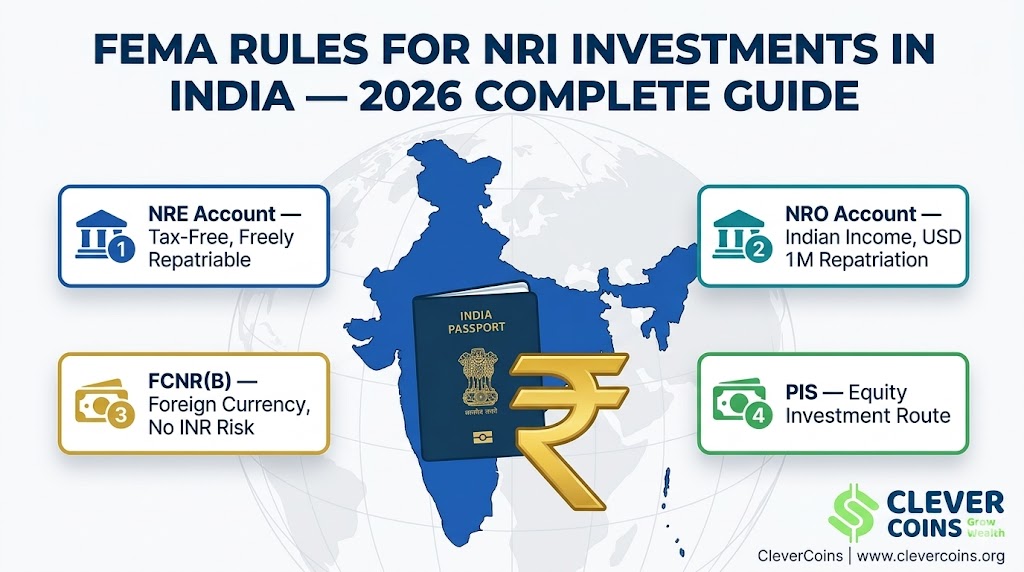
This comprehensive 2026 guide by CleverCoins — India’s trusted tax and FEMA consultancy — covers everything an NRI investor needs to know: the legal framework, NRE/NRO/FCNR account differences, the complete investment permission matrix (18 categories), real estate rules, equity investment through PIS, repatriation rules, income tax obligations, TDS rates, DTAA benefits, and a 12-point compliance checklist.
Who is an NRI? — FEMA vs Income Tax Definition
The definition of ‘Non-Resident Indian’ differs between FEMA and the Income Tax Act — and this distinction has critical practical implications.
NRI Under FEMA (Foreign Exchange Management Act, 1999)
Under FEMA, a person is an NRI if they are a CITIZEN OF INDIA residing outside India — or a person of Indian origin residing outside India. FEMA residency is primarily citizenship and domicile-based — not stay duration. Key points:
- An Indian citizen who has GONE ABROAD for employment, business, or any other purpose indicating an intention to stay abroad for an indefinite period is treated as an NRI under FEMA
- There is no specific ‘number of days’ test under FEMA — unlike the Income Tax Act
- A person of Indian Origin (PIO) — someone whose parents or grandparents were Indian citizens — is also treated like an NRI under FEMA for most provisions
- OCI (Overseas Citizenship of India) card holders are generally treated at par with NRIs for FEMA purposes
NRI Under Income Tax Act, 1961
Under the Income Tax Act, residency is determined strictly by the number of days of physical presence in India during the financial year. A person is a NON-RESIDENT if:
- They are NOT present in India for 182 or more days during the previous year (general rule — Section 6(1)(a)), AND
- They do not satisfy the 60-day rule (presence in India for 60 days in the relevant year AND 365 days in the preceding 4 years) — Section 6(1)(c)
- For Indian citizens going abroad for employment on a ship or as crew: the threshold is 182 days
- For Indian citizens or PIOs with Indian-source income above Rs. 15 lakh and who are NOT liable to tax in any other country: RNOR (Resident but Not Ordinarily Resident) rules apply under Finance Act 2020
⚠️ Critical Distinction: You can be a FEMA NRI (based on living abroad) but an Income Tax RESIDENT of India (if you visited India for 182+ days in a year). In such cases, your worldwide income becomes taxable in India — but FEMA still treats you as an NRI. Always track both FEMA and Income Tax residency status annually.
FEMA — The Legal Framework for NRI Investments
The Foreign Exchange Management Act, 1999 (FEMA) replaced the earlier Foreign Exchange Regulation Act (FERA) — making the approach more management-oriented and less criminal-penalty-focused. Key FEMA provisions relevant to NRI investments:
- Section 6 — Capital Account Transactions: Governs NRI ability to invest, transfer, and repatriate capital. RBI regulates which capital account transactions are permissible for NRIs.
- Section 7 — Current Account Transactions: Covers trade, services, remittances — generally more freely permitted
- FEMA (Non-Debt Instruments) Rules, 2019: Replaced FEMA Schedule 1 of 2000 — governs equity, FDI, portfolio investment
- FEMA (Debt Instruments) Regulations: Covers NRI investment in bonds, debentures, NCDs
- FEMA (Transfer or Issue of Security by a Person Resident Outside India) Regulations: Core FDI and portfolio investment regulations
- FEMA (Acquisition and Transfer of Immovable Property in India) Regulations: Governs property purchase by NRIs
- FEMA (Borrowing and Lending) Regulations: Covers NRI lending to and borrowing from Indian residents
📌 FEMA operates on a ‘permissible unless prohibited’ basis — meaning NRIs can make most investments in India unless specifically prohibited by RBI regulations. The key is identifying the correct ROUTE (automatic vs approval), the correct ACCOUNT (NRE vs NRO), and the applicable LIMITS.
NRE, NRO & FCNR(B) Accounts — Complete Comparison
The foundation of all NRI investment activity in India is the correct bank account. Every NRI who wants to invest in India must have the right type of bank account — and the choice between NRE, NRO, and FCNR(B) significantly affects tax liability, repatriation flexibility, and investment eligibility.
|
Feature |
NRE Account |
NRO Account |
FCNR(B) Account |
|
Full Form |
Non-Resident External |
Non-Resident Ordinary |
Foreign Currency Non-Resident (Banks) |
|
Currency |
Indian Rupees (INR) |
Indian Rupees (INR) |
Foreign Currency (USD, GBP, EUR, AUD, CAD, JPY etc.) |
|
Deposits Allowed From |
Foreign earnings / overseas remittances only |
Indian income (rent, dividends, pension, sale of property) |
Overseas foreign currency remittances only |
|
Repatriation of Principal |
Freely repatriable — 100% |
Restricted — up to USD 1 million per year with CA certificate |
Freely repatriable — 100% |
|
Repatriation of Interest |
Freely repatriable — 100% |
Freely repatriable after TDS |
Freely repatriable — 100% |
|
Interest Income Taxation |
EXEMPT from Indian income tax |
Taxable in India at applicable slab rates |
EXEMPT from Indian income tax |
|
TDS on Interest |
No TDS (tax exempt) |
30% TDS on interest (for NRIs) |
No TDS (tax exempt) |
|
Account Type Available |
Savings, Current, FD, RD |
Savings, Current, FD, RD |
Fixed Deposit only |
|
Joint Account (with Resident Indian) |
Not permitted (can only be joint with another NRI) |
Permitted — can have resident Indian as joint holder |
Not permitted with resident |
|
Power of Attorney to Resident |
Permitted for routine transactions — not for repatriation |
Permitted — broader powers allowed |
Permitted for routine transactions |
|
Exchange Rate Risk |
YES — converted at current INR rate when repatriated |
YES — INR-based |
NO — maintained in foreign currency; no INR conversion risk |
|
Best Used For |
Parking overseas earnings tax-free; easy repatriation |
Receiving Indian-source income (rent, dividends, salary) |
Long-term savings in foreign currency; hedge against INR depreciation |
|
Minimum Balance |
As per bank — typically Rs. 10,000 to Rs. 25,000 |
As per bank |
As per bank — typically USD 1,000 or equivalent |
|
Premature Withdrawal Penalty |
Penalty for FDs closed before 1 year (no interest paid) |
Standard FD premature withdrawal rules apply |
Penalty applicable — minimum 1 year for no-penalty |
💡 CleverCoins Account Strategy: Use NRE for parking overseas savings tax-free and for investments you want to freely repatriate. Use NRO for receiving Indian income (rent, dividends, pension, royalties) and for investing using Indian earnings. Use FCNR(B) for long-term savings in foreign currency to avoid INR depreciation risk — ideal for NRIs planning to return to India after several years.
NRI Investment Permission Matrix — 18 Investment Categories
The following comprehensive table covers what NRIs can and cannot invest in under FEMA, with applicable routes, repatriation rules, and restrictions:
|
Investment Category |
NRI Permitted? |
Route |
Repatriation |
Key Restrictions / Notes |
|
Direct Equity — Listed Indian Companies (Shares) |
YES |
Portfolio Investment Scheme (PIS) / NRI Direct Route |
From NRE = Freely repatriable; From NRO = Up to USD 1M/year |
PIS account mandatory via designated bank; 10% FDI cap for portfolio |
|
IPOs / Fresh Issue of Shares |
YES |
Non-PIS (NRO) or PIS (NRE) |
Subject to repatriation rules of account used |
Apply through Indian bank/demat account linked to NRI status |
|
Mutual Funds (Regular Plans) |
YES — with restrictions |
Direct investment via NRE/NRO — KYC required |
Repatriation as per account (NRE = free; NRO = restricted) |
Some MFs (Mirae, Nippon, etc.) do not accept NRI investments due to FATCA complexity |
|
Exchange Traded Funds (ETFs) |
YES |
Via demat account linked to NRE/NRO |
Same as mutual funds |
Treated same as equity — PIS may be required |
|
Government Securities (G-Secs, T-Bills) |
YES |
Fully Accessible Route (FAR) and general portfolio route |
Freely repatriable from NRE account |
100% FPI limit in certain FAR bonds |
|
Corporate Bonds / Debentures (listed) |
YES |
Through demat account |
From NRE = free; From NRO = restricted |
Subject to aggregate foreign investment limits in corporate bonds |
|
Fixed Deposits — NRE / NRO / FCNR(B) |
YES |
Direct with scheduled banks |
NRE and FCNR(B) = 100% repatriable; NRO = restricted |
Interest on NRE and FCNR exempt from Indian tax |
|
Residential Real Estate (self-use / investment) |
YES |
Automatic Route — direct purchase |
Can repatriate 2 residential property purchase amounts |
Can buy max 2 residential properties; repatriation from NRO up to USD 1M/year |
|
Commercial Real Estate |
YES |
Automatic Route |
Freely repatriable from NRO (up to USD 1M/year) |
No cap on number of commercial properties |
|
Agricultural Land / Farmhouse / Plantation Property |
PROHIBITED |
Not permitted for NRIs |
N/A |
NRIs CANNOT purchase agricultural land, farmhouses, or plantation properties in India — acquisition as gift also not permitted |
|
National Pension System (NPS) |
YES |
Direct enrolment via NPS portal / Point of Presence |
Partial repatriation on exit — subject to NPS rules |
NRI can contribute to NPS; on leaving India permanently, corpus available subject to FEMA |
|
Public Provident Fund (PPF) |
RESTRICTED |
Existing accounts can continue; new PPF accounts NOT allowed for NRIs |
Proceeds on maturity can be credited to NRO account |
NRIs cannot open new PPF accounts; existing accounts can run to maturity |
|
Sovereign Gold Bonds (SGBs) |
NO — not allowed post FEMA clarification |
Not permitted for NRIs |
N/A |
RBI has clarified NRIs cannot subscribe to SGBs |
|
Small Savings Schemes (NSC, Post Office FD, Kisan Vikas Patra) |
RESTRICTED — cannot open new |
Existing accounts may continue in some cases |
Proceeds to NRO account |
NRIs generally cannot open new small savings scheme accounts |
|
Listed Equity Derivatives (F&O) — NSE / BSE |
YES — limited |
Through NRE/NRO linked demat via PIS |
Subject to account repatriation rules |
NRIs can trade in exchange-traded derivatives — subject to exchange guidelines |
|
Private Equity / Pre-IPO / Unlisted Shares |
YES — FDI route |
FDI route via FEMA Schedule 1 |
Subject to FEMA capital account repatriation rules |
Requires compliance with sectoral FDI caps; filing with RBI/DPIIT if required |
|
Startup Investment (DPIIT-recognised) |
YES |
Angel/FDI route |
Subject to FEMA exit norms |
NRIs investing in DPIIT-recognised startups get easier FDI compliance |
|
Real Estate Investment Trusts (REITs / InvITs) |
YES |
Portfolio route via demat account |
From NRE = repatriable; from NRO = restricted |
Treated same as listed securities — PIS rules apply |
⚠️ ABSOLUTE PROHIBITION — Agricultural Land: NRIs CANNOT purchase agricultural land, farmhouses, or plantation property in India — this is an absolute FEMA prohibition under Section 6(5) of FEMA. Any attempt to acquire agricultural land by an NRI — even through a nominee or trust — is a serious FEMA violation.
PIS — Portfolio Investment Scheme for Equity Investment
NRIs who want to invest in listed Indian equities (stocks on NSE/BSE) must do so through the Portfolio Investment Scheme (PIS) — a framework administered by the RBI through designated AD Banks.
How PIS Works
- The NRI designates a specific branch of a scheduled commercial bank as their PIS banker
- The bank opens a PIS-designated NRE or NRO bank account linked to the demat account
- All equity purchases and sales of listed securities flow through this PIS account
- The bank tracks and reports aggregate NRI investment in each company to ensure the 10% FDI cap per NRI investor (and 24% aggregate NRI limit per company) is not breached
- Only ONE bank can be the designated PIS banker for an NRI — cannot have PIS accounts at multiple banks
PIS — NRE vs NRO Route
- PIS on NRE Account: Funds from overseas; capital gains and proceeds are freely repatriable outside India; interest/dividends also freely repatriable
- PIS on NRO Account: Funds from Indian sources (existing Indian income); repatriation subject to USD 1 million annual cap with Form 15CA/15CB
What Happens Without PIS?
⚠️ Investing in listed Indian equities WITHOUT a PIS account is a FEMA violation. If an NRI buys stocks through a regular resident demat account (which has not been converted to NRI status) or without PIS designation — every such transaction is technically illegal under FEMA and can attract penalties. Many NRIs continue using old resident demat accounts after becoming NRIs — this is a very common and serious compliance gap.
NRI Real Estate Investment — FEMA Rules in Detail
Real estate is one of the most popular investment categories for NRIs — both as an emotional connection to India and as a financial investment. FEMA has specific and important rules governing NRI property investment.
What NRIs CAN Buy
- Residential properties: NRIs can purchase residential properties in India without any limit — EXCEPT only 2 properties can be repatriated (i.e., sale proceeds sent back abroad)
- Commercial properties: NRIs can purchase unlimited commercial properties — shops, offices, warehouses, commercial buildings
- Under-construction properties from RERA-registered developers: Allowed
- Properties by inheritance: NRIs can inherit any property — including agricultural land
- Properties received as gift from a relative: Residential and commercial property allowed; NOT agricultural land
What NRIs CANNOT Buy
- Agricultural land: Absolute prohibition — no purchase allowed
- Plantation properties: Absolute prohibition
- Farm houses: Absolute prohibition
- Note: NRIs CAN receive agricultural land by inheritance — but CANNOT purchase it
Property Purchase — Payment Rules
- Payment must be made through NRE or NRO bank account — not through foreign currency direct to seller
- Foreign remittance to NRO account and then property purchase — compliant
- Payment through RTGS/NEFT from NRE/NRO account to seller — standard method
- Home loan from Indian bank — allowed; repayment through NRE/NRO account or by direct remittance from overseas
⚠️ Power of Attorney (PoA): NRIs frequently give PoA to a resident relative to manage property transactions. The PoA must be carefully drafted to avoid FEMA violations — particularly around repatriation and fund routing. A PoA holder cannot make payments from their personal account on behalf of the NRI — payment must still flow from NRI’s own NRE/NRO account.
Repatriation from Property Sale
- Residential property: NRI can repatriate sale proceeds of up to 2 residential properties over their lifetime (acquisition cost only — not capital gains)
- Commercial property: Repatriation of sale proceeds allowed — subject to NRO annual USD 1 million cap
- Capital gains from property sale are TAXABLE in India — TDS is deducted by the BUYER at 12.5% (LTCG) or 30% (STCG) before paying the NRI
- After TDS, the NRI must file an ITR claiming TDS credit and computing actual capital gains tax
- Repatriation requires Form 15CA + Form 15CB (from a Chartered Accountant certifying tax compliance) + registered sale deed
✅ CleverCoins specialises in property repatriation for NRIs — computing correct capital gains tax, preparing Form 15CB, filing Form 15CA, coordinating with the buyer’s lawyer for TDS compliance, and ensuring clean repatriation.
NRI Equity Investment — Income Tax Treatment in India
NRIs investing in Indian equities are subject to a special tax regime under Section 115E and Section 115F of the Income Tax Act, which provides beneficial treatment:
Special Tax Rates for NRIs — Section 115E
- Long-Term Capital Gains (LTCG) on listed equity (held > 12 months): 12.5% (Finance Act 2024 — reduced from 20% without indexation)
- Short-Term Capital Gains (STCG) on listed equity (held < 12 months): 15% (Section 111A — same as residents)
- Dividends from Indian companies: 20% flat (Section 115A) — OR DTAA rate, whichever is lower
- Interest on NRE/FCNR(B): EXEMPT
- Interest on NRO account: 30% flat TDS (OR DTAA rate, whichever is lower)
- Mutual fund income: As per type — equity-oriented MF at equity rates; debt MF at applicable slab rates
No Basic Exemption Limit for NRIs on Investment Income
NRIs earning ONLY investment income (interest, capital gains, dividends) from India under the special NRI tax scheme do NOT benefit from the basic exemption limit of Rs. 2.5 lakh or Rs. 3 lakh (new regime). The tax is applied at special rates on the GROSS income — without deducting the basic exemption.
⚠️ Exception: If the NRI has a combination of Indian income — including salary or business income (not just investment income) — and they opt for the regular tax regime (filing ITR with a claim under regular provisions), then the basic exemption limit DOES apply. The special NRI regime (Sections 115E–115H) applies when the NRI does NOT opt out of it in their ITR.
NRI Investment Income — TDS and Tax Rates
|
Income Type |
Indian Tax Rate for NRIs |
TDS Applicable? |
TDS Rate |
DTAA Benefit Available? |
|
Salary from Indian employer (for NRI secondment to India) |
Slab rates (Old or New Regime) |
YES — Section 192 |
As per applicable slab |
Depends on DTAA with country of residence |
|
Interest on NRE / FCNR(B) Account |
EXEMPT — Section 10(4) |
NO TDS |
Nil |
N/A — exempt in India |
|
Interest on NRO Fixed Deposit / Savings |
Taxable at 30% (flat for NRIs) |
YES — Section 195 |
30% + surcharge + cess |
YES — DTAA may reduce to 10%–15% |
|
Rental Income from Indian Property |
Taxable at 30% flat (NRI) |
YES — Section 194I/195 |
30% TDS by tenant |
YES — DTAA may reduce rate; need Form 67 for credit |
|
Capital Gains — Short Term (Equity > 12 months) |
15% STCG (Section 111A) |
YES — Section 195 |
15% + surcharge + cess |
YES — DTAA capital gains article applies |
|
Capital Gains — Long Term (Equity > 12 months) |
12.5% LTCG above Rs. 1.25 lakh (Finance Act 2024) |
YES — Section 195 |
12.5% (with indexation removed) |
YES — DTAA may exempt or reduce LTCG |
|
Capital Gains — Short Term (Property < 24 months) |
Slab rate STCG |
YES — 30% TDS by buyer (Section 194IA) |
30% TDS (or DTAA rate with Form 13) |
YES — DTAA real property article |
|
Capital Gains — Long Term (Property > 24 months) |
12.5% LTCG (Finance Act 2024 — without indexation) |
YES — 12.5% TDS by buyer |
12.5% + surcharge + cess |
YES — DTAA may provide exemption |
|
Dividends from Indian Companies |
Taxable at 20% (Section 115A) |
YES — Section 194 |
20% + surcharge + cess |
YES — DTAA dividend rate (typically 10%–15%) |
|
Royalty / Technical fees from India |
10% (Section 115A — for non-residents) |
YES — Section 195 |
10% + surcharge + cess |
YES — DTAA royalty article |
|
Winnings from lotteries, games (Indian source) |
30% (Section 115BB) |
YES — Section 194B |
30% |
Generally NO — DTAA usually excludes lottery |
|
NPS Withdrawal on Repatriation |
60% taxable at slab — 40% annuity |
YES — on taxable portion |
As per slab |
DTAA may apply if NRI in treaty country |
📌 DTAA (Double Taxation Avoidance Agreement) Benefits: India has DTAAs with over 90 countries. NRIs from the US, UK, UAE, Canada, Singapore, Australia, Germany, and most major countries can benefit from reduced tax rates under the DTAA — particularly on interest (reduced from 30% to 10-15%), dividends (reduced from 20% to 10-15%), and capital gains (sometimes fully exempt). Always file Form 67 before ITR to claim DTAA credit.
Form 15CA and Form 15CB — Repatriation Compliance
Before any funds can be repatriated (sent outside India) from an NRO account — the NRI and their Chartered Accountant must complete a critical compliance process involving Forms 15CA and 15CB.
What is Form 15CA?
Form 15CA is a declaration/undertaking filed by the REMITTER (the NRI or their representative) with the Income Tax Department — certifying that all applicable taxes on the remittance have been paid and the remittance complies with FEMA and the Income Tax Act. It is filed online on the IT portal before the remittance is effected.
What is Form 15CB?
Form 15CB is a certificate issued by a CHARTERED ACCOUNTANT certifying the nature and amount of remittance, applicable taxes, DTAA provisions, and TDS already deducted. It is a prerequisite for filing Form 15CA in most cases (for repatriation above Rs. 5 lakh and for those not listed as exempt under Rule 37BB).
When is Form 15CA / 15CB NOT Required?
- Repatriation of FREELY REPATRIABLE amounts from NRE or FCNR(B) account — no Form 15CA/15CB needed
- Below Rs. 5 lakh remittance where the NRI certifies no tax withholding is required
- Transactions specifically listed as exempt under Rule 37BB of the Income Tax Rules
✅ Critical Rule: All repatriation from NRO accounts (other than freely repatriable NRE/FCNR amounts) requires Form 15CA filed before repatriation and Form 15CB signed by a CA. The bank will NOT process the SWIFT transfer without these documents. CleverCoins prepares Form 15CB and files Form 15CA for NRI clients routinely.
NRI Inherited Property — Special FEMA Rules
Inheritance is one of the most complex areas of FEMA for NRIs — because NRIs can inherit properties (including agricultural land) that they cannot PURCHASE. The rules are:
- NRIs can INHERIT any property in India — including agricultural land, plantation property, and farmhouse — from a resident Indian or another NRI
- However, NRIs who inherit agricultural land/farmhouse CANNOT repatriate the sale proceeds — the sale of inherited agricultural land must be in favour of a resident Indian and the proceeds must stay in an NRO account (not repatriated abroad)
- Inherited residential and commercial property: Sale proceeds can be repatriated from NRO account (within USD 1 million per year cap), subject to Form 15CA/15CB and capital gains tax compliance
- Succession certificate or probate of will is required to prove inheritance — needed for property registration and bank account transfers
- Estate/succession planning for NRI families should be done in advance — a registered will in both India and the country of residence significantly simplifies inheritance
💡 NRI Estate Planning Tip: If you are an NRI with significant Indian assets (property, shares, bank balances), create a registered Will in India clearly specifying Indian assets and their beneficiaries. This avoids lengthy probate proceedings and ensures smooth transfer to heirs — both NRI and resident — under FEMA and Indian inheritance law.
NRI Return to India — RNOR Status and Account Conversion
When an NRI returns to India permanently (or for a sustained period), their residency status changes — and this affects both FEMA compliance and income tax obligations.
RNOR — Resident but Not Ordinarily Resident
An individual who was an NRI in 9 out of the 10 preceding financial years, or who was outside India for at least 729 days in the 7 preceding financial years, qualifies as RNOR (Resident but Not Ordinarily Resident) for a period of 2–3 years after returning.
- RNOR persons are NOT taxed in India on foreign income (income from assets held outside India, foreign pensions, etc.)
- Only Indian-source income is taxable for RNOR — same as NRI
- RNOR is a transitional status — after 2-3 years of return, the person becomes a full Resident Indian (OR) and worldwide income becomes taxable in India
Bank Account Conversion on Return
- NRE accounts must be converted to Resident Accounts or RFC (Resident Foreign Currency) accounts within a reasonable time of return to India
- NRO accounts can be designated as ordinary resident savings accounts
- FCNR(B) deposits can be either matured and converted, or retained as RFC (Resident Foreign Currency) account if the person qualifies as RNOR or returning NRI
- Resident accounts earn taxable interest — unlike NRE and FCNR(B)
⚠️ Continuing to operate NRE accounts after returning to India permanently is a FEMA violation. Many NRIs continue to receive income in NRE accounts even after returning — attracted by the tax-free interest. This is non-compliant. The NRE account must be converted immediately upon change of FEMA residency status.
Sending Money to India — FEMA Rules for Inward Remittances
NRIs frequently send money to India — for family maintenance, property purchase, investment, or business. All inward remittances are governed by FEMA and the income tax provisions on TDS and income disclosure.
- NRE Account Funding: Foreign earnings remitted to NRE account — fully compliant; no limit; no Indian tax
- NRO Account Funding: Indian income credited to NRO; foreign remittances can also be credited to NRO; subject to Indian tax on income
- Wire Transfer (SWIFT): Most common method — processed by AD Bank; automatically checked for AML/PMLA compliance
- Money Transfer Operators (MTO): Platforms like Wise, Remitly, Western Union — can credit to NRE/NRO accounts; governed by FEMA and FIU reporting
- No gift tax on money sent by NRI to resident Indian relative — treated as gift; exempt under Section 56(2) for gifts from specified relatives
- Gift to non-relatives above Rs. 50,000 in a year: Taxable in the hands of the Indian recipient under Section 56(2)(x)
✅ NRI sending money to parents in India: Completely tax-free in the parents’ hands if they are ‘relatives’ as defined under the Income Tax Act. No gift tax applies. However, any INCOME generated from such gifted money (e.g., interest on FD created with the gift) IS taxable in the parents’ hands.
FATCA and CRS — Global Compliance for NRIs
The FATCA (Foreign Account Tax Compliance Act — US) and CRS (Common Reporting Standard — OECD) framework creates automatic information exchange between India and 90+ countries — making it impossible for NRIs to maintain undisclosed financial accounts.
- Indian banks report account details of US-person NRIs to IRS via the Indian Tax Department under FATCA IGA
- CRS requires Indian banks to report account details of NRIs from 90+ countries to the IT Department — which then shares with the relevant foreign tax authority
- NRIs from the US, UK, UAE, Canada, Singapore, Australia must self-certify their FATCA/CRS status with Indian banks annually
- Failure to provide FATCA self-certification can result in account restriction
- Undisclosed foreign accounts held by Indian residents are reportable to India under CRS — creating symmetrical transparency
- US persons (NRIs holding US citizenship/green card) must file FBAR (FinCEN 114) and Form 8938 for Indian financial accounts above USD 10,000
📌 The era of hidden offshore accounts is over. The FATCA/CRS framework — combined with India’s Black Money Act — creates a completely transparent global financial picture. NRIs must ensure full compliance in BOTH their country of residence AND India to avoid penalties on both sides.
FEMA Penalties — What Happens When You Violate?
FEMA violations by NRIs are investigated by the Enforcement Directorate (ED). The penalties are:
- Standard Penalty: Up to three times the amount involved in the contravention OR Rs. 2 lakh — whichever is higher
- Continuing Violation: Additional Rs. 5,000 per day for each day the violation continues
- Criminal Prosecution: Wilful violations under FEMA can attract prosecution and imprisonment under certain provisions
- Compounding: Minor FEMA violations can be ‘compounded’ (settled by payment of compounding fee) with the RBI — avoiding prolonged adjudication
- Account Freeze: The ED can attach and freeze accounts pending investigation
- Look-Out Notice: In serious cases, authorities can prevent departure from India
⚠️ Most Common NRI FEMA Violations: (1) Continuing to use a resident bank account after becoming NRI. (2) Buying equity without PIS account. (3) Repatriating from NRO without Form 15CA/15CB. (4) Purchasing agricultural land. (5) Exceeding repatriation limits. (6) Using hawala or unofficial channels. All of these are detectable through the PAN-linked banking system.
FEMA Compliance Checklist for NRI Investors
Use this comprehensive checklist to ensure complete FEMA and tax compliance for your NRI investments in India:
|
Compliance Activity |
Applicable To |
Deadline / Frequency |
Consequence of Non-Compliance |
|
Designate NRE/NRO/FCNR account before investment — cannot use resident account after becoming NRI |
All NRIs with any Indian investment or income |
Immediately on becoming NRI / before next transaction |
FEMA violation — use of resident account by NRI is contravention |
|
PIS (Portfolio Investment Scheme) account for equity trading |
NRIs investing in listed Indian equity |
Before first equity purchase after becoming NRI |
Equity transactions without PIS are FEMA violations — liable to penalty |
|
KYC update to NRI status with all banks and demat accounts |
All NRIs with Indian bank/demat accounts |
Immediately on becoming NRI |
Accounts may be frozen; FEMA compliance issue |
|
Informing Indian employer / income payers of NRI status for correct TDS |
NRIs earning Indian income (rent, interest, salary from India) |
At start of each financial year or on change of status |
Under-deduction of TDS by payer — both payer and NRI liable |
|
Annual IT Return Filing (ITR-2) — for NRIs with taxable Indian income |
NRIs with Indian income > basic exemption (Rs. 2.5 lakh) |
31st July (non-audit) / 31st October (audit) |
Penalty u/s 234F (Rs. 1,000 to Rs. 5,000) + interest u/s 234A |
|
Form 67 — Foreign Tax Credit filing (DTAA claim) |
NRIs claiming credit of foreign tax in India (if applicable) |
Before filing ITR |
Loss of DTAA credit for the year — cannot file late |
|
Form 15CA / 15CB for repatriation from NRO account |
NRIs repatriating funds from NRO account abroad |
Before each repatriation transaction |
Bank will not process repatriation without 15CA/15CB |
|
Annual FEMA declaration if holding Indian immovable property |
NRIs owning Indian real estate |
Not strictly annual — but property records must be correct |
FEMA penalty if property held in violation of acquisition rules |
|
FATCA / CRS self-certification with Indian banks |
All NRIs with Indian bank/demat accounts |
Annually or on status change |
Account flagged; automatic reporting to foreign tax authority |
|
Reporting to RBI for FDI investments > threshold |
NRIs making FDI-route investments (unlisted companies) |
Within 30 days of receipt of funds by Indian company |
FEMA penalty on company for delayed reporting |
|
Form FC-GPR / FLA filing (FEMA annual return) |
NRIs investing in Indian companies via FDI route |
Annual — within specified dates |
RBI compounding proceeding against the Indian company receiving FDI |
|
Capital Gains Tax — pay TDS before repatriation from property sale |
NRIs selling Indian immovable property |
Before sale is registered — buyer deducts TDS u/s 194-IA |
Buyer liable for TDS default + interest + penalty if not deducted |
✅ CleverCoins Annual NRI Compliance Service: We provide an annual NRI tax and FEMA compliance review — covering ITR-2 filing, Schedule FA disclosure, Form 67 (DTAA credit), Form 15CA/15CB (repatriation), PIS account maintenance, TDS reconciliation, and capital gains computation for all Indian investments. This annual review ensures no compliance gaps accumulate over time.
Common Mistakes NRI Investors Make — and How to Avoid Them
- Continuing to use resident bank account after leaving India — convert to NRO immediately upon departure
- Not opening a PIS account before buying listed Indian equities — every buy/sell without PIS is a FEMA violation
- Crediting rental income to NRE account — rental income is INDIAN SOURCE income and must go to NRO only
- Not updating KYC status from Resident to NRI with demat broker — account may be frozen
- Missing ITR filing deadline — even if all TDS is deducted, ITR is required for claiming refunds and capital gains computation
- Not accounting for DTAA when computing tax — overpaying 30% tax when DTAA provides 10% or 15%
- Purchasing agricultural land, plantation, or farmhouse — absolute prohibition
- Repatriating from NRO without Form 15CA/15CB — bank rejection + potential FEMA violation
- Not disclosing Indian income in country of residence tax return — dual non-disclosure risk under FATCA/CRS
- Giving joint ownership of NRE account to resident relative — not permitted under FEMA
- Making gifts to Indian non-relatives above Rs. 50,000 without understanding recipient’s tax exposure
- NRIs on H-1B/work visa in the US failing to file US FBAR/Form 8938 for Indian NRO/NRE accounts above USD 10,000
- Not maintaining clear records of acquisition cost of Indian property — essential for capital gains computation on future sale
How CleverCoins Helps NRI Investors Navigate FEMA and Tax Compliance
- FEMA Status Assessment: Determining your exact FEMA residency status, its implications, and action items required
- NRI Account Setup: Guiding NRI account opening (NRE, NRO, FCNR), PIS account designation, demat conversion to NRI status
- ITR-2 Filing: Complete NRI income tax return preparation — rental income, capital gains, interest income, DTAA claims, Schedule FA, Schedule FSI
- Form 15CA/15CB: Preparation and filing of repatriation compliance documents — ensuring all taxes are correctly computed and documents are clean for bank processing
- Capital Gains Computation: Detailed computation of STCG/LTCG on property, equity, and MF investments — with indexation, DTAA, and deduction analysis
- DTAA Advisory: Identifying and claiming the most favourable DTAA provisions — particularly for UAE, US, UK, Singapore, and Canada NRIs
- Property Transaction Compliance: TDS advice to buyers, Form 26QB, capital gains computation, 15CA/15CB, repatriation — end-to-end property sale compliance
- FEMA Compounding: Assistance in RBI compounding applications for past FEMA violations — regularising old non-compliances
- Estate & Succession Planning: NRI will drafting, succession advice, and FEMA-compliant asset transfer planning
- Return to India Planning: RNOR status analysis, account conversion timeline, RFC account advice, and tax optimisation on return
Expert FEMA & NRI Tax Compliance — CleverCoins Is Your Trusted Partner!
www.clevercoins.org | Instagram @clevercoins
Frequently Asked Questions — FEMA NRI Investments
Q1: Can an NRI buy property in India from an NRO account?
Yes. NRIs can purchase residential and commercial property in India using funds from their NRO account. The payment must be made through banking channels (RTGS/NEFT from NRO to seller). Cash transactions for property are not permitted regardless of NRI status.
Q2: Can an NRI give a loan to a resident Indian relative?
NRIs can lend money to resident Indian CLOSE RELATIVES (as defined under Companies Act) — in Indian Rupees only — through normal banking channels (from NRO account). The loan must be interest-free and not used for business in India. Loans for purchasing agricultural land or immovable property from NRI funds to non-relatives are not permitted under standard FEMA provisions without prior RBI approval.
Q3: Can NRI invest in Indian mutual funds?
Yes, NRIs can invest in most Indian mutual funds — but with restrictions. SEBI-registered KYC is mandatory. Funds must be from NRE or NRO accounts. Some mutual funds (particularly those available in the US and Canada) have FATCA compliance challenges and do not accept NRI investors from those countries — check with individual AMCs.
Q4: Is interest earned on NRE FD really tax-free?
Yes. Interest earned on NRE Fixed Deposits and NRE Savings Accounts is completely exempt from Indian income tax under Section 10(4) of the Income Tax Act — as long as the account holder maintains NRI status under FEMA. The moment the account holder becomes a resident Indian (returns to India), the NRE account must be converted — and from that point, interest becomes taxable.
Q5: Can an NRI take a home loan in India?
Yes. NRIs can take home loans from Indian banks (Scheduled Commercial Banks, Housing Finance Companies) to purchase residential or commercial property in India. The loan must be repaid through NRE/NRO accounts or by direct inward remittance from overseas. The tax benefit on home loan interest and principal repayment is available to NRIs filing Indian ITR — same as resident Indians under Sections 24(b) and 80C.
Q6: What is the maximum amount an NRI can repatriate from India?
From NRE and FCNR(B) accounts: No limit — freely repatriable at any time. From NRO account: Maximum USD 1,00,00,000 (USD 1 million) per financial year — with Form 15CA + Form 15CB and proof that all applicable taxes have been paid. Repatriation of property sale proceeds for 2 residential properties is allowed over a lifetime subject to Form 15CA/15CB.
Conclusion — FEMA Compliance is the Foundation of Successful NRI Investment
India offers NRIs tremendous investment opportunities — from tax-free NRE fixed deposits to dividend-paying blue-chip stocks, from prime real estate in booming Indian cities to high-growth startups. The investment landscape is vast, accessible, and increasingly well-governed.
But this landscape is governed by FEMA — a comprehensive legal framework that defines how NRIs can invest, how income is taxed, and how funds can be repatriated. Non-compliance is not just a legal risk — it can result in account freezes, Enforcement Directorate investigations, and penalties that dwarf the investment returns.
At CleverCoins, we are India’s trusted FEMA and NRI tax compliance specialists — helping NRIs from the US, UK, UAE, Canada, Singapore, and across the globe navigate every dimension of Indian investment compliance. From the first bank account setup to annual ITR filing to seamless repatriation to inheritance planning — we are your partner at every step of your Indian investment journey.