In a rapidly growing economy like India, product safety and quality are not just market advantages — they are legal obligations. The Bureau of Indian Standards (BIS) is the national standards body of India that ensures products sold in the Indian market meet defined quality and safety benchmarks. For hundreds of product categories, obtaining BIS certification is not optional — it is mandatory by law.
Whether you are a manufacturer, importer, e-commerce seller, or retailer, understanding the BIS Certification Mandatory Products List is critical. Selling a product that falls under the mandatory list without a valid BIS license can lead to seizure of goods, heavy financial penalties, and even criminal prosecution.
This comprehensive guide covers everything you need to know about the BIS mandatory certification framework — from the legal basis and categories of mandatory products, to the certification schemes, step-by-step application process, fees, timelines, and consequences of non-compliance. Whether you are new to BIS or looking to expand your product portfolio, this is your single most complete resource.
What is BIS? — Bureau of Indian Standards
The Bureau of Indian Standards (BIS) was established under the BIS Act, 2016 (replacing the earlier Bureau of Indian Standards Act, 1986). It functions under the Ministry of Consumer Affairs, Food & Public Distribution, Government of India. BIS is headquartered in New Delhi and operates through a network of regional, branch, and sub-branch offices across India.
BIS performs four primary functions:
- Standards Formulation — Development of Indian Standards (IS) across all product and service categories
- Product Certification — Granting ISI Mark and other certification marks for quality assurance
- Hallmarking — Quality assurance of gold and silver jewellery
- Laboratory Testing — Operating accredited testing laboratories across India
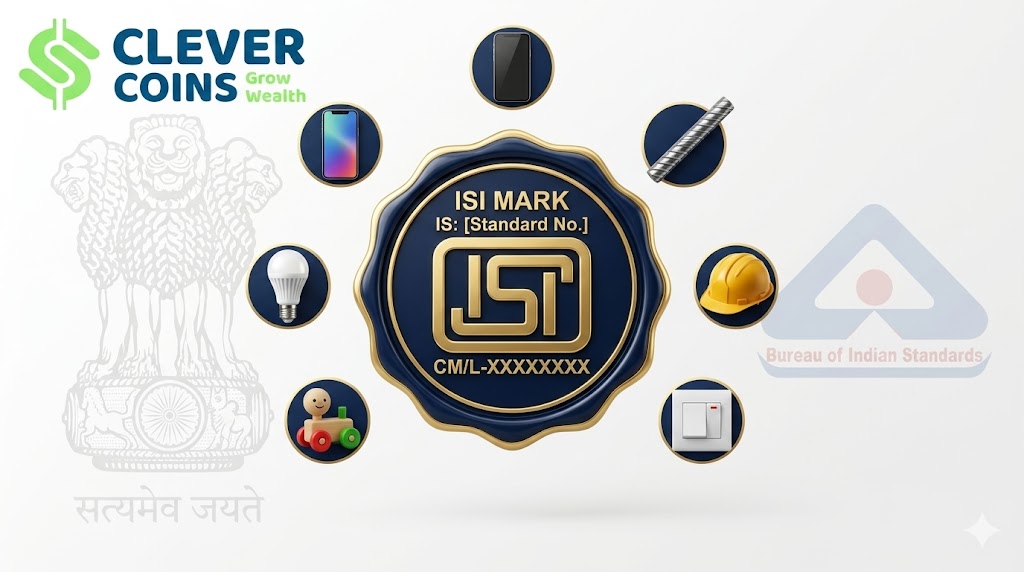
The ISI Mark (Indian Standards Institute mark) on a product signals that it has been tested, certified, and found to conform to the relevant Indian Standard. For mandatory products, the ISI mark is a legal requirement, not a voluntary quality badge.
Legal Framework — Why BIS Certification is Mandatory for Certain Products
The mandatory BIS certification framework is rooted in multiple legislations and government orders:
1. BIS Act, 2016
The BIS Act empowers the government to notify any article, process, or service under a mandatory certification scheme. Once notified, no product can be manufactured, imported, or sold in India without a valid BIS license.
2. Quality Control Orders (QCOs)
The Ministry of Commerce & Industry, along with sector-specific ministries (e.g., Ministry of Electronics & IT, Ministry of Steel, Ministry of Chemicals), issues Quality Control Orders (QCOs) under the Essential Commodities Act, 1955 or BIS Act, 2016. Each QCO specifies the products covered, the applicable Indian Standard, effective date, and mandatory certification requirement.
3. Compulsory Registration Scheme (CRS) — Electronics
Under the Ministry of Electronics and Information Technology (MeitY), the Compulsory Registration Scheme mandates registration of electronic and IT goods with BIS before they can be sold in India.
4. Import Restriction Orders
Many products on the BIS mandatory list cannot be imported without a valid BIS license. Customs authorities at Indian ports check for BIS compliance before releasing shipments.
Overview: BIS Mandatory Products List — Key Sectors
As of 2026, over 400 product categories are covered under mandatory BIS certification in India. These span across electronics, electrical equipment, steel, chemicals, food, textiles, toys, helmets, cement, and many more. Below is a sector-wise detailed breakdown.
Sector 1: Electronics & IT Products (Under CRS — Compulsory Registration Scheme)
The Compulsory Registration Scheme (CRS) covers a wide range of electronic and IT products that must be registered with BIS before sale in India:
- Mobile phones and smartphones
- Tablets and laptop computers
- LED lights, LED drivers, and LED luminaires
- Televisions (LED, LCD, OLED)
- Set-top boxes (DTH, cable)
- Printers and scanners
- Power banks and portable chargers
- Adaptors and battery chargers for mobile phones
- Wireless keyboards and mice
- Smart wearables — smartwatches and fitness bands
- IP cameras and CCTV surveillance cameras
- Routers and modems
- Bluetooth speakers and headsets
- Microwave ovens (domestic)
- Induction cooktops
- Electronic toys
- Video door phones
- Air purifiers
- Electric water heaters (instant type)
- Automatic voltage regulators / voltage stabilizers
Sector 2: Electrical Equipment & Household Appliances
Electrical products are among the most regulated categories under BIS, given their direct safety implications:
- Electric irons (domestic and industrial)
- Electric immersion water heaters
- Room air conditioners (splits and window units)
- Refrigerators and deep freezers
- Washing machines (front-load and top-load)
- Electric fans (ceiling, table, pedestal, exhaust)
- Switches, sockets, plugs, and connectors
- MCBs (miniature circuit breakers) and RCCBs
- Wiring accessories — switchgear
- Electric cables and wires (household)
- Fluorescent lamps and ballasts
- CFLs (compact fluorescent lamps)
- Transformers (distribution-grade)
- Electric motors (AC, single-phase and three-phase)
- Welding machines and electrodes
- UPS systems (offline and online)
- Electric geysers (storage water heaters)
- Pressure cookers (electric)
- Extension cords and multi-plug adapters
Sector 3: Steel, Iron & Metal Products
The steel sector has some of the oldest QCOs in India, given its critical role in construction and infrastructure:
- High strength deformed steel bars (TMT bars / Fe 415, Fe 500, Fe 550)
- Structural steel (angles, channels, I-beams, H-beams)
- Hot-rolled steel plates, strips, and sheets
- Cold-rolled steel sheets (galvanized and non-galvanized)
- Stainless steel kitchen utensils and cookware
- Steel pipes and tubes (water, gas, structural)
- Mild steel wire rods
- Barbed wire and chain link fencing
- Pressure vessels and boiler-quality steel plates
- Steel castings and forgings
- Lead acid storage batteries (automotive)
- Galvanized steel wire
Sector 4: Chemicals, Petroleum & Construction Materials
- Portland cement (OPC 33, 43, 53 grades)
- Blended cements (PPC, PSC, etc.)
- Fly ash for use in Portland cement concrete
- Liquefied petroleum gas (LPG) cylinders
- LPG pressure regulators and hoses
- Safety valves for LPG
- Paints and varnishes (decorative and industrial)
- Automotive lubricating oils (engine oils)
- Hydraulic brake fluids
- Calcium carbide
- Caustic soda (industrial-grade sodium hydroxide)
- Chlorine cylinders and storage vessels
- Thermal insulation materials (for industrial use)
Sector 5: Food, Agriculture & Packaged Goods
- Packaged drinking water and mineral water
- Baby food / infant milk formula
- Condensed milk (sweetened)
- Skimmed milk powder
- Edible refined oils (groundnut, soybean, palm)
- Vanaspati (hydrogenated vegetable oil)
- Iodised salt (branded packaged table salt)
- Carbonated beverages / soft drinks
- Processed cheese and cheese products
- Ready-to-eat food products (licensed categories)
- Pesticides and insecticides (agricultural use)
- Fertilizers (nitrogenous, phosphatic, potassic)
Sector 6: Automotive & Safety Products
- Protective helmets for two-wheeler riders (IS 4151)
- Automobile tyres and tubes (two, three, four-wheelers)
- Automotive safety glass (windshields)
- Seat belts for motor vehicles
- Automotive brake pads and linings
- Reflective material for road signs and vehicles
- Fire extinguishers (portable)
- Automotive batteries — lead acid starter batteries
- Automotive rear-view mirrors
- Retroreflective sheeting (Type 1 and Type 2)
Sector 7: Toys & Children’s Products
Following the Quality Control Order for Toys (2020, effective Sept 2020 for domestic and Jan 2021 for imports), all toys sold in India — whether domestically manufactured or imported — must carry the ISI mark:
- Mechanical and wind-up toys
- Soft-filled and stuffed toys
- Dolls and fashion figurines
- Outdoor and activity toys (swings, slides, tricycles)
- Toy vehicles (battery-operated and non-battery)
- Building sets and construction toys
- Toy guns and toy weapons
- Puzzles and board games
- Educational toys and STEM kits
- Toy musical instruments
The QCO for Toys is considered one of the most impactful recent mandatory notifications, significantly affecting global toy brands importing into India.
Sector 8: Textiles & Apparel
- School uniforms (specified government procurement categories)
- Jute bags and hessian cloth
- Hosiery products (socks, underwear — specific categories under QCO)
- Blankets and woollen textiles (Defence and Government supply)
- Safety shoes and industrial footwear
Sector 9: Medical Devices & Healthcare Products
- Condoms (male contraceptive condoms — IS 4046)
- Surgical dressings and bandages
- Clinical thermometers (digital and mercury-type)
- Blood pressure monitors (automatic)
- Nebulizers and respiratory devices (selected categories)
- Examination gloves (latex)
- Drinking water purifiers (domestic)
Sector 10: Water, Sanitation & Plumbing Products
- PVC pipes (pressure and non-pressure)
- uPVC pipes for potable water
- CPVC pipes and fittings
- GI pipes (galvanized iron)
- Water meters (domestic)
- Sanitary ware (WC pans, wash basins — BIS voluntary scheme, moving to mandatory)
- Domestic pressure reducing valves
- Ball valves and gate valves (water supply)
BIS Certification Schemes for Mandatory Products
BIS operates multiple certification schemes. For mandatory products, the following are most relevant:
Scheme | Full Name | Applicable To |
ISI Mark Scheme | Product Certification Scheme | Most manufactured goods, steel, chemicals, electrical products |
CRS | Compulsory Registration Scheme | Electronics & IT goods (notified by MeitY) |
FMCS | Foreign Manufacturers Certification Scheme | Imported products from foreign manufacturers |
SDoC | Self-Declaration of Conformity | Low-risk products under simplified procedure |
Hallmarking | BIS Hallmarking Scheme | Gold and silver jewellery |
Step-by-Step Process to Obtain BIS Certification
Step 1: Identify the Applicable Indian Standard (IS)
Every BIS-certified product must conform to a specific Indian Standard (IS number). Visit the BIS website (www.bis.gov.in) or use the online IS catalogue to identify the applicable standard for your product category. For example, IS 4151 applies to protective helmets for two-wheeler riders.
Step 2: Determine the Certification Scheme
Based on your product and whether you are a domestic or foreign manufacturer, identify the correct scheme: ISI Mark, CRS, FMCS, or SDoC.
Step 3: Select a BIS-Recognized Testing Laboratory
Your product must be tested at a BIS-recognized/accredited laboratory. BIS maintains a list of recognized labs on its website. Select a lab based on the product category and geographic convenience.
Step 4: Product Testing
Submit product samples to the recognized lab for testing against all parameters of the applicable Indian Standard. The lab issues a test report upon successful testing.
Step 5: Prepare Application & Documents
Compile all required documents, including:
- Duly filled BIS application form (online via BIS portal)
- Test report from BIS-recognized laboratory
- Plant layout and manufacturing process details
- Proof of land ownership / factory lease
- GST and company registration documents
- Quality control manual and in-process inspection records
- Declaration of conformity to the applicable IS
- Details of raw materials and suppliers
Step 6: Online Application Submission
Submit the application online through the BIS Integrated Management System (MANAK online portal). Pay the application fee. BIS has moved to a fully digital application process — manual paper applications are no longer accepted for most categories.
Step 7: Factory Inspection by BIS Officer
A BIS officer visits the manufacturing facility to verify production processes, in-house testing capabilities, and quality control systems. For foreign manufacturers, BIS conducts an overseas inspection at the factory premises abroad.
Step 8: Grant of BIS License
Upon successful inspection and verification of test reports, BIS grants the license. The license comes with conditions including periodic surveillance testing, payment of marking fees, and maintenance of production quality records.
Step 9: Marking of Products with ISI Mark
Once licensed, every product unit must bear the ISI mark along with the license number. The standard number and ISI mark must be marked as per BIS specifications — size, position, and permanence requirements are specified by BIS.
Documents Required for BIS Certification Application
For Domestic Manufacturers (ISI Mark)
- Completed BIS application form
- Test report from a BIS-recognized laboratory (not older than 3 years)
- Site plan / factory layout drawing
- Certificate of Incorporation / Partnership Deed
- GST Registration Certificate
- Proof of factory ownership / lease deed
- List of plant and machinery
- Quality control plan / in-process inspection procedure
- Details of key personnel responsible for quality
- Existing BIS license details (if renewal)
For Foreign Manufacturers (FMCS Scheme)
- Application through an Authorised Indian Representative (AIR)
- Copy of valid manufacturing license from the country of origin
- Test reports from recognized international/Indian laboratories
- Factory audit details and quality management records
- Letter of authorisation naming AIR in India
- Country of origin certificate
BIS Certification Fee Structure (2026)
Fee Type | Amount (Approx.) | Frequency |
Application / Processing Fee | Rs. 1,000 – Rs. 25,000 | One-time (per application) |
Initial Grant Fee | Rs. 1,000 – Rs. 50,000 | On license grant |
Annual License Fee | Rs. 2,000 – Rs. 20,000 | Annually |
Marking Fee (ISI Mark) | 0.1% – 1% of production value | Per quarter |
Factory Inspection Charges | Rs. 5,000 – Rs. 2,00,000+ | Per inspection |
Overseas Inspection (FMCS) | Actual travel cost + Rs. 1,500/day | Per foreign visit |
Laboratory Testing Charges | Varies by product & lab | Per test batch |
Note: Always verify the current fee schedule on the BIS MANAK portal (www.manakonline.in) before applying as fees are periodically revised.
BIS Certification Timeline
Stage | Domestic (ISI) | Foreign (FMCS) |
Product Testing at Lab | 2–6 weeks | 4–10 weeks |
Application Processing | 2–4 weeks | 4–6 weeks |
Factory Inspection | 2–6 weeks | 6–12 weeks (overseas travel scheduling) |
License Grant (after inspection) | 2–4 weeks | 4–6 weeks |
Total Estimated Timeline | 2–4 months | 4–8 months |
Validity and Renewal of BIS License
A BIS ISI Mark license is typically valid for 1 year and is renewed annually, subject to:
- Payment of annual license fee
- Satisfactory surveillance inspection by BIS
- Continuous conformance of production to Indian Standard requirements
- No recorded violations, consumer complaints, or market surveillance failures
For the CRS (electronics), the registration is valid for 2 years and must be renewed before expiry. Renewal applications should be filed at least 60 days before the expiry date to ensure continuity without a gap in certification status.
Consequences of Selling BIS-Mandatory Products Without Certification
The BIS Act, 2016 prescribes serious penalties for non-compliance:
- First Offence: Imprisonment up to 2 years OR fine up to Rs. 2,00,000 (Rs. 2 lakh), or both
- Subsequent Offence: Imprisonment up to 5 years AND fine up to Rs. 5,00,000 (Rs. 5 lakh)
- False ISI Mark Use: Imprisonment up to 2 years + fine (Rs. 2 lakh minimum)
- Seizure and confiscation of non-compliant goods by enforcement agencies
- Import clearance denial at Indian customs for uncertified products
- Blacklisting from government procurement tenders
- E-commerce delisting — platforms like Amazon, Flipkart, Meesho remove listings of uncertified mandatory products following BIS enforcement notices
- Reputational damage affecting brand equity and distributor relationships
BIS has become increasingly aggressive in market surveillance. Its officers can inspect manufacturing premises, warehouses, and retail stores and seize non-compliant goods. Third-party testing agencies are also deployed for market-level sample collection.
BIS Certification for Imported Products
India’s import regulations require that all imported products on the mandatory BIS list must carry a valid BIS certification before they can clear customs. Key points for importers:
- Foreign manufacturers must obtain a BIS license under the FMCS scheme or register under CRS before shipping to India
- The product label must display the ISI mark, standard number, license number, and other mandatory information
- Imports without a valid BIS license will be detained at the port of entry
- DGFT (Directorate General of Foreign Trade) has linked BIS compliance to Import Export Code (IEC) compliance in several product categories
- The Ministry of Commerce periodically updates the list of mandatory BIS products in the import policy conditions
For large volume importers, working with an experienced Indian Authorized Representative (AIR) and a BIS consultant is strongly recommended to navigate the FMCS process.
BIS Certification and E-Commerce Compliance in India
The rapid growth of e-commerce in India has brought BIS compliance into the spotlight for online sellers. Major e-commerce platforms have updated their seller policies to mandate BIS certification proof for all listed products that fall under mandatory categories. Key developments:
- Amazon India requires sellers to provide BIS license details and ISI mark images for all mandatory products before listing
- Flipkart has a dedicated compliance portal where BIS certificates must be uploaded for mandatory product categories
- Meesho and other platforms have implemented similar compliance requirements following BIS enforcement actions
- BIS conducts regular market surveillance of online marketplaces to detect uncertified mandatory products
- Sellers found listing uncertified mandatory products face account suspension in addition to legal penalties
For D2C brands and online-first businesses, obtaining BIS certification early in the product development cycle — before going to market — is the most cost-effective approach.
Recent Updates & Newly Notified Mandatory Products (2023–2026)
The government has been progressively expanding the mandatory BIS certification list. Key additions in recent years include:
- Wireless Bluetooth devices (earphones, headphones, neckbands) — CRS notification
- Smart meters and energy meters — QCO issued
- Photovoltaic (PV) solar modules — BIS certification made mandatory under ALMM scheme
- Lithium-ion batteries for electric vehicles — mandatory IS certification
- Personal protective equipment (PPE) — safety helmets, safety harnesses
- Gas stoves and LPG appliances — revised QCO with mandatory ISI mark
- Children’s jewellery — new QCO restricting heavy metals
- Mosquito repellent devices and coils — mandatory BIS conformance
- Steel chairs and furniture for government procurement — mandatory IS
It is strongly recommended to check the BIS website and DPIIT QCO tracker quarterly to stay updated on newly notified mandatory categories.
How to Check if Your Product Requires Mandatory BIS Certification
- Visit the BIS official website: www.bis.gov.in
- Navigate to ‘Certification’ and look for ‘Mandatory Certification Products List’
- Cross-reference with the DPIIT Quality Control Orders tracker
- Search by product category, HS Code, or IS number
- For electronics, check the MEITY CRS product list
- Consult a BIS-registered consultant or the regional BIS office for your state
- Check import policy conditions under DGFT’s EXIM Policy for import-related mandatory notifications
Pro Tips for Businesses Navigating BIS Mandatory Certification
- Start Early: Begin the BIS certification process at the product design stage, not after manufacturing. Test reports and inspections take time.
- Use BIS-Recognized Labs: Always test at BIS-recognized/accredited labs to ensure test reports are accepted by BIS without re-testing.
- Hire a BIS Consultant: For foreign manufacturers and complex products, a qualified BIS consultant in India can reduce application errors and timeline significantly.
- Monitor QCO Updates: Subscribe to DPIIT and BIS notifications to stay ahead of newly notified mandatory products.
- Train Your QC Team: BIS inspectors evaluate in-house quality control procedures rigorously. Invest in training your quality team.
- Maintain Batch Records: BIS requires detailed production and testing records for all batches. Implement a robust records management system.
- Renew on Time: BIS licenses that lapse mid-production can cause costly disruptions. Set renewal reminders at least 90 days before expiry.
- E-Commerce Readiness: Upload BIS certificate details to all marketplace seller portals immediately after certification to avoid listing removal.
Frequently Asked Questions (FAQs)
Q1. Is ISI mark and BIS certification the same thing? — ISI mark is the certification mark used on products certified under the BIS product certification scheme. BIS certification is the broader process. All ISI-marked products are BIS-certified, but BIS has other schemes (like CRS for electronics) that do not use the ISI mark.
Q2. Can I sell a mandatory BIS product without a license if stocks are limited? — No. There is no exemption for quantity or stock level. Even a single unit of a mandatory product sold without certification is a violation.
Q3. Does BIS certification cover all India or only certain states? — BIS certification is a central government requirement and is valid across all of India, including Union Territories.
Q4. Can a retailer be penalised for selling uncertified mandatory products? — Yes. The BIS Act makes it an offence to sell or stock for sale any product covered under mandatory certification without a valid BIS license. Retailers are also liable.
Q5. How long does the BIS FMCS process take for a Chinese manufacturer? — Typically 4–8 months from start to license grant. The overseas factory inspection by BIS officers is the most time-consuming step, often requiring 2–4 months for scheduling.
Q6. Is BIS certification required for goods meant only for export? — Mandatory BIS certification applies to products manufactured or sold within India. Products manufactured exclusively for export and not intended for domestic sale are generally exempt, but the factory must maintain clear production segregation and documentation.
Q7. Can two products be covered under one BIS license? — No. Each product model / variant typically requires a separate BIS license under the applicable IS number. However, product groups may be covered under one application if they conform to the same IS standard.
Conclusion
The BIS Certification Mandatory Products List is not static — it is a growing, dynamic regulatory framework that reflects India’s commitment to product safety, consumer protection, and quality assurance. As India positions itself as a global manufacturing hub under initiatives like Make in India and PLI schemes, the government is progressively expanding the scope of mandatory quality certification across sectors.
For manufacturers, importers, and brands operating in the Indian market, BIS compliance is non-negotiable. Early certification planning, disciplined quality management, and regular monitoring of QCO updates are the three pillars of a robust BIS compliance strategy.
Stay certified, stay compliant, and build brands that India’s consumers can trust.