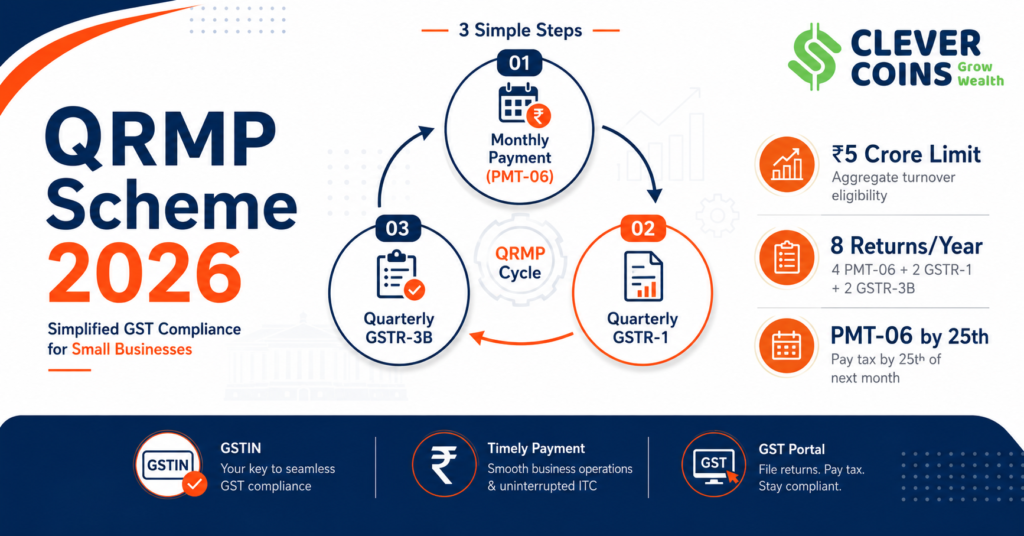
The QRMP Scheme — Quarterly Return Monthly Payment — is a GST compliance simplification initiative introduced by the Government of India through CBIC (Central Board of Indirect Taxes and Customs) vide Notification No. 84/2020-Central Tax dated 10th November 2020. It became effective from 1st January 2021 and has since helped millions of small and medium GST-registered businesses reduce their compliance burden while ensuring steady monthly revenue collection for the government.
Under the QRMP Scheme, eligible GST taxpayers file their GSTR-1 (outward supply statement) and GSTR-3B (monthly summary return) on a QUARTERLY basis instead of the standard monthly cycle. However, they are still required to pay their GST liability every month using a simplified challan mechanism — hence the name ‘Quarterly Return, Monthly Payment.’
As of January 2026, over 65 lakh GST taxpayers across India are enrolled under the QRMP Scheme. This guide covers every aspect of the QRMP Scheme — eligibility, process, Invoice Furnishing Facility (IFF), payment methods, due dates, advantages, disadvantages, and the latest updates for FY 2025-26.
Quick Fact: The QRMP Scheme reduces the number of GST returns filed annually from 24 (GSTR-1 + GSTR-3B monthly) to just 8 (4 GSTR-1 + 4 GSTR-3B quarterly), saving taxpayers significant time and resources.
Background and Objective of the QRMP Scheme
Before the QRMP Scheme, every GST-registered taxpayer — regardless of turnover — was required to file GSTR-1 and GSTR-3B on a monthly basis. For small businesses with annual turnover below ₹5 crore, this monthly compliance was considered excessive and burdensome, often requiring dedicated accounting support.
The GST Council in its 42nd meeting (October 2020) recommended the introduction of the QRMP Scheme to ease this burden. The key objectives were:
- Reduce the number of GST filings for small taxpayers
- Ensure continuous monthly tax payments to maintain government revenue flow
- Simplify the process for micro, small, and medium enterprises (MSMEs)
- Reduce dependence on chartered accountants for routine monthly filings
- Promote voluntary GST compliance by reducing compliance fatigue
Who Is Eligible for the QRMP Scheme? – Eligibility Criteria 2026
The eligibility for the QRMP Scheme for FY 2025-26 (AY 2026-27) is determined based on the taxpayer’s aggregate annual turnover in the preceding financial year:
Primary Eligibility Condition
- Taxpayers with aggregate annual turnover up to ₹5 crore in the preceding financial year (FY 2024-25) are eligible.
- Both Regular taxpayers and taxpayers who have migrated from the Composition Scheme (and now file regular returns) can opt in.
- Taxpayers registered under the Normal Scheme (not Composition Scheme) filing GSTR-1 and GSTR-3B.
Who Is NOT Eligible?
- Taxpayers with aggregate annual turnover exceeding ₹5 crore — they must file monthly.
- Composition Scheme taxpayers (they have a separate quarterly filing system under CMP-08).
- Non-Resident Taxable Persons (NRTP)
- Input Service Distributors (ISD)
- OIDAR Service providers
- TDS/TCS deductors under GST
- Casual Taxable Persons
Important 2026 Update: CBIC has confirmed via Circular No. 231/25/2026-GST that the ₹5 crore turnover threshold for QRMP eligibility remains unchanged for FY 2025-26. Turnover calculation includes all GSTINs under the same PAN across India.
How to Opt In or Opt Out of the QRMP Scheme
The QRMP Scheme is NOT automatic. Eligible taxpayers must actively choose to opt in through the GST portal (www.gst.gov.in). Here is the complete process:
Opting In to QRMP Scheme – Step-by-Step Process
- Log in to the GST portal at www.gst.gov.in using your credentials.
- Navigate to: Services → Returns → Opt-in for Quarterly Return.
- Select the Financial Year for which you want to opt in.
- Select ‘Quarterly’ for both GSTR-1 and GSTR-3B.
- Click ‘Save’. A confirmation message will appear.
Important Deadlines for Opting In / Out
Quarter | Opt-In / Out Window | Applicable From |
January – March | 1st Oct – 31st Jan | January quarter |
April – June | 1st Feb – 30th April | April quarter |
July – September | 1st May – 31st July | July quarter |
October – December | 1st Aug – 31st Oct | October quarter |
Auto-Assignment Rules
- New GST registrations: Automatically assigned to QRMP if turnover is below ₹5 crore.
- Taxpayers who cross ₹5 crore during the year: Must switch to monthly filing from the next quarter.
- If a taxpayer does not opt in/out within the window, the previous quarter’s selection continues.
Pro Tip: Always opt-in before the deadline of the first month of each quarter to avoid penalties. Once opted in for a quarter, you cannot revert within that quarter.
Return Filing Under QRMP Scheme – GSTR-1 and GSTR-3B
Under the QRMP Scheme, taxpayers file returns quarterly. However, a unique feature called the Invoice Furnishing Facility (IFF) allows them to upload invoices monthly for the first two months of the quarter.
GSTR-1 (Quarterly)
- Filed once per quarter — covering all 3 months of the quarter.
- Due date: 13th of the month following the end of the quarter.
- Example: For Q1 (April–June), GSTR-1 is due by 13th July.
- Covers all B2B invoices, B2C invoices, credit/debit notes, amendments, and advances.
GSTR-3B (Quarterly)
- Filed once per quarter — a summary of GST liability and input tax credit.
- Due date for Category X states: 22nd of the month following the quarter end.
- Due date for Category Y states: 24th of the month following the quarter end.
Quarter | GSTR-1 Due Date | GSTR-3B (Cat X) | GSTR-3B (Cat Y) |
Apr–Jun 2025 | 13th July 2025 | 22nd July 2025 | 24th July 2025 |
Jul–Sep 2025 | 13th Oct 2025 | 22nd Oct 2025 | 24th Oct 2025 |
Oct–Dec 2025 | 13th Jan 2026 | 22nd Jan 2026 | 24th Jan 2026 |
Jan–Mar 2026 | 13th April 2026 | 22nd April 2026 | 24th April 2026 |
Category X States (Due: 22nd)
Chhattisgarh, Madhya Pradesh, Gujarat, Maharashtra, Karnataka, Goa, Kerala, Tamil Nadu, Telangana, Andhra Pradesh, the Union Territories of Dadra and Nagar Haveli and Daman and Diu, Puducherry, Andaman and Nicobar Islands, Lakshadweep.
Category Y States (Due: 24th)
Himachal Pradesh, Punjab, Uttarakhand, Haryana, Rajasthan, Uttar Pradesh, Bihar, Sikkim, Arunachal Pradesh, Nagaland, Manipur, Mizoram, Tripura, Meghalaya, Assam, West Bengal, Jharkhand, Odisha, Jammu and Kashmir, Ladakh, Chandigarh, Delhi.
Invoice Furnishing Facility (IFF) – Complete Explanation
The Invoice Furnishing Facility (IFF) is one of the most important features of the QRMP Scheme. It addresses a critical concern: under quarterly GSTR-1 filing, B2B buyers of QRMP taxpayers would not see their Input Tax Credit (ITC) reflected in GSTR-2B for two months out of three, causing disruption to their ITC claims.
IFF solves this by allowing QRMP taxpayers to optionally upload B2B invoices for Month 1 and Month 2 of the quarter, so that their buyers can claim ITC on time.
Key Features of IFF
- Optional facility — not mandatory.
- Available only for Month 1 and Month 2 of each quarter (not for Month 3).
- Covers only B2B invoices, credit notes, and debit notes (NOT B2C invoices).
- Invoices uploaded via IFF are NOT required to be reported again in quarterly GSTR-1.
- Invoice value limit per IFF: ₹50 lakh per month (aggregate of all invoices uploaded).
- Due date: 13th of the following month (same as regular GSTR-1).
IFF Due Dates for FY 2025-26
Quarter | Month | IFF Due Date |
Apr–Jun 2025 | April 2025 | 13th May 2025 |
Apr–Jun 2025 | May 2025 | 13th June 2025 |
Jul–Sep 2025 | July 2025 | 13th Aug 2025 |
Jul–Sep 2025 | August 2025 | 13th Sep 2025 |
Oct–Dec 2025 | October 2025 | 13th Nov 2025 |
Oct–Dec 2025 | November 2025 | 13th Dec 2025 |
Jan–Mar 2026 | January 2026 | 13th Feb 2026 |
Jan–Mar 2026 | February 2026 | 13th Mar 2026 |
Note: IFF for Month 3 of each quarter does NOT exist. All Month 3 B2B invoices (along with any remaining invoices) are reported in the quarterly GSTR-1 due on 13th of the next month.
IFF vs GSTR-1 – Key Differences
Feature | IFF | Quarterly GSTR-1 |
Frequency | Monthly (M1 & M2 only) | Once per quarter |
Invoice Types | B2B only | B2B + B2C + all others |
Optional/Mandatory | Optional | Mandatory |
Invoice Value Cap | ₹50 lakh per month | No cap |
Impact on ITC | Immediate (next month GSTR-2B) | After quarter end |
Monthly Tax Payment Under QRMP Scheme – PMT-06
Despite quarterly return filing, QRMP taxpayers must pay their GST tax liability every month using Form PMT-06 (a payment challan). This monthly payment is due on the 25th of each month for the first two months of the quarter. No payment is required separately for Month 3 — it is settled in the quarterly GSTR-3B.
Monthly Payment Due Dates – FY 2025-26
Quarter | Month 1 Payment Due | Month 2 Payment Due | Month 3 Settlement |
Apr–Jun 2025 | 25th May 2025 | 25th June 2025 | In Jul GSTR-3B |
Jul–Sep 2025 | 25th Aug 2025 | 25th Sep 2025 | In Oct GSTR-3B |
Oct–Dec 2025 | 25th Nov 2025 | 25th Dec 2025 | In Jan GSTR-3B |
Jan–Mar 2026 | 25th Feb 2026 | 25th Mar 2026 | In Apr GSTR-3B |
The PMT-06 payment can be made through two methods:
Method 1 – Fixed Sum Method (35% Rule)
- The taxpayer pays 35% of the tax paid in cash in the last quarter (if quarterly filer) OR 35% of the tax paid in cash in the last month of the preceding quarter (if monthly filer transitioning to QRMP).
- This amount is auto-calculated by the GST portal and shown as a pre-filled challan.
- No manual calculation required.
- Suitable for taxpayers with stable monthly turnover.
Method 2 – Self-Assessment Method
- The taxpayer calculates their actual GST liability for the month based on outward and inward supplies.
- Uses GSTR-2B data for ITC claims.
- Pay the difference between output tax liability and available ITC.
- More accurate but requires detailed monthly bookkeeping.
Which method to choose? If your business has seasonal fluctuations or significantly lower sales in a particular month, use the Self-Assessment Method to avoid paying excess tax. Otherwise, the Fixed Sum Method saves time.
What Happens if No Tax Is Payable?
- If the taxpayer’s ITC is sufficient to cover the tax liability for Month 1 or Month 2, no cash payment via PMT-06 is required.
- However, the taxpayer must still assess their liability and confirm nil payment if applicable.
Interest and Late Fees Under QRMP Scheme
Interest on Late Payment
- If PMT-06 is not paid by the 25th of the month: Interest @ 18% per annum is applicable on the shortfall.
- Interest is calculated from the due date of payment to the actual date of payment.
- Even if you use the Fixed Sum Method and your actual liability is higher, interest applies on the difference.
Late Fee for Delayed Return Filing
Late fees under QRMP for GSTR-1 and GSTR-3B are charged as follows (effective from July 2022 as per CBIC notification, in effect for FY 2025-26):
Return Type | Nil Return Late Fee | Other Cases Late Fee | Maximum Late Fee |
GSTR-1 (Quarterly) | ₹0 per day | ₹50 per day (₹25 CGST + ₹25 SGST) | ₹2,000 per return |
GSTR-3B (Quarterly) | ₹20 per day (₹10 CGST + ₹10 SGST) | ₹50 per day (₹25 CGST + ₹25 SGST) | ₹10,000 per return |
Budget 2026 Update: Finance Act 2026 has introduced a GST late fee amnesty scheme for returns filed between FY 2017-18 and FY 2022-23. QRMP taxpayers with pending dues from those years can settle with reduced late fees. Details available on GST portal under ‘Notices and Orders.’
Input Tax Credit (ITC) Under QRMP Scheme
ITC under the QRMP Scheme follows the same rules as for regular taxpayers, with one important distinction — GSTR-2B is generated quarterly for QRMP taxpayers.
GSTR-2B Under QRMP
- For Month 1 and Month 2: GSTR-2B reflects IFF data uploaded by suppliers.
- For Month 3: GSTR-2B reflects all quarterly GSTR-1 data of suppliers.
- The ITC available in GSTR-2B must be used while making PMT-06 payments in Month 1 and Month 2.
ITC Claim Rules for QRMP Taxpayers
- ITC can be claimed in the quarterly GSTR-3B based on cumulative GSTR-2B for the quarter.
- Provisional ITC (the old 20%/10%/5% rule) is no longer available — ITC is fully GSTR-2B based.
- Rule 36(4) cap of 5% provisional ITC was removed from January 2022 — ITC is 100% as per GSTR-2B.
Key Concern for Buyers: If your supplier is under QRMP and does NOT file IFF, your ITC from their invoices will only appear in GSTR-2B after their quarterly GSTR-1 is filed. This can cause a 2-month delay in ITC for Month 1 and Month 2 invoices. Always verify if your key B2B suppliers are using IFF.
Advantages of the QRMP Scheme
The QRMP Scheme offers substantial benefits to eligible small and medium GST taxpayers:
Reduced Return Filing Burden
From 24 returns per year (12 GSTR-1 + 12 GSTR-3B) to just 8 returns per year (4 GSTR-1 + 4 GSTR-3B). This represents a 67% reduction in mandatory return filings.
Lower Compliance Costs
Fewer returns mean lower CA/accountant fees, less software subscription costs, and less time spent on GST compliance — critical savings for micro businesses and sole proprietors.
Flexible Payment Methods
The choice between Fixed Sum Method and Self-Assessment Method gives taxpayers flexibility based on their cash flow situation.
IFF for ITC Continuity
The optional IFF ensures that B2B buyers of QRMP taxpayers are not disadvantaged and can continue to claim ITC without disruption.
Auto-Population of GSTR-3B
The quarterly GSTR-3B is auto-populated from GSTR-1/IFF data and GSTR-2B, reducing manual data entry errors.
System-Generated Challan
The pre-filled PMT-06 challan under the Fixed Sum Method eliminates calculation errors for monthly payments.
Disadvantages and Challenges of the QRMP Scheme
Despite its benefits, the QRMP Scheme also comes with certain limitations:
- ITC Mismatch for Buyers – Buyers of QRMP taxpayers who do not use IFF face potential 2-month ITC delays.
- Over-Payment Risk (Fixed Sum Method) – If business is slow in a given month, paying 35% of previous quarter’s tax may result in excess cash blocking.
- Interest on Underestimation – If actual liability in Month 1/2 exceeds the Fixed Sum payment, interest @ 18% p.a. applies on the shortfall.
- Complex for New Businesses – New registrations are auto-assigned to QRMP but may find the IFF and PMT-06 mechanism confusing initially.
- Not Suitable for High-Volume B2B Businesses – If you issue more than ₹50 lakh/month in B2B invoices, IFF cap requires careful invoice management.
- Manual Reconciliation Still Required – Despite simplification, taxpayers must still reconcile purchase data with GSTR-2B every quarter.
QRMP Scheme vs Monthly Return Filing – Comparison 2026
Parameter | QRMP Scheme | Monthly Filing |
Eligible Turnover | Up to ₹5 crore/year | Any turnover |
GSTR-1 Frequency | Quarterly (4/year) | Monthly (12/year) |
GSTR-3B Frequency | Quarterly (4/year) | Monthly (12/year) |
Total Returns/Year | 8 | 24 |
Monthly Tax Payment | PMT-06 (by 25th) | GSTR-3B itself |
IFF Available | Yes (optional, M1+M2) | N/A |
ITC in GSTR-2B | Quarterly (+ IFF) | Monthly |
Late Fee (Nil return) | ₹0 (GSTR-1) | ₹0 (GSTR-1) |
Compliance Cost | Lower | Higher |
Suitable For | MSMEs, small traders | Large businesses |
QRMP Scheme vs Composition Scheme – Key Differences
Many small taxpayers confuse the QRMP Scheme with the GST Composition Scheme. Both are simplification mechanisms, but they are fundamentally different:
Feature | QRMP Scheme | Composition Scheme |
Tax Collection | Collect GST from customers | Cannot collect GST from customers |
ITC Eligibility | Full ITC available | No ITC claim allowed |
Eligible Turnover | Up to ₹5 crore/year | Up to ₹1.5 crore/year (goods) |
Return Filed | GSTR-1 + GSTR-3B (Quarterly) | CMP-08 (Quarterly) + GSTR-4 (Annual) |
Inter-State Supply | Allowed | Not allowed |
Tax Rate | Normal GST rates | Flat concessional rate (1%–6%) |
Invoice Type | Normal Tax Invoice | Bill of Supply only |
Practical Example – QRMP Scheme in Action (FY 2025-26)
Let us understand the QRMP Scheme with a practical example for a small business:
Business Profile
- Taxpayer: M/s Sunita Traders, Delhi (GSTIN: 07AAAPS1234A1Z5)
- Annual Turnover: ₹3.2 crore (FY 2024-25) – Eligible for QRMP
- Opted into QRMP Scheme for FY 2025-26
Quarter: April–June 2025
Month 1 – April 2025:
- Total sales (B2B): ₹28 lakh | GST liability: ₹5.04 lakh
- ITC available (GSTR-2B): ₹3.20 lakh
- Tax payable via PMT-06: ₹5.04 lakh – ₹3.20 lakh = ₹1.84 lakh
- PMT-06 due by: 25th May 2025
- IFF filed by 13th May 2025 (B2B invoices of ₹28 lakh uploaded)
Month 2 – May 2025:
- Total sales (B2B): ₹22 lakh | GST liability: ₹3.96 lakh
- Uses Fixed Sum Method: 35% of last quarter’s cash payment
- If last quarter’s cash payment was ₹4 lakh: PMT-06 = ₹1.40 lakh
- PMT-06 due by: 25th June 2025
Month 3 – June 2025 & Quarter Filing:
- GSTR-1 (Q1) filed by 13th July 2025 — covering all April+May+June invoices.
- GSTR-3B (Q1) filed by 22nd July 2025 (Delhi is Cat Y — but shown as 24th for Y states; Delhi is Cat X in some notifications — using 22nd here as example).
- Quarterly GSTR-3B accounts for total liability (April+May+June) minus PMT-06 payments already made.
Result: Sunita Traders filed only 4 GSTR-1s and 4 GSTR-3Bs in FY 2025-26 (instead of 24 returns), saving approximately ₹36,000 in CA fees annually and 120+ hours of compliance work.
Latest QRMP Scheme Updates and Notifications – 2026
CBIC Circular No. 231/25/2026-GST (January 2026)
The CBIC confirmed the continuation of the QRMP Scheme for FY 2025-26 with no changes to the ₹5 crore turnover threshold. The circular also clarified that taxpayers who inadvertently crossed ₹5 crore in any quarter of FY 2024-25 but averaged below ₹5 crore for the full year will still be eligible for QRMP for FY 2025-26, subject to their aggregate PAN-level turnover.
GST Portal Upgrade (February 2026)
The GST portal was upgraded in February 2026 to provide QRMP taxpayers with a dashboard showing:
- Real-time PMT-06 payment status
- Quarter-wise IFF upload summary
- Mismatch alerts between IFF data and buyer GSTR-2B claims
- Auto-reminder notifications for PMT-06 due dates via SMS and email
Finance Act 2026 – GST Amendments Affecting QRMP
- IFF Invoice Cap: The ₹50 lakh per month IFF cap remains unchanged for FY 2025-26.
- Late Fee Amnesty: One-time opportunity to clear late fees for FY 2017-18 to FY 2022-23 pending returns.
- E-Invoice Integration: QRMP taxpayers with turnover above ₹5 lakh per transaction are now required to generate e-invoices (IRN) for B2B transactions — these are auto-populated to IFF/GSTR-1.
- New GSTN Analytics: QRMP taxpayers can now view a predictive tax liability estimate for the current quarter based on past data — helpful for PMT-06 payment decisions.
Important Notification: E-Invoice Threshold
Effective 1st April 2025, the e-invoice threshold was lowered to ₹5 crore annual turnover. This means all QRMP taxpayers with turnover between ₹5 crore and beyond are now mandatorily required to generate e-invoices (IRN) for B2B transactions. For those with turnover below ₹5 crore enrolled in QRMP, e-invoicing remains voluntary but recommended for seamless IFF auto-population.
Step-by-Step Guide to Filing Returns Under QRMP Scheme
Step 1 – Opt In to QRMP (One-time per quarter window)
- Login to www.gst.gov.in → Services → Returns → Opt-in for Quarterly Return
- Select Financial Year 2025-26 → Choose ‘Quarterly’ → Save
Step 2 – Upload IFF (Optional, Month 1 & 2 only)
- Services → Returns → Invoice Furnishing Facility → Select Quarter → Select Month
- Add B2B invoices manually or import from Excel/JSON
- Submit IFF by 13th of the following month
Step 3 – Pay Monthly Tax via PMT-06 (Month 1 & 2)
- Services → Payments → Create Challan → Select PMT-06
- Choose Fixed Sum Method (auto-filled) OR Self-Assessment Method
- Select tax heads (IGST/CGST/SGST) and pay by 25th of the month
Step 4 – File Quarterly GSTR-1
- Services → Returns → GSTR-1 → Select Quarter → Add remaining invoices
- Note: IFF-uploaded invoices are auto-populated; add only Month 3 invoices
- Preview, validate, and submit by 13th of the month after quarter end
Step 5 – File Quarterly GSTR-3B
- Services → Returns → GSTR-3B → Auto-populated from GSTR-1 and GSTR-2B
- Verify ITC, net tax liability (minus PMT-06 payments already made)
- Pay remaining tax (if any) and file by 22nd/24th as applicable
Frequently Asked Questions (FAQs) – QRMP Scheme 2026
Q1. Can a taxpayer with ₹4.8 crore turnover in FY 2024-25 opt for QRMP in FY 2025-26?
Yes. Any taxpayer with aggregate annual turnover up to ₹5 crore in the preceding financial year is eligible for QRMP.
Q2. Is filing IFF compulsory under the QRMP Scheme?
No. IFF is completely optional. However, if your B2B buyers need timely ITC, it is strongly advisable to use IFF for Month 1 and Month 2.
Q3. What happens if PMT-06 is not paid by the 25th?
Interest at 18% per annum applies on the outstanding tax amount for the period of delay. No separate penalty, but interest accrues daily.
Q4. Can a QRMP taxpayer also be required to file GSTR-9?
Yes. GSTR-9 (Annual Return) is mandatory for QRMP taxpayers with annual turnover above ₹2 crore. For turnover between ₹2 crore and ₹5 crore, GSTR-9C (reconciliation statement) was made optional from FY 2021-22 onwards. For FY 2025-26, this remains the same.
Q5. Can one GSTIN be under QRMP and another under monthly for the same PAN?
Yes. The QRMP opt-in is GSTIN-specific, not PAN-specific. Different GSTINs under the same PAN can independently choose QRMP or monthly filing, provided each GSTIN individually meets the eligibility criterion.
Q6. What is the consequence of crossing ₹5 crore turnover mid-year under QRMP?
If a taxpayer’s aggregate turnover exceeds ₹5 crore during the year, they become ineligible for QRMP from the next quarter onwards. The system will not automatically migrate them — they must opt out and switch to monthly filing.
Q7. Is there a penalty for incorrect IFF filing?
There is no specific penalty for IFF errors, but incorrect IFF data can cause ITC mismatches for buyers, leading to demand notices for the buyer and potential scrutiny of the supplier’s GSTR-1.
Expert Tips for QRMP Scheme Compliance
These practical tips will help QRMP taxpayers avoid common mistakes and stay compliant in FY 2025-26.
- Always file IFF if you have B2B buyers — it protects their ITC and your business relationships.
- Use Self-Assessment Method for PMT-06 if your monthly sales are significantly variable.
- Keep your GSTR-2B reconciliation updated every month — do not wait until the quarter end.
- Set calendar reminders for PMT-06 due (25th) and IFF due (13th) every month.
- Verify your annual turnover at the start of each year to confirm QRMP eligibility.
- If you are a new GSTIN, check your auto-assignment status on the GST portal before filing.
- For QRMP taxpayers using accounting software (Tally, Zoho Books, Busy), enable the QRMP mode in settings to auto-segregate monthly payments from quarterly filings.
- Always keep a record of your PMT-06 challans — they are your proof of monthly tax payment and needed during any GST audit or assessment.
The QRMP Scheme — Quarterly Return Monthly Payment — is a GST compliance simplification initiative introduced by the Government of India through CBIC (Central Board of Indirect Taxes and Customs) vide Notification No. 84/2020-Central Tax dated 10th November 2020. It became effective from 1st January 2021 and has since helped millions of small and medium GST-registered businesses reduce their compliance burden while ensuring steady monthly revenue collection for the government.
Under the QRMP Scheme, eligible GST taxpayers file their GSTR-1 (outward supply statement) and GSTR-3B (monthly summary return) on a QUARTERLY basis instead of the standard monthly cycle. However, they are still required to pay their GST liability every month using a simplified challan mechanism — hence the name ‘Quarterly Return, Monthly Payment.’
As of January 2026, over 65 lakh GST taxpayers across India are enrolled under the QRMP Scheme. This guide covers every aspect of the QRMP Scheme — eligibility, process, Invoice Furnishing Facility (IFF), payment methods, due dates, advantages, disadvantages, and the latest updates for FY 2025-26.
Quick Fact: The QRMP Scheme reduces the number of GST returns filed annually from 24 (GSTR-1 + GSTR-3B monthly) to just 8 (4 GSTR-1 + 4 GSTR-3B quarterly), saving taxpayers significant time and resources.