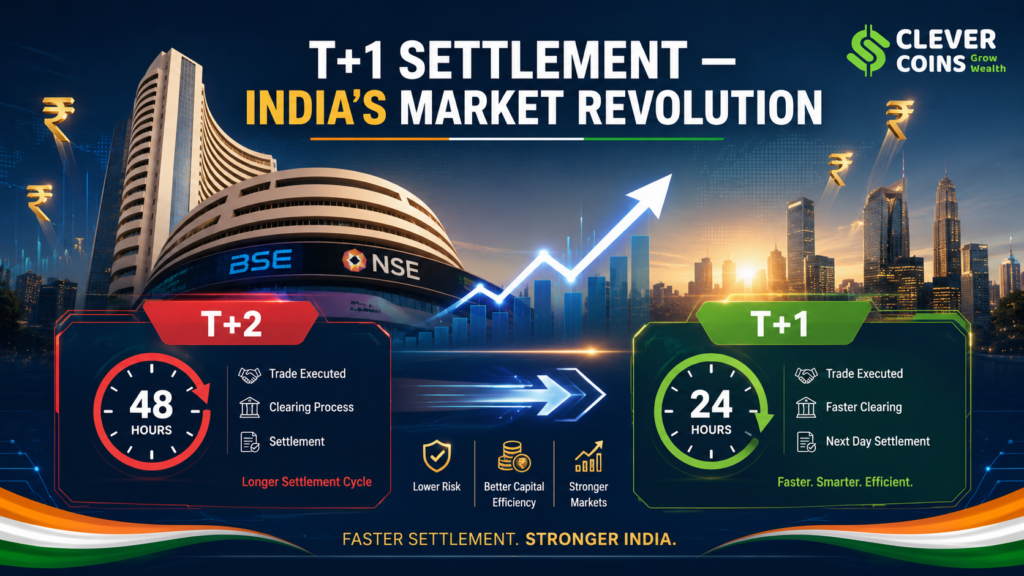
India’s Settlement Revolution
The Indian stock market witnessed a landmark transformation when SEBI (Securities and Exchange Board of India) successfully rolled out the T+1 (Trade plus One Day) settlement cycle across all listed securities. This change, one of the most significant operational reforms in recent memory, fundamentally altered how stock trades are settled on Indian exchanges — NSE, BSE, and MSEI.
In the conventional T+2 framework, if you bought shares on a Monday, the shares would arrive in your demat account only by Wednesday, and funds would be released to the seller on the same day. Under the new T+1 cycle, all of this happens within one business day. This guide takes you through every aspect of this pivotal change — from its regulatory history to its real-world impact on retail investors, institutional traders, Foreign Portfolio Investors (FPIs), and brokers.
🕐 What is Settlement Cycle? Understanding the Basics
Defining T+N Settlement
In financial markets, the ‘T’ stands for the Trade Date — the day on which a buy or sell transaction is executed on the stock exchange. The number that follows (N) indicates the number of business days after the trade date by which the actual exchange of securities and funds must be completed.
- T+0: Trade and settlement happen on the same day (same-day settlement — optional pilot in India since April 2024)
- T+1: Settlement completed within 1 business day after the trade date
- T+2: Settlement completed within 2 business days after the trade date (India’s previous standard)
- T+3: The older global standard, now largely phased out
How Settlement Works in Practice
Settlement involves two key processes: securities settlement (transfer of shares from seller’s demat account to buyer’s demat account) and funds settlement (transfer of money from buyer to seller). Both processes are coordinated through the Clearing Corporations — NSE Clearing Limited (NCL) and BSE Clearing (Indian Clearing Corporation Limited — ICCL).
📜 Regulatory Journey: From T+2 to T+1 in India
Pre-2022: The T+2 Era
India moved from T+3 to T+2 settlement back in April 2003, an upgrade that was considered progressive at the time. For nearly two decades, T+2 served as the standard, providing what seemed like adequate time for fund transfers, securities movement, and reconciliation by brokers and custodians.
SEBI’s Historic Circular – January 2022
SEBI issued a circular on January 1, 2022, announcing the introduction of an optional T+1 settlement cycle. The implementation was designed to be phased and voluntary — exchanges were given the freedom to offer T+1 on select scrips, giving the market time to adapt.
Phased Rollout Timeline (2022–2023)
Phase / Date | Scrips Covered | Remarks |
Feb 2022 | Bottom 100 stocks by market cap | Pilot phase launched |
Mar–Sep 2022 | Gradual expansion to mid/small-cap scrips | Market adjustment period |
Oct 2022 – Jan 2023 | Large-cap & Nifty 50 / Sensex stocks | High-volume blue chips added |
27 Jan 2023 | ALL listed equity securities | Full T+1 mandatory for all equity scrips |
By January 27, 2023, India achieved a complete transition to T+1 settlement for all listed equity securities — a milestone that made India only the second major market in the world, after China, to operate on T+1 as a standard.
🔄 What Exactly Changed: A Detailed Breakdown
1. Funds Settlement Timeline
Under T+2, sellers had to wait two business days to receive sale proceeds. Under T+1, funds are credited to the seller’s bank account (linked via their broker) by the evening of the next business day. For example, if you sell shares worth ₹1,00,000 on Monday, the funds would be available in your account by Tuesday evening — a day sooner than before.
2. Securities (Shares) Transfer
Similarly, buyers now receive their purchased shares in their demat account (held with NSDL or CDSL) by the next business day. Earlier, there was a two-day wait which exposed investors to counterparty risk for an additional 24 hours. The faster transfer also means investors can utilize their newly acquired securities sooner for pledging, IPO applications, or other purposes.
3. Margin & Pay-in Requirements
One of the most operationally significant changes is around pay-in deadlines. Under T+2, the pay-in of funds and securities happened on the second day. Under T+1, the pay-in must be completed by 7:00 AM on T+1 (the next business day), creating a tighter window for brokers to collect margins and ensure client obligations are met before market hours begin.
4. Early Pay-in (EPI) Mechanism
To facilitate smooth operations under T+1, SEBI and the exchanges introduced an enhanced Early Pay-in (EPI) mechanism. Clients who sell shares and want immediate credit of those shares to the clearing pool can submit them on the trade day itself (intraday), which reduces the settlement obligation and improves capital efficiency.
5. Depository Processes – NSDL & CDSL Updates
Both NSDL (National Securities Depository Limited) and CDSL (Central Depository Services Limited) updated their back-end systems to accommodate same-next-day settlement. The cut-off times for debit instructions, corporate actions adjustments, and pledge/unpledge requests were all revised to align with the T+1 framework.
6. Short Selling & Securities Lending and Borrowing (SLB)
T+1 created new dynamics for short sellers. With a shorter settlement window, borrowing securities for short selling requires more agility. The Securities Lending and Borrowing (SLB) mechanism was updated to ensure that short positions entered on any day can be covered within the compressed settlement timeline without default risk.
💹 Impact on Different Market Participants
Retail Investors
For the average Indian retail investor — whether a salaried employee, homemaker, or entrepreneur investing through platforms like Zerodha, Groww, Upstox, or Angel One — T+1 is an unambiguous benefit:
- Faster access to sale proceeds: Sell today, get money tomorrow
- Quicker ownership of purchased shares: Buy today, hold tomorrow
- Reduced counterparty risk exposure by one full day
- Greater liquidity and faster portfolio rebalancing
- Better capital efficiency — less idle capital tied up in settlement
Brokers and Trading Members
Brokers faced the most challenging adaptation to T+1. Key operational changes included:
- Re-engineering back-office software for faster trade processing
- Tighter risk management systems to handle overnight margin requirements
- Upgraded banking partnerships for same-next-day fund movement via RTGS/NEFT
- Training for compliance, operations, and client servicing teams
- Higher technology investment — estimated at ₹50 lakh to ₹5 crore per mid-to-large broker
Discount brokers like Zerodha and Upstox, with tech-first models, adapted faster. Traditional full-service brokers had longer transition periods.
Foreign Portfolio Investors (FPIs)
FPIs raised significant concerns during the T+1 transition, particularly around time zone mismatches and currency hedging:
- FPIs in the US and Europe found it difficult to complete fund allocation and FX conversion within the tight T+1 window due to time differences of 5–12 hours
- Currency conversion from USD/EUR to INR was a bottleneck since forex markets in their home countries would be closed when Indian exchanges were open
- SEBI addressed this by introducing a special FPI window, allowing certain FPIs to access an optional T+2 facility for settlement via Global Custodians, while the market overall moved to T+1
- As of 2026, most large FPIs have adapted their operational models and custodian arrangements to align with T+1, with Global Custodians like Citi, HSBC, and Deutsche Bank upgrading their Indian operations
Clearing Corporations
NSE Clearing Limited (NCL) and ICCL (BSE) had to overhaul their entire settlement infrastructure:
- Revised settlement schedules and cut-off timings
- Enhanced risk management algorithms for overnight exposures
- Upgraded interfaces with depositories and clearing banks
- Introduction of new settlement reports and dashboards for members
Custodians and Asset Managers
Domestic mutual funds, insurance companies, and portfolio management services (PMS) providers had to re-engineer their trade confirmation and settlement workflows. The Association of Mutual Funds in India (AMFI) coordinated with SEBI to ensure smooth adaptation.
📊 T+1 vs T+2 Comparison: At a Glance
Parameter | T+2 (Old) | T+1 (New) |
Settlement Period | 2 Business Days | 1 Business Day |
Fund Credit to Seller | T+2 evening | T+1 evening |
Share Credit to Buyer | T+2 morning | T+1 morning |
Counterparty Risk Window | 48 hours | 24 hours |
Pay-in Deadline | T+2, 10:30 AM | T+1, 7:00 AM |
Capital Idle Period | 2 days | 1 day |
FPI Convenience | Higher | Requires adaptation |
Global Ranking | Standard | World-class (2nd after China) |
Margin Efficiency | Lower | Higher |
🏛️ SEBI’s 2026 Updates & Current Framework
T+0 Optional Settlement Pilot (April 2024 onwards)
Building on the success of T+1, SEBI launched an optional T+0 (same-day) settlement pilot in April 2024. Under this, select stocks were offered on an optional T+0 basis, allowing buyers to get shares and sellers to get money on the same trading day. As of 2026, the T+0 pilot has been expanded to cover the top 500 scrips by market capitalization.
For T+0, the trade must be executed in a specific session (usually before 1:30 PM), and the settlement happens by 4:30 PM on the same day. Fund pay-in must be completed by 12:00 PM. This option is currently available on the NSE platform, with BSE also having enabled it in 2025.
Instant Settlement (Beta) – 2026 Outlook
SEBI is piloting an even faster ‘Instant Settlement’ mechanism in 2026, where trade confirmation and settlement happen in near real-time (within minutes of trade execution). This is facilitated by UPI-based fund transfers and pre-funded demat accounts. The beta program is limited to select tech-enabled brokers and retail investors who opt in.
Updated SEBI Circular 2026 Key Points
- All equity stocks, ETFs, REITs, and InvITs on NSE, BSE, and MSEI now settle on T+1 as default
- Sovereign Gold Bonds (SGBs) and government securities (G-Secs) continue on their respective settlement cycles
- Mutual fund units are settled separately under respective AMFI/RTA guidelines
- SEBI’s 2026 circular mandates brokers to maintain 100% segregation of client funds — margin shortfall on T+1 basis attracts enhanced penal action
- Peak Margin reporting has been updated to reflect T+1 settlement windows
Penalty Framework for Settlement Failures (2026)
Non-delivery (auction) in a T+1 environment triggers swift action:
- Securities not delivered by 7:00 AM on T+1 are put to auction on the same day
- Auction premium/discount is absorbed by the defaulting seller/broker
- Close-out prices can be significantly disadvantageous — up to 20% above the trade price for the defaulting party
- SEBI’s enhanced surveillance system tracks repeated failures and can trigger broker-level risk categorization reviews
🌐 India in the Global Context
Where India Stands in 2026
India’s T+1 implementation placed it among the most progressive markets globally. Here is a 2026 comparison:
Country/Market | Settlement Cycle (2026) | Notes |
India | T+1 (Default), T+0 Optional | One of fastest globally |
China | T+1 | Pioneer of T+1 |
USA | T+1 (since May 2024) | SEC mandated in 2024 |
UK / Europe | T+2 | In discussion for T+1 |
Japan | T+1 (for equities since 2024) | Gradual transition |
Hong Kong | T+2 | Reviewing T+1 feasibility |
💰 Financial Impact & Market Efficiency in Numbers
Systemic Risk Reduction
One of the most important, yet less visible, benefits of T+1 is the massive reduction in systemic risk within the clearing and settlement ecosystem. Quantitatively:
- The settlement exposure (the total value of outstanding/unsettled trades at any given point) dropped by approximately 50% overnight when T+1 came into full effect
- On an average day when NSE trades approximately ₹60,000–80,000 crore in the cash segment, the T+1 change reduced the outstanding settlement exposure by ₹30,000–40,000 crore on a daily basis
- Clearing corporations’ net worth and settlement guarantee fund (SGF) requirements were recalibrated — resulting in operational cost savings for exchanges and clearing corporations
Capital Unlocked for Investors
For investors, the capital cycle improved significantly:
- A retail investor managing a ₹10 lakh portfolio can now trade more actively with the same capital, as sale proceeds become available the very next day
- For active traders dealing in ₹50 lakh+ per day, the efficiency gain translates to better intraday and overnight positioning
- Mutual funds with large equity AUMs (Assets Under Management) — several above ₹10,000 crore — can reallocate capital more efficiently upon redemption
Technology Spend by Brokers
Industry estimates indicate that the brokerage ecosystem collectively invested between ₹2,000 crore to ₹3,500 crore in upgrading technology infrastructure to support T+1 settlement. This includes trading system upgrades, back-office overhaul, API integrations with depositories and clearing corporations, and staff training programs.
❓ Common Questions About T+1 Settlement
Q1: Can I sell shares I bought today under T+1?
Under T+1, shares bought today are available for sale only from the next business day. Intraday trading (Buy Morning, Sell Same Day) remains separately governed and is not covered under delivery settlement.
Q2: Does T+1 affect F&O (Futures & Options) trading?
No. Futures and Options segments have separate settlement mechanisms. F&O daily MTM settlement and final settlement on expiry follow their own schedules (which are essentially T+1 for MTM). The equity delivery segment is what moved to T+1.
Q3: What happens if settlement fails?
If a seller fails to deliver shares, the trade goes to an auction. In the auction, the shares are procured from the market at potentially higher prices. The cost differential (auction price vs. original trade price) is borne by the defaulting seller/broker. Under T+1, auctions are conducted on T+1 itself, making it more time-sensitive.
Q4: How does T+1 affect IPO allotment and listing?
IPO listing timelines were also compressed. SEBI reduced the IPO listing timeline to T+6 days from the issue closure — meaning listing happens 6 days after issue close. While IPOs do not directly follow T+1 equity settlement (they use a separate allotment-based process), SEBI continues to push for further compression.
Q5: Is T+1 applicable to ETFs and Sovereign Gold Bonds?
ETFs (Exchange Traded Funds) listed on NSE and BSE settle under the T+1 framework, just like equity shares. Sovereign Gold Bonds (SGBs) issued by RBI/Government of India have their own settlement cycle and are not governed by the equity T+1 framework directly.
Q6: What does T+0 mean and is it mandatory?
T+0 is an optional, same-day settlement facility currently available for select scrips. It is not mandatory — investors choose it on a trade-by-trade basis. For T+0, the buyer must ensure funds are available upfront, and the seller must ensure shares are available for delivery, all by specified cut-off times earlier in the day.
📱 Practical Tips for Investors in the T+1 Era
For Retail Investors
- Ensure your bank account linked to your broker account has sufficient balance before you place buy orders — under T+1, your broker may need faster fund confirmation
- Use ASBA (Application Supported by Blocked Amount) and UPI for faster fund movement
- Check your demat account the morning after a purchase to confirm share credit
- Avoid delay in DIS (Delivery Instruction Slips) submissions if you still use physical DIS — switch to CDSL’s TPIN or NSDL’s OTP-based digital delivery for speed
- If you are an NRI investor, coordinate with your broker and bank well in advance for faster INR fund availability
For Active Traders
- Maintain adequate margin in your trading account at all times — T+1 leaves less room for overnight fund arrangement
- Use pledging mechanisms wisely — under T+1, unpledging and re-pledging has tighter timelines
- Monitor auction exposure carefully — in case of accidental short delivery, auctions under T+1 are conducted faster
- Use broker tools and APIs that are T+1-compliant and provide real-time portfolio and margin visibility
For HNIs and Institutional Investors
- Review custodian arrangements — ensure your custodian has T+1 compatible workflows
- Work with Global Custodians who have dedicated India desks available during IST trading hours
- For FX hedging, pre-arrange currency conversion limits with authorized dealers to avoid settlement delays
🎯 Benefits of T+1 – A Summary
For the Indian Capital Market Ecosystem
- Enhanced market integrity and reduced systemic risk
- Better global competitiveness — aligned with or ahead of US, Japan, and China
- Increased investor confidence due to faster fund and security access
- Reduced need for large settlement guarantee funds (SGFs)
- Greater market depth as capital cycles faster
- Foundation for future T+0 and instant settlement frameworks
For SEBI and Regulatory Bodies
- Closer alignment between trade execution and ownership — reducing regulatory arbitrage
- Better surveillance capabilities as outstanding positions are resolved faster
- Demonstrates India’s ability to lead global market infrastructure reforms