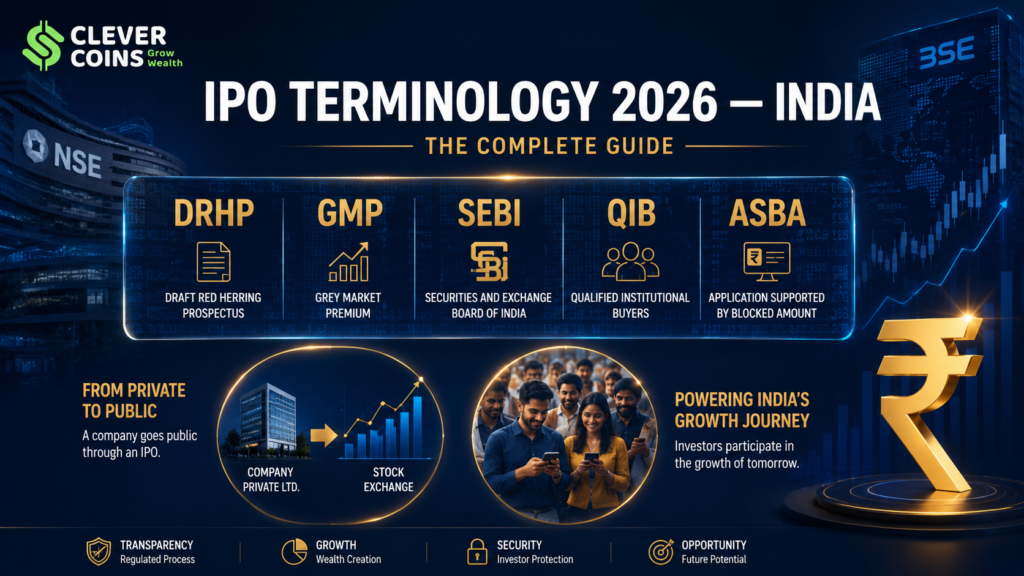
Why IPO Terminology Matters in 2026
India’s primary capital market has witnessed an unprecedented boom in 2025-2026. With the Bombay Stock Exchange (BSE) and National Stock Exchange (NSE) hosting hundreds of IPOs annually, and with over 13.6 crore registered demat account holders as of early 2026, there has never been a more critical time for Indian retail investors to understand IPO terminology inside out.
Whether you are a first-time investor applying through UPI Mandate or a seasoned market participant tracking Grey Market Premium (GMP), the language of IPOs is the foundation of informed decision-making. This comprehensive guide decodes every major IPO term — from the very first step of a company filing a Draft Red Herring Prospectus (DRHP) with SEBI, all the way to listing day gains and beyond.
This blog is updated as per SEBI (Issue of Capital and Disclosure Requirements) Regulations, 2018 — Amendment 2024 and is India-specific, with all currency references in Indian Rupees (INR/₹).
💡 Did You Know? India raised over ₹1.6 lakh crore through IPOs in FY2024-25, making it one of the most active IPO markets globally.
🏦 What is an Initial Public Offering (IPO)?
An Initial Public Offering (IPO) is the process by which a privately held company offers its shares to the general public for the first time through a stock exchange. This process transforms a private company into a publicly listed company, enabling ordinary Indian citizens to become shareholders.
In India, IPOs are regulated by the Securities and Exchange Board of India (SEBI) and listed on BSE (Bombay Stock Exchange) and/or NSE (National Stock Exchange of India). The process is governed by the SEBI (ICDR) Regulations, 2018, most recently amended in 2024.
Why Companies Launch IPOs
- To raise capital for business expansion, debt repayment, or acquisitions
- To provide an exit opportunity to early investors (Venture Capitalists, Angel Investors, Private Equity firms)
- To enhance the company’s brand visibility and public credibility
- To facilitate Employee Stock Option Plans (ESOPs) liquidity
- To comply with listing norms as required under certain regulatory frameworks
👥 Key Players in an IPO — Who Does What?
1. Issuer Company
The company that is launching the IPO. It is also referred to as the ‘Issuer.’ The issuer prepares financial statements, undergoes due diligence, appoints underwriters, and files regulatory documents.
2. Book Running Lead Manager (BRLM)
Also known as the Lead Manager or Merchant Banker, the BRLM is a SEBI-registered investment bank that manages the entire IPO process. Key responsibilities include preparing the DRHP, building the order book, coordinating with exchanges, and ensuring regulatory compliance. Major BRLMs in India include Kotak Mahindra Capital, ICICI Securities, Axis Capital, JM Financial, and SBI Capital Markets.
3. Registrar to the Issue (RTI)
The Registrar processes IPO applications, manages the allotment process, handles refunds, and maintains the shareholder register. SEBI-registered RTIs include KFin Technologies, Link Intime India, and Bigshare Services.
4. Underwriters
Underwriters (typically the BRLMs and syndicate members) guarantee the purchase of unsold shares at the issue price. In India, under-writing is mandatory for fixed-price issues and optional but common for book-built issues.
5. Depositories
CDSL (Central Depository Services Limited) and NSDL (National Securities Depository Limited) are the two depositories in India that hold shares in electronic (dematerialised) form. Every investor must have a demat account with a Depository Participant (DP) linked to either CDSL or NSDL.
6. Stock Exchanges (BSE & NSE)
The exchanges list the shares after the IPO closes. NSE’s segment for IPO listing is NSE Emerge (for SME IPOs) and NSE Mainboard. BSE has BSE SME and BSE Mainboard. Minimum listing requirement differs between the two.
7. Syndicate Members & Sub-Brokers
These are SEBI-registered brokers authorized to accept IPO applications on behalf of the lead manager. They help distribute the issue to a wider investor base.
8. Bankers to the Issue (Self-Certified Syndicate Banks — SCSBs)
SCSBs are banks authorized by SEBI to accept Application Supported by Blocked Amount (ASBA) applications. As of 2026, all IPO applications by retail investors in India are mandatorily through the ASBA mechanism. Over 65 banks are recognized as SCSBs by SEBI.
📊 Types of IPO in India
1. Mainboard IPO
Companies with a post-issue paid-up capital of more than ₹10 crore or with a net worth of more than ₹25 crore are eligible to list on the mainboard of BSE or NSE. These are large, established companies. Examples: LIC IPO (₹20,557 crore in 2022), Hyundai India IPO (2024), and numerous large-cap companies in 2025-2026.
2. SME IPO (Small & Medium Enterprise IPO)
Designed for smaller companies, SME IPOs are listed on NSE Emerge or BSE SME. As per SEBI’s updated norms for 2024-2026, the minimum application size for SME IPOs has been increased to ₹1,00,000 (1 lakh rupees) to restrict speculative retail participation. The lock-in periods for promoters in SME IPOs are also stricter.
3. Fresh Issue
In a fresh issue, the company issues new shares to the public and raises fresh capital. The proceeds go directly to the company for stated business purposes.
4. Offer for Sale (OFS)
In an OFS, existing shareholders (promoters, VCs, PE funds) sell their existing shares to the public. No fresh capital is raised by the company — the money goes to the selling shareholders. Many IPOs in India contain both a fresh issue and an OFS component.
Parameter | Fresh Issue | Offer for Sale (OFS) |
Money goes to | Company (Issuer) | Selling Shareholders |
Purpose | Business Expansion, Capex | Promoter Exit / PE Exit |
Impact on Share Count | Increases (dilution) | No change |
Tax liability (2026) | STT on listing | Capital Gains Tax on seller |
SEBI Lock-in | Promoter lock-in on retained shares | Lower applicable restriction |
📋 The IPO Process — Step by Step Terminology
Step 1: Appointment of Intermediaries
The company appoints BRLMs, Registrar, Legal Counsel, Auditors, and Bankers. This is the planning phase where the IPO team is assembled.
Step 2: Due Diligence
The BRLM conducts thorough financial, legal, and operational due diligence on the company. All material facts must be disclosed — failure to do so is a SEBI violation.
Step 3: Draft Red Herring Prospectus (DRHP)
The DRHP is the primary legal document filed with SEBI and the stock exchanges before the IPO. It contains the company’s financials (minimum 3 years audited), business description, risk factors, use of proceeds, promoter details, and legal proceedings. The ‘Red Herring’ in the name refers to the fact that the final price and number of shares are not yet determined at this stage.
SEBI has 30 days (extendable to 75 days) to issue its observations on the DRHP. After SEBI clearance, the company can proceed with the IPO within 12 months.
Step 4: Red Herring Prospectus (RHP)
The RHP is the updated version of the DRHP filed with the Registrar of Companies (RoC) just before the IPO opens. It includes the Price Band and IPO opening/closing dates, making it the final pre-subscription document.
Step 5: Price Band
For book-built IPOs, a Price Band is set — a minimum (Floor Price) and maximum (Cap Price). Investors can bid anywhere within this range. As per SEBI rules, the cap price cannot be more than 20% above the floor price for mainboard IPOs. Example: A price band of ₹450 to ₹500 means the floor is ₹450 and the cap is ₹500.
Step 6: IPO Subscription Period
The IPO is open for subscription for a minimum of 3 working days and maximum 10 working days. For most mainboard IPOs in India, the window is typically 3 days. SEBI mandates that the IPO must achieve a minimum subscription of 90% to proceed; otherwise, the issue is cancelled and all funds are refunded.
Step 7: Allotment
After the subscription window closes, shares are allotted to applicants. Allotment for retail investors is done via a computerised lottery if the issue is oversubscribed. The allotment date is typically T+6 days from the closing date (T = closing date).
Step 8: Listing
Shares are credited to demat accounts on T+5 and listed on the exchange on T+6 (as per SEBI’s T+6 listing timeline introduced for mainboard IPOs). The listing price may differ from the issue price, creating listing gains or listing losses.
🎯 Investor Categories in an Indian IPO
SEBI divides IPO applicants into distinct categories, each with a reserved quota. Understanding these categories is critical for every investor.
Category | Full Form | Quota (Mainboard) | Min. Application (2026) | Allotment Method |
QIB | Qualified Institutional Buyer | 50% of Net Issue | No min. (in ₹ crore lots) | Proportionate |
NII (HNI) | Non-Institutional Investor (High Net Worth) | 15% of Net Issue | Above ₹2,00,000 | Lottery (as per SEBI 2021/2024 norms) |
RII | Retail Individual Investor | 35% of Net Issue | Min ₹10,000, Max ₹2,00,000 | Lottery |
Employee | Company Employees (EE) | Up to 5% (discretionary) | As specified in prospectus | Proportionate |
Shareholder | Existing Shareholders | Up to 5% (discretionary) | As specified in prospectus | Proportionate |
Qualified Institutional Buyers (QIBs)
QIBs are large institutional investors such as Mutual Funds, Foreign Portfolio Investors (FPIs), Insurance Companies (like LIC), Banks, NBFCs with net worth above ₹500 crore, Alternative Investment Funds (AIFs), and Scheduled Commercial Banks. QIBs get 50% of the net offer (post anchor allocation).
Anchor Investors
Anchor investors are QIBs allocated shares one day before the IPO opens (called ‘Anchor Investor Allocation Day’). They are allocated up to 60% of the QIB portion. The minimum bid for anchor investor allocation is ₹10 crore. Anchor investors must lock in their allotted shares for 30 days from the allotment date (for 50% of shares) and 90 days (for the remaining 50%), as per SEBI’s 2024 norms.
Strong anchor investor participation is seen as a positive signal by retail and HNI investors, as it indicates institutional confidence in the IPO.
Non-Institutional Investors (NII / HNI)
NIIs include High Net Worth Individuals (HNIs), companies, societies, trusts, and NRIs applying for more than ₹2,00,000 worth of shares. They are sub-divided as: sNII (Small NII): applications between ₹2 lakh and ₹10 lakh, and bNII (Big NII): applications above ₹10 lakh. Each sub-category has a separate quota within the NII portion.
Retail Individual Investors (RII)
Retail investors can apply for a maximum of ₹2,00,000 in any single IPO. Any application above ₹2,00,000 is classified as NII. In oversubscribed IPOs, retail allotment is done via lottery — one lot per successful applicant.
💹 Key Financial Terms in an IPO
Face Value (FV) / Par Value
The nominal value of a share as stated in the company’s Memorandum of Association. Common face values in India are ₹1, ₹2, ₹5, or ₹10. The issue price is always at a premium over the face value. Example: If face value is ₹5 and issue price is ₹500, the premium is ₹495 per share.
Issue Price / Cut-Off Price
The Issue Price is the final price at which shares are sold to investors. In a book-built issue, the Cut-Off Price is the price discovered through the price discovery mechanism — where the total demand equals or exceeds the total supply. Retail investors often bid at the cut-off price, meaning they are willing to pay whatever price is finally determined by the market.
Price Band
The range of prices within which investors can bid during a book-built IPO. The lower limit is the Floor Price and the upper limit is the Cap Price. As per SEBI rules for 2026, the gap between floor and cap cannot exceed 20%.
Premium / Issue Premium
The amount by which the issue price exceeds the face value. This premium represents the market’s valuation of the company above its book value. Example: Tata Technologies IPO had a face value of ₹2 and issue price of ₹500, implying a premium of ₹498 per share.
Lot Size
The minimum number of shares an investor must apply for. Lot sizes are calculated such that the minimum application amount for retail investors is typically around ₹14,000 to ₹15,000, though it can be lower. Multiple lots can be applied, up to the ₹2 lakh retail limit. Example: If the lot size is 30 shares and the issue price is ₹500, one lot costs ₹15,000.
Market Capitalization at Issue
The total market value of all outstanding shares at the IPO price. Formula: Market Cap = Issue Price × Total Number of Shares Post-Issue. This is one of the primary metrics used to evaluate whether an IPO is fairly priced.
Earnings Per Share (EPS)
EPS = Net Profit / Total Number of Shares Outstanding. This metric tells you how much profit each share earns. A higher EPS relative to peers is a positive indicator.
Price-to-Earnings Ratio (P/E Ratio)
P/E Ratio = Issue Price / Earnings Per Share. The P/E ratio helps investors assess if the IPO is fairly valued compared to industry peers. A very high P/E may indicate overvaluation; a low P/E may suggest undervaluation or investor pessimism.
Price-to-Book Ratio (P/B Ratio)
P/B = Issue Price / Book Value per Share. It compares the market price to the company’s net asset value per share.
Return on Equity (ROE)
ROE = (Net Profit / Shareholders’ Equity) × 100. ROE measures how efficiently a company uses investors’ money to generate profit. SEBI mandates disclosure of ROE in IPO prospectuses.
EBITDA and EBITDA Margin
EBITDA = Earnings Before Interest, Tax, Depreciation, and Amortisation. It is a proxy for operational cash flow. EBITDA Margin = EBITDA / Revenue × 100. Companies with higher and growing EBITDA margins are generally more attractive for IPO investment.
📈 Subscription & Allotment Terminology
Subscription Ratio / Times Subscribed
This ratio tells you how many times the shares offered in an IPO were applied for. Formula: Subscription = Total Shares Applied For / Total Shares Offered. Example: If an IPO offered 1 crore shares and received applications for 70 crore shares, it is ’70 times subscribed’ (70x). Higher subscription (especially in QIB and retail categories) is generally a positive indicator.
Oversubscription
When the number of shares applied for exceeds the number of shares offered. Oversubscription leads to pro-rata allotment for QIBs and a lottery for retail investors.
Undersubscription
When demand is less than the shares offered. If an IPO is undersubscribed by more than 10% in any reserved category, underwriters are obligated to subscribe to the shortfall. If total subscription falls below 90%, the IPO is cancelled.
ASBA — Application Supported by Blocked Amount
ASBA is the mandatory application mechanism for all Indian IPO investors since January 2016 and remains mandatory in 2026. Under ASBA, the application money is not debited from the investor’s bank account but is blocked (lien marked) until allotment. If shares are allotted, the blocked amount is debited; if not, the block is released. This mechanism is operated through Self-Certified Syndicate Banks (SCSBs).
UPI Mandate for IPO
Since 2019, retail investors (RII category, applications up to ₹2 lakh) can apply for IPOs using their UPI ID (through apps like BHIM, Google Pay, PhonePe, Paytm, or net banking). The investor enters their UPI ID in the application and approves the mandate request on their UPI app within 4 hours. As of 2026, UPI-based IPO applications are processed through UPI 2.0 with enhanced transaction limits.
Allotment Basis
Post subscription, the Registrar (RTI) finalises the allotment. For retail investors, if oversubscribed, one lot per applicant is allotted via lottery. For QIBs, allotment is proportionate to bids. The allotment basis is publicly available on the BSE/NSE website and on the RTI’s website.
Refund / Unblocking of ASBA
For applicants who did not receive allotment (or received partial allotment), the blocked amount is unblocked by the SCSB. As per SEBI’s T+6 listing timeline, unblocking happens on T+5 (5 days after IPO closing date).
📄 Prospectus-Related Terminology
Draft Red Herring Prospectus (DRHP)
The preliminary offer document filed with SEBI, the stock exchanges, and made publicly available. It does not contain the final price band or IPO dates. The DRHP is available for public comments for 21 days after its filing on SEBI’s SCORES portal and the exchange websites.
Red Herring Prospectus (RHP)
The final prospectus filed with SEBI and RoC before the IPO opens. It includes the price band, number of shares, dates of opening and closing, and the final use of proceeds.
Abridged Prospectus
A shorter version of the prospectus that is provided to retail applicants with the application form. It contains all material information from the RHP in a condensed format as mandated by SEBI.
Final Prospectus
Filed after the IPO closes. It contains the final issue price (cut-off price), the number of shares allotted in each category, and other post-subscription details.
Offer Document
A generic term for any document (DRHP, RHP, Final Prospectus) that describes the offer to the public.
Material Information Disclosure
SEBI mandates that companies disclose all material information that could affect investor decisions — including ongoing litigations, contingent liabilities, related-party transactions, promoter pledging, and regulatory risks. Non-disclosure can result in SEBI penalising the issuer and BRLMs.
📉 Grey Market, Listing & Post-IPO Terminology
Grey Market Premium (GMP)
The Grey Market is an unofficial, unregulated market where IPO shares are traded before they are officially listed on the exchange. The Grey Market Premium (GMP) is the amount above the issue price at which IPO shares are traded in the grey market. Example: If the issue price is ₹500 and GMP is ₹150, the expected listing price is around ₹650. However, GMP is not a reliable predictor — it is informal, unregulated, and can be manipulated.
⚠️ SEBI Warning (2024-2026): Grey market trading is illegal and unregulated. SEBI does not recognise or protect grey market transactions. Investors participate at their own risk.
Kostak Rate
The Kostak Rate is a unique term from the Indian IPO grey market. It is the price at which an investor’s entire IPO application (the form itself, not shares) is sold before allotment. Example: Kostak of ₹2,000 on a 1-lot application means the buyer pays ₹2,000 to buy the right to the applicant’s potential allotment. This is also an unregulated, informal practice.
Subject-to-Sauda
Another grey market term — it refers to a deal where payment is conditional on the applicant getting allotment. If the applicant does not get allotted shares, the deal is void. This is distinct from Kostak (where payment is irrespective of allotment).
Listing Price
The price at which a share opens for trading on the stock exchange on listing day. The listing price can differ significantly from the issue price.
Listing Gain / Listing Loss
Listing Gain = (Listing Price – Issue Price) / Issue Price × 100. A positive percentage is a listing gain; negative is a listing loss. Example: If issue price is ₹500 and listing price is ₹650, the listing gain is 30%.
Lock-in Period
Post-IPO, certain shareholders — especially promoters — cannot sell their shares for a specified lock-in period. As per SEBI (ICDR) Regulations 2024 updates: Promoter minimum shareholding of 20% is locked in for 18 months from the date of allotment. Remaining promoter shares are locked in for 6 months. Pre-IPO investors/anchor investors have specific lock-in periods as described in Section 6 above.
Listing Day Trading
On listing day, once the shares start trading on the exchange, retail investors can sell their allotted shares. Short-term IPO investors (‘flippers’) typically sell on listing day to capture listing gains. Long-term investors hold the shares post-listing.
Market Maker
For SME IPOs, a Market Maker is a SEBI-registered broker who commits to buying and selling the IPO shares in the secondary market to ensure liquidity. SME IPO companies are required to appoint a market maker as per SEBI’s SME IPO guidelines.
⚖️ SEBI IPO Regulations — Key Updates for 2026 (India)
SEBI has progressively tightened IPO regulations to protect retail investors and ensure market integrity. Key regulatory developments applicable in 2026:
1. SME IPO Minimum Application Size
As per SEBI’s circular effective from 2024, the minimum application size for SME IPOs has been raised to ₹1,00,000 (₹1 lakh). This was done to reduce speculative participation by retail investors in high-risk SME issues.
2. IPO Grading (Discontinued)
SEBI had introduced mandatory IPO grading by credit rating agencies, but this was discontinued as it was found to be misleading. As of 2026, IPO grading is not mandatory.
3. Mandatory Demat for All IPO Applications
Physical share certificates are no longer issued. All shares allotted in IPOs must be held in demat form. Investors must have a valid demat account (with CDSL or NSDL) before applying.
4. T+6 Listing Timeline
SEBI mandated the T+6 listing timeline (6 working days after IPO close) for mainboard IPOs, reducing the previous T+12 timeline significantly. This ensures faster credit of shares and refunds to investors.
5. Increased Disclosure Norms
SEBI’s 2024-2026 amendments require greater disclosure of Key Performance Indicators (KPIs) in IPO prospectuses, mandatory disclosure of non-GAAP financial metrics with reconciliation, and comparisons of valuation metrics with listed industry peers.
6. Restriction on Use of IPO Proceeds
As per SEBI’s updated norms, IPO proceeds cannot be used for general corporate purposes beyond 25% of the total fresh issue size. Proceeds must be tied to specific, disclosed objects of the issue. Any deviation requires shareholder approval.
7. Promoter Minimum Contribution
Post-IPO, promoters must maintain a minimum 20% shareholding (where the post-issue paid-up capital is up to ₹1,600 crore). For larger issues, the minimum promoter contribution is defined separately. This ensures promoters have ‘skin in the game’.
8. Enhanced Anchor Investor Lock-in
SEBI increased the lock-in period for 50% of anchor investor allocations to 90 days (from the earlier 30 days) to prevent early flipping by large institutional investors.
💰 Taxation on IPO Investments — India 2026
Understanding the tax implications of IPO investments is crucial for every Indian investor. Here is a simplified overview as per the Finance Act 2024-2025 applicable in 2026:
Scenario | Holding Period | Tax Type | Tax Rate (2026) |
Sold on Listing Day (Short Term) | Less than 12 months | Short Term Capital Gains (STCG) | 20% on gains (Budget 2024 revision) |
Sold after 12 months (Long Term) | More than 12 months | Long Term Capital Gains (LTCG) | 12.5% on gains above ₹1.25 lakh (Budget 2024) |
IPO Allotment (No Sale) | Not applicable | No Tax Event | Tax applies only on sale |
Listing Gains on SME IPO | Less than 12 months | STCG | 20% |
Dividend received post-listing | N/A | Income Tax | Added to income, taxed at slab rate |
Securities Transaction Tax (STT) | On all secondary market sales | STT | 0.1% on sell value (equity delivery) |
Note: Tax rates are based on the Finance Act 2024 and applicable for FY2025-26 / AY2026-27. Consult a Chartered Accountant for personalised tax advice.
📐 IPO Valuation Methods — How is the Price Decided?
Valuing an IPO is both an art and a science. The BRLM and the issuer company use several methods to determine an appropriate price band:
1. Comparable Company Analysis (CCA) / Peer Comparison
The most common method — the company is compared to similar listed companies on metrics like P/E, EV/EBITDA, P/B, Price-to-Sales, etc. The IPO price is set at a discount or premium relative to peers based on the company’s growth potential.
2. Discounted Cash Flow (DCF) Analysis
DCF values the company based on the present value of expected future cash flows. It is particularly used for mature, cash-generating businesses. However, for high-growth startups (common in recent Indian tech IPOs), DCF is less reliable due to speculative future projections.
3. Price/Book Value Method
Used primarily for banks and financial institutions, where book value (net asset value) is a key metric. RBI-regulated entities like banks use this extensively in their IPO pricing.
4. EV/Revenue Multiple
For early-stage or loss-making companies (like many new-age tech startups), the EV/Revenue (Enterprise Value to Revenue) multiple is used since they may have no meaningful earnings or EBITDA.
📚 Book Building Process — Detailed Terminology
Book Building is the method of IPO price discovery where the price is determined through investor demand. It is the dominant IPO method in India today, used by over 95% of mainboard IPOs.
Floor Price
The minimum price at which bids can be placed by investors. No bid below the floor price is accepted.
Cap Price
The maximum price at which bids can be placed. Most investors bid at the cap price to maximise their chances of allotment.
Cut-Off Price
After the bidding period closes, the BRLM and issuer discover the price at which the issue is fully subscribed. This is the cut-off price. Retail investors who bid at the cut-off price pay the final determined cut-off price (which is at or below the cap price).
Book
The ‘Book’ refers to the electronic record of all bids placed during the IPO subscription period. BSE and NSE both run the book-building platform (BSE’s platform is called BOLT and NSE’s is NEAT, with both integrated into the IPO bidding system).
Bid-Lot
The combination of the number of shares bid (in multiples of lot size) and the price at which they are bid.
Revision of Bids
Investors can revise their bids (change price, quantity, or both) during the bidding period. All revisions must be made through the same channel (same SCSB or UPI) used for the original application.
Withdrawal of Application
Investors can withdraw their IPO applications during the subscription period. However, once the bidding period closes, withdrawal is not permitted.
🔬 Advanced IPO Terms — For Serious Investors
Green Shoe Option (GSO) / Overallotment Option
The Green Shoe Option allows the underwriter to allot up to 15% more shares than originally planned if demand is very high. The stabilising agent (usually the BRLM) buys shares in the secondary market post-listing to stabilise the price if it falls below the issue price, using proceeds from the overallotment. This mechanism protects early investors from sharp post-listing falls.
Stabilisation Period
The period (up to 30 days post-listing) during which the stabilising agent can use the Green Shoe proceeds to support the listing price. At the end of stabilisation, any unspent funds are returned to the company.
Greenshoe Fund
A separate escrow account opened for the Green Shoe Option proceeds, managed by the stabilising agent.
Pre-IPO Placement
Companies can raise funds from select investors up to 60 days before filing the RHP. This is called a Pre-IPO Placement or Pre-IPO round. The issue size is correspondingly reduced if a pre-IPO placement has occurred.
Qualified Institutional Placement (QIP)
A QIP is not an IPO but is often confused with one. It is a mechanism by which an already-listed company raises fresh capital from QIBs without filing a prospectus with SEBI. QIPs must be offered at a discount of no more than 5% to the floor price (determined by SEBI’s formula based on volume-weighted average price).
Rights Issue vs. IPO
A Rights Issue is when an already-listed company offers new shares to existing shareholders in proportion to their existing holdings. It is distinct from an IPO, which is the first-time offering to the general public.
Follow-on Public Offer (FPO)
An FPO is a secondary public offering where an already-listed company issues additional shares to the public. This is different from an IPO (first-time offer) and a QIP (only to institutions).
Initial Public Offering vs. Direct Listing
In a traditional IPO, an investment bank underwrites the issue. In a Direct Listing (very rare in India), a company lists existing shares directly on the exchange without underwriting or new share issuance. Direct listing is more common in US markets (Spotify, Roblox) and is not widely practiced in India as of 2026.
Special Purpose Acquisition Company (SPAC)
SPACs are shell companies formed specifically to raise capital through an IPO to acquire or merge with a private company. While popular in the US, SEBI issued a consultation paper on SPAC regulation in India in 2022-2024, but as of 2026, a comprehensive SPAC regulatory framework is still being finalised.
IPO Withdrawal
If market conditions deteriorate significantly, a company can withdraw its IPO before the subscription window opens (after SEBI approval). Post-2023, several high-profile Indian IPOs were withdrawn due to poor market sentiment. Once the IPO opens for subscription, withdrawal is extremely rare and procedurally complex.
📖 Complete IPO Terminology Glossary — A to Z
Term | Full Form / Meaning |
ABRIDGED PROSPECTUS | Short version of RHP given to retail applicants |
ALLOTMENT | Assignment of IPO shares to successful applicants |
ANCHOR INVESTOR | QIB allocated shares 1 day before IPO opens; 30/90 day lock-in |
ASBA | Application Supported by Blocked Amount — mandatory IPO application method |
BRLM | Book Running Lead Manager — manages the IPO process |
BOOK BUILDING | Price discovery mechanism for IPOs |
CAP PRICE | Upper limit of the price band in book-built issues |
CDSL | Central Depository Services Limited — one of two Indian depositories |
CUT-OFF PRICE | Final price at which shares are allotted in a book-built issue |
DEMAT ACCOUNT | Dematerialised account — electronic account to hold shares |
DRHP | Draft Red Herring Prospectus — preliminary IPO document filed with SEBI |
EPS | Earnings Per Share — net profit divided by shares outstanding |
EV/EBITDA | Enterprise Value to EBITDA — valuation multiple |
FACE VALUE | Nominal value of a share (₹1, ₹2, ₹5, ₹10) |
FII / FPI | Foreign Institutional Investor / Foreign Portfolio Investor |
FLOOR PRICE | Minimum price in the price band |
FPO | Follow-on Public Offer — additional shares by listed company |
GMP | Grey Market Premium — unofficial pre-listing price premium |
GREEN SHOE OPTION | Overallotment option (up to 15%) to stabilise listing price |
HNI | High Net Worth Individual — applies in NII category (above ₹2 lakh) |
ICDR | SEBI (Issue of Capital and Disclosure Requirements) Regulations 2018 |
IPO | Initial Public Offering — first public offer of shares |
KPI | Key Performance Indicator — non-financial metric disclosed in DRHP |
KOSTAK RATE | Grey market term — price for IPO application form before allotment |
LISTING | Commencement of trading on stock exchange after IPO |
LISTING GAIN | Profit from selling shares at listing price above issue price |
LOCK-IN | Mandatory holding period for promoters and anchor investors |
LOT SIZE | Minimum number of shares in one IPO application |
MARKET CAP | Total market value of all outstanding shares |
MARKET MAKER | Broker ensuring liquidity for SME IPO shares post-listing |
NSDL | National Securities Depository Limited — one of two depositories |
NII | Non-Institutional Investor — applies above ₹2 lakh |
OFS | Offer for Sale — existing shareholders sell shares in IPO |
OVERSUBSCRIPTION | IPO demand exceeds shares offered |
P/E RATIO | Price-to-Earnings Ratio — issue price divided by EPS |
PRICE BAND | Range (Floor to Cap) for bidding in book-built IPO |
PROMOTER | Founder / controlling shareholder of the company |
QIB | Qualified Institutional Buyer — institutional investors with SEBI registration |
QIP | Qualified Institutional Placement — fundraising by listed companies from QIBs |
REFUND | Return of blocked amount if shares not allotted |
RHP | Red Herring Prospectus — final prospectus before IPO opens |
RII | Retail Individual Investor — applies for up to ₹2 lakh |
ROC | Registrar of Companies — where RHP is filed |
ROE | Return on Equity — net profit as % of shareholders’ equity |
RTI | Registrar to the Issue — manages allotment and refunds |
SCSB | Self-Certified Syndicate Bank — SEBI-authorised bank for ASBA |
SEBI | Securities and Exchange Board of India — IPO regulator |
SME IPO | Small & Medium Enterprise IPO — listed on BSE SME or NSE Emerge |
SPAC | Special Purpose Acquisition Company — IPO shell for future acquisition |
STABILISATION | Post-listing price support using Green Shoe proceeds |
SUBSCRIPTION | Number of times IPO demand exceeds supply |
UPI MANDATE | Blocking of funds via UPI for retail IPO applications |
UNDERSUBSCRIPTION | IPO demand falls short of shares offered |
UNDERWRITER | Entity that commits to buying unsold IPO shares |