Why Health Insurance Portability Matters in 2026
In a country where healthcare costs are rising at approximately 14% annually, having the right health insurance is not just a financial decision — it is a matter of security and well-being. But what happens when your current health insurer fails to meet your expectations? What if you find better coverage, lower premiums, or superior service from another company?
This is where Health Insurance Portability comes in. Introduced by the Insurance Regulatory and Development Authority of India (IRDAI), health insurance portability gives every Indian policyholder the legal right to switch their health insurance policy from one insurer to another — without losing the benefits they have already accumulated, most importantly the credit for pre-existing disease (PED) waiting periods.
As of 2026, with updated IRDAI guidelines, increased competition among insurers, and rising consumer awareness, understanding portability is more important than ever. This comprehensive guide covers everything you need to know — what portability is, how it works step by step, what you gain, what to watch out for, and much more.
What Is Health Insurance Portability?
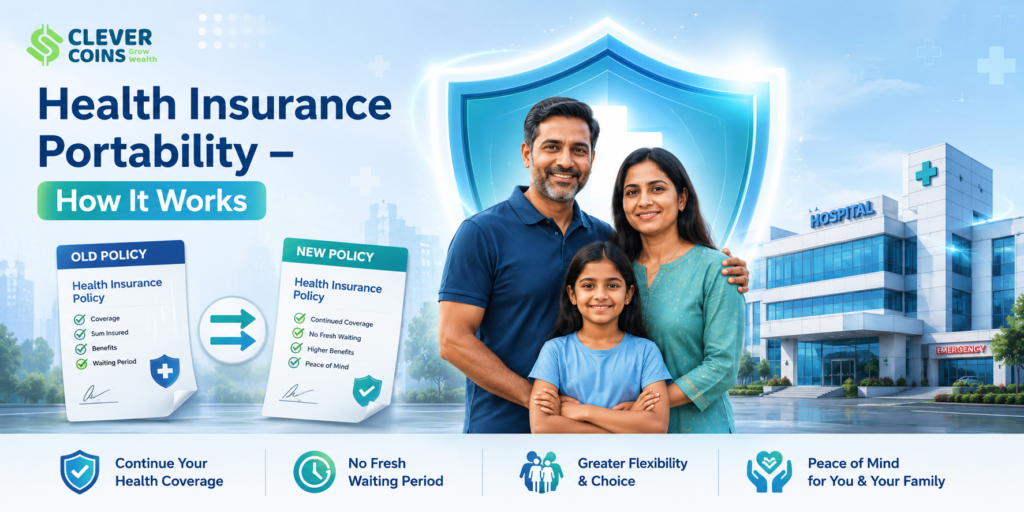
Health Insurance Portability is a facility that allows a health insurance policyholder to transfer their existing health insurance policy to a different insurance company at the time of renewal, while retaining certain accrued benefits.
Before portability was introduced in India (effective 1 October 2011 by IRDAI), policyholders were virtually locked into their insurer. Switching meant losing all accumulated benefits — particularly the waiting period credits for pre-existing diseases. This gave insurers little incentive to improve service or pricing, and customers had no real power to walk away.
Portability changed this dynamic entirely. It brought a market-driven approach to health insurance, benefiting consumers and pushing insurers to compete more aggressively on price, features, and service.
Key Principle of Portability
The core principle is simple: the receiving (new) insurer must give credit for the waiting period(s) already served with the previous insurer for pre-existing diseases and specific illnesses. This means if you have completed 2 years of a 4-year PED waiting period with your current insurer, the new insurer can only impose a remaining 2-year waiting period — not start fresh from zero.
📋 Legal Basis (IRDAI 2026) Health insurance portability in India is governed by IRDAI (Health Insurance) Regulations, 2016, as amended and updated in 2024–2026. It applies to all individual health insurance policies and family floater policies issued by general insurance and standalone health insurance companies registered with IRDAI. |
Who Is Eligible for Health Insurance Portability?
Not everyone can port their policy at any time. There are specific eligibility conditions that must be met:
Individual and Family Floater Policy Holders
Both individual health insurance policyholders and those with family floater policies are eligible to port their health insurance policies. Corporate group health insurance policies, however, have a different portability structure and are not covered under the general individual portability rules.
Minimum Policy Tenure Requirement
As per the 2026 IRDAI guidelines, the policyholder must have maintained the policy continuously for at least one policy year (12 months) before applying for portability. Policies that have lapsed or have gaps in coverage may face restrictions.
Timely Application Is Mandatory
The portability request must be submitted to the new insurer at least 45 days before the renewal date of the existing policy. This is a critical deadline — missing it means you will have to wait for the next renewal cycle to apply for portability.
No Multiple Portability in the Same Year
A policyholder cannot port their policy multiple times in the same policy year. Portability is permitted once per renewal cycle.
Eligibility Condition | Requirement |
Policy Type | Individual / Family Floater |
Minimum Duration | At least 1 continuous year |
Application Deadline | Minimum 45 days before renewal |
Policy Status | Active, no lapse in coverage |
Frequency | Once per renewal cycle |
How Health Insurance Portability Works – Step by Step
The process of porting your health insurance in India involves multiple steps across both your current insurer and the new (receiving) insurer. Here is a detailed, step-by-step breakdown as per the 2026 process:
Step 1: Research and Identify a New Insurer
Begin by researching available health insurance plans in the market. Compare: Sum insured options, Premium costs (use online premium calculators), Network hospital coverage — especially in your city or region, Claim settlement ratio of the insurer (IRDAI publishes annual data), Features like room rent limits, co-payment clauses, sub-limits, and restoration benefits, and Customer service ratings and reviews.
In India, as of 2026, some of the top standalone health insurers include Niva Bupa (formerly Max Bupa), Star Health and Allied Insurance, Care Health Insurance, Aditya Birla Health Insurance, and ManipalCigna Health Insurance.
Step 2: Apply for Portability with the New Insurer
Once you have selected the new insurer, submit a portability request at least 45 days before your existing policy renewal date. You will need to fill out a Portability Form (also called a Proposal Form for portability) along with a separate Portability Request Form.
Step 3: New Insurer Requests Data from Current Insurer
After receiving your portability request, the new insurer will contact your existing insurer through IRDAI’s centralised portability database — known as the Insurance Information Bureau of India (IIB) portal. The current insurer is legally obligated to share your insurance history within 7 working days of the portability request.
Step 4: Underwriting Assessment by New Insurer
The new insurer reviews your claim history, policy details, and health disclosures to underwrite the new policy. They may request a medical examination, especially for high sum insured amounts (typically above ₹10 lakh) or for applicants above a certain age (usually 45 years). The new insurer has 15 days to make a decision. If no decision is communicated within 15 days, IRDAI regulations deem the portability as accepted.
Step 5: Policy Issuance and Continuity of Benefits
Once accepted, the new insurer issues a new policy. Key benefits carried forward from the old policy include: Pre-existing disease waiting period credit already completed, Cumulative Bonus (No-Claim Bonus) may or may not be portable — check specific insurer terms, Coverage continuity with no fresh waiting period for claims already settled.
⏱ Important Timelines Summary Apply for portability: At least 45 days before renewal | Current insurer to share data: Within 7 working days | New insurer to decide: Within 15 working days of receiving data | If no decision in 15 days: Portability is deemed accepted |
Benefits You Retain When You Port Your Health Insurance
One of the biggest fears policyholders have about switching is losing their hard-earned insurance benefits. The good news is that portability was specifically designed to protect your accumulated benefits. Here is what you retain:
1. Pre-Existing Disease (PED) Waiting Period Credit
This is the most significant benefit of portability. Under IRDAI regulations, all health insurance policies in India have a waiting period for pre-existing diseases — conditions you had before taking the policy. The standard PED waiting period under most Indian policies is 3 years (36 months), though from 2023 IRDAI regulations, this has been capped at a maximum of 3 years.
When you port: If you have completed 2 years of the PED waiting period, the new insurer can only apply a remaining 1-year waiting period. If you have completed the full 3-year PED waiting period, the new insurer cannot impose any new PED waiting period.
2. Specific Disease Waiting Period Credit
Apart from PED, many policies have specific waiting periods for conditions like hernias, cataracts, joint replacements, sinusitis, and certain other ailments (typically a 2-year waiting period). The credit for waiting periods already served for such specific illnesses is also carried forward during portability.
3. Initial Waiting Period Waiver
Most health insurance policies have an initial 30-day waiting period from the commencement date, during which no claims are payable (except for accidental injuries). Upon porting, you do not have to serve this initial 30-day waiting period again with the new insurer.
4. Sum Insured Continuity
Your existing sum insured amount is recognised by the new insurer, and the PED credit is given up to the sum insured of your previous policy. If you choose a higher sum insured with the new insurer, the additional amount may carry its own waiting period conditions.
Benefit | Without Portability | With Portability |
PED Waiting Period | Starts fresh (3 years) | Credit for years completed |
Initial 30-Day Wait | Serves again | Waived off |
Specific Illness Wait | Starts fresh | Credit given |
Accumulated NCB | Lost | May be portable (insurer-specific) |
Coverage Continuity | Gap possible | Seamless transition |
What May NOT Be Ported – Important Limitations
While portability protects key benefits, there are certain things that may not transfer or may vary:
Cumulative Bonus (No-Claim Bonus)
The No-Claim Bonus (NCB) — the enhanced sum insured or premium discount earned for claim-free years — is not mandatorily portable under IRDAI rules. Some insurers may offer to carry it forward as a competitive feature, but it is at their discretion. Always check this before switching. Typical NCBs in the Indian market can range from 5% to 50% of the base sum insured per claim-free year, so this can be a significant benefit to potentially lose.
Premium Rate Benefits and Loyalty Discounts
Any long-term premium discounts or loyalty bonuses offered by your current insurer will not transfer to the new insurer.
Add-On Riders
If your current policy has specific add-on riders (e.g., OPD cover, maternity add-on, personal accident cover), these are not automatically portable. You will need to purchase equivalent riders separately with the new insurer.
Existing Pending Claims
Portability does not cover pending or in-progress claims with the current insurer. All active claims must be settled with the old insurer before the policy is ported.
Enhanced Sum Insured Portion
If you opt for a higher sum insured with the new insurer, the benefit carry-forward (PED credit etc.) applies only up to the sum insured of the old policy. The additional sum insured amount will be treated as fresh coverage and may have its own waiting periods.
Group to Individual Portability – IRDAI 2026 Update
A significant and extremely useful provision under the updated IRDAI guidelines is the ability to port from a Group (Corporate) Health Insurance Policy to an Individual Health Insurance Policy.
Why This Matters
Millions of Indian employees rely on their employer-provided group health insurance. However, when they resign, retire, or lose their job, this coverage ceases. Previously, such individuals had no health cover and had to purchase a fresh individual policy — which meant starting all waiting periods from scratch, often at a higher age with potential health complications.
IRDAI’s Group-to-Individual Portability Rule
As per updated IRDAI regulations applicable in 2026, employees leaving a group health insurance scheme are entitled to port their coverage to an individual or family floater policy with any insurer. The key benefits: No fresh waiting period for conditions covered under the group policy if the employee has been covered for the required period, The new insurer must offer a standard individual policy to the employee, The employee must apply within the specified migration window (typically within 30 days of cessation of group cover).
👔 Important for Job Changers & Retirees If you are leaving a job or retiring in 2026, do not let your group health insurance lapse. Immediately initiate the portability or migration process within 30 days to safeguard your health insurance continuity and avoid fresh waiting periods on your individual policy. |
Family Floater Policy Portability
Family floater policies that cover multiple members can also be ported. However, there are some important nuances:
Porting the Entire Family
The entire family covered under a floater policy can be ported together to a new family floater policy with the receiving insurer.
Splitting the Family Cover
Individual members of a family floater policy may also port individually to separate individual plans, subject to the new insurer’s underwriting terms. For example, if a couple has a joint family floater, one spouse could port to a separate individual policy while the other remains or also switches.
Age-Related Premium Recalculation
Upon porting a family floater, the new insurer will recalculate the premium based on the current ages of the covered members. This is standard practice and may result in a different premium than your current policy.
Premium Impact of Porting – What to Expect in 2026
One of the primary reasons people consider porting is the hope of lower premiums. Here is a realistic picture of premium dynamics during portability in India in 2026:
Premiums Are NOT Frozen During Portability
The new insurer will quote their own premium based on your current age, health status, sum insured, and their own underwriting criteria. Your old premium rate does not transfer. However, you can negotiate and compare — and with rising competition, you may indeed find better rates.
Age-Linked Premium Bands
In India, health insurance premiums are primarily age-linked. For example, a 35-year-old with a ₹5 lakh sum insured might pay approximately ₹8,000–₹12,000 per annum with established insurers, while a 50-year-old for the same cover may pay ₹18,000–₹28,000 per annum. These are indicative figures for 2026 and vary widely by insurer and plan features.
Loading Due to Health Conditions
If you have pre-existing medical conditions, the new insurer may apply a ‘loading’ — an additional premium charge — to account for the higher risk. This loading cannot be used as a reason to deny portability, but it may make the new policy more expensive.
Age Group | Sum Insured | Approx. Annual Premium (₹) | With NCB (Indicative) |
25–35 years | ₹5 Lakhs | ₹6,000 – ₹10,000 | ₹5,500 – ₹9,000 |
35–45 years | ₹10 Lakhs | ₹12,000 – ₹20,000 | ₹10,800 – ₹18,000 |
45–55 years | ₹10 Lakhs | ₹22,000 – ₹35,000 | ₹19,800 – ₹31,500 |
55–65 years | ₹15 Lakhs | ₹38,000 – ₹60,000 | ₹34,200 – ₹54,000 |
Note: These are indicative premium ranges for 2026, based on general market data. Actual premiums vary by insurer, city, health status, and specific plan features. Always get a personalised quote.
When Should You Consider Porting Your Health Insurance?
Portability is a powerful tool, but it is not always the right move for everyone. Here are the key situations when porting makes strong sense:
Reason 1: Poor Claim Settlement Experience
If your current insurer has a poor track record of settling claims — delays, rejections, excessive documentation demands, or unsatisfactory resolution of disputes — it is a strong signal to switch. Check the insurer’s Claim Settlement Ratio (CSR) published annually by IRDAI. A CSR above 90% is generally considered good.
Reason 2: High and Unjustified Premium Hike at Renewal
If your premium has increased dramatically at renewal without a commensurate improvement in benefits — and you find comparable or better coverage at a lower price elsewhere — portability is worth exploring.
Reason 3: Inadequate Network Hospitals
If your insurer’s cashless hospital network does not include good hospitals in your city, or if the hospitals you prefer are not empanelled, switching to an insurer with a better network in your area is a valid reason to port.
Reason 4: Better Features Available Elsewhere
The Indian health insurance market has evolved significantly. In 2026, many insurers offer features like No Room Rent Capping, No Sub-Limits on ICU charges, Unlimited Restoration Benefit, OPD Coverage, Mental Health Coverage (now mandated by IRDAI), Domiciliary Treatment Cover, and Annual Health Check-ups. If your current policy lacks these and you find a comprehensive plan at a competitive price, porting makes sense.
Reason 5: Insurer Solvency or Reputation Concerns
If you have concerns about the financial stability or reputation of your current insurer, switching to a more established and financially strong company is a prudent decision.
When You Should NOT Port Your Health Insurance
Just as important as knowing when to port is knowing when NOT to port. Here are situations where staying with your current insurer may be the smarter choice:
You Have a Recent or Ongoing Claim
If you have filed a claim recently or have an ongoing treatment, do not port until the claim is settled and your health has stabilised. Porting during or immediately after a major illness can trigger loading or exclusions by the new insurer.
You Are in the Middle of Waiting Periods
If you have recently started a specific waiting period (e.g., for a condition that will become claimable in 6 more months), it may be better to wait until after that period has been served before porting.
The New Policy Has Fewer Features Despite Lower Premium
Never compromise on coverage quality for a marginally lower premium. A policy with sub-limits, room rent capping, and high co-payment clauses may cost less but can leave you significantly out-of-pocket during hospitalisation.
Your Current Insurer Has Strong Loyalty Benefits
If you have accumulated significant NCB (e.g., 50% increase in sum insured due to claim-free years), and the new insurer will not carry this forward, you may effectively be reducing your coverage by switching.
Documents Required for Health Insurance Portability
Having the right documents ready will make your portability process smooth and efficient. Here is the complete list of documents typically required in 2026:
Mandatory Documents
- Duly filled Portability/Proposal Form of the new insurer
- Copy of all previous health insurance policies (last 3-5 years)
- Previous policy premium payment receipts
- Complete claim history document (obtained from current insurer or IIB portal)
- Medical history and reports for any pre-existing conditions
- IRDAI Portability Form (Port Form 1 and Port Form 2 as applicable)
- KYC Documents: Aadhaar Card, PAN Card, Passport, or Voter ID
- Recent passport-size photographs
- Age proof (if required by new insurer)
- Income proof (if required for high sum insured — typically above ₹25 lakh)
For Group-to-Individual Portability
- Employer letter confirming cessation of employment / retirement
- Group insurance certificate of coverage
- Last renewal notice from group insurer
IRDAI’s Role and Your Rights as a Policyholder
The Insurance Regulatory and Development Authority of India (IRDAI) is the apex regulatory body that governs all insurance activities in India, including health insurance portability.
Your Rights Under IRDAI Portability Guidelines (2026)
- Right to Port: Every individual health insurance policyholder has the right to port their policy to any IRDAI-registered general or health insurer at the time of renewal.
- Right to Credit: The new insurer must credit the waiting period already served with the previous insurer for pre-existing diseases and specified conditions.
- Right to Transparency: Both current and new insurers must provide clear information about the portability process, timelines, and benefit carry-forwards.
- Right to Timely Decision: If the new insurer does not communicate a decision within 15 days, the portability is deemed to have been accepted.
- Right to Grievance Redressal: If your portability request is unjustly denied, you can file a complaint with the IRDAI’s Integrated Grievance Management System (IGMS) or approach the Insurance Ombudsman.
IRDAI Grievance Helpline
IRDAI Toll-Free Helpline: 155255 or 1800 4254 732 (accessible from all networks in India, 2026)
IRDAI Consumer Portal: igms.irda.gov.in
Health Insurance Portability vs Health Insurance Migration – Key Difference
These two terms are often used interchangeably but have distinct meanings in the Indian insurance context:
Parameter | Portability | Migration |
Definition | Switching from one insurer to another | Switching within the same insurer (different plan) |
Insurer Change | Yes – new insurer | No – same insurer, different product |
Benefit Credit | PED & waiting period credit | Full benefit carry-forward |
Application | To the new insurer | To the same insurer |
Common Use Case | Better deal from competitor | Upgrading to a more comprehensive plan |
IRDAI Regulation | Full portability guidelines apply | Migration guidelines of respective insurer |
Tax Benefits on Ported Health Insurance Policies
Health insurance premiums paid in India qualify for tax deductions under Section 80D of the Income Tax Act. This benefit continues seamlessly even after porting your policy — there is no tax implication or loss of benefit due to the act of porting itself.
Section 80D Deduction Limits (2026 – As Per Existing Law)
- For Self, Spouse, and Children (below 60 years): Up to ₹25,000 per annum
- For Self, Spouse, and Children (any member above 60 years): Up to ₹50,000 per annum
- For Parents below 60 years: Additional ₹25,000
- For Parents above 60 years (Senior Citizens): Additional ₹50,000
- Maximum total deduction possible (if both self and parents are senior citizens): Up to ₹1,00,000 per annum
Note: Preventive health check-up expenses of up to ₹5,000 are included within the overall 80D limit. These limits are as per the Finance Act applicable for Assessment Year 2026-27.
Common Mistakes to Avoid During Portability
Mistake 1: Missing the 45-Day Deadline
The most common and costly mistake is failing to submit the portability application 45 days before renewal. Set a calendar reminder well in advance — ideally 60 days before renewal — so you have ample time to research and apply.
Mistake 2: Not Disclosing Medical History Honestly
Always provide complete and honest medical history when applying for portability. Non-disclosure can lead to claim rejection in the future, and insurers have access to your IIB claim history. Hiding information is not only unethical but counterproductive.
Mistake 3: Choosing Based Solely on Premium
The cheapest policy is not necessarily the best. Carefully compare sub-limits, co-payment clauses, room rent restrictions, exclusions, and network hospital quality before deciding.
Mistake 4: Not Getting the Portability Benefits in Writing
Before finalising the portability, get written confirmation from the new insurer specifying exactly which waiting period credits are being carried forward and the effective sum insured for benefit continuity.
Mistake 5: Porting Without Comparing Claim Settlement Ratios
Always check the new insurer’s Incurred Claim Ratio (ICR) and Claim Settlement Ratio (CSR). An ICR significantly below 100% may indicate that the insurer is being highly selective in settling claims. IRDAI publishes this data annually on its official website.
Health Insurance Portability for Senior Citizens – Special Considerations
Senior citizens (age 60 and above) face unique challenges with health insurance portability. Here is what they need to know:
Higher Premiums Post-Porting
For senior citizens, premiums are significantly higher. A 65-year-old porting from one insurer to another for a ₹10 lakh sum insured may face premiums ranging from ₹50,000 to ₹80,000 or more per annum in 2026, depending on health status and insurer.
Medical Underwriting
Most insurers will require senior citizens to undergo a pre-policy medical examination before accepting portability. Existing health conditions will be scrutinised more closely, and loading may be applied.
Senior Citizen Specific Plans
In 2026, several insurers offer dedicated senior citizen health plans (e.g., Star Health’s Senior Citizens Red Carpet, Niva Bupa’s Senior First) that can be better suited for portability than standard plans. These are designed with age-appropriate features, including higher PED coverage tolerance and lower co-payment options.
IRDAI’s Stance on Senior Citizen Portability
IRDAI has repeatedly emphasised that insurers cannot arbitrarily deny portability to senior citizens. Blanket age-based rejection is not permitted. However, insurers can apply reasonable loading or conditions based on medical underwriting.
Future of Health Insurance Portability in India – 2026 and Beyond
The health insurance portability landscape in India is rapidly evolving. Here are key trends shaping its future:
Digital and Instant Portability
IRDAI is working towards a more seamless, digital portability process. The Insurance Information Bureau (IIB) is being upgraded to enable faster data exchange between insurers, potentially reducing the process from weeks to days.
Account Aggregator Framework
India’s Account Aggregator (AA) framework, which enables consent-based sharing of financial data, is being extended to insurance data. This will make it easier for policyholders to share their complete insurance history with new insurers securely and instantly.
Bima Sugam – IRDAI’s Digital Insurance Marketplace
IRDAI’s ambitious Bima Sugam platform, being developed and refined in 2025–2026, aims to be a one-stop digital marketplace for buying, renewing, and porting health insurance policies. When fully operational, it is expected to make health insurance portability as simple as a few clicks.
Increased Product Standardisation
IRDAI’s push towards standardised health insurance products (Arogya Sanjeevani being the flagship standard product) makes comparison and portability easier for consumers who choose these standardised policies.
Practical Portability Checklist – Before You Port
Use this checklist before initiating the health insurance portability process:
- Check renewal date — apply for portability at least 45 days before
- Review your current policy — note sum insured, NCB accumulated, PED waiting period status
- Research at least 3–5 new insurers and plans
- Compare features: Room rent limits, sub-limits, co-payment, restoration, OPD, network hospitals
- Check Claim Settlement Ratio (target above 90%) and Incurred Claim Ratio
- Get a premium quote for your exact age, health status, and desired sum insured
- Confirm which waiting period credits will be carried forward — get it in writing
- Check if your NCB will be ported or lost — factor this into your decision
- Gather all required documents — policy copies, claim history, KYC documents
- Submit portability application with all documents to new insurer
- Follow up to ensure current insurer has shared your data within 7 working days
- Await the new insurer’s decision within 15 working days
- Review the new policy document carefully before accepting
- Ensure there is no gap in coverage between old and new policy
Conclusion
Health Insurance Portability is one of the most consumer-friendly provisions in India’s insurance regulatory framework. It empowers you to demand better service, fairer premiums, and more comprehensive coverage — without sacrificing the benefits you have worked to accumulate.
In 2026, with India’s health insurance market more competitive than ever — over 30 IRDAI-registered health and general insurers offering hundreds of plans — portability gives you genuine bargaining power. Whether you are dissatisfied with claims service, facing a steep premium hike, or simply finding that another insurer’s product is a better fit for your evolving needs, porting your health insurance is a well-supported, legally protected option.
The key is to be informed, proactive, and strategic. Understand what you will carry forward, what you might lose, compare comprehensively, and never compromise coverage depth for a short-term premium saving. Your health coverage is an investment in your well-being — make sure it is working as hard as it should be.
✅ Key Takeaway Health insurance portability in India allows you to switch insurers at renewal while retaining PED waiting period credits. Apply at least 45 days before renewal, gather all documents, and compare plans carefully. You deserve the best health insurance — and with portability, you have the power to get it. |