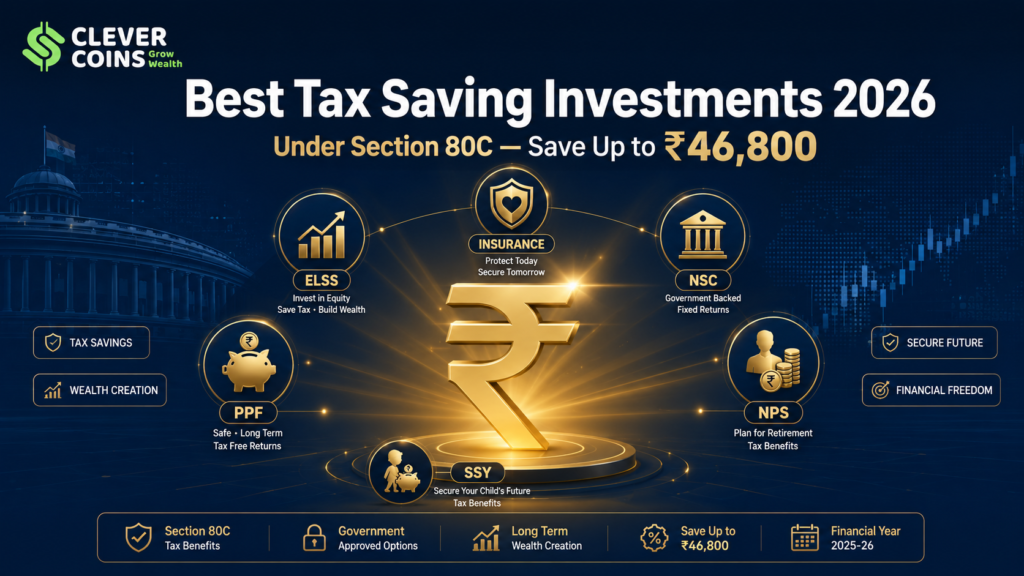
Are you looking for the best ways to save taxes while also growing your wealth? If yes, you have arrived at the right place. Under Section 80C of the Income Tax Act, 1961, every Indian taxpayer — whether salaried, self-employed, or a business owner — can claim deductions of up to ₹1,50,000 per financial year.
However, with so many options available — from PPF to ELSS, from NPS to tax-saving FDs — choosing the right one can be overwhelming. This comprehensive guide, updated for FY 2025-26 and AY 2026-27, breaks down every eligible investment option, compares their returns, lock-in periods, risk levels, and tax benefits, so you can make the most informed decision possible.
What Is Section 80C and Why Does It Matter?
Section 80C is one of the most popular and widely used sections of the Income Tax Act, 1961. It allows individual taxpayers and Hindu Undivided Families (HUFs) to reduce their taxable income by up to ₹1,50,000 per year by investing in specified instruments or making certain payments.
Who Can Claim Section 80C Deductions?
- Individual taxpayers (resident and non-resident)
- Hindu Undivided Families (HUFs)
- Both salaried employees and self-employed professionals
- Note: Companies, LLPs, and partnership firms are NOT eligible
Tax Savings Potential by Income Bracket (FY 2025-26)
Tax Bracket | Tax Rate | Max Tax Saved on ₹1.5 Lakh |
₹3L – ₹7L (New Regime) | 5% | ₹7,500 |
₹7L – ₹10L (Old Regime) | 20% | ₹31,200 |
Above ₹10L (Old Regime) | 30% | ₹46,800 |
Above ₹15L (New Regime) | 30% | ₹46,800 |
⚠️ Important Note (2026 Update): From FY 2024-25 onwards, the New Tax Regime is the default regime. Section 80C deductions are NOT available under the New Tax Regime. You must opt for the Old Tax Regime to avail 80C benefits. Choose your regime wisely based on your total deductions. |
Complete List of Tax Saving Investments Under ₹1.5 Lakh (Section 80C)
Let us explore every single eligible instrument under Section 80C in detail.
- Equity Linked Savings Scheme (ELSS) — Best for Wealth Creation
📈 ELSS Snapshot | |
Parameter | Details |
Lock-in Period | 3 Years (Shortest among 80C options) |
Expected Returns | 12% – 18% p.a. (market-linked, not guaranteed) |
Risk Level | High (Equity Market Risk) |
Tax on Returns | LTCG at 12.5% above ₹1.25 lakh gain (post 2024 Budget) |
Minimum Investment | ₹500 per month (SIP) or lump sum |
Who Should Invest | Taxpayers with 3+ year horizon and moderate-to-high risk appetite |
ELSS mutual funds invest primarily in equities and are the only mutual fund category eligible for Section 80C benefits. With a lock-in of just 3 years — the shortest among all 80C instruments — ELSS also has the potential to deliver the highest inflation-beating returns.
Top-performing ELSS funds in 2026 include: Mirae Asset Tax Saver Fund, Axis Long Term Equity Fund, Canara Robeco Equity Tax Saver, and Quant Tax Plan Fund.
- You can invest via monthly SIP starting at just ₹500
- Each SIP instalment has its own 3-year lock-in
- Eligible for LTCG tax exemption up to ₹1.25 lakh per year
- Public Provident Fund (PPF) — Best for Safe, Long-term Savings
Parameter | Details |
Current Interest Rate | 7.1% p.a. (compounded annually, Q1 FY 2025-26) |
Lock-in Period | 15 years (partial withdrawal after 7 years) |
Risk Level | Zero Risk (Government Backed) |
Tax Treatment | EEE (Exempt-Exempt-Exempt) — Fully Tax-Free |
Minimum Investment | ₹500 per year |
Maximum Investment | ₹1,50,000 per year |
Where to Open | Post Office, SBI, HDFC, ICICI, Axis Bank, and more |
PPF remains one of the most trusted tax-saving instruments for risk-averse investors. The Triple Tax Benefit (EEE) makes it exceptional — your investment, interest earned, and maturity amount are all tax-free. With ₹1.5 lakh invested annually for 15 years at 7.1%, you accumulate approximately ₹40.68 lakh completely tax-free.
- Employee Provident Fund (EPF) — Automatic Tax Saving for Salaried Employees
Parameter | Details |
Current Interest Rate | 8.25% p.a. (for FY 2024-25, declared by EPFO) |
Contribution | 12% of Basic + DA (Employee) + 12% (Employer) |
Tax Treatment | EEE up to ₹2.5L/year employee contribution |
Lock-in Period | Till retirement (withdrawal rules apply) |
Who It Applies To | All salaried employees in organized sector |
For most salaried employees, EPF contribution is automatic and already forms part of their Section 80C limit. The employer’s contribution is an additional benefit that is not taxed in the employee’s hands (subject to limits). Employees can also make Voluntary Provident Fund (VPF) contributions for additional 80C benefits.
- National Pension System (NPS) — Best for Retirement + Additional Tax Benefit
🎯 NPS Dual Tax Benefit: ₹1.5 lakh under 80C (Tier-I) + ₹50,000 additional deduction under Section 80CCD(1B) = Total ₹2 lakh deduction! |
Parameter | Details |
Returns | Market-linked: 9–12% p.a. (Equity Tier), 7–9% (Debt Tier) |
Lock-in | Till age 60 (partial withdrawal allowed after 3 years) |
Maturity Rule | 60% lump sum (tax-free) + 40% mandatory annuity |
Additional Benefit | Extra ₹50,000 deduction under Sec 80CCD(1B) |
Tax on Annuity | Taxable as per income slab |
Who Should Choose | Long-term retirement investors who want market-linked returns |
- National Savings Certificate (NSC) — Best for Conservative Short-term Investors
Parameter | Details |
Current Interest Rate | 7.7% p.a. (compounded annually, FY 2025-26) |
Lock-in Period | 5 years |
Risk Level | Zero (Government Guaranteed) |
Tax on Interest | Taxable (but interest reinvested is eligible for 80C again) |
Minimum Investment | ₹1,000 (no maximum limit) |
NSC is issued by India Post and is backed by the Government of India. A unique feature is that the interest accrued each year (except the final year) is deemed to be reinvested and can be claimed again under Section 80C, reducing your effective tax burden. NSC is available at all post offices across India
- Tax Saving Fixed Deposit (5-Year FD) — Best for Bank FD Lovers
Parameter | Details |
Interest Rate | 6.5% – 7.5% p.a. (varies by bank, 2026) |
Lock-in Period | 5 years (premature withdrawal NOT allowed) |
Risk Level | Very Low (DICGC insured up to ₹5 lakh) |
Tax on Interest | Fully Taxable as per slab; TDS applies |
Minimum Investment | ₹100 (most banks) |
Who Should Invest | Senior citizens, conservative investors, retirees |
Senior citizens get an additional 0.25%–0.50% higher interest rate on tax-saving FDs. However, unlike PPF or ELSS, interest income is taxable, which reduces the effective post-tax returns significantly for those in higher tax brackets. Best suited for those in the 0% or 5% tax slab.
- Sukanya Samriddhi Yojana (SSY) — Best for Girl Child’s Future
👧 SSY is EEE — Completely Tax-Free! Highest interest rate among all small savings schemes. |
Parameter | Details |
Current Interest Rate | 8.2% p.a. (highest among all small savings, FY 2025-26) |
Eligibility | Girls below age 10 (one account per girl, max 2 accounts per family) |
Lock-in | Till girl turns 21, or marriage after age 18 |
Deposit Period | Active for 15 years from account opening |
Min/Max Deposit | ₹250/year – ₹1,50,000/year |
Tax Treatment | EEE (Fully Tax-Free) |
- Unit Linked Insurance Plan (ULIP) — Insurance + Investment Combo
Parameter | Details |
Returns | Market-linked: 8%–14% p.a. depending on fund allocation |
Lock-in Period | 5 years |
Tax on Maturity | Tax-free if annual premium ≤ ₹2.5 lakh |
Risk | Medium to High |
Benefit | Life insurance + investment in single plan |
Who Should Choose | Those who want insurance + investment in one product |
Post-2021 Budget amendment: ULIP maturity proceeds are taxable if the annual premium exceeds ₹2.5 lakh. For premiums within this limit, ULIP still offers tax-free maturity. Choose ULIPs with low charges and a good track record. Compare ULIP vs ELSS before deciding.
- Senior Citizen Savings Scheme (SCSS) — Best for Retirees Above 60
Parameter | Details |
Interest Rate | 8.2% p.a. (quarterly payout) |
Eligibility | Age 60+, or 55-60 for VRS/superannuation retirees |
Lock-in | 5 years (extendable by 3 more years) |
Maximum Investment | ₹30 lakh (revised from ₹15 lakh — Budget 2023) |
Tax on Interest | Taxable; TDS if interest > ₹50,000/year for seniors |
- Life Insurance Premium — Fundamental Financial Protection
Premiums paid for life insurance policies (including term plans, endowment plans, and traditional plans) qualify for Section 80C deduction, subject to these conditions:
- Premium must not exceed 10% of the Sum Assured (for policies issued after 1 April 2012)
- Policy must be in your name, spouse’s name, or children’s names
- If the policy is surrendered within 2 years (for non-ULIP), the benefit is reversed
- Pure term insurance premiums also qualify — best combination of protection + tax saving
- Home Loan Principal Repayment — Save Tax While Owning Your Home
The principal component of your home loan EMI qualifies for Section 80C deduction. Additionally:
- Stamp duty and registration charges for house purchase also qualify in the year of payment
- This is subject to the overall ₹1.5 lakh limit of Section 80C
- Note: The house must not be sold within 5 years of possession; otherwise the benefit is reversed
- Interest component of home loan qualifies separately under Section 24(b) up to ₹2 lakh
- Children’s Tuition Fees — Education and Tax Saving Together
Tuition fees paid for up to 2 children for full-time education in any Indian school, college, or university are eligible under Section 80C. This includes:
- School fees, college fees, university fees
- Does NOT include: donation, development fees, hostel charges, or private coaching fees
- Available to both mother and father individually (so a couple can claim for up to 4 children between them)
Side-by-Side Comparison of All Section 80C Instruments
Investment Option | Returns (p.a.) | Lock-in |
ELSS Mutual Funds | 12–18% (Market) | 3 Years |
PPF | 7.1% (Fixed) | 15 Years |
EPF / VPF | 8.25% (Fixed) | Till Retirement |
NPS (Tier-I) | 9–12% (Market) | Till Age 60 |
NSC | 7.7% (Fixed) | 5 Years |
Tax Saving FD | 6.5–7.5% (Fixed) | 5 Years |
SSY | 8.2% (Fixed) | 21 Years |
SCSS | 8.2% (Fixed) | 5 Years |
ULIP | 8–14% (Market) | 5 Years |
Life Insurance | 4–6% (Endowment) | Policy Term |
How to Maximise Your ₹1.5 Lakh Tax Saving — Smart Strategy for 2026
Recommended Allocation Strategies Based on Age & Risk Profile
🎯 Strategy A: Young Professional (Age 25–35, High Risk Appetite) • ELSS Mutual Funds: ₹75,000 (SIP of ₹6,250/month) • PPF: ₹50,000 per year • Life Insurance Premium (Term Plan): ₹25,000 per year Total: ₹1,50,000 | Expected Tax Saving: ₹46,800 | Expected Returns: 12–15% p.a. blended |
🎯 Strategy B: Mid-Career Professional (Age 35–50, Moderate Risk) • EPF / VPF: ₹60,000 per year (already deducted for most) • NPS (80C portion): ₹40,000 (+ additional ₹50,000 under 80CCD1B) • ELSS: ₹30,000 • Life Insurance Premium: ₹20,000 Total: ₹1,50,000 | Expected Tax Saving: ₹31,200–₹46,800 | Expected Returns: 10–13% p.a. blended |
🎯 Strategy C: Conservative / Senior Investor (Age 50+, Low Risk) • SCSS: ₹30,00,000 (lifetime investment, but 80C limit applies per year) • SSY (if applicable): ₹1,50,000 • Tax Saving FD: ₹1,00,000 • NSC: ₹50,000 Total: ₹1,50,000 | Expected Tax Saving: Up to ₹46,800 | Returns: 7.5–8.2% p.a. |
Beyond Section 80C: Additional Tax Saving Opportunities in 2026
While ₹1.5 lakh under Section 80C is powerful, you can save even more taxes with these additional deductions:
Section | Benefit Available |
Sec 80CCD(1B) — NPS | Additional ₹50,000 deduction over and above 80C limit |
Sec 80D — Health Insurance | ₹25,000 (self/family) + ₹25,000 (parents) = ₹50,000 |
Sec 80D — Senior Parents | ₹50,000 if parents are senior citizens (60+ years) |
Sec 24(b) — Home Loan Interest | Up to ₹2,00,000 deduction on home loan interest |
Sec 80E — Education Loan | 100% deduction on interest for 8 years (no upper limit) |
Sec 80G — Donations | 50%–100% deduction for donations to eligible charities/PM Fund |
Sec 80TTA/80TTB — Savings Interest | ₹10,000 (general) / ₹50,000 (senior citizens) on savings interest |
Sec 80U — Disability | ₹75,000–₹1,25,000 for persons with disability |
Old Tax Regime vs New Tax Regime: Which Should You Choose in 2026?
After Union Budget 2025 (effective FY 2025-26), the income tax slabs under the New Tax Regime have been revised. Here’s a quick comparison:
Income Slab | Old Regime Rate | New Regime Rate (Revised) |
Up to ₹3,00,000 | Nil | Nil |
₹3,00,001 – ₹7,00,000 | 5% | 5% |
₹7,00,001 – ₹10,00,000 | 20% | 10% |
₹10,00,001 – ₹12,00,000 | 30% | 15% |
₹12,00,001 – ₹15,00,000 | 30% | 20% |
Above ₹15,00,000 | 30% | 30% |
Under the New Regime: Standard deduction of ₹75,000 is available. However, Section 80C, 80D, HRA, and most other deductions are NOT available. Choose Old Regime if your total deductions (80C + 80D + HRA + NPS + home loan) exceed approximately ₹3.75 lakh. Otherwise, the New Regime may offer lower taxes.
Common Mistakes to Avoid While Tax Planning
- ❌ Waiting till March to invest in 80C — Start SIP from April itself
- ❌ Investing only for tax saving, not for returns — Choose instruments based on goals
- ❌ Ignoring employer’s EPF contribution in 80C calculation — It counts toward limit
- ❌ Not declaring Form 15G/15H — Senior citizens should submit to avoid TDS on FD/NSC
- ❌ Buying insurance for 80C alone — Term insurance is better; endowments give poor returns
- ❌ Over-investing in traditional plans — Diversify across ELSS, PPF, and NPS
- ❌ Missing the regime selection deadline — Submit Form 10-IEA by due date for old regime
- ❌ Not keeping investment proofs — Maintain all receipts, account statements, and premium certificates
Frequently Asked Questions (FAQs) — Tax Saving Investments 2026
Q1. Can I claim 80C deductions under the New Tax Regime?
No. Section 80C deductions are exclusively available under the Old Tax Regime. If you opt for the New Tax Regime (which is the default from FY 2024-25), you cannot claim 80C benefits.
Q2. Is ₹1.5 lakh the total limit for all 80C investments combined?
Yes. The aggregate deduction across all 80C instruments (ELSS + PPF + NSC + Insurance + etc.) cannot exceed ₹1,50,000 in a single financial year. However, NPS has an additional ₹50,000 under Section 80CCD(1B) over and above this limit.
Q3. What is the best 80C investment for maximum returns?
ELSS (Equity Linked Savings Scheme) has historically delivered the highest returns (12–18% p.a.) among all 80C instruments, with the shortest lock-in period of 3 years. However, it carries market risk and is suitable for investors with a moderate-to-high risk appetite.
Q4. Can a housewife or homemaker invest in PPF or ELSS for 80C?
Yes, any individual taxpayer can invest in PPF or ELSS and claim 80C deductions, provided they have taxable income. If a homemaker has no income, they will have no tax liability and hence no benefit from 80C deductions.
Q5. Can I invest more than ₹1.5 lakh in PPF?
No. The maximum PPF deposit per year is ₹1,50,000. However, only ₹1,50,000 is eligible for the 80C deduction. Any excess investment above this limit cannot be made in PPF.
Q6. Is SCSS interest taxable?
Yes. Interest earned from SCSS is taxable as per your income tax slab. However, TDS is deducted only if the total SCSS interest exceeds ₹50,000 in a year (for senior citizens). You can submit Form 15H to avoid TDS if your income is below the taxable limit.
Conclusion: Build a Tax-Smart Investment Portfolio in 2026
Tax saving under Section 80C is not just about reducing your tax outgo — it is an opportunity to build long-term wealth. The ₹1.5 lakh annual limit, if invested wisely, can generate significant wealth over time while ensuring complete tax compliance.
Here is your action plan for FY 2025-26:
- Step 1: Calculate your existing 80C investments (EPF, insurance premiums, home loan principal, tuition fees)
- Step 2: Identify the gap remaining in your ₹1.5 lakh limit
- Step 3: Allocate the remaining amount to ELSS, PPF, or NPS based on your risk appetite
- Step 4: Also invest ₹50,000 in NPS under Section 80CCD(1B) for extra savings
- Step 5: Decide between Old and New Tax Regime before the financial year begins
- Step 6: Submit your investment proofs to your employer by December-January for Form 16