Why Reading Your Credit Report Matters in 2026
In today’s credit-driven financial landscape, your credit report is one of the most powerful documents that defines your financial identity. Whether you are applying for a home loan, a personal loan, a car loan, or even a credit card, lenders in India look at your credit report before making any lending decision. Yet, a large majority of Indians have never read their own credit report — and this is a costly mistake.
As of 2026, the Reserve Bank of India (RBI) mandates that every Indian citizen is entitled to one free credit report per year from each of the four licensed credit bureaus in India — TransUnion CIBIL, Experian, Equifax, and CRIF High Mark. Understanding your credit report is not just a financial best practice — it is your right as a consumer.
This comprehensive guide will walk you through every section of a credit report, how to interpret the data, how to spot errors, and how to use this information to improve your financial health. Whether you are a first-time borrower or a seasoned professional managing multiple credit accounts, this guide is designed to empower you with the knowledge you need in 2026.
Did You Know? According to a 2025 TransUnion CIBIL report, over 60% of loan rejections in India are linked to poor or unknown credit history. Reading and managing your credit report is the first step to financial freedom. |
What is a Credit Report?
A credit report is a detailed statement that contains your credit history. It is compiled by credit bureaus — also called Credit Information Companies (CICs) — and is based on data submitted by banks, Non-Banking Financial Companies (NBFCs), and other lending institutions. In India, there are four RBI-licensed credit bureaus:
- TransUnion CIBIL (most widely used in India)
- Experian India
- Equifax India
- CRIF High Mark
Each bureau collects data independently and may show slightly different scores and details based on the lenders that report to them. However, all four follow guidelines laid out by the RBI’s Credit Information Companies (Regulation) Act, 2005 (amended up to 2026).
Credit Report vs. Credit Score: Understanding the Difference
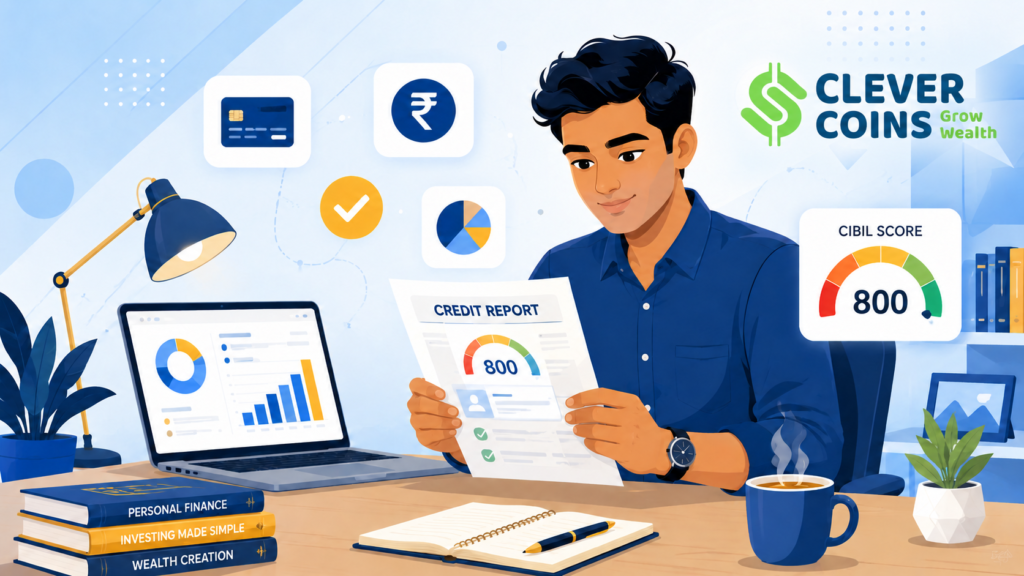
A credit report is the full, detailed record of your credit history — it lists every loan, credit card, repayment, and inquiry. A credit score is a three-digit numerical summary (typically between 300 and 900 for CIBIL) that is derived from the data in your credit report. Think of the credit report as a detailed report card and the credit score as your final grade.
Feature | Details |
What it is | Detailed record of all your credit accounts |
Issued by | TransUnion CIBIL, Experian, Equifax, CRIF High Mark |
Score Range | 300 – 900 (CIBIL); 300 – 850 (Experian/Equifax) |
Good Score | 750 and above (ideal for loan approvals) |
Free access | Once per year per bureau (RBI mandate 2026) |
Update frequency | Monthly (as reported by lenders) |
How to Get Your Free Credit Report in India (2026)
As per RBI guidelines effective from 2026, every individual is entitled to one free credit report annually from each of the four credit bureaus. Here is a step-by-step process to access your credit report:
Step 1: Visit the Official Credit Bureau Website
Go to the official website of any one of the four bureaus. The RBI-approved portals are:
- TransUnion CIBIL: www.cibil.com
- Experian India: www.experian.in
- Equifax India: www.equifax.co.in
- CRIF High Mark: www.crifhighmark.com
Step 2: Register / Log In
Create an account by providing your basic details: full name as per PAN card, date of birth, PAN number, mobile number, and email ID. You may be asked to complete an OTP-based verification.
Step 3: Identity Verification (KYC)
You will need to verify your identity. Common verification methods accepted in 2026 include Aadhaar-based OTP, PAN card details, or by answering authentication questions based on your credit history (such as your last EMI amount or existing loan type).
Step 4: Download Your Credit Report
Once verified, you can view and download your credit report in PDF format. Your free annual report will be available at no cost. Additional reports during the year may be purchased. As of 2026, the typical cost for an additional CIBIL report is approximately Rs. 550 and for the full CIBIL Score + Report pack is Rs. 1,200 per year.
Step 5: Save and Review
Save your credit report securely. Print it if needed. Review each section carefully using the guidance in this blog.
Understanding the Key Sections of Your Credit Report
A typical Indian credit report is divided into several important sections. Let us break down each one in detail:
Section 1: Personal Information
This section contains your basic identification details as reported by lenders. It includes:
- Full Name (as reported by various lenders — may appear in variations)
- Date of Birth
- Gender
- PAN Number
- Passport Number (if provided)
- Voter ID / Aadhaar (if available)
- Current and previous addresses
- Phone numbers and email addresses on record
Important Note: Check this section carefully. If you notice any incorrect name spellings, wrong PAN number, or wrong date of birth, raise a dispute immediately with the bureau. Incorrect personal details can affect your ability to get credit. |
Section 2: Credit Summary (Overview)
This is a snapshot of your overall credit profile. It typically includes:
- Total number of accounts (open + closed)
- Total credit limits across all credit cards
- Total outstanding balances
- Number of active loans
- Number of overdue accounts (if any)
- Number of credit inquiries in the past 12 months
This section gives both you and lenders a quick picture of your overall debt load and credit activity.
Section 3: Account Information (Credit Account Details)
This is the most detailed and important section of your credit report. It lists all your credit accounts — both current and past — and contains the following for each account:
- Name of the lender (bank or NBFC)
- Type of account (Home Loan, Personal Loan, Auto Loan, Credit Card, Education Loan, etc.)
- Account number (partially masked for security)
- Date when the account was opened
- Date of last activity / last payment
- Sanctioned amount or credit limit
- Current outstanding balance
- Amount overdue (if any)
- EMI amount (for loans)
- Repayment history (shown month by month — often for 24-36 months)
- Account status (Active, Closed, Written-Off, Settled, etc.)
Understanding Repayment History Codes
The repayment history for each account is shown month by month. Each month is typically coded as follows:
Code / Indicator | Meaning |
000 / STD | Standard – Payment made on time (ideal) |
SMA | Special Mention Account – Overdue 1-89 days |
SUB | Sub-Standard – Overdue 90 days to 12 months |
DBT | Doubtful – Overdue for more than 12 months |
LSS | Loss – Account written off as a loss |
XXX | No data reported for that month |
WO | Written Off – Lender has written off the account |
SET | Settled – Settled for less than the full amount owed |
Section 4: Enquiry Information
Every time you apply for a loan or a credit card, the lender pulls your credit report. This is called a hard inquiry. This section lists all hard enquiries made in the past 24 months. Each entry shows:
- Date of the enquiry
- Name of the lender who made the enquiry
- Type of credit applied for (e.g., Home Loan, Personal Loan)
- Amount enquired upon (if available)
Caution: Multiple hard enquiries within a short period (e.g., applying for 5 personal loans within 2 months) can significantly lower your credit score. Each hard enquiry can reduce your score by 5-10 points. Lenders may view this as credit-hungry behaviour. |
Note: Checking your own credit report is a soft enquiry and does not affect your score.
Section 5: Credit Score
Most credit reports issued in India include your credit score as a separate section or at the top of the report. CIBIL scores range from 300 to 900. Here is how to interpret your score in 2026:
Score Range | Category & Interpretation |
750 – 900 | Excellent – Best interest rates, easy loan approvals |
700 – 749 | Good – Most loans and credit cards approved |
650 – 699 | Fair – Approvals possible but at higher interest rates |
550 – 649 | Poor – High rejection risk; only secured credit possible |
300 – 549 | Very Poor – Extremely high rejection risk; rebuild required |
-1 or NH/NA | No History – No credit accounts found; new to credit |
How to Read the Repayment History Month by Month
The repayment history is the single biggest factor in your credit score — accounting for approximately 35% of the total score calculation. Here is how to read it correctly:
Each account in the Account Information section will show a grid or a series of monthly entries. Reading from right to left (most recent to oldest), each cell represents one month. A clean, consistent row of ‘000’ or ‘STD’ entries for 24-36 months is what ideal credit history looks like. Even a single missed EMI (shown as SMA or SUB) can pull your score down significantly.
What Lenders Look For
- No missed payments in the last 12 months
- No defaults or write-offs in the last 7 years
- Settled accounts viewed negatively — always pay in full
- Credit utilisation below 30% on credit cards
- A mix of secured loans (home, car) and unsecured credit (credit cards)
Common Credit Report Errors and How to Spot Them
Studies suggest that a significant number of credit reports contain at least one error. In India, errors are more common than many borrowers realise. Knowing what to look for can save you from an unjust loan rejection. Here are common errors to watch for:
Type 1: Personal Information Errors
- Misspelled name or name variations leading to merged reports
- Incorrect date of birth
- Wrong PAN number linked to your profile
- Incorrect address that does not match your current records
Type 2: Account Information Errors
- Accounts that do not belong to you (possible identity theft or mixed file)
- Loan accounts showing as active even after full repayment and closure
- Incorrect outstanding balances or credit limits
- Payments marked as late when they were made on time
- Duplicate accounts — same account appearing twice
Type 3: Enquiry Errors
- Hard enquiries from lenders you never approached
- Old enquiries that should have fallen off after 24 months
Type 4: Status Errors
- Accounts marked as ‘Written Off’ or ‘Settled’ that were paid in full
- Closed accounts still showing as active
How to Raise a Credit Report Dispute in India (2026 Process)
If you identify any error in your credit report, you have the legal right to dispute it under the Credit Information Companies (Regulation) Act, 2005 and the RBI Master Direction on Credit Information, 2025. The dispute resolution process is as follows:
Step 1: Raise a Dispute Online
Visit the official website of the bureau where you found the error (CIBIL, Experian, Equifax, or CRIF). Navigate to the ‘Dispute Resolution’ section and fill in the dispute form with the specific account details and the nature of the error.
Step 2: Submit Supporting Documents
Attach relevant proof: bank statements showing timely payments, loan closure certificates, NOC (No Objection Certificate) from the lender, or any other supporting documents.
Step 3: Bureau Forwards Dispute to Lender
The credit bureau forwards your dispute to the concerned lender within 3 working days. The lender is legally obligated to respond and investigate.
Step 4: Resolution Timeline
As per RBI guidelines 2025, the lender must resolve the dispute and update the bureau within 30 calendar days of the bureau receiving the complaint. If the error is confirmed, the bureau must update your report within 7 working days of confirmation.
Step 5: Escalation Options
If the bureau or lender does not resolve your dispute within 30 days, you can escalate the matter to:
- The RBI Ombudsman for Digital Lending / Banking Ombudsman (via cms.rbi.org.in)
- The National Consumer Disputes Redressal Commission (NCDRC)
- SEBI or respective regulator if the lender is an NBFC regulated by them
Pro Tip: Always follow up with the bureau in writing (email) after raising a dispute. Keep a record of all correspondence, including confirmation numbers and dates. If the error is from identity theft, also file a complaint with your local police station and keep the FIR copy. |
How Your Credit Report Affects Your Financial Life in India
Impact on Loan Approvals
A clean credit report with a score above 750 significantly increases your chances of loan approval. In 2026, most banks offer preferential interest rates to borrowers with high credit scores. For example, on a home loan of Rs. 50,00,000 (50 Lakhs), a borrower with a CIBIL score of 800 may get an interest rate of 8.50% per annum, whereas a borrower with a score of 650 may be charged 10.50% per annum — a difference that translates to over Rs. 6,000 extra per month in EMI and over Rs. 7,20,000 in total additional interest over 10 years.
Impact on Credit Card Approvals
Banks in India assess your credit report before issuing premium credit cards. A poor report may limit you to low-limit secured credit cards, while an excellent report opens doors to premium cards with high limits, cashback benefits, and reward points.
Impact on Employment Background Checks
In 2026, a growing number of employers in India — particularly in the BFSI sector (Banking, Financial Services and Insurance), senior management roles, and government-linked positions — conduct credit background checks as part of their hiring process. A report with defaults or write-offs could potentially impact your career opportunities in these sectors.
Impact on Rental Applications
Some landlords in metro cities like Mumbai, Bengaluru, Delhi, and Hyderabad now check credit reports before signing lease agreements for high-value properties.
How to Improve Your Credit Report and Score
Reading your credit report is only the first step. The real value lies in using that information to improve your creditworthiness. Here is a detailed improvement plan:
1. Pay All EMIs and Credit Card Bills on Time
Set up auto-debit mandates (NACH) for all your loan EMIs and credit card minimum due amounts. Even one missed payment can stay on your report for 7 years and can significantly lower your score.
2. Keep Credit Utilisation Below 30%
If your total credit card limit across all cards is Rs. 2,00,000, try to keep your outstanding balance below Rs. 60,000. High utilisation (above 60-70%) signals financial stress to lenders and lowers your score.
3. Do Not Close Old Credit Accounts
The age of your credit accounts matters. An old credit card with a zero balance is good for your credit score as it shows a long credit history. Closing it can shorten your average credit age and reduce your available credit limit, hurting your utilisation ratio.
4. Avoid Multiple Loan Applications Simultaneously
Each application triggers a hard inquiry. Space out your loan applications by at least 3-6 months. Instead of applying to multiple lenders at once, research your eligibility online (soft inquiry) and then apply selectively.
5. Maintain a Healthy Credit Mix
Having a mix of secured credit (home loan, auto loan) and unsecured credit (personal loan, credit card) is viewed positively. Avoid being too heavily concentrated in only one type of credit.
6. Become an Authorised User on a Family Member’s Account
If you have no credit history or a thin file, being added as an authorised user on a family member’s well-managed credit card can help build your credit profile — with their permission.
7. Check and Monitor Your Report Every Quarter
Regular monitoring (using soft inquiry tools offered by platforms like BankBazaar, Paytm, CreditMantri, or directly via bureau apps) allows you to catch errors early and track improvements in your score over time
Special Topics: Credit Reports for Self-Employed Individuals and Students
For Self-Employed Individuals
Self-employed individuals, freelancers, and business owners often have less predictable credit profiles. In 2026, lenders look for the following in their credit reports:
- Consistent EMI repayment history across business and personal loans
- Low or no overdue on GST-linked credit or business credit cards
- Balance between business and personal credit accounts
Self-employed applicants are advised to maintain their business credit separately from personal credit where possible, and to ensure all business loans are being serviced on time.
For Students and Young Adults
If you are new to credit, your report will show ‘NH’ (No History) or ‘-1’ as the CIBIL score. This is not necessarily bad — you simply have no credit history yet. To start building credit:
- Apply for a secured credit card (against a fixed deposit of Rs. 10,000 to Rs. 25,000)
- Apply for a small personal loan (even Rs. 5,000-10,000) and repay it promptly
- Use your student credit card responsibly and clear the balance every month
- Make sure your bank account and any existing EMIs are linked to your PAN
Frequently Asked Questions (FAQs) About Credit Reports in India
Q1: How often should I check my credit report?
You should check your credit report at least once every 3-4 months. Annually at minimum. With a free report available once per year from each of the four bureaus, you can effectively get 4 free reports per year by rotating between CIBIL, Experian, Equifax, and CRIF.
Q2: Does checking my own credit report lower my score?
No. Checking your own credit report is a soft inquiry and has absolutely no impact on your credit score. Only hard inquiries (by lenders when you apply for credit) affect the score.
Q3: How long does negative information stay on my credit report?
In India, negative information such as defaults, write-offs, and late payments typically remains on your credit report for 7 years from the date the account first became delinquent.
Q4: What is the difference between a settled account and a closed account?
A settled account means the lender accepted less than the full amount owed to close the debt. This is viewed very negatively by lenders as it suggests you could not pay the full amount. A closed account in good standing means the account was fully repaid and closed — this is neutral to slightly positive for your score.
Q5: Can a lender reject my loan even if my score is 780?
Yes. A credit score is one of many factors. Lenders also consider your income, Debt-to-Income ratio, employment stability, the specific policy of that lender, and internal scoring models. A CIBIL score of 780 puts you in a strong position, but does not guarantee approval in every case.
Q6: My credit report shows an account I never opened. What should I do?
This could indicate identity fraud. Immediately raise a dispute with the bureau, inform the concerned lender, and file a complaint with the Cybercrime Cell or your nearest police station. Also report the matter to the RBI Ombudsman portal at cms.rbi.org.in.
Conclusion: Your Credit Report is Your Financial Mirror
Reading your credit report may seem overwhelming at first, but once you understand each section, it becomes a powerful tool for financial self-awareness and planning. In 2026, with digital access to your credit report easier than ever, there is no reason to be in the dark about your credit health.
Remember: your credit report is not just a document — it is a reflection of your financial behaviour. By reading it carefully, disputing errors promptly, paying your bills on time, and monitoring it regularly, you are taking control of your financial future. Whether you are dreaming of owning a home in Mumbai, buying a car in Bengaluru, or starting a business anywhere in India — your credit report is the foundation you build on.
Start today. Pull your free report from CIBIL or any of the four bureaus, go through it section by section using this guide, and take the first empowering step toward financial freedom.