A New Era of Startup Funding in India
India’s startup ecosystem has evolved dramatically. As of 2026, India is home to over 1,40,000 DPIIT-recognised startups, making it the world’s third-largest startup ecosystem. Yet, one persistent challenge remains — access to the right kind of capital at the right stage, without giving away precious equity.
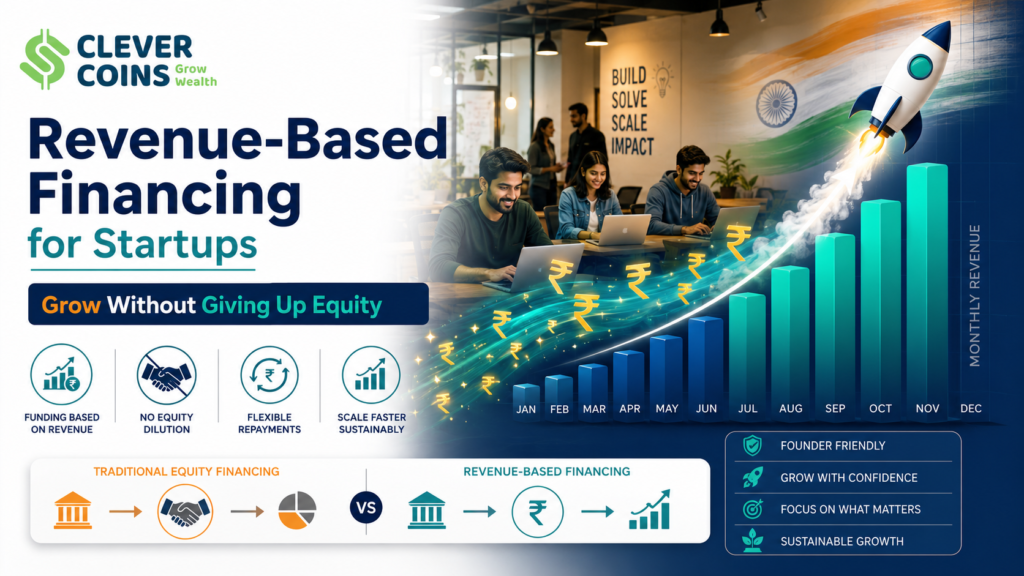
Enter Revenue-Based Financing (RBF) — a flexible, founder-friendly funding model that has gained massive traction globally and is now rapidly transforming how Indian startups raise capital.
Whether you are a D2C brand scaling operations, a SaaS company with predictable MRR, or an e-commerce startup with seasonal revenues, RBF could be the smartest financial move you make in 2026.
💡 Quick Fact The Indian RBF market is projected to cross ₹12,000 Crore by 2027, growing at a CAGR of 38% — driven by booming digital commerce, SaaS adoption, and alternative lending platforms. |
What Is Revenue-Based Financing (RBF)?
Revenue-Based Financing (RBF) is a form of alternative funding where a startup receives a lump sum capital in exchange for a fixed percentage of its future monthly revenues — until a predetermined repayment cap (usually 1.3x to 2x of the principal) is fully paid.
Unlike traditional bank loans, there is no fixed EMI. Unlike equity funding, there is zero dilution of ownership. Repayments automatically rise when revenue increases and fall when revenue decreases, making RBF uniquely aligned with a startup’s business reality.
How RBF Works — Step by Step
- The startup applies to an RBF provider with its financial data (bank statements, GST returns, revenue analytics).
- The lender analyses recurring revenues, growth trajectory, customer retention, and gross margins.
- A funding offer is made — typically 1 to 6 months of annualised revenue (ARR/MRR).
- The startup agrees to repay a fixed percentage of monthly revenue (usually 3%–12%) until the repayment cap is met.
- Repayments are automatically deducted each month based on actual revenue — no fixed EMI.
- Once the repayment cap is reached, the arrangement ends — no equity lost, no long-term obligation.
RBF vs Traditional Financing — Quick Comparison
Feature | RBF | Bank Loan | VC Equity |
Equity Dilution | None ✅ | None ✅ | Yes ❌ |
Fixed EMI | No ✅ | Yes ❌ | No ✅ |
Collateral Required | Usually No ✅ | Yes ❌ | No ✅ |
Approval Speed | 3–7 Days ✅ | 30–90 Days ❌ | 6–18 Months ❌ |
Revenue Dependency | Yes | No | No |
Repayment Flexibility | High ✅ | Low ❌ | Not Applicable |
Funding Range (INR) | ₹10L – ₹10 Cr | ₹50L – ₹50 Cr | ₹1 Cr – ₹500 Cr+ |
Revenue-Based Financing in India — 2026 Landscape
The RBF model in India has matured significantly. Early movers like Velocity, GetVantage, Klub, Recur Club, and N+1 Capital have collectively deployed over ₹3,000 Crore to 2,500+ startups across sectors. In 2026, the market has expanded further with new entrants and traditional NBFCs launching RBF products.
Key Drivers of RBF Growth in India (2026)
- Rise of D2C (Direct-to-Consumer) brands on Shopify, Amazon, Flipkart, and Meesho requiring working capital.
- Boom in SaaS startups with predictable Monthly Recurring Revenue (MRR) — a perfect fit for RBF.
- Improved data accessibility through GST returns, UPI payment data, e-commerce analytics APIs, and account aggregators (RBI’s AA Framework).
- RBI’s regulatory sandbox and NBFC-P2P framework providing structured pathways for alternative lenders.
- Increased startup awareness about equity dilution costs — founders preferring non-dilutive capital.
- SEBI’s Alternative Investment Fund (AIF) Category II regulations allowing more structured deployment.
Sectors Seeing Highest RBF Adoption in India
- D2C Brands (FMCG, Beauty, Fashion, Home Decor)
- SaaS & B2B Software Companies
- EdTech Platforms with subscription revenues
- HealthTech & Telemedicine startups
- Agri-Tech companies with seasonal revenue cycles
- Logistics & Supply Chain Tech
- Food & Beverage brands on Swiggy/Zomato
- Content & Media platforms with subscription models
Eligibility Criteria for Revenue-Based Financing in India
While eligibility varies by lender, the following are the most commonly assessed parameters by Indian RBF providers in 2026:
Minimum Revenue Requirements
- Monthly Recurring Revenue (MRR): Minimum ₹5 Lakhs to ₹25 Lakhs (varies by platform).
- Annual Revenue: Typically ₹60 Lakhs to ₹3 Crore minimum.
- Revenue Consistency: At least 6–12 months of consistent revenue history.
- Revenue Growth Rate: Positive month-on-month growth preferred (10%+ MoM is ideal).
Business & Legal Requirements
- Business must be registered in India (Private Limited, OPC, LLP, or Partnership Firm).
- Active GST registration with regular filing history.
- Business vintage of at least 6–24 months (varies by lender).
- Clean financial history — no active NPA or significant defaults.
- Director(s) should have a CIBIL score of 650+ in most cases.
Operational Requirements
- Active bank account with healthy transaction history (typically 6 months of bank statements required).
- Revenue must be verifiable through digital channels (payment gateways, GST, invoices, e-commerce dashboards).
- Business should not be in a heavily regulated sector (e.g., pure lending, gambling).
🇮🇳 2026 Regulatory Note Under RBI’s Account Aggregator (AA) Framework, startups can now share verified financial data digitally with RBF providers — making the underwriting process faster, more accurate, and consent-based. This has significantly reduced documentation burden and approval timelines. |
How to Apply for Revenue-Based Financing — Complete Process
Step 1: Prepare Your Financial Data
- Last 12 months of bank statements (all business accounts).
- GST returns (GSTR-1, GSTR-3B) for the last 12 months.
- MIS reports or revenue dashboards from payment gateways (Razorpay, PayU, Cashfree).
- E-commerce seller dashboards (Amazon, Flipkart, Shopify) if applicable.
- P&L Statement and Balance Sheet (CA-certified preferred).
- Director KYC documents (Aadhaar, PAN, passport).
- Business registration documents (COI, MOA, AOA, GST certificate).
Step 2: Approach RBF Platforms
In 2026, you can approach the following established Indian RBF platforms:
Platform | Typical Range | Best For |
Velocity | ₹10L – ₹3 Cr | D2C, E-commerce brands |
GetVantage | ₹25L – ₹10 Cr | SaaS, D2C, Media |
Klub | ₹10L – ₹5 Cr | Consumer brands, F&B |
Recur Club | ₹10L – ₹5 Cr | SaaS, Subscription businesses |
N+1 Capital | ₹1 Cr – ₹20 Cr | Growth-stage startups |
Varanium Cloud | ₹10L – ₹2 Cr | Digital & tech startups |
BlackSoil | ₹1 Cr – ₹50 Cr | VC-backed growth companies |
Step 3: Underwriting & Due Diligence
RBF providers perform a rapid underwriting process (typically 3–10 business days) covering:
- Revenue quality analysis — recurring vs one-time, customer concentration.
- Gross margin evaluation — higher margins = better repayment capacity.
- Customer retention metrics (churn rate, LTV:CAC ratio).
- Digital channel health — growth trends on e-commerce, SaaS metrics.
- Legal and compliance checks — GST filing regularity, company health.
Step 4: Offer & Term Sheet
Upon successful underwriting, the lender issues a term sheet specifying:
- Funding Amount (e.g., ₹50 Lakhs)
- Revenue Share Percentage (e.g., 8% of monthly revenue)
- Repayment Cap / Multiplier (e.g., 1.5x = ₹75 Lakhs total repayment)
- Estimated Repayment Timeline (typically 12–36 months)
- Platform Fee (typically 2%–6% of the funding amount)
Step 5: Disbursement & Repayment
Post agreement signing and KYC completion, funds are disbursed within 24–72 hours to the registered business account. Repayment is then auto-debited monthly based on actual revenue reported via integrated payment gateways or bank statements.
Understanding the True Cost of RBF — Calculations in INR
The RBF Repayment Formula
📐 Formula Total Repayment Amount = Principal × Multiplier (Cap Rate) Monthly Payment = Monthly Revenue × Revenue Share % Estimated Timeline = Total Repayment ÷ Average Monthly Payment |
Real-World Example — Indian D2C Brand
Scenario: A Mumbai-based skincare D2C brand with ₹25 Lakhs MRR applies for RBF funding:
Parameter | Value |
Funding Amount | ₹75 Lakhs |
Revenue Share Percentage | 8% of Monthly Revenue |
Repayment Multiplier (Cap) | 1.5x |
Total Repayment Amount | ₹1,12,50,000 (₹1.125 Crore) |
Current MRR | ₹25 Lakhs |
Expected Monthly Growth | 15% MoM |
Month 1 Repayment | ₹2,00,000 (8% of ₹25L) |
Estimated Payoff Period | ~22 Months |
Platform Fee (3%) | ₹2,25,000 |
Effective Annual Cost | Approx. 28%–34% p.a. |
Note: While 28–34% p.a. may seem high compared to bank loans, RBF comes without collateral, without equity dilution, and without fixed EMIs that could strain cash flow during slow months.
Legal & Regulatory Framework for RBF in India — 2026
RBI Guidelines & NBFC Compliance
In India, RBF providers typically operate under one of the following structures regulated by the Reserve Bank of India (RBI):
- NBFC (Non-Banking Financial Company) licence — most common structure for RBF lenders.
- NBFC-Account Aggregator (AA) — used for secure financial data sharing in underwriting.
- Alternative Investment Funds (AIF) Category II — used by institutional RBF funds registered with SEBI.
- Co-lending arrangements with scheduled banks under RBI’s Co-Lending Model (CLM) guidelines.
Key Regulatory Compliances for Startups Availing RBF
- Ensure the RBF provider is registered with RBI or SEBI — verify on the RBI CRILC portal or SEBI AIF registration list.
- All agreements must comply with the Indian Contract Act, 1872.
- Revenue share agreements are typically structured as loan agreements (not equity) — GST is not applicable on repayment.
- TDS implications: Businesses must check if repayments attract any TDS under the Income Tax Act, 1961.
- Startups registered under DPIIT may benefit from tax exemptions under Section 80-IAC — RBF financing does not affect this status.
- FEMA compliance required if any foreign-origin capital is involved in the RBF fund.
Data Privacy & Account Aggregator (AA) Framework
India’s AA Framework (regulated by RBI) allows startups to share financial data with RBF lenders through a secure, consent-based architecture. Under the Digital Personal Data Protection (DPDP) Act, 2023 (effective 2025–2026), startups must ensure:
- Explicit, informed consent is given before sharing financial data.
- Data shared through AA is used only for the stated purpose (underwriting).
- Right to withdraw consent is preserved at any time.
Advantages and Disadvantages of Revenue-Based Financing
✅ Advantages of RBF for Indian Startups
- No Equity Dilution: Founders retain 100% ownership and control — ideal for bootstrapped founders who have built value and don’t want to give it away.
- No Fixed EMI: Repayments flex with revenue — in slow months, you pay less. Zero risk of default due to fixed repayment pressure.
- No Personal Guarantee or Collateral: Most RBF providers do not require personal guarantees or asset pledging.
- Fast Disbursal: Funding in 3–10 days vs 3–6 months for VC rounds and 45–90 days for bank loans.
- Founder Autonomy: No board seats given, no investor interference in business decisions.
- Aligned Incentives: Lender succeeds only when you succeed — no predatory interest structures.
- Scalable: As revenues grow, you can access larger tranches of RBF capital.
- Build Financial Track Record: Regular RBF repayments build your credit profile for future financing.
❌ Disadvantages & Risks to Consider
- Higher Effective Cost: Annualised cost of RBF (25%–40%) is higher than secured bank loans (10%–18%).
- Revenue Dependency: Businesses with highly irregular or seasonal revenues may find repayment unpredictable.
- Limited Funding Size: Most Indian RBF providers cap at ₹10–20 Crore — insufficient for deep-tech or capital-intensive businesses.
- Not for Pre-Revenue Startups: RBF requires proven revenue — not suitable for idea-stage or pre-launch startups.
- Sector Restrictions: Certain sectors (crypto, gambling, real estate, pure financial services) are often excluded.
- Potential Cash Flow Squeeze: During revenue dips, even a small percentage deduction can reduce operating capital.
- Shorter Relationship: Unlike VC/PE investors, RBF providers do not offer strategic mentorship or network access.
Revenue-Based Financing vs Equity Funding — Which Is Right for You?
This is perhaps the most important question for any Indian startup founder in 2026. Here is a framework to decide:
Choose RBF If:
- You have consistent monthly revenues of ₹5 Lakhs+ and want to scale without dilution.
- You need capital for specific, ROI-measurable purposes (inventory, marketing, tech infra).
- You want to maintain complete operational control and decision-making authority.
- You are profitable or near-profitable with strong unit economics.
- You want a short-term (12–36 month) capital commitment rather than a decade-long investor relationship.
Choose Equity Funding If:
- You are building a capital-intensive, high-growth, winner-take-all business (EV, DeepTech, Space).
- You need strategic support, industry connections, and brand credibility from investors.
- Your revenue is pre-launch or too early for RBF eligibility.
- Your total capital requirement exceeds ₹25–50 Crore in a single round.
- You are targeting global markets requiring a USD-denominated cap table structure.
The Hybrid Strategy — Best of Both Worlds
Many savvy Indian founders in 2026 are using both: Seed equity for product development → RBF for scaling revenues → Series A with a stronger revenue story. This approach preserves equity at early stages (when valuation is low) and uses non-dilutive capital when revenues are proven.
Top Use Cases for RBF Capital in Indian Startups
1. Marketing & Customer Acquisition
The most popular use case. Founders use RBF to fund performance marketing spends on Meta, Google, and influencer campaigns — where ROI is measurable and campaigns can be scaled based on ROAS.
2. Inventory & Supply Chain Financing
D2C brands and manufacturers use RBF to buy inventory in advance for festive seasons (Diwali, Navratri), reducing the risk of stockouts without committing to long-term credit lines.
3. Tech Infrastructure & Product Development
SaaS startups use RBF to fund developer salaries, AWS/Azure cloud infrastructure scaling, or product feature buildouts — accelerating revenue growth without giving up equity for tech builds.
4. Geographic Expansion
Brands use RBF to launch in new cities, open dark stores, or onboard new distributors — capital-light expansion using revenue-backed financing.
5. Hiring & Team Building
Growth-stage startups use RBF to fund key senior hires (CMO, CTO, Sales Head) — avoiding the need for expensive equity grants that reduce founder ownership.
6. Working Capital Gap Bridging
B2B SaaS or enterprise sales businesses with 60–90 day payment cycles use RBF to bridge the working capital gap while waiting for large invoice settlements.
10 Pro Tips to Maximize Your RBF Success in 2026
- Clean Up Your Financials: Ensure GST filings are up-to-date and bank statements clearly reflect business revenues. Commingled personal/business accounts are a red flag.
- Strengthen Revenue Quality: Shift revenue towards recurring models (subscriptions, retainer contracts) — higher quality revenue gets better RBF terms.
- Know Your Metrics: Have your MRR, ARR, CAC, LTV, Gross Margin, Churn Rate, and ARPU data ready and well-organized.
- Apply to Multiple Platforms: Just like comparing loan offers, apply to 3–4 RBF platforms simultaneously to compare terms and get the best deal.
- Start Small, Scale Up: Take a smaller first tranche, repay diligently, and use the track record to unlock larger amounts at better terms.
- Use Funds for Revenue-Generating Activities: ROI-positive deployment (marketing, inventory) ensures the business can easily repay from generated revenue.
- Negotiate the Cap Rate: The repayment multiplier is negotiable — strong revenues and growth metrics can get you a 1.3x cap vs a standard 1.5x–2x.
- Understand the Reconciliation Process: Know exactly how your lender will track revenue — ensure your payment gateway/accounting system integrates cleanly.
- Consult a CA Familiar with RBF: Tax treatment of RBF interest costs as business expenses requires proper structuring under the Income Tax Act, 1961.
- Plan Your Exit from RBF: Have a clear plan for what comes next after RBF — whether a larger debt facility, equity raise, or sustained profitability.
Common Mistakes Indian Startups Make with RBF
- Taking RBF for Operational Survival: RBF is a growth tool, not a lifeline. Using it to cover salaries during a revenue crisis worsens the situation.
- Not Reading the Fine Print: Ignoring minimum payment clauses, prepayment penalties, or data-sharing requirements can lead to unpleasant surprises.
- Over-leveraging: Taking multiple RBF tranches simultaneously from different lenders can create a debt burden that outpaces revenue growth.
- Misrepresenting Revenue Data: RBF lenders have sophisticated data verification. Any misrepresentation is fraud and can lead to legal action under IPC and Information Technology Act.
- Ignoring Seasonality in Projections: Not accounting for revenue seasonality can make repayments feel disproportionately large in off-peak months.
- Not Comparing Offers: The first offer is rarely the best. Always benchmark against at least 2–3 providers before signing.
Conclusion: Is Revenue-Based Financing the Right Move for Your Startup?
Revenue-Based Financing represents a genuine paradigm shift in how Indian startups can access growth capital. In 2026, as the ecosystem matures, the options have never been better — with more platforms, better terms, and a stronger regulatory framework than ever before.
If you have built a business with consistent, growing revenues and want to accelerate growth without surrendering equity or taking on inflexible debt, RBF is a compelling, founder-friendly choice.
The key is to approach it strategically — know your numbers, use the capital for ROI-positive activities, compare multiple providers, and always read the fine print. Done right, RBF can be the capital bridge that takes your startup from ₹5 Crore ARR to ₹50 Crore ARR while you retain full ownership of your vision.