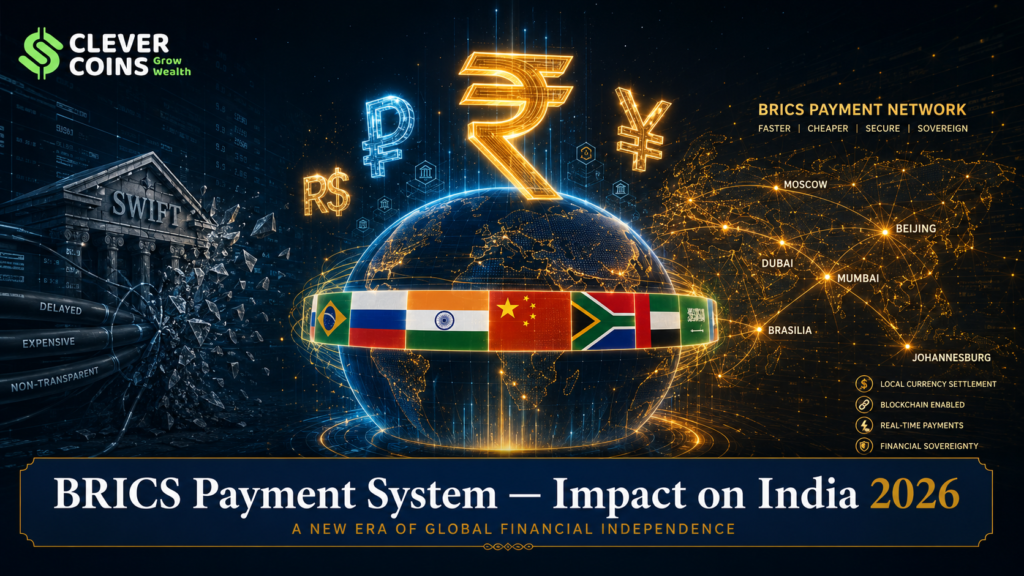
The global financial order is undergoing its most significant transformation since the 1944 Bretton Woods Agreement. At the centre of this shift is the BRICS Payment System — an ambitious multilateral financial architecture being developed by Brazil, Russia, India, China, South Africa, and the expanded BRICS+ nations to reduce dependence on the US dollar and the SWIFT interbank messaging network. For India — the world’s fastest-growing major economy in 2026, with a GDP of approximately ₹3,40,00,000 crore (USD ~4.1 trillion) — the stakes are enormous. This blog delivers a comprehensive, updated analysis of where the BRICS payment system stands in 2026, what India has agreed to, what it has resisted, and what it means for Indian businesses, exporters, consumers, and policymakers.
What is the BRICS Payment System? A 2026 Overview
The BRICS Payment System — often referred to in policy circles as BRICS Pay, BRICS Bridge, or the BRICS Cross-Border Payment Initiative (BCPI) — is a multilateral framework designed to facilitate trade and financial transactions among BRICS member nations without using the US dollar as the primary intermediary currency and without relying on the SWIFT network controlled by Western financial institutions.
In its 2026 iteration, the BRICS payment system encompasses three interconnected components:
Component 1 — BRICS Pay (Retail and Cross-Border Payments)
BRICS Pay is a digital payments interoperability platform that allows citizens and businesses across BRICS nations to transact using local currencies — Indian Rupee (INR), Chinese Yuan (CNY), Russian Ruble (RUB), Brazilian Real (BRL), and South African Rand (ZAR). It is modelled partly on India’s own UPI (Unified Payments Interface) architecture, which BRICS nations have identified as a global benchmark.
- UPI’s influence: India’s NPCI (National Payments Corporation of India) has been in active discussions to provide technical architecture input to BRICS Pay
- Interoperability: BRICS Pay aims to allow a user in Mumbai to scan a QR code in Moscow or São Paulo and pay in INR, with the merchant receiving RUB or BRL automatically
- Status in 2026: Pilot programmes operational between Russia-India and China-Russia corridors; India-Brazil and India-South Africa pilots are in testing phase
Component 2 — BRICS Bridge (Wholesale & Interbank Settlement)
BRICS Bridge is the interbank settlement layer — the SWIFT alternative for large-value transactions between banks across BRICS nations. It is being developed on a distributed ledger technology (DLT) platform, allowing real-time gross settlement (RTGS) in local currencies.
- Inspired by: mBridge (BIS-backed multi-CBDC platform) and India’s own RTGS system
- CBDC integration: BRICS Bridge is designed to eventually integrate with each nation’s Central Bank Digital Currency (CBDC)
- India’s Digital Rupee (e₹): The Reserve Bank of India’s (RBI) Digital Rupee, launched in wholesale pilot in 2022 and expanded to retail in 2023, is being positioned for integration with BRICS Bridge
- Status in 2026: Architecture finalised; Russia-China corridor live; India in advanced integration testing
Component 3 — BRICS Contingency Reserve Arrangement (CRA) Integration
The existing BRICS Contingency Reserve Arrangement — a USD 100 billion (approximately ₹8,33,000 crore) financial safety net — is being linked with the payment system to provide liquidity support in local currencies during balance of payments crises among member nations.
BRICS Expansion 2024-2026: New Members and Their Payment Impact
At the BRICS Summit in Kazan, Russia (October 2024), BRICS formally expanded to include six new full members: Iran, Egypt, Ethiopia, UAE, Saudi Arabia, and Argentina (though Argentina later opted for observer status under the Milei government). Additionally, 13 partner nations joined in 2025. This expansion — creating BRICS+ — dramatically changes the payment system’s scale and implications for India.
Country/Region | BRICS Status 2026 | Trade with India (₹ Crore) | Payment System Role |
China | Full Member | ₹1,87,000 Cr | BRICS Bridge anchor; CNY-INR settlement |
Russia | Full Member | ₹1,10,000 Cr | Pilot live; RUB-INR oil trade settlement |
Brazil | Full Member | ₹28,000 Cr | BRICS Pay pilot active |
South Africa | Full Member | ₹12,000 Cr | BRICS Pay testing phase |
UAE | Full Member (2024) | ₹4,20,000 Cr | Critical INR-AED trade corridor |
Saudi Arabia | Full Member (2024) | ₹2,90,000 Cr | Oil-in-Rupee potential; key for India |
Iran | Full Member (2024) | ₹18,000 Cr | Sanctions bypass potential; sensitive for India |
Egypt | Full Member (2024) | ₹9,000 Cr | Suez corridor trade payments |
BRICS+ Partners | 13 Nations | ₹3,50,000 Cr (combined) | Expanding INR settlement network |
The inclusion of UAE and Saudi Arabia is particularly significant for India. The UAE is India’s largest bilateral trade partner in value terms, and Saudi Arabia is India’s third-largest crude oil supplier. INR-AED (UAE Dirham) and INR-SAR (Saudi Riyal) settlement through the BRICS payment framework could save Indian oil importers thousands of crores annually in dollar conversion costs.
India’s Official Position on the BRICS Payment System in 2026
India’s stance is characterised by strategic ambiguity — actively participating in BRICS payment architecture development while simultaneously maintaining its deep integration with the dollar-based global financial system. This is a deliberate policy choice reflecting India’s ‘multi-alignment’ foreign policy doctrine under the Modi government.
India’s Three-Layer Strategy
- Promote INR Internationalisation: Aggressively push for Indian Rupee-denominated trade settlements within BRICS and beyond
- Leverage UPI Architecture: Position India’s UPI as the technical backbone or reference model for BRICS Pay — gaining soft power influence over the system’s design
- Maintain Dollar & SWIFT Relationships: Avoid formally committing to BRICS payment exclusivity to protect India’s access to Western financial markets, FDI, and IMF/World Bank facilities
RBI’s Role — Reserve Bank of India Policy 2026
The Reserve Bank of India has been the primary institutional driver of India’s BRICS payment engagement. Key RBI actions as of 2026:
- RBI Circular on Rupee Trade Settlement (2022, updated 2025): Allows Indian exporters and importers to invoice, pay, and settle trade in INR through Vostro accounts — 22 countries have set up INR Vostro accounts with Indian banks
- RBI Digital Rupee (e₹) Expansion: The wholesale e₹ pilot has been expanded to cover BRICS interbank settlement corridors; the retail e₹ user base crossed 50 lakh (5 million) in 2025
- FEMA Amendments 2025: The Foreign Exchange Management Act has been amended to provide regulatory clarity for cross-border INR transactions under the BRICS payment framework
- Gold-Backed Settlement Discussions: India has engaged in BRICS discussions on a partial commodity/gold-backed settlement mechanism — but has not committed to any specific gold-backed currency proposal
Ministry of Finance — 2026 Budget Provisions
The Union Budget 2026-27 presented by Finance Minister Nirmala Sitharaman included:
- ₹1,200 crore allocation for Digital Rupee (e₹) infrastructure expansion, including BRICS interoperability development
- ₹800 crore for NPCI International’s expansion of UPI-based BRICS Pay integration
- Tax clarity: Cross-border INR transactions under BRICS payment corridors will be treated as ‘export/import in INR’ under existing Indian income tax and GST provisions — GST zero-rated on exported services even when settled in INR through BRICS mechanism
De-Dollarisation: What It Means for India Specifically
De-dollarisation — the process of reducing global reliance on the US dollar for trade, reserves, and financial transactions — is the most discussed but also the most misunderstood aspect of the BRICS payment system in the Indian context.
Current Dollar Dependence of India
- India’s forex reserves (April 2026): USD 6,68,000 crore equivalent (approximately ₹55,85,000 crore) — predominantly held in US dollar assets
- ~85% of India’s international trade is currently invoiced in USD
- India pays USD 2,10,000 crore+ (₹17,55,000 crore) annually for crude oil imports — primarily in dollars
- Dollar conversion costs: Indian businesses lose an estimated ₹35,000–50,000 crore annually in currency conversion costs and hedging expenses
What BRICS Payment System Reduces for India
- Oil import costs: If crude oil from Russia (currently supplying ~35% of India’s imports at discounted rates) is fully settled in INR or through BRICS currency basket, India saves approximately ₹18,000–22,000 crore annually in dollar conversion and SWIFT transaction costs
- Sanctions exposure: India’s trade with Russia has grown dramatically post-2022 Ukraine conflict. The BRICS payment system reduces India’s exposure to secondary US sanctions risk on Russia-India trade
- Transaction costs for SMEs: Indian exporters currently pay 1.5–3% as foreign exchange conversion costs. INR settlement reduces this to 0.3–0.8%
- Remittance savings: India receives the world’s largest remittances — approximately ₹8,90,000 crore (USD 107 billion) in 2025-26. BRICS Pay’s corridors could reduce remittance costs from current 5-7% to under 1%
What India Cannot Afford to Lose — The Dollar Counterargument
India’s economic establishment — including RBI, Ministry of Finance, and major Indian conglomerates — is acutely aware of the risks of rapid de-dollarisation:
- FDI vulnerability: India attracts USD 70,000 crore+ (₹5,85,000 crore) in annual FDI, primarily from US, EU, and Japan — all dollar/euro denominated. An aggressive de-dollarisation stance could deter these flows
- IMF-World Bank access: India is a major borrower and beneficiary of multilateral financial institutions. These are dollar-denominated systems. India must protect this access
- INR volatility: The INR is not yet a fully convertible currency. An abrupt shift to INR-dominated international trade could expose India to currency volatility risks it is currently shielded from by dollar invoicing
- China risk: India is acutely conscious that the BRICS payment system, if Yuan-dominated, could increase China’s financial leverage over BRICS members including India — a geopolitically sensitive concern
India-Russia INR-Ruble Trade — A Live Case Study
The India-Russia trade relationship has become the real-world testing ground for BRICS payment system concepts. Following Western sanctions on Russia after February 2022, India-Russia bilateral trade has grown from ₹62,000 crore (2021-22) to approximately ₹1,10,000 crore (2025-26) — a near-180% increase in four years.
How India-Russia INR Settlement Works in 2026
- Russian exporters sell crude oil to Indian refiners (IOC, HPCL, BPCL) at a discount to Brent crude
- Indian refiners pay in INR into the Vostro accounts of Russian banks (Sberbank, VTB, Gazprombank) held at Indian banks (SBI, UCO Bank, IndusInd)
- Russian banks accumulate INR. They can use this INR to pay for Indian exports — pharmaceuticals, tea, steel, engineering goods — or invest in Indian government securities
- The BRICS Bridge system is expected to eventually provide the settlement infrastructure; currently managed through bilateral Vostro account arrangements
The INR Overhang Problem
Russia has accumulated a significant INR surplus in its Vostro accounts — estimated at ₹35,000–42,000 crore — that it cannot easily deploy because:
- INR is not fully convertible to third currencies
- Russia’s import capacity from India is limited relative to India’s oil purchases from Russia
- Indian capital markets have caps on foreign portfolio investment
This INR overhang problem is one that the BRICS payment system’s design must solve — either through INR convertibility within BRICS, a currency netting mechanism, or a commodity-backed settlement layer. India and Russia are actively negotiating this in 2026.
Impact on Key Indian Sectors
Indian Oil & Gas Sector
India imports approximately 87% of its crude oil requirements. The BRICS payment system directly impacts this critical sector:
- Russia now supplies 35% of India’s crude at 10-15% discount to Brent — enabled by INR settlement
- Saudi Arabia (BRICS member since 2024) in discussions for partial INR settlement of oil trade
- Iran (BRICS member since 2024): India’s previous oil imports from Iran were halted due to US sanctions. BRICS payment system could reopen Iranian oil to India — but India is proceeding with extreme caution given dollar access concerns
- Annual crude import bill: Approximately ₹12,00,000 crore. Even a 10% shift to INR settlement saves ₹18,000–25,000 crore in conversion costs
Indian IT and Software Services
India’s IT sector — earning approximately ₹2,40,000 crore annually in exports, predominantly from US and EU clients — is largely unaffected by BRICS payment system in the near term. However:
- BRICS tech contracts (government IT, software projects with Russia, China, Brazil): INR settlement through BRICS Pay would simplify billing and reduce hedging costs
- Indian IT firms with Russia exposure (Infosys, Tech Mahindra): Already using INR-RUB settlement mechanisms
- Long-term risk: If BRICS payment system develops a robust Digital Rupee settlement layer, it could attract new IT contracts from BRICS+ nations currently reluctant to deal in USD
Indian Pharmaceuticals
India is the world’s largest generic medicine manufacturer. BRICS payment system creates significant opportunities:
- Russia: India supplies 25% of Russia’s pharma imports — worth ₹12,000 crore annually; now settled in INR-RUB through Vostro accounts
- Brazil: INR-BRL settlement pilot underway for pharma trade worth ₹6,000 crore
- African BRICS+ nations: Enormous opportunity for Indian pharma to supply generic medicines to Africa settled in INR, bypassing dollar transaction costs
Indian Agricultural Exports
India’s agricultural exports — Basmati rice, spices, sugar, pulses — worth approximately ₹4,20,000 crore annually are beginning to utilise BRICS payment channels:
- Russia and Egypt: Major buyers of Indian wheat and rice; INR settlement reduces transaction costs by 2-3%
- GCC nations (UAE, Saudi Arabia — now BRICS members): Represent ₹90,000 crore in Indian agri-exports; INR-AED and INR-SAR corridors could transform this trade
Indian MSMEs and Exporters
For India’s 63 million MSMEs, the BRICS payment system has transformative potential:
- Reduced hedging costs: MSMEs typically cannot afford sophisticated forex hedging instruments. INR settlement eliminates this cost
- DGFT (Directorate General of Foreign Trade) has issued a special notification in 2025 allowing MSME exporters to avail INR Vostro account-based settlement with simplified KYC
- Trade Credit: RBI has expanded the Export Credit in INR scheme to cover BRICS trade corridors — reducing export finance costs by 1.5-2% for MSMEs
BRICS Payment System vs. SWIFT — A Technical Comparison
Feature | SWIFT (Current) | BRICS Bridge / BRICS Pay | India’s Position |
Currency Used | USD dominant | Local currencies / CBDC | Prefer INR; resist CNY dominance |
Control | Western banks consortium | BRICS member nations | Supports shared governance |
Sanctions Risk | High (US can exclude nations) | Lower (no single-nation control) | Key benefit for India |
Transaction Speed | 1-5 business days | Near real-time (DLT-based) | Faster settlement preferred |
Transaction Cost | 0.1-0.5% + FX conversion | 0.05-0.2% in local currency | Significant savings for India |
Coverage | 200+ countries | BRICS+ (35+ nations, expanding) | India wants wider coverage |
Indian Law Compliance | FEMA compliant | FEMA 2025 amendment needed | RBI working on alignment |
CBDC Support | Limited | Core architecture feature | e₹ integration planned |
Geopolitical Dimensions: India’s Balancing Act
The BRICS payment system sits at the intersection of finance and geopolitics — and India’s position is one of the world’s most complex balancing acts.
India vs. China Within BRICS
India’s primary concern within the BRICS payment system is Chinese dominance. If the BRICS payment system becomes Yuan-centric, India effectively trades dollar dependency for Yuan dependency — which India considers geopolitically worse given the ongoing border tensions with China. India has consistently advocated for:
- A multi-currency basket approach — no single BRICS currency
- Equal governance rights for all BRICS members in the payment system
- Blocking any proposal that would give China disproportionate veto power over BRICS financial institutions
India-US Relations and the Dollar Dilemma
The United States has been watching India’s BRICS payment system engagement carefully. US Treasury Secretary and US Ambassador to India have both delivered diplomatic messages expressing concern about BRICS payment system developments. India has reassured the US that:
- India is not abandoning the dollar-based system
- India’s engagement is driven by economic efficiency, not geopolitical confrontation
- India will not allow the BRICS system to be used to circumvent legitimate international sanctions regimes
Russia-Ukraine Conflict Impact
The prolonged Russia-Ukraine conflict (now in its fourth year in 2026) has paradoxically accelerated the BRICS payment system’s development. Russia’s urgency to build a functional SWIFT alternative has injected political will and technical resources into BRICS payment infrastructure that might otherwise have taken a decade to develop. India has benefited economically from cheap Russian oil through this system, even as it maintains formal neutrality on the conflict.
India’s G20 and IMF Engagement
India holds a permanent seat at the G20 and is an active IMF member. New Delhi has been careful to frame its BRICS payment system engagement as complementary to — not competitive with — existing multilateral institutions. India’s position: The world needs multiple payment rails, just as the internet has multiple protocols.
Indian Legal and Regulatory Framework for BRICS Payments in 2026
Foreign Exchange Management Act (FEMA), 1999 — 2025 Amendments
FEMA has been the primary legal framework governing India’s cross-border financial transactions. The 2025 FEMA amendments specifically address BRICS payment system integration:
- Section 3 amendment: Permits cross-border INR transactions through BRICS payment corridors without requiring prior RBI approval — provided they are within the approved Vostro account framework
- Section 6 amendment: Foreign capital receipts in INR through BRICS Pay are treated as ‘Rupee Receipts’ for FEMA purposes, with the same reporting requirements as dollar-denominated receipts
- Schedule I amendment: Adds BRICS Bridge and BRICS Pay as approved cross-border payment systems
Income Tax Act — Treatment of BRICS Payment Transactions
The Central Board of Direct Taxes (CBDT) has issued Circular No. 14/2025 clarifying:
- INR receipts from BRICS payment corridors by Indian exporters are treated as ‘export income’ for the purpose of Section 10AA (SEZ) and Section 80HHC deductions
- Transfer Pricing: Cross-border INR transactions within BRICS framework between related parties are subject to normal arm’s length transfer pricing rules under Section 92
- TDS provisions: Payments to non-residents through BRICS Pay mechanism are subject to TDS under Section 195 at applicable treaty rates
GST Treatment of BRICS Payment Transactions
CBIC Circular No. 210/2025 clarifies:
- Export of goods and services settled through BRICS payment system in INR qualify as ‘zero-rated supply’ under IGST Act Section 16 — exporters can claim IGST refunds
- Import of goods through BRICS payment corridors is subject to normal IGST, BCD, and applicable cess — no differential treatment
- B2B digital service imports paid through BRICS Pay: Subject to IGST under reverse charge mechanism (Section 5(3) IGST Act)
Banking Regulation — RBI Master Directions 2025
RBI’s Master Direction on Cross-Border Payments (2025 Update) mandates:
- Authorised Dealer (AD) banks must maintain separate BRICS payment reconciliation accounts
- Daily reporting to RBI of all BRICS payment corridor transactions above ₹1 crore
- KYC and AML compliance: BRICS payment transactions are subject to Prevention of Money Laundering Act (PMLA) 2002 provisions — same as regular cross-border transactions
- Fraud risk management: RBI has issued specific cybersecurity guidelines for banks handling BRICS Bridge transactions given the DLT-based architecture
Risks, Challenges, and India’s Red Lines
Risk 1 — Chinese Yuan Dominance
China has the most developed CBDC (Digital Yuan / e-CNY) and the largest BRICS economy. There is a real risk that BRICS Bridge becomes effectively Yuan-centric. India’s red line: If the BRICS payment system’s reserve currency weight or governance structure disproportionately favours China, India has signalled it will not participate in that layer.
Risk 2 — US Secondary Sanctions
If the BRICS payment system is used for transactions involving sanctioned entities (Iranian oil, Russian defence companies), Indian banks using the system could face US secondary sanctions — potentially being cut off from the US dollar correspondent banking network. India has been extremely careful on this: the INR Vostro account framework specifically excludes sanctioned entities.
Risk 3 — INR Volatility and Convertibility
A significant increase in INR-denominated international trade requires INR to be more stable and convertible. India’s capital account is not fully open. If BRICS trade expansion creates sudden large INR demand or supply shifts, it could create currency volatility that hurts Indian businesses. RBI is actively managing this risk through phased implementation.
Risk 4 — Cyber Security
A distributed ledger-based payment system spanning 40+ nations is a significant cyber security challenge. India’s CERT-In (Indian Computer Emergency Response Team) has been integrated into BRICS cybersecurity working group for the payment system. However, the risk of state-sponsored cyber attacks on BRICS payment infrastructure — particularly from adversarial actors — is real and acknowledged.
Risk 5 — Fragmentation of Global Financial System
There is a broader risk that BRICS payment system development accelerates global financial fragmentation — creating a ‘dollar bloc’ and a ‘BRICS bloc’ with limited interoperability. For India, which trades extensively with both blocs, this fragmentation is a threat. India’s strategy is to ensure it remains a bridge between both systems.
UPI’s Role as India’s Contribution to BRICS Payment Architecture
India’s most significant contribution to the BRICS payment system is not financial — it is technological. India’s UPI (Unified Payments Interface), operated by NPCI (National Payments Corporation of India), has become a global benchmark for real-time digital payments.
UPI Statistics — 2025-26
- Monthly UPI transactions: Over 1,500 crore (15 billion) transactions per month
- Monthly UPI value: ₹20,64,000 crore (~USD 250 billion) per month
- Countries using UPI internationally: 8 countries (Singapore, UAE, Bhutan, Nepal, Sri Lanka, France, Mauritius, Fiji)
- NPCI International (NIPL): The international arm of NPCI, tasked with expanding UPI globally — including BRICS nations
UPI-BRICS Pay Integration Model
NPCI International has proposed — and BRICS has provisionally agreed to — using UPI’s interoperability layer as the consumer-facing interface for BRICS Pay. Under this model:
- Indian users of UPI apps (PhonePe, GPay, Paytm) would be able to make payments in BRICS nations using existing QR code infrastructure
- The back-end settlement would use the BRICS Bridge DLT layer
- For India, this is a massive soft power and commercial win: Indian fintech companies and NPCI would gain technical influence over the entire BRICS payment stack
What the BRICS Payment System Means for Indian Businesses — Practical Guide
For Indian Exporters
If you are an Indian exporter, here is what BRICS payment system means for you practically in 2026:
- Invoice in INR: For trade with Russia, UAE, Brazil, South Africa — you can now invoice in Indian Rupees. Use the RBI’s INR Vostro account framework
- Reduce hedging costs: No need to buy forward dollar contracts for INR invoiced exports — saving 1.5-3% of invoice value
- Faster payment: BRICS Bridge settlement is expected to reduce payment receipt time from current 3-5 days to same-day or next-day
- Access new markets: BRICS+ expansion means your INR payment infrastructure now potentially covers 40+ nations representing 45% of global GDP
- Register with DGFT: Ensure your Importer Exporter Code (IEC) is updated and you are registered for INR Vostro settlement under DGFT’s BRICS trade facilitation portal
For Indian Importers
- Oil importers: If you source crude from Russia, Vostro-based INR payment is already operational; Saudi Arabia INR settlement expected by end-2026
- Machinery and equipment importers: Limited BRICS payment coverage currently for Chinese and European machinery — use conventional SWIFT for now
- Agricultural commodity importers: Pulses from Australia, edible oils from Indonesia — limited BRICS coverage; watch for BRICS+ expansion
For Indian Fintech Companies
The BRICS payment system is a massive opportunity for Indian fintech:
- PhonePe, Paytm, GPay: Potential to power BRICS Pay QR codes across 40+ nations
- Razorpay, Cashfree: Cross-border payment gateway opportunities for B2B BRICS trade
- Indian neo-banks: Opportunity to offer INR-denominated trade finance for BRICS corridors
- NPCI International: Direct integration opportunity — already in discussions with BRICS payment secretariat
For Indian Consumers
The most direct consumer benefit is expected in:
- Travel: UPI-BRICS Pay integration means Indian tourists in Russia, UAE, Brazil, South Africa can pay using their UPI apps in INR
- Remittances: Indians sending money home from Russia, UAE (BRICS members) will see costs drop from 5-7% to under 1%
- Imported goods: Modest benefit as reduced import transaction costs are gradually passed through supply chains
What’s Next? Road Ahead for BRICS Payments and India in 2026-2027
BRICS Summit 2026 — Expected Outcomes
The 2026 BRICS Summit is scheduled to be held in Brazil (2025 BRICS chair was Russia; 2025 concluded in Moscow; Brazil holds the 2026 chair). Key expected outcomes for the payment system:
- Formal launch of BRICS Bridge operational protocol for all full BRICS members
- Announcement of Digital Rupee (e₹) integration timeline with BRICS Bridge
- Extension of BRICS Pay QR code interoperability to all BRICS+ partner nations
- Possible announcement of BRICS Trade and Investment Facilitation Platform — integrating payment system with trade documentation and customs
India’s Digital Rupee (e₹) Expansion — 2026-2027
The RBI’s Digital Rupee roadmap includes:
- Retail e₹ user target: 1 crore (10 million) users by December 2026 — up from current 50 lakh
- BRICS Bridge integration: Full wholesale e₹ settlement on BRICS Bridge by Q2 2027
- Offline e₹ functionality: For use in areas with limited internet — critical for BRICS+ African partner nations
INR Internationalisation Index — RBI Target
The RBI has set an internal target of increasing INR’s share of India’s international trade settlement from the current 4.8% to 15% by 2028. The BRICS payment system is the primary vehicle for achieving this target.
Expert Perspectives on BRICS Payment System and India
RBI Governor Sanjay Malhotra (March 2026)
India’s RBI Governor has stated: ‘The Digital Rupee and the expanding INR Vostro settlement network represent India’s forward-looking approach to international payments. We are building an architecture that serves India’s interests — efficient, cost-effective, and aligned with our foreign policy of multi-alignment. We will not be rushed into a system that compromises India’s financial sovereignty.’
FICCI President (May 2026)
The Federation of Indian Chambers of Commerce and Industry has formally endorsed India’s BRICS payment engagement: ‘Indian exporters — especially MSMEs — are already seeing tangible benefits from INR-based trade settlement. The elimination of dollar hedging costs alone is saving the sector an estimated ₹8,000–12,000 crore annually.’
Arvind Subramanian, Former Chief Economic Adviser to GoI
Former CEA Arvind Subramanian has offered a cautionary note: ‘India must be careful not to be used as a BRICS payment system’s legitimacy shield while the real architecture is being built to serve Chinese and Russian interests. India’s leverage is its UPI technology and market size — we must use both as bargaining chips.’
Conclusion: BRICS Payment System — An Opportunity India Cannot Ignore
The BRICS payment system in 2026 represents one of the most significant structural shifts in the global financial architecture in decades. For India — the world’s most populous nation, fastest-growing major economy, and a country with a strategic interest in both the Western-led and BRICS-led financial systems — the challenge is to extract maximum economic benefit from the BRICS payment framework without compromising its carefully cultivated relationships with the United States, European Union, and multilateral institutions.
The numbers tell a compelling story: ₹18,000–22,000 crore in annual savings on oil import currency conversion costs; potential annual savings of ₹35,000–50,000 crore in total trade currency costs; remittance cost reductions that could put ₹45,000–89,000 crore more in the hands of Indian families abroad. These are real, tangible economic benefits that directly serve India’s national interest.
At the same time, India’s ‘multi-alignment’ approach — engaging with BRICS payment infrastructure while resisting full de-dollarisation — is not a contradiction. It is a sophisticated recognition that in a multipolar world, India’s best position is not in any single bloc, but as the indispensable bridge between them. As the BRICS payment system matures in 2026 and beyond, India’s UPI architecture, Digital Rupee, and strategic patience position it to be not just a participant in this new financial order — but one of its principal architects.