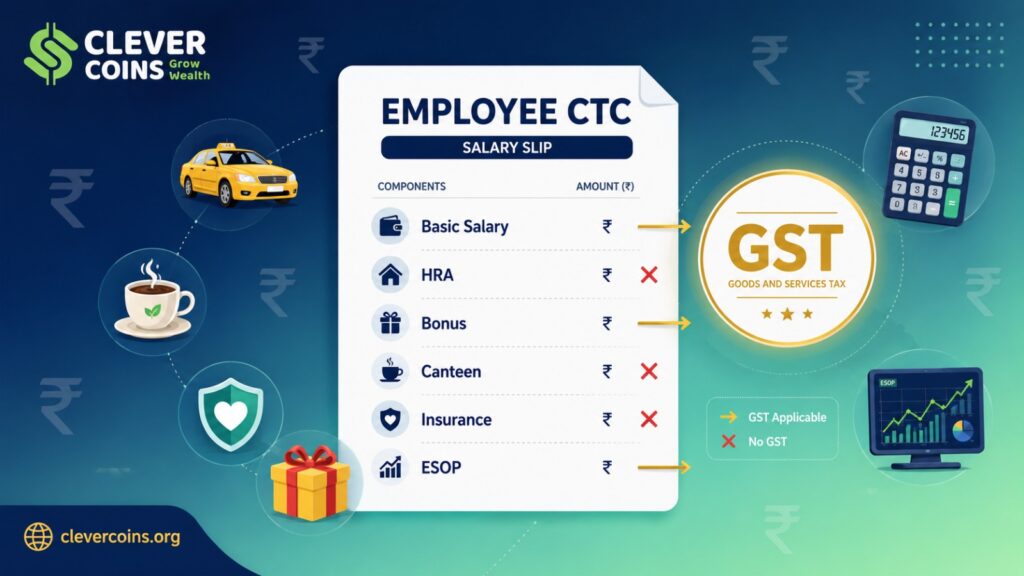
Almost every HR head, payroll manager and finance controller in India has at some point asked the same question — does GST apply on my employee CTC? The answer is rarely a simple yes or no. While the salary you pay to your employees is firmly outside the GST scope, the buffet of allowances, perquisites, reimbursements and amenities that make up a modern Cost-to-Company package live in a much greyer zone.
This in-depth guide, prepared by the team at CleverCoins, breaks down the GST treatment of every common CTC component in FY 2026-27 — from basic salary and HRA to canteen subsidies, cab facilities, free meals, ESOPs, notice-pay recovery and gift vouchers. We also cover Input Tax Credit (ITC) eligibility under Section 17(5), the latest CBIC circulars and landmark Supreme Court and High Court rulings that have reshaped employer-employee GST jurisprudence in the last two years.
Understanding the GST Framework on Employment
Before we dive into individual CTC components, you must understand one foundational concept — the employer-employee relationship is largely carved out of the GST law. Three statutory provisions create this protection:
Schedule III of the CGST Act, 2017 — The Cornerstone
Paragraph 1 of Schedule III states: ‘Services by an employee to the employer in the course of or in relation to his employment’ shall be treated neither as a supply of goods nor a supply of services. This single line ensures that salary, wages, performance bonuses and standard reimbursements paid to employees are completely outside the GST ambit.
Section 7 of the CGST Act — The Definition of Supply
Section 7(2) read with Schedule III explicitly excludes employer-employee transactions from the scope of ‘supply’. Since GST is triggered only when there is a ‘supply’, the absence of supply means no GST. This applies regardless of the amount, designation or industry.
What ‘In the Course of Employment’ Actually Means
The phrase ‘in the course of or in relation to employment’ has been interpreted broadly by courts and the CBIC. Any benefit, payment or facility flowing from an employment contract — whether fixed, variable, monetary, or in-kind — is generally protected. However, anything that falls outside the contractual employment relationship (for example, an employee invoicing the company as a separate consultant) loses this protection.
How GST Treats Each CTC Component — A Quick Map
Here is a consolidated view of how the most common CTC components are treated under GST in India as on FY 2026-27:
CTC Component | GST Applicability | Brief Reason |
Basic Salary, DA | Not Applicable | Schedule III — services by employee to employer |
House Rent Allowance (HRA) | Not Applicable | Part of employment contract; Schedule III protected |
Conveyance / Transport Allowance | Not Applicable | Schedule III protected |
Leave Travel Allowance (LTA) | Not Applicable | Part of CTC; Schedule III protected |
Medical Allowance / Reimbursement | Not Applicable | Schedule III protected |
Performance Bonus, Incentives | Not Applicable | Employment-linked reward |
Employer’s PF / ESI / Gratuity contribution | Not Applicable | Statutory obligation, not a supply |
Free / Subsidised Canteen | Partially Applicable | Recovery from employee may attract GST — see detailed section |
Cab / Transport Facility | Partially Applicable | Recovery from employee taxable; ITC blocked except in specific cases |
Group Health Insurance | Not Applicable on perquisite, ITC available if mandated by law | Section 17(5) carve-out |
Gift Vouchers above ₹50,000/employee/year | Applicable — treated as supply | Schedule I — gifts above ₹50,000 are deemed supply |
ESOP / RSU / Stock Options | Not Applicable on grant; cross-border charge-back may attract | Recent CBIC clarification — see detailed section |
Notice Pay Recovery | Not Applicable | CBIC Circular 178/10/2022 — not a supply |
Free Accommodation / Housing | Not Applicable as perquisite | Schedule III protected |
Reimbursements (travel, mobile, internet) | Not Applicable | Pure agent / business expense reimbursement |
Salary, Allowances and Standard Reimbursements — The Clear Zone
This is the simplest portion of the CTC for any GST analysis. All payments made by an employer to an employee that flow from the contract of employment — whether labelled as basic salary, dearness allowance, HRA, transport allowance, medical allowance, LTA, performance bonus, ex-gratia, retention bonus or joining bonus — are not ‘supply’ under GST. No invoice is issued, no GST is charged, no GST is paid.
Statutory Employer Contributions
Employer contributions toward Provident Fund (12% of basic), Employees’ State Insurance (3.25% of wages up to ₹21,000/month), gratuity, NPS and the Labour Welfare Fund are statutory obligations under their respective laws. These are not consideration for any supply and therefore fall outside the GST ambit.
Reimbursements Against Actual Bills
Mobile bills, internet at home, business travel, hotel, and entertainment reimbursements paid against original tax invoices in the name of the company are business expenses of the employer, not employee income. These are recorded as company expenses, GST charged on those bills is claimed as Input Tax Credit by the employer, and the employee acts merely as a conduit — no GST trigger occurs at the employee’s end.
Free or Subsidised Canteen Facility — The Most Litigated Benefit
Few employee benefits have generated as much GST controversy as the office canteen. The question is: when an employer provides a canteen — either free, or with a nominal recovery from the employee — does GST apply?
The 2026 Position — Based on CBIC Circular 172/04/2022 and AAR Rulings
As clarified by the CBIC in Circular No. 172/04/2022-GST dated 6th July 2022, perquisites provided by the employer to the employee in terms of a contractual agreement entered into between them are in lieu of services provided by the employee to the employer in relation to employment. Such perquisites are not subjected to GST.
When Recovery is Made from the Employee
If the employer recovers a nominal amount from the employee (say ₹500 per month for canteen) and the canteen facility is provided as part of the employment contract or HR policy, the recovery itself is generally not treated as a taxable supply by the employer. However, several Advance Ruling Authorities (Gujarat, Maharashtra, Karnataka) have held that the GST charged by the third-party canteen contractor to the employer is fully payable by the employer, but the employer cannot claim ITC on this expense as per Section 17(5)(b) — unless the canteen is statutorily mandated under the Factories Act, 1948.
Factories Act Exception — When ITC is Allowed
Under Section 46 of the Factories Act, 1948, a canteen must be provided where more than 250 workers are ordinarily employed. In such factories, the canteen becomes a ‘statutorily mandated’ service, and the proviso to Section 17(5)(b) of the CGST Act allows the employer to claim ITC on the GST charged by the canteen contractor — to the extent the cost is borne by the employer and not recovered from the employee.
Employee Cab / Transport Facility — GST and ITC Treatment
Employer-provided cabs and shuttle services are common in IT parks and large offices. Their GST and ITC treatment depends on how the facility is structured.
Cab Provided Free as a Perquisite
If the cab service is provided free as a perquisite under the employment contract, it falls within the Schedule III protection. The GST charged by the cab vendor to the employer, however, sits inside Section 17(5)(b) — ITC is blocked unless the seating capacity exceeds 13 passengers or the cab service is mandated by law (e.g., women’s safety transport in certain states after specified hours).
Cab Service with Cost Recovery from Employee
If the employer recovers a portion of the cab cost from the employee, several AAR rulings have held this recovery to be ‘consideration’ for a taxable supply. The employer must charge GST at 5% (without ITC) or 12% (with ITC) on the recovery amount. Many companies in 2026 are restructuring this as ‘no recovery / cost loaded into CTC’ to stay clean.
Group Health Insurance, Life Insurance and ITC Eligibility
Group Mediclaim, Group Personal Accident and Group Term Life policies are now standard CTC components in mid-sized and large Indian organisations. GST applies on the insurance premium charged by the insurer, but the ITC question for the employer is decided by Section 17(5)(b)(i) of the CGST Act.
General Rule — ITC Blocked
ITC on health insurance, life insurance and rent-a-cab services availed by an employer is blocked under Section 17(5)(b)(i). This means the employer must absorb the 18% GST as a cost.
Mandatory Insurance — ITC Allowed
The proviso to Section 17(5)(b) (inserted with retrospective effect from 1st February 2019 by the Finance Act, 2022) allows ITC where the service is obligatory for an employer to provide to its employees under any law in force. For example, Group Personal Accident or Workmen’s Compensation cover mandated by the Employees’ Compensation Act, 1923, or insurance mandated by state-specific shop and establishment rules, qualifies for ITC.
Director Insurance
Premium paid on personal life or health insurance of directors (without it being a contractual perquisite for all employees of a class) is treated as a personal expense — ITC is blocked and the amount may also be added to the director’s taxable perquisite under the Income Tax Act.
Notice Pay Recovery — The Long-Settled Big Question
If an employee resigns without serving the full notice period, the employer typically recovers an amount equivalent to the unserved notice period. For years, this ‘notice pay recovery’ was a litigation hotspot — was the employer ‘tolerating’ the breach and therefore providing a taxable service to the employee?
CBIC Circular 178/10/2022 — The Final Word
The CBIC, through Circular No. 178/10/2022-GST dated 3rd August 2022, clarified that notice pay recovered by an employer is not consideration for any service. The employer is not ‘tolerating’ an act — the relationship is governed by the employment contract, and the recovery is merely compensation for breach. The Madras and Bombay High Courts had earlier ruled in favour of taxpayers in the same direction, and the CBIC circular has settled this matter for FY 2026-27.
Practical Impact on Payroll and Finance Teams
Employers no longer need to charge GST on notice pay recovery. If any past liability was paid under protest between July 2017 and August 2022, taxpayers may evaluate refund options subject to Section 54 time limits and unjust enrichment tests.
Gift Vouchers, Diwali Hampers and the ₹50,000 Rule
Gifts to employees are a sensitive area because Schedule I of the CGST Act treats gifts above a specified value as a deemed supply, even without consideration.
The ₹50,000 Annual Threshold
Gifts not exceeding ₹50,000 in value provided by an employer to an employee in a financial year are excluded from the scope of supply. Anything in excess of ₹50,000 per employee per year is treated as a supply and attracts GST.
Gift Vouchers and the 2024 GST Council Clarification
The GST Council in its 55th meeting in December 2024 clarified that gift vouchers and gift cards (whether single-purpose or multi-purpose) are ‘actionable claims’ and not goods or services in themselves. They are therefore neither leviable to GST at the time of issue nor when transferred to the employee, unless they exceed the ₹50,000 annual threshold, in which case the underlying value is treated as a deemed supply by the employer.
Practical Compliance
Maintain an employee-wise register of gifts and vouchers issued in each financial year. Once the cumulative value crosses ₹50,000 for any employee, the excess is taxable and the employer must discharge GST at the applicable rate of the underlying goods/services.
ESOPs, RSUs and Sweat Equity — GST Implications in 2026
Employee Stock Option Plans, Restricted Stock Units and sweat equity shares are common retention tools, especially in startups and IT companies. Their GST treatment was finally clarified by the CBIC in 2024.
Domestic ESOPs — No GST
Where an Indian company grants ESOPs or RSUs to its own employees, the transaction is part of the employer-employee relationship and falls within Schedule III. No GST applies on the grant, vesting or exercise of such options.
Cross-Border ESOPs — The 2024 CBIC Clarification
Where an Indian subsidiary’s employees receive ESOPs from a foreign parent company and the Indian subsidiary reimburses the parent for the cost of shares allotted, the CBIC clarified in Circular No. 213/07/2024-GST (June 2024) that such reimbursement is not consideration for any supply of service by the foreign parent. Therefore, no GST under reverse charge is payable by the Indian subsidiary on the cost-to-cost reimbursement. However, if an additional fee or markup is charged by the foreign parent over and above the cost of shares, that markup is taxable under reverse charge.
Free Accommodation, Company Lease and Hostel Facility
Free or concessional company-provided accommodation is a common perquisite, especially in manufacturing units, hospitality and remote project sites.
Perquisite to Employee — No GST
Provision of company accommodation to employees, free of cost or at concessional rent, is a Schedule III protected perquisite and does not attract GST at the employee end. The Income Tax perquisite valuation rules under the Income Tax Act, 2025 (and the corresponding rules of the 1961 Act for legacy assessments) determine its value for income tax purposes, but GST is not triggered.
Lease Rent Paid by Employer — ITC Position
Where the employer takes a residential apartment on lease and provides it to the employee, the lease itself may be exempt (residential dwelling for use as residence is exempt under Notification 12/2017). However, if the landlord is GST-registered and the apartment is used for commercial accommodation, GST applies and ITC may or may not be available depending on the use and the renting structure.
Input Tax Credit (ITC) on Employee-Related Expenses — Section 17(5)
Section 17(5) of the CGST Act lists ‘blocked credits’ — expenses on which ITC cannot be claimed by the recipient even if GST has been paid. Several common employee-related expenses fall in this list, and understanding the carve-outs is critical for any payroll/finance team.
Blocked Credits Relevant to Employee Benefits
- Food and beverages, outdoor catering, beauty treatment, health services, cosmetic and plastic surgery — blocked under Section 17(5)(b)(i)
- Membership of a club, health and fitness centre — blocked
- Rent-a-cab, life insurance, health insurance — blocked
- Travel benefits extended to employees on vacation such as leave or home travel concession — blocked under Section 17(5)(b)(iii)
The Game-Changing Proviso
The proviso to Section 17(5)(b) (inserted retrospectively from 1st February 2019) allows ITC on the above expenses where it is obligatory for an employer to provide the goods or services to its employees under any law in force. So a 250+ worker factory canteen, mandatory women’s safety cab post 8 PM in certain states, mandatory health check-up under Factories Act, or statutorily mandated insurance — all qualify for ITC.
Common Eligible Employee Expenses Where ITC IS Allowed
- Office stationery, laptops, mobile phones used for business
- Training and skill development programmes for employees
- Subscription to business journals, software licences used by employees
- Office consumables, water, electricity (where charged with GST)
- Office renovation (if capitalised separately from immovable property)
Practical Compliance Checklist for Employers in FY 2026-27
Use the following operational checklist within your payroll, finance and HR functions to stay on the right side of GST on CTC and employee benefits:
- Document every perquisite in the employment contract or HR policy: Schedule III protection works only when the benefit flows from the employment relationship — make sure your offer letters and HR manuals explicitly list every perquisite.
- Maintain an employee-wise gift register: Track cumulative gift and voucher values. Trigger a GST compliance review once any employee crosses ₹50,000 in a financial year.
- Segregate ITC-eligible and ITC-blocked invoices: In your accounting system, tag every employee-related vendor invoice as ‘eligible’ or ‘blocked’ for ITC and reconcile this monthly with GSTR-2B.
- Apply the Factories Act / mandatory benefit proviso correctly: Where ITC is being claimed on canteen, transport or insurance under the statutory mandate proviso, maintain the underlying notification or licence as audit evidence.
- Stop charging GST on notice pay recovery: Update your payroll software and HR exit checklists in light of Circular 178/10/2022.
- Document cab and canteen recoveries carefully: Where you recover any amount from employees, either treat the recovery as taxable supply or restructure the policy as a pure perquisite with no recovery.
- Review ESOP cross-charge agreements: If your Indian entity is receiving ESOPs from a foreign parent, ensure the recharge is at cost-to-cost without any markup to remain outside reverse charge GST.
- Annual ITC reconciliation: At the end of the financial year, reconcile ITC claimed on employee-related expenses with the eligibility framework — reverse any wrongly availed credit before filing GSTR-9 to avoid interest and penalty.
Common GST Mistakes Employers Make on Employee CTC
In our experience at CleverCoins, the following are the most frequent GST errors we see during diagnostic reviews of mid-sized Indian employers:
- Charging GST on salary or notice pay recovery: Both are protected by Schedule III / Circular 178.
- Claiming ITC on group health insurance without checking the statutory mandate proviso: Default rule is blocked; ITC requires a clear legal mandate.
- Not tracking gift value per employee: Most employers miss the ₹50,000 threshold for high-performing employees who receive multiple awards in a year.
- Claiming ITC on full canteen invoice: Where part of the cost is recovered from the employee, ITC is allowed only on the employer-borne portion — proportionate reversal is required.
- Treating consultant payments as ’employee benefits’: Independent consultants invoicing the company are providing a B2B supply — GST applies, TDS provisions differ, and Schedule III protection does not apply.
- Wrongly availing ITC on personal expenses of directors: Personal insurance, club fees, holidays of directors are personal in nature and ITC is fully blocked.
Recent Circulars, Rulings and 2026 Developments
The last 24 months have been busy on the employer-employee GST front. Here is a quick chronology of the developments every compliance team should know:
- CBIC Circular 172/04/2022-GST: Clarified that perquisites provided to employees as part of the employment contract are not chargeable to GST.
- CBIC Circular 178/10/2022-GST: Held that notice pay recovery, surety forfeiture, liquidated damages and similar receipts are not consideration for any supply.
- Finance Act, 2022 (proviso to Section 17(5)(b)): Allowed ITC on goods and services that are obligatory to be provided by an employer under any law, retrospectively from 1st February 2019.
- CBIC Circular 213/07/2024-GST: Clarified cross-border ESOP recharges from foreign parents to Indian subsidiaries — cost-to-cost reimbursement is not taxable; markup attracts reverse charge.
- 55th GST Council Meeting Outcomes (December 2024): Confirmed that gift vouchers are ‘actionable claims’ and not goods/services.
- Income Tax Act, 2025 alignment: Perquisite valuation rules under the new Income Tax Act, 2025 have been aligned with the GST treatment for several benefits, making cross-tax reporting simpler from FY 2026-27.
Frequently Asked Questions on GST and Employee Benefits
Is GST charged on the salary I pay to my employees?
No. Salary is consideration for services by an employee to the employer in the course of employment, which is excluded from supply under Schedule III of the CGST Act. No GST applies, no invoice is raised.
Do I need to charge GST on notice pay recovery in 2026?
No. The CBIC Circular 178/10/2022-GST and several High Court rulings have settled that notice pay recovery is not consideration for any service. Stop charging GST on this and update your exit settlement workings accordingly.
Can I claim ITC on group health insurance premium of my employees?
Generally no, since Section 17(5)(b)(i) blocks ITC on life and health insurance. ITC is allowed only if the insurance is obligatory under any law applicable to your business — for example, certain statutory employee welfare requirements under state shops and establishment laws or specific industry safety regulations.
What happens if I gift a watch worth ₹75,000 to my best-performing employee?
Gifts up to ₹50,000 per employee per financial year are outside the GST net. The excess ₹25,000 is treated as a deemed supply under Schedule I and attracts GST at the applicable rate on the value of the gift. The employer must self-invoice and pay GST on this excess amount.
Is GST applicable on the food coupons (like Sodexo) given to employees?
Meal vouchers and food coupons are treated as actionable claims under the December 2024 GST Council clarification. They are not taxable as goods or services in themselves. However, if the cumulative value of such vouchers exceeds ₹50,000 per employee per year, the excess may attract GST under Schedule I.
Are reimbursements to employees taxable under GST?
No. Reimbursement of business expenses incurred by an employee on behalf of the employer — fuel, mobile, internet, business travel — against actual bills in the name of the company is not taxable. The employer can claim ITC on the underlying invoices if they are otherwise eligible.
Do startups paying salaries in ESOPs need to charge GST?
No. Domestic ESOPs granted by an Indian employer to its Indian employees are protected by Schedule III. The recent CBIC Circular 213/07/2024 has also clarified that cross-border ESOP cost reimbursements at cost-to-cost do not attract reverse charge GST.
Can I claim ITC on the canteen bills if I run a factory with 300 workers?
Yes. Since the Factories Act, 1948 mandates a canteen where more than 250 workers are employed, the proviso to Section 17(5)(b) allows ITC on the GST charged by the canteen contractor — but only to the extent the cost is borne by the employer. The portion recovered from employees is not ITC-eligible.
Final Word — Build GST-Smart CTC Structures
Employee CTC is no longer just an HR exercise — it is a multi-tax compliance puzzle that spans GST, Income Tax, payroll laws and labour codes. The good news is that the GST framework, after years of litigation, has reached a relatively stable position in 2026, with clear CBIC guidance on the most contentious items — perquisites, notice pay, ESOPs and gift vouchers.
Every employer should run a one-time CTC structure audit in the first quarter of FY 2026-27 — review each component, map it against Schedule III, Section 17(5) and the recent circulars, and rebuild your payroll, ITC and HR documentation to match. The cost of getting this wrong runs into lakhs of avoidable GST liability, blocked credits and audit exposure.
Need a GST-CTC Structure Review? CleverCoins offers a one-time GST CTC Health Check for Indian employers — we review your CTC components, payroll policies, perquisite documentation and ITC working papers, and deliver a 360° compliance report with practical restructuring recommendations. Visit clevercoins.org or message us on Instagram @clevercoins_official to book a free 20-minute discovery call. |