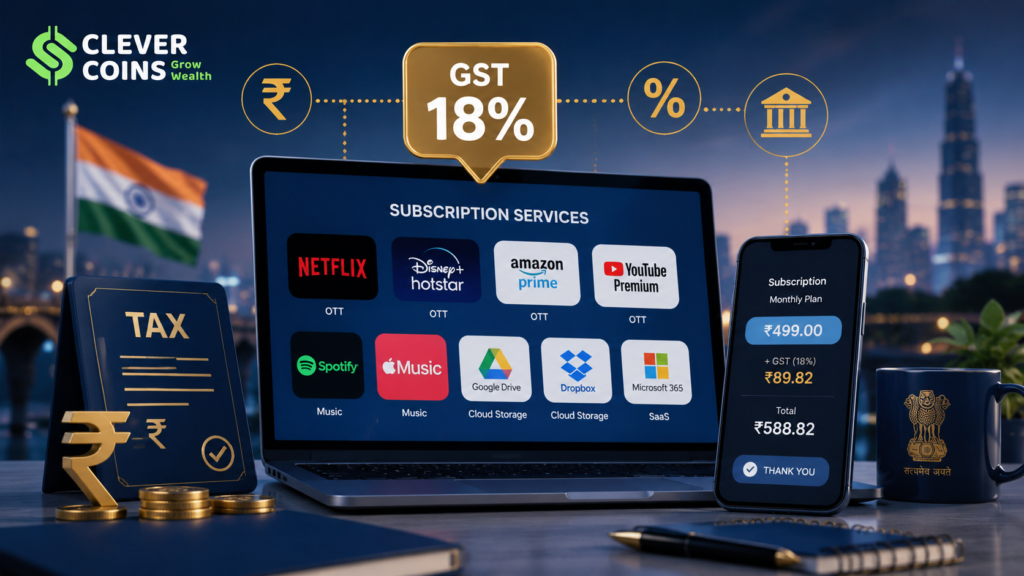
In today’s digital-first economy, subscription services have become an inseparable part of everyday life — from streaming entertainment on OTT platforms like Netflix, Amazon Prime, and Hotstar to using cloud-based SaaS tools for business operations. Whether you are binge-watching your favourite series, attending online fitness classes, or running your CRM software on the cloud, you are almost certainly paying Goods and Services Tax (GST) on that subscription — whether you know it or not.
As of 2026, with the Indian government tightening compliance norms for digital businesses and overseas service providers, understanding how GST applies to subscription services is critical — for individual consumers, start-ups, SMEs, and large enterprises alike. This comprehensive guide will walk you through every aspect of GST on subscription services in India, covering applicable rates, SAC codes, ITC eligibility, place of supply rules, overseas taxation, compliance obligations, and practical examples with Indian Rupee calculations.
1. What Are Subscription Services Under the GST Framework?
Under India’s GST regime, ‘subscription services’ broadly refer to any arrangement where a consumer pays a recurring fee — monthly, quarterly, or annual — in exchange for continuous access to a service. These are typically governed under the category of ‘Online Information and Database Access or Retrieval (OIDAR) Services’ or ‘Information Technology Enabled Services (ITES)’, depending on their nature.
Key Characteristics of Subscription Services:
- Recurring billing model (monthly/quarterly/annual)
- Delivery is predominantly digital/automated
- No physical delivery of goods
- Access is licensed, not owned, by the user
- Covered under the Supply of Services definition under Section 2(102) of CGST Act, 2017
Common Categories of Subscription Services in India (2026):
- OTT Video Streaming: Netflix, Amazon Prime Video, Disney+ Hotstar, Zee5, SonyLIV
- Music Streaming: Spotify Premium, Gaana Plus, JioSaavn Pro, Apple Music
- Cloud & SaaS Software: Microsoft 365, Google Workspace, Adobe Creative Cloud, Zoho, Salesforce
- Online Education: Udemy, Coursera, BYJU’s, Unacademy, upGrad, LinkedIn Learning
- News & Digital Magazines: The Hindu Digital, Economic Times Prime, Times Prime
- Gaming Subscriptions: Xbox Game Pass, PlayStation Plus, Google Play Pass
- Online Fitness: Cult.fit, HealthifyMe Premium, Nike Training App
- Cloud Storage: iCloud+, Google One, Dropbox, OneDrive
- Cybersecurity & VPN Services
- CRM, ERP, HRMS & Accounting Tools (B2B SaaS)
2. GST Rates Applicable on Subscription Services — 2026
GST on subscription services in India is governed by the GST Council’s classification under Schedule II of the CGST Act and the Notification No. 11/2017-Central Tax (Rate). In 2026, the Council has maintained the following rate structure for digital/subscription services:
Rate Overview Table — GST on Subscription Services 2026
Service Type | GST Rate | SAC Code | Example |
OTT Platforms (Netflix, Hotstar, etc.) | 18% | 998431 | Rs. 649/month plan => Rs. 116.82 GST |
Music Streaming (Spotify, Gaana) | 18% | 998432 | Rs. 119/month => Rs. 21.42 GST |
News & Magazine Subscriptions | 5% | 998391 | Rs. 200/month => Rs. 10 GST |
Software as a Service (SaaS) | 18% | 998315 | Rs. 5,000/month => Rs. 900 GST |
Cloud Storage Services | 18% | 998316 | Rs. 299/month => Rs. 53.82 GST |
Gaming Subscriptions | 18% | 998433 | Rs. 499/month => Rs. 89.82 GST |
E-Learning Platforms | 18% | 998393 | Rs. 999/month => Rs. 179.82 GST |
Online Fitness Apps | 18% | 999319 | Rs. 399/month => Rs. 71.82 GST |
CRM/ERP Tools (B2B) | 18% | 998314 | Rs. 20,000/month => Rs. 3,600 GST |
Important Rate Notes for 2026:
- Most digital subscription services attract 18% GST (9% CGST + 9% SGST for intra-state, or 18% IGST for inter-state)
- Print and digital news/magazine subscriptions (registered publishers) may attract 5% GST under Notification 12/2017
- Educational content subscriptions for recognized courses may be exempt — verify with the provider’s classification
- Pure e-books (not periodicals) attract 18% GST
3. SAC Codes for Subscription-Based Services
The Service Accounting Code (SAC) is a classification system under GST used to identify specific types of services. Correct SAC codes must be mentioned on all GST invoices issued by subscription service providers.
Critical SAC Codes (2026):
- 998431 — Video/audio streaming services including OTT platforms
- 998432 — Music streaming and audio-on-demand services
- 998315 — Software-as-a-Service (SaaS) and cloud-based application subscriptions
- 998316 — Cloud infrastructure and storage services (IaaS/PaaS)
- 998391 — Online newspaper and news aggregation subscriptions
- 998393 — Online educational content and e-learning subscriptions
- 998433 — Online gaming subscriptions and in-game premium memberships
- 999319 — Online health, wellness, and fitness app subscriptions
- 998314 — Database management and data processing services
- 998312 — IT consulting and managed IT service subscriptions
Pro Tip: Always verify the SAC code mentioned on your subscription invoice. Misclassified SAC codes can lead to ITC disputes or GST audit notices in 2026, as the GST Council has enhanced AI-driven mismatch detection.
4. GST Registration Requirements for Subscription Service Providers
For Indian Subscription Businesses:
Under Section 22 of the CGST Act, 2017, any business supplying subscription services must register for GST if their aggregate annual turnover exceeds Rs. 20 Lakhs (Rs. 10 Lakhs for special category states). However, there is NO threshold exemption for businesses engaged in inter-state supply of services — they must register from the very first transaction.
- Threshold for Intra-State Services: Rs. 20 Lakhs/year (regular states), Rs. 10 Lakhs/year (NE states, Himachal, Uttarakhand, Jammu & Kashmir)
- Inter-State Supply of Subscription Services: Mandatory GST registration regardless of turnover
- E-Commerce Operators hosting third-party subscription services: Mandatory registration
- Composition Scheme: NOT available for service providers — subscription businesses cannot opt for Composition
For Overseas Subscription Service Providers (OIDAR Rules 2026):
Under the amended OIDAR provisions and Finance Act 2023 implementation (fully effective from 2026), ALL overseas companies providing digital subscription services to Indian consumers — both Business-to-Consumer (B2C) and Business-to-Business (B2B) — must either register under GST or appoint an Indian representative/intermediary for GST compliance.
- Netflix (Netherlands entity), Spotify (Sweden entity), and similar platforms must file GST returns as OIDAR service providers
- The reverse charge mechanism (RCM) may apply when Indian businesses receive B2B services from unregistered overseas providers
- As per Notification No. 10/2017-IT (Rate), unregistered overseas OIDAR suppliers to Indian B2B customers attract RCM — the Indian recipient must pay GST
- Non-compliance can result in penalties under Section 125 of the CGST Act: up to Rs. 25,000 per violation
5. Place of Supply Rules for Subscription Services
The ‘Place of Supply’ (POS) determines whether CGST + SGST or IGST applies to a subscription service transaction. This is especially important for cross-state and cross-border subscription billing.
Intra-State Subscription Services:
If both the service provider and the recipient are in the same state, CGST + SGST applies at equal split. For example: A Mumbai-based OTT platform selling a subscription to a Mumbai consumer pays 9% CGST + 9% SGST = 18% total on the subscription value.
Inter-State Subscription Services:
If the provider and recipient are in different states, IGST at 18% applies. For example: A Bengaluru-based SaaS company selling a subscription to a Delhi-based business — 18% IGST applies.
International / Cross-Border Subscription Services:
For OIDAR services provided by overseas companies to Indian consumers, IGST applies based on the location of the Indian recipient:
- B2C: Overseas provider collects 18% IGST from the Indian consumer and remits to the government
- B2B (Registered Recipient): Under Reverse Charge Mechanism (RCM), the Indian company self-assesses and pays IGST
- B2B (Unregistered Recipient): RCM applies — the recipient is liable to pay GST
Practical Example — Place of Supply Calculation:
Scenario: An Indian marketing agency in Chennai subscribes to HubSpot (US) at $300/month (approx. Rs. 25,000/month).
- Since HubSpot is an overseas OIDAR provider and the Chennai agency is GST-registered: RCM applies
- GST Liability = Rs. 25,000 x 18% = Rs. 4,500 IGST per month
- The agency pays Rs. 4,500 as GST to the government under RCM
- Input Tax Credit of Rs. 4,500 can be claimed in GSTR-3B (subject to conditions)
6. Input Tax Credit (ITC) on Subscription Services
Input Tax Credit (ITC) is one of the most powerful features of GST — allowing businesses to offset the GST paid on inputs against their GST liability on outputs. However, ITC on subscription services has specific rules that many businesses overlook.
ITC Eligibility on Subscription Services for Businesses:
- SaaS Tools (CRM, ERP, Accounting, Design Software): ITC Available — if used for business purposes
- Cloud Storage & Web Hosting: ITC Available — business use qualifies
- Online Learning (Employee Training): ITC Available — if for professional development
- OTT Subscriptions (Netflix, Prime): ITC NOT Available — personal/entertainment use
- Music Streaming (Personal): ITC NOT Available — blocked under Section 17(5)
- Business Productivity Tools (Google Workspace, MS 365): ITC Available
- VPN / Cybersecurity subscriptions for business: ITC Available
- Gym/Fitness App subscriptions: ITC NOT Available (personal nature)
Conditions for Valid ITC Claim on Subscription Services:
- The subscription must be used in the course or furtherance of business
- A valid GST invoice must be received from the supplier with correct GSTIN and SAC code
- The supplier must have filed their GSTR-1 and the ITC must appear in GSTR-2B
- ITC cannot be claimed on subscription services used for personal or non-business purposes
- ITC on mixed-use subscriptions (personal + business) must be apportioned under Rule 42/43 of CGST Rules
- The ITC must be claimed within the stipulated time — by the 30th November of the following financial year or before filing the Annual Return, whichever is earlier
ITC Calculation Example (2026):
A Pune-based digital marketing firm subscribes to:
- Adobe Creative Cloud: Rs. 4,230/month (GST: Rs. 762) — ITC ELIGIBLE
- Zoho CRM: Rs. 3,540/month (GST: Rs. 637) — ITC ELIGIBLE
- Netflix for office entertainment: Rs. 649/month (GST: Rs. 117) — ITC NOT ELIGIBLE
- Google Workspace: Rs. 2,360/month (GST: Rs. 425) — ITC ELIGIBLE
Total Monthly ITC Available = Rs. 762 + Rs. 637 + Rs. 425 = Rs. 1,824 per month
Annual ITC Savings = Rs. 1,824 x 12 = Rs. 21,888 per year
7. GST Invoicing Requirements for Subscription Service Providers
Every subscription service provider registered under GST must issue a valid tax invoice that complies with Rule 46 of the CGST Rules, 2017. With the e-invoicing mandate expanding in 2026, compliance has become non-negotiable.
Mandatory Fields on a GST Subscription Invoice:
- Sequential Invoice Number (unique for each financial year)
- Invoice Date
- Supplier’s GSTIN, Name, and Address
- Recipient’s GSTIN (for B2B), Name, and Address
- Place of Supply (State Code)
- HSN/SAC Code (minimum 6-digit for turnover > Rs. 5 Crore)
- Description of Service (e.g., ‘Monthly OTT Subscription — May 2026’)
- Taxable Value of Supply
- Applicable GST Rate (CGST + SGST or IGST)
- GST Amount (separately for CGST, SGST, and IGST)
- Total Invoice Value (including GST)
- Subscription Period covered (From Date — To Date)
- Digital Signature (for e-invoices)
E-Invoicing Mandate for Subscription Businesses (2026):
As of 1st August 2023, e-invoicing became mandatory for all registered businesses with annual aggregate turnover above Rs. 5 Crore. In 2026, the government has further lowered the threshold, making e-invoicing applicable to businesses with turnover above Rs. 2 Crore. Subscription businesses must generate e-invoices through the Invoice Registration Portal (IRP) and obtain an Invoice Reference Number (IRN) and QR Code for every B2B transaction.
8. GST Compliance Obligations for Subscription Businesses in 2026
Subscription service providers must adhere to a comprehensive compliance calendar to avoid penalties and interest under the GST law. Below is the complete compliance framework:
Compliance Task | Frequency | Due Date | Portal |
GST Registration | One-Time | Before crossing threshold | GST Portal |
GSTR-1 Filing | Monthly/Quarterly | 11th of next month | GST Portal |
GSTR-3B Filing | Monthly | 20th of next month | GST Portal |
Annual Return GSTR-9 | Yearly | 31st December | GST Portal |
E-Invoice Generation | Per Transaction | At time of billing | IRP Portal |
ITC Reconciliation | Monthly | Before GSTR-3B | GSTIN Dashboard |
Key Compliance Updates in 2026:
- GSTR-1A: Introduced in 2024-25, allows amendments to GSTR-1 before GSTR-3B filing
- Enhanced AI-based ITC Mismatch Detection: GSTN’s AI system now flags ITC claims not matching supplier GSTR-1 in real-time
- Annual Return Threshold: GSTR-9 is mandatory for all businesses above Rs. 2 Crore turnover
- Quarterly Return Monthly Payment (QRMP) Scheme: Available for subscription businesses with turnover up to Rs. 5 Crore
- GST Amnesty Scheme 2026: Businesses can rectify past compliance errors with reduced penalties — check the latest circular on the GST portal
- Penalty for Late Filing: Rs. 50/day (Rs. 20/day for nil returns) — capped at Rs. 10,000 per return
- Interest on Late Payment: 18% per annum on outstanding GST liability
9. GST Implications for Consumers of Subscription Services
From a consumer’s perspective, GST is already embedded in the subscription price you pay. However, there are several important things individual consumers and freelancers/sole proprietors should know:
For Individual (B2C) Subscribers:
- The subscription price displayed on platforms like Netflix, Spotify, or Udemy is INCLUSIVE of GST — unless explicitly stated otherwise
- Consumers cannot claim ITC — this is exclusively for GST-registered businesses
- When subscribing to foreign platforms (e.g., Coursera, LinkedIn Learning), the platform itself collects and remits GST on your behalf
- If you receive a tax invoice from a subscription service, always verify that the GST amount shown matches the applicable rate
For Freelancers and Sole Proprietors:
- If you are GST-registered (turnover > Rs. 20 Lakhs or engaged in inter-state services), you can claim ITC on business-use subscriptions
- If you are not GST-registered, you are a final consumer and bear the GST cost
- Registering for GST voluntarily (even below threshold) can give you ITC benefits on tools like Canva Pro, Adobe, or Zoom
Price Impact Example for Consumers (2026):
OTT Platform Monthly Subscription: Rs. 649 (Inclusive of 18% GST)
- Base Price: Rs. 549.15
- GST @ 18%: Rs. 98.85 (approximately Rs. 99)
- Total Paid: Rs. 649
This means of your Rs. 649 subscription, nearly Rs. 99 goes to the government as GST — representing about 15.2% of what you pay.
10. GST on Bundled Subscription Services
Many providers now offer bundled subscription packages that combine multiple services at a single price — such as telecom operators bundling OTT subscriptions with data packs, or e-commerce platforms bundling delivery benefits with digital subscriptions.
How GST Applies to Bundled Subscriptions:
Under Section 8 of the CGST Act, 2017, a ‘composite supply’ consists of two or more supplies that are bundled together in the ordinary course of business. In a composite supply, the GST rate of the ‘principal supply’ applies to the entire bundle.
- Composite Supply: If a telecom operator bundles a data plan with a Hotstar subscription, and the telecom plan is the principal supply, telecom GST rates apply to the entire bundle
- Mixed Supply: When two or more distinct services are bundled for a single price and it is NOT a composite supply, the highest GST rate among all components applies to the entire bundle
- Amazon Prime: Bundles fast delivery + Prime Video + Prime Music. GST authorities have clarified this is a composite supply where the delivery/subscription benefit is principal. 18% GST applies on the full membership fee
Practical Example — Bundled Subscription GST (2026):
Jio Cinema Premium + Jio Fiber Bundle: Rs. 1,499/month
- Internet Service: Attracts 18% GST
- OTT Add-on: Attracts 18% GST
- Since both attract the same rate, total GST = Rs. 1,499 x 18% = Rs. 269.82 per month
- Annual GST on this bundle = Rs. 269.82 x 12 = Rs. 3,237.84
11. GST on Free Trial and Discounted Subscription Periods
Free Trials:
Free trials (e.g., 30-day free trial of Netflix) do not attract GST because there is no consideration (payment) involved. However, if a free trial converts to a paid subscription, GST applies from the first billing date. No GST is payable on the trial period itself.
Discounted Subscriptions:
When subscription services are offered at a discounted price (e.g., annual subscription at 20% discount), GST is calculated on the ACTUAL transaction value (discounted price), not the maximum retail price — provided the discount is mentioned on the invoice. This is per Section 15(3) of the CGST Act.
Cashback and Reward Points:
Cashbacks offered on subscription payments (e.g., credit card cashback on OTT subscriptions) are NOT deductible from the GST taxable value unless the cashback is given by the supplier themselves and clearly established before supply. Bank/card cashbacks from third parties do not reduce GST liability.
12. Recent GST Updates Affecting Subscription Services in 2026
The GST Council has been actively refining the tax treatment of digital and subscription services. Here are the most important updates relevant to 2026:
- OIDAR Expansion (2023-24 & 2026 Implementation): Overseas digital service providers must now register and file GST for ALL supplies to India — both B2C and B2B. This closes previous loopholes where B2B RCM compliance was ignored
- E-Invoicing Threshold Lowered: Businesses with turnover above Rs. 2 Crore must generate e-invoices for all B2B subscription transactions from April 2026
- GST on Gaming Subscriptions (Revised): Online skill gaming platforms saw GST revised to 28% on the full face value of deposits in October 2023. Gaming subscription platforms (like Xbox Game Pass) remain at 18% as they are not gambling/wagering
- Cryptocurrency/NFT Subscription Services: The GST Council clarified in 2024 that subscription-based access to crypto trading platforms attracts 18% GST on subscription fees (not on trading volumes)
- AI-Powered Compliance Tools: GSTN launched AI-based analytics in 2025-26 to detect subscription businesses not compliant with GSTR-1 filings, particularly targeting overseas OIDAR providers
- Composition-Levy Exclusion Reinforced: Service providers — including all subscription businesses — are explicitly excluded from the Composition Levy scheme as of 2026
- GST Appellate Tribunal (GSTAT): Fully operational in 2026, providing faster dispute resolution for subscription tax cases
13. Common GST Mistakes by Subscription Service Businesses
Mistakes to Avoid in 2026:
- Not obtaining GSTIN before starting inter-state subscription services — every rupee earned from day one is taxable without ITC benefit
- Incorrect SAC code on invoices — leads to ITC mismatches for recipients
- Not declaring overseas OIDAR subscriptions received under RCM — a common audit trigger
- Claiming ITC on personal subscriptions (OTT, music, gym) — results in demand notices with interest
- Missing the e-invoice mandate for B2B transactions — invalid invoices mean the recipient cannot claim ITC
- Not reconciling GSTR-2B with purchase invoices monthly — causes ITC blockages
- Treating subscription renewals as new supplies without proper credit note/debit note adjustments for cancellations
- Not filing GSTR-9C (Annual Reconciliation) when applicable — attracts Rs. 200/day penalty
- Incorrect Place of Supply determination for multi-state subscribers — can lead to CGST/SGST vs IGST dispute
- Delay in passing GST reduction benefits to consumers when GST rates are revised — Anti-Profiteering provisions apply
14. GST Refund on Subscription Services
GST refunds on subscription services are available in specific scenarios:
- Export of Services: Indian SaaS/subscription companies serving overseas clients can claim GST refund under Section 54 of CGST Act — since services exported are ‘zero-rated supplies’
- Inverted Duty Structure: If input tax paid is higher than output tax (rare in subscription services), refund is available
- Excess Payment: Refund of tax paid by mistake (excess amount) can be claimed within 2 years from the relevant date
- B2B Subscription Cancelled Before Period End: Supplier must issue a Credit Note; subscriber adjusts ITC accordingly
How to Apply for GST Refund (Subscription Businesses):
- Log in to GST Portal (www.gst.gov.in)
- Navigate to Refunds > Application for Refund
- Select the appropriate refund type and financial year
- Upload supporting documents (invoices, export proof for zero-rated supplies)
- Submit RFD-01 form
- Refund processed within 60 days (90 days for scrutiny cases)
15. Practical GST Compliance Checklist for Subscription Businesses (2026)
Monthly Checklist:
- File GSTR-1 by 11th of each month (monthly filers)
- File GSTR-3B by 20th of each month
- Reconcile GSTR-2B with purchase ledger
- Verify ITC claims — ensure supplier has filed GSTR-1
- Generate e-invoices for all B2B transactions
- Pay GST liability before 20th to avoid interest
Quarterly Checklist (QRMP Filers):
- File GSTR-1 quarterly (by 13th of month after quarter end)
- Pay tax monthly via PMT-06 challan (by 25th of each month)
- File GSTR-3B quarterly (by 22nd/24th depending on state)
Annual Checklist:
- File GSTR-9 (Annual Return) by 31st December
- File GSTR-9C (Reconciliation Statement) if applicable
- Reconcile books of accounts with GST returns
- Review and reverse any blocked ITC under Section 17(5)
- Check for GST notices and respond within stipulated time
- Update GST registration details (address, directors, bank account) if changed
Conclusion
GST on subscription services in India is a dynamic and nuanced area of tax law — one that affects millions of consumers and thousands of businesses in 2026. Whether you are a start-up offering a SaaS product, a mid-sized company managing multiple software subscriptions, or an individual streaming your favourite content, understanding GST implications helps you stay compliant, optimize costs, and avoid penalties.
Key takeaways from this guide: most digital subscription services attract 18% GST; ITC is available only for business-use subscriptions by registered taxpayers; OIDAR rules now extend to all overseas digital service providers supplying to India; e-invoicing compliance is mandatory for businesses above Rs. 2 Crore turnover; and the GST compliance calendar must be adhered to strictly to avoid interest and penalties.
As GST law continues to evolve, we recommend consulting a qualified GST practitioner for transaction-specific advice. Bookmark this blog and check back for regular updates as the GST Council issues new circulars and notifications throughout 2026.