ISD – Input Service Distributor Mechanism Under GST: The Definitive Guide (2026)
In any large organisation with multiple business units, branches, or subsidiaries operating across India, it is common practice for a centralised head office or corporate office to procure certain common services — such as legal advisory, IT infrastructure, software licences, management consultancy, or audit services — on behalf of the entire organisation. The critical question that arises under the Goods and Services Tax (GST) framework is: How should the Input Tax Credit (ITC) on such commonly procured services be distributed to the various branches or units that actually consume those services?
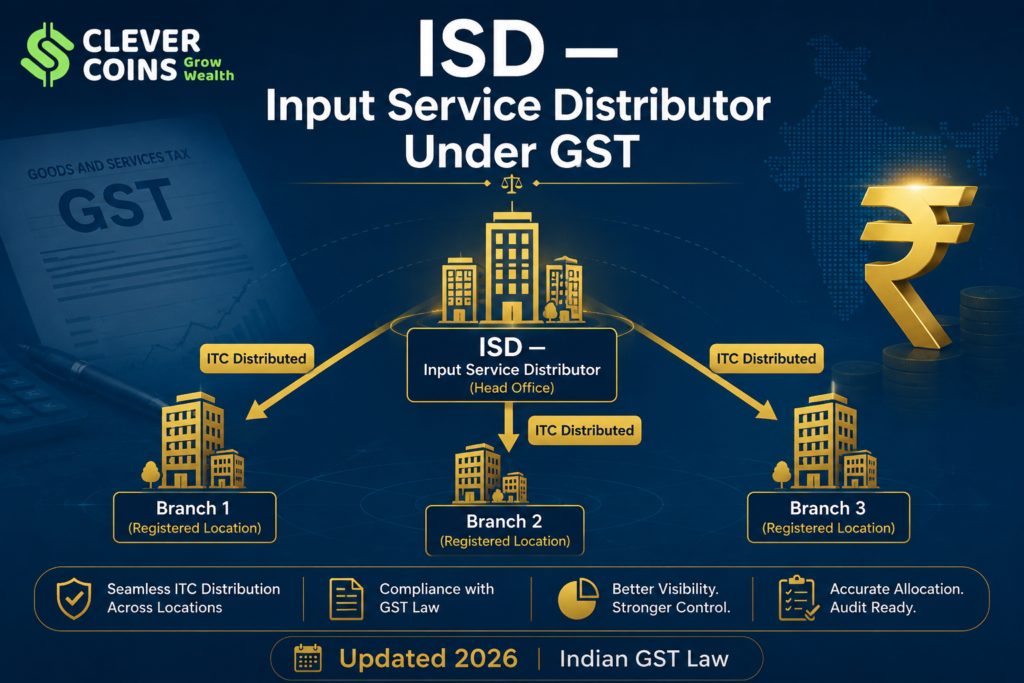
This is precisely where the Input Service Distributor (ISD) mechanism under GST plays a transformative role. The ISD is a formal, legally recognised mechanism that enables a head office or centralised registration holder to receive invoices for input services and distribute the corresponding ITC to all its branches or units registered under GST. As of 2026, with several landmark amendments including those introduced through the Finance Act 2024 making ISD mandatory for certain transactions, understanding this mechanism in its entirety has never been more critical for Indian businesses.
This blog is your complete, authoritative, and updated guide to the ISD mechanism under GST in India — covering every dimension from legal provisions and eligibility to practical compliance, GSTR-6 filing, ITC distribution formulas, and the important 2024 amendments that took effect from April 2025.
1. What Is an Input Service Distributor (ISD)? — Definition and Concept
1.1 Statutory Definition of ISD Under the CGST Act
Section 2(61) of the Central Goods and Services Tax (CGST) Act, 2017 defines an Input Service Distributor (ISD) as follows:
Statutory Definition — Section 2(61) CGST Act, 2017 “Input Service Distributor means an office of the supplier of goods or services or both which receives tax invoices issued under Section 31 towards the receipt of input services and issues a prescribed document for the purposes of distributing the credit of central tax, State tax, integrated tax or Union territory tax paid on the said services to a supplier of taxable goods or services or both having the same Permanent Account Number as that of the said office.” |
1.2 Simplified Explanation
In plain language, an Input Service Distributor is essentially a distribution mechanism — not a separate entity, but a specific registration of an office (usually the head office or corporate headquarters) that:
- Receives invoices for common input services procured centrally.
- Avails the Input Tax Credit on those services.
- Distributes that ITC proportionately to all connected branches, units, or establishments that share the same PAN and are registered under GST.
1.3 The Core Problem ISD Solves
Before the ISD mechanism, there was no standardised way for organisations to distribute the ITC from centrally procured services to their consuming units. Without ISD, the head office would be left with accumulated ITC that could not be legitimately transferred to branches — leading to stuck credit and increased tax costs. The ISD mechanism solves this by creating a formal, transparent, and auditable distribution pathway.
2. Legal Framework Governing ISD in 2026
2.1 Key Statutory Provisions
The ISD mechanism is governed by a robust set of statutory provisions and rules under the GST framework. Here are the primary legal references:
Provision | Description | Relevance |
Section 2(61) CGST Act | Definition of Input Service Distributor | Defines the scope of ISD |
Section 20 CGST Act | Manner of distribution of credit by ISD | Core ISD distribution rules |
Rule 39 CGST Rules, 2017 | Procedure for distribution of ITC by ISD | Detailed procedural rules |
Section 48 CGST Act | Returns to be filed by ISD | GSTR-6 filing obligation |
Finance Act 2024 | Mandatory ISD for common services among distinct persons | Major 2024 amendment |
Notification 50/2023-CT | Amendment expanding ISD provisions | Effective from 01.04.2025 |
Rule 54(1) CGST Rules | ISD Invoice format requirements | Document issuance rules |
2.2 The Finance Act 2024 Amendment — A Game Changer
The Finance Act 2024 introduced a landmark amendment to Section 20 of the CGST Act, which became effective from 01 April 2025. This amendment made the ISD mechanism MANDATORY for distributing ITC on certain common services received by a head office on behalf of its branches. Previously, the ISD route was optional — companies could distribute credit through cross-charges or the ISD route. Now, for specific categories of common input services, the ISD route is the only permissible method.
Critical 2024 Amendment Alert With effect from 01 April 2025, it is mandatory for a registered person (head office) to register as an ISD and distribute ITC through the ISD mechanism when receiving common input services on behalf of its branches (distinct persons under GST). The alternative method of ‘cross-charging’ is no longer permissible for common input services under GST law. Businesses that have not yet transitioned to mandatory ISD registration must do so immediately to avoid ITC disallowance and penalties. |
3. ISD vs. Cross-Charge: Understanding the Difference in 2026
3.1 What Is Cross-Charge?
Cross-charge refers to the practice of one GST registration (head office) raising a tax invoice on another GST registration of the same entity (branch) for services or supplies made between them. Before the 2024 amendment, many organisations used cross-charge as an alternative to ISD for distributing common service costs.
3.2 Comparative Analysis: ISD vs. Cross-Charge
Parameter | ISD Mechanism | Cross-Charge |
Legal Basis | Section 20 CGST Act + Rule 39 | Section 7 read with Schedule I CGST Act |
Mandatory Post-April 2025? | YES — for common input services | NOT permitted for common input services |
Invoice Type | ISD Invoice / ISD Credit Note | Regular Tax Invoice |
GST Return | GSTR-6 (by ISD) + GSTR-2A/2B of recipient | GSTR-1 of supplier + GSTR-3B of recipient |
ITC Distribution | Proportionate (based on turnover formula) | As per actual cost allocation |
Value of Supply | No taxable value — only ITC distribution | Taxable value plus applicable GST rate |
Best Use Case | Distributing ITC on common input services | Restricted post April 2025 amendment |
Risk of Challenge | Lower (compliant with 2025 mandate) | Higher (non-compliance risk for common services) |
3.3 What Can Still Be Cross-Charged?
Post the 2025 amendment, cross-charge is still permissible for:
- Employee services (salaries, benefits) shared between head office and branches.
- Services where the head office itself consumes a portion of the service and only the residual is to be shared with branches.
- Non-GST supplies or supplies that do not involve ITC.
- Any transaction that falls outside the definition of ‘common input services’ as clarified by CBIC.
4. Who Can Register as an ISD? — Eligibility and Requirements
4.1 Eligibility Criteria for ISD Registration
Any office of a registered GST person can register as an ISD, subject to the following conditions:
- The ISD must be an ‘office’ of the supplier — it can be the head office, registered office, corporate headquarters, or any centralised procurement office.
- The ISD and the recipient branches must have the same Permanent Account Number (PAN). This is a non-negotiable condition.
- The recipient branches/units must be registered under GST (i.e., they must have their own GSTIN).
- The ISD must receive tax invoices for input services in its own name.
- The ISD must obtain a separate GST registration specifically for ISD purposes, even if the same office already has a regular GST registration.
4.2 Important Clarification on Dual Registration
A head office that is already registered as a regular taxpayer must obtain a SEPARATE ISD registration. Both registrations can co-exist at the same address. This dual registration is mandatory — the ISD cannot use its regular GSTIN for distributing ITC; it must use the ISD-specific GSTIN.
Dual Registration Example ABC Ltd. has its head office in Mumbai. The Mumbai office has a regular GSTIN (27AABCA1234A1Z5) for its own supply activities. For distributing common ITC to its branches in Delhi, Pune, and Bengaluru, it must also obtain a separate ISD registration with a different GSTIN (27AABCA1234A2Z4). The ISD GSTIN is exclusively used for ISD-related activities and GSTR-6 filing. |
4.3 Entities That Cannot Register as ISD
- Input Service Distributors CANNOT distribute credit for goods (only input services).
- Entities under the Composition Scheme are not eligible to be ISD.
- An ISD cannot distribute credit for capital goods.
- Unregistered persons cannot act as ISD.
5. ISD Registration Process — Step-by-Step Guide (2026)
5.1 How to Register as an ISD on the GST Portal
The ISD registration process is conducted on the official GST Portal (www.gst.gov.in). Here is the complete step-by-step process:
- Log in to the GST Portal using credentials of the existing registered taxpayer (head office).
- Navigate to: Services > Registration > New Registration.
- In the ‘I am a’ dropdown, select ‘Input Service Distributor’ as the type of taxpayer.
- Fill in the required details — PAN, mobile number, email ID (same PAN as the existing registration).
- Upload mandatory documents: PAN card, proof of address of the ISD office, authorisation letter.
- Verify using OTP sent to the registered mobile and email.
- Submit ARN (Application Reference Number) and await approval.
- Upon approval, receive a separate ISD GSTIN for the office.
5.2 Documents Required for ISD Registration
Document | Specification | Purpose |
PAN Card of Entity | Same PAN as existing registration | Mandatory linkage requirement |
Proof of Address of ISD Office | Electricity bill / Rent agreement / Property deed | To establish the ISD’s location |
Board Resolution / Authorisation Letter | Authorising the signatory to apply for ISD registration | Corporate governance requirement |
Digital Signature Certificate (DSC) | Class 2 or Class 3 DSC for companies / LLPs | For e-signing the application |
Photograph of Authorised Signatory | Recent passport-size photograph | Identity verification |
List of Recipient GSTINs | Details of all branches to receive ITC | For ISD distribution setup |
6. ITC Distribution Rules Under ISD — The Mechanics
6.1 Types of Input Services Eligible for ISD Distribution
Not all input services received by the head office can be distributed through ISD. The following types of input services are eligible:
- IT and software services procured centrally for use by all branches.
- Legal and professional fees for services benefiting the entire organisation.
- Management consultancy and advisory services.
- Audit and accounting services.
- Centrally procured annual maintenance contracts (AMC).
- HR services, payroll management services (excluding salaries).
- Insurance premium for group policies covering all branches.
- Common marketing and advertising services.
- Centralised cloud computing, data storage, and cybersecurity services.
6.2 The ISD Distribution Formula — Section 20 CGST Act
The ITC distributed by an ISD to recipient branches must follow a specific formula prescribed under Section 20 and Rule 39 of the CGST Rules. The distribution is based on the TURNOVER of the recipient units:
ISD Distribution Formula: ITC Distributed to Unit X = Total ITC to be Distributed x (Turnover of Unit X / Aggregate Turnover of All Recipient Units) Turnover Reference Period: Turnover of the previous financial year. For the first year of operation, use the turnover of the current year up to the month of distribution. |
6.3 Practical Numerical Example of ISD Distribution
Let us understand the ISD distribution formula with a comprehensive numerical example:
Scenario ABC Technology Ltd. has its head office in Mumbai (ISD Registration). It has three branches: Branch Delhi (GSTIN: 07XXXXX), Branch Pune (GSTIN: 27XXXXX), Branch Bengaluru (GSTIN: 29XXXXX). The HO received an invoice from a law firm for legal services amounting to Rs. 10,00,000 + GST @ 18% = Rs. 1,80,000 as IGST. This legal service was procured for the benefit of all branches. The ISD must distribute Rs. 1,80,000 ITC among the three branches. |
Branch | Previous Year Turnover | Proportionate Share (%) | ITC to be Distributed (Rs.) |
Delhi | Rs. 2,00,00,000 | 40% | Rs. 72,000 |
Pune | Rs. 1,50,00,000 | 30% | Rs. 54,000 |
Bengaluru | Rs. 1,50,00,000 | 30% | Rs. 54,000 |
TOTAL | Rs. 5,00,00,000 | 100% | Rs. 1,80,000 |
6.4 Special Cases in ISD Distribution
Scenario | Rule | Action Required |
Service exclusively used by one branch | 100% ITC goes to that specific branch — no proportionate distribution needed | Direct allocation to consuming unit |
Service used by some (but not all) branches | ITC distributed only among the branches that use the service | Identify consuming units and apply formula only to them |
New branch with no previous year turnover | Use current year’s turnover up to the month of distribution | Special calculation for new units |
ITC on exempt supplies (blocked credit) | ITC attributable to exempt supplies cannot be distributed — must be reversed | Pro-rata reversal before distribution |
Excess ITC distributed in a previous period | Excess must be recovered via ISD Credit Note in subsequent period | Issue ISD Credit Note and file revised GSTR-6 |
7. ISD Invoice and ISD Credit Note — Format and Requirements
7.1 Documents Issued by ISD
An ISD issues two types of documents for distributing ITC and for making corrections:
- ISD Invoice: Issued when distributing ITC to recipient units.
- ISD Credit Note: Issued when reducing previously distributed ITC (e.g., due to excess distribution or return of services).
7.2 Mandatory Contents of an ISD Invoice (Rule 54(1) CGST Rules)
Sl. No. | Mandatory Field | Details |
1 | Name, Address and GSTIN of ISD | ISD-specific GSTIN to be mentioned |
2 | Consecutive Serial Number | Unique serial number for each ISD invoice |
3 | Date of Issue | Date when the ISD invoice is issued |
4 | Name, Address and GSTIN of Recipient | Details of the branch receiving ITC |
5 | Amount of ITC Distributed | Separately for CGST, SGST, IGST, UTGST |
6 | Signature of ISD | Authorised signatory’s signature or DSC |
7 | Original Invoice Details | Reference to the original tax invoice on which ITC was availed |
7.3 Nature of Credit Distributed — Tax Heads
The ISD must carefully distribute ITC under the correct tax head — CGST, SGST, IGST, or UTGST. The rules for determining the tax head of distribution are:
Original Tax on Invoice | Recipient in Same State as ISD | Recipient in Different State from ISD |
CGST + SGST (Intra-State) | Distribute as CGST + SGST | Distribute as IGST |
IGST (Inter-State) | Distribute as IGST | Distribute as IGST |
CGST + UTGST | Distribute as CGST + UTGST | Distribute as IGST |
8. GSTR-6: The ISD Return — Filing Guide for 2026
8.1 What Is GSTR-6?
GSTR-6 is the monthly GST return that every registered ISD is mandatorily required to file. This return captures all inward supplies received by the ISD and the details of ITC distributed to recipient units. The GSTR-6 serves as the basis for recipients to claim ITC in their GSTR-3B.
8.2 GSTR-6 Filing Details
Parameter | Details |
Return Name | GSTR-6 |
Filed By | Input Service Distributor (ISD GSTIN) |
Frequency | Monthly |
Due Date | 13th of the following month |
Mode of Filing | Online on GST Portal (www.gst.gov.in) |
Verification | DSC or EVC |
Late Fee | Rs. 50 per day (Rs. 20 per day for NIL return); Maximum Rs. 5,000 |
Applicability | Mandatory even if no distribution made in a month (NIL GSTR-6 required) |
8.3 GSTR-6 Table Structure — What to Report
Table No. | Description | Information to Fill |
Table 3 | Details of ITC received for distribution | Inward supply invoices on which ITC is availed by ISD |
Table 4 | Eligible ITC to be distributed | ITC split between distributable and non-distributable (blocked) |
Table 5 | Distribution of ITC (ISD invoices) | Details of each ISD invoice issued to recipient units |
Table 6 | Distribution of ITC through ISD Credit Notes | Adjustments, reversals, reductions in ITC previously distributed |
Table 7 | Late fees and interest payable | Auto-calculated based on filing date |
8.4 How Recipients Claim ISD Credit
Once the ISD files GSTR-6, the ITC distributed appears in the GSTR-2A and GSTR-2B of the recipient units automatically. Recipient units can view and claim this ITC in their GSTR-3B under the relevant head. Importantly:
- The recipient’s GSTR-2B will reflect ISD credit separately from regular supplier credits.
- The recipient can claim ISD credit subject to the standard ITC eligibility conditions.
- If the ISD has made an incorrect distribution, the recipient cannot independently rectify it — only the ISD can issue an ISD Credit Note and file a revised GSTR-6.
9. Blocked Credits and ITC Restrictions for ISD
9.1 What Credits Cannot Be Distributed Through ISD?
The ISD mechanism does not allow distribution of all types of ITC. Certain categories of ITC are blocked and cannot be passed on to recipient units:
- ITC blocked under Section 17(5) of the CGST Act: This includes ITC on motor vehicles (subject to exceptions), food and beverages, health and fitness club services, beauty treatment, membership of a club, travel benefits to employees, construction of immovable property (except plant and machinery), and so on.
- ITC related to purely exempt supplies: ITC attributable to exempt supplies cannot be distributed.
- ITC on capital goods: The ISD mechanism applies only to input services — not to goods or capital goods.
- ITC where the time limit for availing credit has expired (Section 16(4) CGST Act): ITC cannot be availed after the deadline.
9.2 Partial Distribution: When Some ITC Is Blocked
When a centrally procured service is partially used for taxable supplies and partially for exempt supplies, the ISD must:
- Calculate the total ITC on the invoice.
- Determine the proportion attributable to exempt supplies using Rule 42/43 of the CGST Rules.
- Reverse the blocked/exempt portion of ITC.
- Distribute only the remaining eligible ITC to recipient branches.
10. ISD Under IGST: Inter-State Distribution Scenarios
10.1 When ISD Distributes to Branches in Different States
A very common scenario for large Indian corporations is where the head office (ISD) is in one state and the branches are spread across multiple states. In this case, IGST dynamics apply, and the ITC must be correctly classified to avoid disputes.
10.2 Practical Rules for Inter-State ISD Distribution
ISD Location | Recipient Branch Location | Original Tax | Distribution Tax Head |
Maharashtra (Mumbai) | Maharashtra (Pune) | CGST + SGST (Maharashtra) | CGST + SGST (Maharashtra) |
Maharashtra (Mumbai) | Delhi | CGST + SGST (Maharashtra) | IGST |
Maharashtra (Mumbai) | Karnataka (Bengaluru) | IGST | IGST |
Delhi | Delhi | CGST + SGST (Delhi) | CGST + SGST (Delhi) |
Delhi | Telangana (Hyderabad) | CGST + SGST (Delhi) | IGST |
10.3 Key Point on IGST Distribution
When the ISD converts intra-state credit (CGST + SGST) to IGST for distribution to out-of-state branches, there is no actual tax payment involved — it is purely a credit reclassification. The recipient branch will receive IGST credit in their GSTR-2B and can use it to offset their IGST, CGST, or SGST liability in the prescribed order of utilisation.
11. Reconciliation and Audit of ISD Transactions
11.1 Why ISD Reconciliation Is Critical
Given the multi-entity, multi-state nature of ISD transactions, proper reconciliation is essential to ensure:
- ITC distributed by ISD matches ITC received by all recipient branches in their GSTR-2B.
- No double-claiming of ITC (once at ISD level and again at branch level).
- Proportionate distribution ratios are correctly applied based on updated turnover figures.
- Blocked credits are correctly identified and not distributed.
- GSTR-6 data is consistent with the ISD invoices issued.
11.2 Monthly ISD Reconciliation Checklist
Step | Reconciliation Activity | Frequency |
1 | Match total ITC availed in GSTR-6 with GSTR-2B of ISD | Monthly |
2 | Verify ISD distribution amounts against turnover ratio calculation | Monthly |
3 | Confirm ISD invoices reflect correctly in GSTR-2B of recipient branches | Monthly |
4 | Check for blocked credit reversals and confirm accuracy | Monthly |
5 | Reconcile GSTR-6 filed data with ISD invoice register | Monthly |
6 | Update turnover data for distribution ratio (new branches, revised turnover) | Quarterly / Annual |
7 | Verify no GST return mismatches between ISD GSTR-6 and recipients’ GSTR-2B | Monthly |
8 | Review for any excess or short distribution from prior months | Monthly |
11.3 ISD in GST Audit (GSTR-9C)
For businesses with aggregate turnover exceeding Rs. 5 Crore, the GST auditor (Chartered Accountant or Cost Accountant) must specifically review ISD transactions while certifying GSTR-9C. Key audit areas include:
- Correctness of ISD distribution formula and turnover ratios used.
- Verification that only eligible input services were routed through ISD.
- Ensuring no capital goods or goods credits were distributed via ISD.
- Compliance with the mandatory ISD requirement effective April 2025.
12. Practical Challenges in ISD Implementation and How to Overcome Them
12.1 Common Challenges Faced by Businesses
Challenge | Description | Solution |
Dual Registration Complexity | Managing two GSTINs (regular + ISD) at the same address creates confusion in invoice management | Implement ERP tagging to differentiate ISD invoices from regular invoices |
Turnover Data Accuracy | Incorrect or outdated turnover data leads to wrong ITC distribution ratios | Maintain a live turnover dashboard; update at the start of each financial year |
Tax Head Mismatch | Errors in classifying distributed credit as CGST/SGST vs. IGST cause mismatches | Build a state-wise distribution matrix and validate before GSTR-6 filing |
Blocked Credit Identification | Difficulty in identifying which portion of a mixed-use service is blocked | Implement a pre-approval policy for centrally procured services |
GSTR-6 Amendment | Correcting errors in filed GSTR-6 is cumbersome and affects multiple recipients | Implement dual-review before GSTR-6 submission; use ISD Credit Notes for corrections |
Late Filing Penalties | Missing the 13th of the month deadline for GSTR-6 | Set automated reminders; designate a dedicated GST compliance officer for ISD |
New Branch Integration | Adding a new branch mid-year requires recalculation of distribution ratios | Have a Standard Operating Procedure (SOP) for onboarding new branches into ISD |
13. ISD Compliance Calendar for Financial Year 2025-26
13.1 Monthly Compliance Tasks
Month | Activity | Due Date | Penalty for Non-Compliance |
Every Month | File GSTR-6 (ISD Return) | 13th of following month | Rs. 50/day (max Rs. 5,000) |
Every Month | Issue ISD Invoices to recipient branches | Within the same tax period | ITC denial to recipients |
Every Month | Reconcile GSTR-2B of ISD with inward invoices | Before filing GSTR-6 | Excess/wrong ITC distribution |
Every Month | Update recipient branch GSTR-2B and confirm ITC receipt | By 15th of following month | Recipient ITC mismatch |
Every Quarter | Review turnover ratios for ISD distribution | Start of each quarter | Inaccurate ITC distribution |
Annual | Annual return GSTR-9 for ISD | 31st December of next FY | Rs. 200/day (max 0.5% of turnover) |
Annual | GSTR-9C audit (if turnover > Rs. 5 Cr) | 31st December of next FY | Penalty under Section 125 CGST Act |
14. Key AAR Rulings and CBIC Circulars on ISD (Updated 2026)
14.1 Landmark Advance Rulings and Clarifications
- CBIC Circular No. 199/11/2023-GST: Clarified the distinction between ISD and cross-charge mechanism. Confirmed that ISD is the appropriate route for distributing ITC on common input services procured by the head office for branches. Cross-charge should be used only where actual supply of goods/services occurs between distinct persons.
- In Re: Columbia Asia Hospitals Pvt. Ltd. (Karnataka AAR): Held that management fees charged by the corporate office to hospital branches constitute a supply and cannot be distributed as ISD credit. The ruling highlighted the boundary between ISD distribution (no taxable supply) and cross-charge (taxable supply).
- In Re: Cummins India Ltd. (Maharashtra AAR): Ruled that ISD must maintain invoice-level details for each distribution to ensure proper ITC matching in GSTR-6. Blanket or aggregate distributions without invoice references are not valid.
- CBIC FAQ on ISD Post Finance Act 2024: CBIC clarified that the mandatory ISD registration requirement covers all centrally procured common input services — including IT services, legal fees, and audit fees — where the head office procures them for the benefit of its branches as distinct persons.
- In Re: Tata Consultancy Services (Maharashtra AAAR): Confirmed that software licences procured centrally and distributed across branches is an eligible input service for ISD distribution. The AAAR also clarified that the distribution formula must use the immediately preceding financial year’s turnover.
15. Penalties, Interest, and Consequences of ISD Non-Compliance
15.1 Penalties Under GST for ISD Violations
Violation | Penalty / Consequence | Legal Provision |
Failure to register as ISD (post April 2025 mandate) | Disallowance of entire ITC distributed without ISD route + penalty up to 100% of tax | Section 122 CGST Act |
Late filing of GSTR-6 | Rs. 50 per day (Rs. 20/day for NIL return); Maximum Rs. 5,000 | Section 47 CGST Act |
Wrongful distribution of blocked credit via ISD | Recovery of wrongly distributed ITC + 18% interest p.a. | Section 73/74 CGST Act |
Non-issuance of ISD Invoice | ITC denial to recipient unit; penalty for non-issuance of invoice | Section 122 CGST Act |
Excess ITC distribution without correction | Recovery of excess ITC from recipient + interest @ 18% p.a. | Section 50 CGST Act |
Fraudulent ISD credit distribution | Penalty equal to ITC amount + potential prosecution | Section 132 CGST Act |
Using incorrect tax head in ISD distribution | Mismatch in recipient GSTR-2B; possible scrutiny notice | CBIC Circular 199/2023 |
16. Technology and Automation for ISD Compliance — Best Practices 2026
16.1 ERP Integration for ISD
As ISD compliance involves multi-entity, multi-state, and multi-invoice management, technology plays a critical role. Here are best practices for technology-driven ISD compliance:
- SAP / Oracle ERP Module for ISD: Configure a dedicated ISD module in SAP or Oracle ERP to auto-tag invoices as ‘ISD-eligible’, calculate distribution ratios, generate ISD invoices, and prepare GSTR-6 data automatically.
- GST Return Filing Software: Use GST-compliant return filing tools such as ClearTax GST, Tally Prime, or GSTN-accredited ASPs (Application Service Providers) for seamless GSTR-6 filing.
- Automated Turnover Dashboard: Maintain a real-time turnover dashboard for all recipient branches to ensure distribution ratios are always current.
- Invoice Management System: Implement an invoice management system that automatically separates ISD invoices from regular purchase invoices.
- GSTR-2B Auto-Reconciliation: Use automated GSTR-2B reconciliation tools to verify that ISD credits distributed match what recipient branches see in their 2B.
16.2 Key Metrics to Monitor for ISD Health
Metric | Target | Monitoring Frequency |
GSTR-6 Filing Rate | 100% (filed by 13th each month) | Monthly |
ISD Distribution Accuracy | < 1% variance from formula-calculated values | Monthly |
ITC Mismatch (ISD vs. Recipient GSTR-2B) | Zero mismatches | Monthly |
Blocked Credit Reversal Rate | 100% of ineligible credit reversed before distribution | Monthly |
Average GSTR-6 Filing Time | < 3 days before deadline | Monthly |
Conclusion: Mastering ISD for Seamless GST Compliance in 2026
The Input Service Distributor (ISD) mechanism is no longer just a tax optimisation tool — it is a mandatory compliance requirement for Indian businesses that centrally procure common input services for their multiple branches. The Finance Act 2024 amendments, effective from 01 April 2025, have fundamentally changed the landscape, making ISD registration and proper GSTR-6 filing non-negotiable for qualifying businesses.
To summarise the key takeaways from this comprehensive guide:
- ISD is the ONLY permissible route for distributing ITC on common input services post April 2025 — cross-charge is no longer an option for such transactions.
- The ISD must obtain a separate GSTIN even if the head office already has a regular GST registration.
- ITC distribution must follow the prescribed turnover-based formula under Section 20 and Rule 39 of the CGST Rules.
- GSTR-6 must be filed monthly by the 13th of the following month — even if there is no distribution (NIL GSTR-6).
- Only input services are eligible for ISD distribution — not goods, not capital goods, and not blocked credits.
- Technology integration — ERP, GSTR-2B reconciliation tools, and automated dashboards — is essential for error-free ISD compliance in large organisations.
Whether you are a Chief Financial Officer structuring your organisation’s tax compliance framework, a GST practitioner advising multi-location businesses, or a finance professional seeking to understand ISD deeply — implementing a robust ISD mechanism will not only ensure legal compliance but also maximise ITC utilisation and reduce overall GST cost for your organisation. Always engage a qualified GST consultant for bespoke transaction-level advice.