Goods and Services Tax (GST) in India has ushered in a new era of tax transparency and compliance. But with greater compliance comes greater scrutiny. One of the most significant tools available with GST tax authorities is the power to conduct a GST Audit — a systematic examination of the taxpayer’s records, books of accounts, returns, and documents to verify the correctness of tax declared, ITC availed, refunds claimed, and overall GST compliance.
In 2026, GST audits by tax authorities have become increasingly data-driven and intelligence-based, leveraging AI-based risk profiling, GSTN analytics, and cross-matching of GSTR-1, GSTR-3B, GSTR-2A/2B, and e-Invoice data. Understanding what a GST audit entails, how to prepare, and what rights you have as a taxpayer is critical for every registered person under GST.
This comprehensive guide covers every aspect of GST Audit by Tax Authorities in India — from the legal provisions and types of audits to audit notices, procedures, taxpayer rights, penalties, and actionable audit preparation strategies.
What is a GST Audit by Tax Authorities?
A GST Audit by tax authorities is a formal inspection of a registered taxpayer’s business records, books of accounts, GST returns, invoices, and other relevant documents by an authorised GST officer. The objective is to verify that the taxpayer has:
- Correctly declared their taxable turnover and output tax liability
- Properly availed Input Tax Credit (ITC) and not claimed excess or ineligible ITC
- Accurately claimed GST refunds, if applicable
- Maintained proper books of accounts and records as mandated under GST law
- Discharged all tax liabilities on time
GST audit by tax authorities is distinctly different from the GSTR-9C reconciliation statement audit (conducted by a Chartered Accountant or Cost Accountant). A departmental audit is conducted by GST officers themselves and carries quasi-judicial powers including the authority to raise a demand and penalty.
Legal Provisions Governing GST Audit by Tax Authorities
GST Audit by tax authorities is primarily governed by two sections of the Central Goods and Services Tax (CGST) Act, 2017, read with the CGST Rules, 2017:
Section 65 – Audit by Tax Authorities (Departmental Audit)
Section 65 of the CGST Act, 2017 empowers the Commissioner or any officer authorised by him to undertake audit of any registered person. Key features:
- The audit may be conducted at the place of business of the registered person OR at the GST office
- The registered person must be given a notice (FORM GST ADT-01) at least 15 working days before commencement of audit
- The period of audit shall be completed within 3 months from commencement. This period can be extended by the Commissioner for a further period of 6 months for reasons to be recorded in writing
- Upon completion of audit, the officer shall inform the person of his findings, discrepancies noticed, and rights — this is done via FORM GST ADT-02
Section 66 – Special Audit
Section 66 of the CGST Act, 2017 provides for a Special Audit — a more intensive audit ordered by the Assistant Commissioner (AC) or Deputy Commissioner (DC) with prior approval of the Commissioner. Key aspects:
- Ordered when, during scrutiny/inquiry/investigation, the AC/DC is of the opinion that the value declared is not correct or the ITC availed is not within normal limits
- The audit is conducted by a Chartered Accountant or Cost Accountant nominated by the Commissioner — at the expense of the department (not the taxpayer)
- The nominated CA/CMA must submit their report (FORM GST ADT-04) within 90 days, extendable by a further 90 days
- The taxpayer is given an opportunity to be heard before any action is taken on the audit report
Relevant CGST Rules
Rule No. | Subject Matter |
Rule 101 | Audit by Tax Authorities – Procedure and Forms (ADT-01, ADT-02) |
Rule 102 | Special Audit – Procedure, CA/CMA Nomination, and Forms (ADT-03, ADT-04) |
Rule 56 | Maintenance of Accounts and Records — mandatory requirements for audit |
Rule 60 | Details of ITC — basis for ITC verification during audit |
Types of GST Audits in India (2026)
It is important to distinguish between the various types of audits under GST, as each has a different trigger, authority, and implication for the taxpayer:
1. Departmental Audit (Section 65)
This is the most common type of GST audit conducted by tax officers at the GST department. It involves a comprehensive review of the taxpayer’s books, returns, and documents at their place of business or the tax office. It is risk-based and driven by data analytics from the GSTN system.
2. Special Audit (Section 66)
Ordered in complex cases where routine departmental review is insufficient. A government-nominated CA or CMA conducts this audit at the department’s cost. It is typically triggered in cases involving large ITC claims, complex business structures, or suspected tax evasion.
3. Scrutiny of Returns (Section 61)
This is not technically an ‘audit’ but is often the precursor to a formal audit. Under Section 61, the tax officer scrutinises the filed GST returns and may send a notice (FORM GST ASMT-10) if discrepancies are found. If unsatisfied with the response, the officer may initiate a formal audit under Section 65.
4. Annual Return Audit (GSTR-9C) — Turnover-Based
Taxpayers with aggregate annual turnover exceeding ₹5 Crore in a financial year are required to file a Reconciliation Statement in FORM GSTR-9C, certified by a Chartered Accountant or Cost Accountant. While this is not a ‘departmental audit’, discrepancies highlighted in GSTR-9C often trigger departmental scrutiny.
5. Anti-Evasion / Intelligence-Based Audit
Conducted by GST Intelligence Wings (DGGI — Directorate General of GST Intelligence), these are specifically targeted audits based on intelligence inputs, tip-offs, or inter-agency data sharing (Income Tax, Customs, FEMA, etc.). These often culminate in search, seizure, and arrest in serious cases.
Type of Audit | Legal Basis | Conducted By | Trigger |
Departmental Audit | Section 65, CGST Act | GST Commissioner / Authorised Officer | Risk profiling, GSTN analytics, random selection |
Special Audit | Section 66, CGST Act | CA/CMA nominated by Commissioner | Complex cases, suspected value/ITC manipulation |
Scrutiny of Returns | Section 61, CGST Act | GST Officer | Discrepancies in filed returns |
Annual Return Audit (GSTR-9C) | Section 35(5) / Rule 80 | CA or CMA (private) | Turnover > ₹5 Crore |
DGGI Anti-Evasion Audit | Sections 67–72, CGST Act | DGGI / Central GST Officers | Intelligence inputs, tipoffs, cross-agency data |
GST Audit Forms – ADT-01 to ADT-04 Explained
The GST law prescribes specific forms for each stage of the audit process. Understanding these forms is crucial for every taxpayer:
FORM GST ADT-01 – Audit Notice
FORM GST ADT-01 is the notice issued to the registered taxpayer informing them of the upcoming departmental audit under Section 65. Key details included in ADT-01:
- Name and GSTIN of the taxpayer to be audited
- Period for which audit will be conducted (e.g., FY 2022-23 or specific months)
- Date of commencement of audit (minimum 15 working days advance notice mandatory)
- Place where audit will be conducted (premises or tax office)
- List of documents, records, and registers to be made available
Key Right: If you receive ADT-01, you have the right to seek a reasonable adjournment from the auditing officer if you need more time to compile records. Engage a GST consultant immediately upon receipt. |
FORM GST ADT-02 – Audit Report / Findings
After completion of audit under Section 65, the GST officer issues FORM GST ADT-02 to communicate the findings, discrepancies, and conclusions of the audit. This may include:
- Discrepancies found in output tax declared vs. actual liability
- Excess or ineligible ITC availed
- Short payment of tax due to classification errors
- Non-payment of RCM (Reverse Charge Mechanism) liability
- Failure to issue proper tax invoices or debit/credit notes
FORM GST ADT-03 – Direction for Special Audit
When the Assistant or Deputy Commissioner decides to refer a case for Special Audit under Section 66, they issue FORM GST ADT-03. This form:
- Names the specific CA or CMA nominated to conduct the special audit
- Specifies the scope and period of the special audit
- Is served on the taxpayer after obtaining Commissioner’s approval
FORM GST ADT-04 – Special Audit Report
This is the report submitted by the nominated CA or CMA upon completion of the special audit. It details findings on valuation, ITC, tax liability, and any other specific issues referred for audit. The taxpayer is given an opportunity to be heard before any demand is raised based on this report.
Form | Stage | Issued By | Purpose |
GST ADT-01 | Pre-Audit | GST Officer | Notice to taxpayer for departmental audit (Section 65) |
GST ADT-02 | Post-Audit | GST Officer | Communication of audit findings & discrepancies |
GST ADT-03 | Pre-Special Audit | AC/DC with Commissioner’s approval | Direction for special audit & CA/CMA nomination (Section 66) |
GST ADT-04 | Post-Special Audit | Nominated CA/CMA | Special audit report submitted to department |
How Are Taxpayers Selected for GST Audit in India 2026?
GST audit selection in 2026 is sophisticated and data-driven. The GSTN (GST Network) infrastructure and AI-powered analytics tools help the department identify high-risk taxpayers. Understanding the selection criteria helps businesses proactively ensure compliance:
1. Risk-Based Profiling by GSTN Analytics
The GSTN system continuously analyses data from multiple returns and databases to generate a Risk Score for each taxpayer. High-risk scores trigger audit selection. Key risk parameters include:
- Significant mismatch between GSTR-1 (outward supplies declared) and GSTR-3B (tax paid)
- Large ITC claimed in GSTR-3B compared to GSTR-2B (auto-populated ITC from supplier’s GSTR-1)
- Sudden spike or drop in turnover without a corresponding change in tax liability
- Frequent amendments in returns (GSTR-1A amendments)
- Mismatches between e-Invoice data and GSTR-1 reported data
- High ratio of exempt supplies without corresponding Exempt ITC reversal
2. Sector-Specific Audits
The GST Council and CBIC (Central Board of Indirect Taxes and Customs) periodically identify sectors with high revenue leakage risk for targeted audits. In 2025-26, sectors under enhanced GST scrutiny include:
- Construction and Real Estate — ITC on inputs vs. proportion for commercial/residential projects
- Restaurants and Hospitality — Composition vs. Regular taxpayer classification
- Trading and E-Commerce — Matching of TCS (Tax Collected at Source) with reported sales
- Export-Oriented Units (EOUs) — Verification of zero-rated supply claims and LUT conditions
- Healthcare and Pharmaceuticals — Classification disputes and exemption eligibility
- Information Technology — Export of services and place of supply issues
3. Intelligence Inputs and Third-Party Data
- Income Tax Return (ITR) vs. GST Turnover mismatch — triggered by cross-departmental data sharing
- Import-Export data from ICEGATE (Customs) vs. GST returns
- Bank account credits vs. declared GST turnover
- Social media, property registrations, and other public data mining
- Informants and tipoffs to DGGI
4. Taxpayer-Requested Audit (Rare)
In certain situations, a taxpayer may proactively request an audit to resolve uncertainty — though this is uncommon in practice.
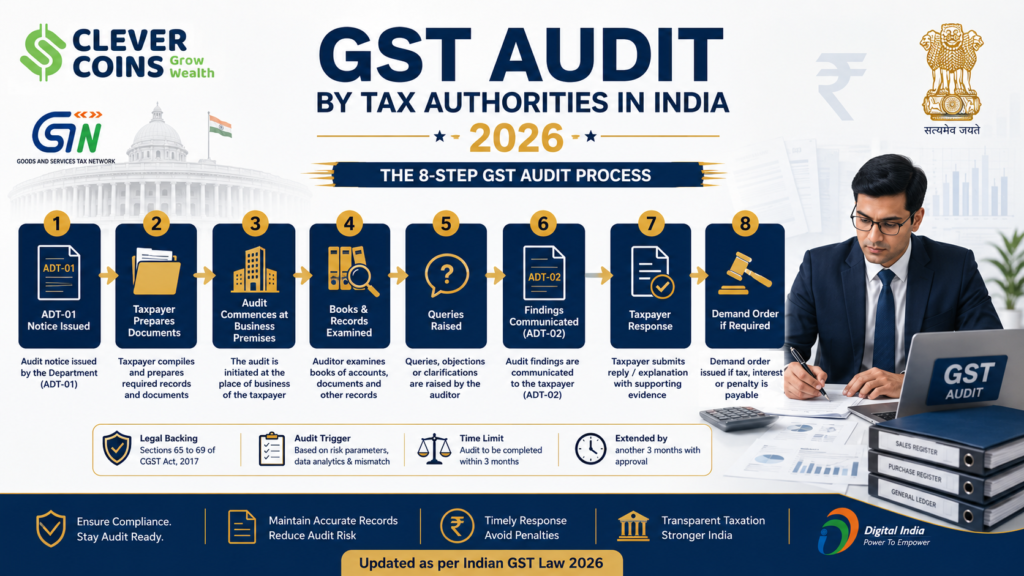
Step-by-Step GST Audit Procedure Under Section 65 (2026)
Step 1: Issuance of Audit Notice (ADT-01)
The GST officer sends FORM GST ADT-01 at least 15 working days before the audit commencement date. The notice specifies the period of audit, place, and documents required.
Step 2: Taxpayer Preparation
Upon receipt of ADT-01, the taxpayer must:
- Acknowledge receipt of the notice on the GST portal
- Compile all books of accounts, invoices, ledgers, and documents for the audit period
- Reconcile GSTR-1, GSTR-3B, GSTR-9, GSTR-9C data with books
- Prepare ITC reconciliation (GSTR-2A/2B vs. books)
- Ensure physical stock tallies with stock records
- Engage a qualified GST advocate or tax consultant to represent during audit
Step 3: Commencement of Audit
The audit team (typically 2-3 officers) arrives at the taxpayer’s premises or the audit is conducted at the GST office. The taxpayer or their authorised representative must cooperate fully and provide all required documents.
Step 4: Examination of Records and Books
During the audit, the officers typically examine:
- GST Returns filed (GSTR-1, GSTR-3B, GSTR-4, GSTR-5, GSTR-9) for the audit period
- Purchase and sales registers
- Tax invoices, debit notes, and credit notes (both issued and received)
- Input Tax Credit ledger and Electronic Credit Ledger
- Payment challans and Electronic Cash Ledger
- Stock registers and inventory records
- Bank statements and reconciliation
- E-Way Bill data and transportation records
- Job work challans (if applicable)
- Import-Export documents (Bill of Entry, Shipping Bills)
- RCM liability registers and payment proof
- Agreements, contracts, and any other relevant commercial documents
Step 5: Raising Queries and Seeking Clarifications
Officers may raise queries during the audit. The taxpayer has the right and responsibility to answer all queries truthfully with supporting documentary evidence. All queries and responses should ideally be in writing to create a proper audit trail.
Practical Tip: Never give verbal explanations during GST audit without a written follow-up. Always maintain copies of everything submitted to the audit team. Keep a written record of every query raised and document submitted. |
Step 6: Audit Completion – Communication of Findings (ADT-02)
Once the audit is complete (within 3 months of commencement, extendable to 9 months), the officer issues FORM GST ADT-02 communicating:
- Discrepancies found
- Tax short-paid or not paid
- ITC availed incorrectly
- Penalty and interest implications
Step 7: Taxpayer Response
After receiving ADT-02, the taxpayer has the opportunity to:
- Pay the additional tax demand voluntarily (with interest) to avoid penalty
- Dispute the findings by submitting a written response with supporting evidence
- Request a personal hearing before the officer
Step 8: Adjudication / Demand Order
If the taxpayer fails to pay the amount or disputes the findings, the officer proceeds to issue a Show Cause Notice (SCN) under Section 73 or Section 74 of the CGST Act, followed by an adjudication order (FORM GST DRC-07).
Documents Required for GST Audit – Complete Checklist 2026
Being well-prepared with the right documents significantly reduces audit disruption and demonstrates good faith compliance. Here is a comprehensive checklist:
GST Returns and Filings
- All GSTR-1 filed for the audit period (monthly/quarterly)
- All GSTR-3B filed for the audit period
- GSTR-2A / GSTR-2B auto-populated statements
- GSTR-9 (Annual Return) and GSTR-9C (Reconciliation Statement) if applicable
- GSTR-4 (for Composition dealers), GSTR-5 (Non-resident taxable persons), GSTR-7 (TDS deductors)
- Any amended returns filed
Books of Accounts and Financial Records
- Purchase register (domestic and imports)
- Sales register (domestic and exports)
- Cash book and bank book
- Journal, ledger, and trial balance
- Profit & Loss Account and Balance Sheet
- Audited Financial Statements (if turnover > ₹2 Crore for tax audit under Income Tax Act)
Tax Invoices and Other Documents
- All outward tax invoices, debit notes, credit notes issued
- All inward tax invoices, debit notes, credit notes received
- Bill of Supply (for exempt/composition/unregistered suppliers)
- Delivery challans
- E-invoices and IRN (Invoice Reference Numbers) where applicable
ITC-Related Documents
- ITC ledger / register maintained internally
- Reconciliation statement of GSTR-2A/2B with purchase register
- Documents for ITC reversal (Rule 42/43 — partial exemption, capital goods, etc.)
- Documentation for ITC claimed on imports (Bill of Entry)
- Records for ITC on RCM (Reverse Charge) transactions
Other Important Records
- E-Way Bills generated / received during the audit period
- Job work challans (Section 143) if applicable
- Stock/inventory records and physical stock count sheets
- Import-Export documents (Shipping Bills, Bills of Entry, IEC certificate)
- LUT / Bond for zero-rated supplies without payment of tax
- Bank statements and reconciliation with reported turnover
- Contracts, agreements with suppliers and customers
Rights of Taxpayers During GST Audit
The GST law, while granting wide powers to audit authorities, also safeguards taxpayer rights. Every taxpayer undergoing a GST audit must be aware of these important rights:
Right to Advance Notice
Under Section 65(3), the taxpayer must be given at least 15 working days’ advance notice before the audit commences. Any audit initiated without proper notice is legally vulnerable and can be challenged.
Right to Authorised Representation
The taxpayer has the right to be represented by an authorised person — a Chartered Accountant, Advocate, Cost Accountant, or any other authorised representative — during the entire audit proceeding.
Right to Be Heard
Before any adverse order is passed based on audit findings, the taxpayer must be given a fair opportunity to be heard (Principles of Natural Justice). Failure to provide this opportunity makes the order legally unsustainable.
Right to Dispute Audit Findings
If the taxpayer disagrees with the findings in ADT-02, they have the right to file a written rebuttal with supporting evidence. The taxpayer is not bound to accept audit findings without contest.
Right Against Harassment
Tax officers are bound by GST Taxpayer Charter principles. Taxpayers can file complaints against harassment or high-handed behaviour with the senior GST officer, or before the National Anti-Profiteering Authority / GST Council mechanism.
Right to Confidentiality
All documents submitted during a GST audit are confidential. Tax officers are bound by Section 158 of CGST Act, which prohibits unauthorised disclosure of information obtained during audit or inspection.
Right to Receive Audit Report (ADT-02)
The taxpayer has a statutory right to receive the completed audit findings report in FORM GST ADT-02 after the audit is concluded.
Remember: During a GST audit, you have the right to say ‘I need time to compile this information’ or ‘Let me consult my tax advisor before responding.’ Never feel pressured to admit liability without proper verification. |
Penalties and Consequences After GST Audit
A GST audit can result in significant financial consequences if discrepancies are found. Understanding the penalty framework helps taxpayers assess their risk and take corrective action:
Tax Short-Paid or Not Paid – Section 73 (Non-Fraud Cases)
Where tax has been short-paid or not paid due to genuine error (without intent to defraud), the consequences are:
Particulars | Amount / Rate |
Tax Demand | Full amount of tax short-paid + applicable interest |
Interest (Section 50) | 18% per annum on short-paid tax (from due date of payment) |
Penalty (if paid within 30 days of SCN) | Nil |
Penalty (if not paid within 30 days) | 10% of tax or ₹10,000 — whichever is HIGHER |
Time Limit for Action | 3 years from the due date of filing annual return for that year |
Tax Evasion / Fraud – Section 74 (Fraud Cases)
Where tax has been evaded due to fraud, wilful misstatement, or suppression of facts:
Particulars | Amount / Rate |
Tax Demand | Full amount of tax evaded + applicable interest |
Interest (Section 50) | 18% per annum on evaded tax |
Penalty (if paid within 30 days of SCN) | 15% of tax evaded |
Penalty (if paid before adjudication order) | 25% of tax evaded |
Penalty (if paid within 30 days of adjudication order) | 50% of tax evaded |
Penalty (in all other cases) | 100% of tax evaded (equal to the tax amount) |
Time Limit for Action | 5 years from the due date of filing annual return for that year |
GST Audit Voluntary Compliance Benefit (Revised Penalty Provisions 2024-25)
As per Finance Act 2024 amendments (effective 2025-26), taxpayers who pay the tax demanded within 60 days of the audit findings (before issuance of SCN) may avail reduced or nil penalty under Section 73. This incentivises voluntary compliance.
Practical Example: Cost of Non-Compliance After GST Audit
Scenario | Calculation (Example) | Amount |
Tax Demand Raised by Audit (FY 2022-23) | Audit period: July 2022 – March 2023 | ₹ 25,00,000 |
Interest @ 18% p.a. for 3 years | ₹25,00,000 × 18% × 3 years | ₹ 13,50,000 |
Penalty (Section 73 — not paid in 30 days) | 10% of ₹25,00,000 | ₹ 2,50,000 |
Total Liability | Tax + Interest + Penalty | ₹ 41,00,000 |
Additional: Legal & Representation Costs | Approximate CA/Advocate fees | ₹ 1,00,000 – ₹ 5,00,000 |
How to Prepare for a GST Audit — Proactive Strategies (2026)
The best defence against a GST audit is proactive compliance. Here are actionable strategies that businesses and tax professionals should implement:
1. Monthly GSTR-2A/2B vs. Purchase Register Reconciliation
Every month, reconcile your ITC claimed in GSTR-3B with the auto-populated GSTR-2B. Identify and reverse ITC for invoices where suppliers have not filed their GSTR-1. This eliminates the most common audit trigger.
2. Periodic Internal GST Health Checks
Conduct quarterly internal audits of your GST compliance. This includes:
- Reconciling turnover reported in GST returns with books of accounts
- Verifying correctness of GST rates applied on all products/services
- Checking RCM applicability on all vendor payments (freight, legal services, import of services)
- Reviewing E-Way Bill compliance for all goods movements
3. Maintain Proper Books and Digital Records
Ensure all records are maintained digitally with proper backup. Rule 56 of CGST Rules mandates maintenance of specific registers. In 2026, digital record maintenance is increasingly accepted and expected during audits.
4. GST Annual Return Preparation
File GSTR-9 and GSTR-9C with care. Discrepancies between GSTR-9/9C and GSTR-3B are a primary audit trigger. Engage a qualified CA for GSTR-9C certification.
5. Stay Updated with GST Notifications and Circulars
GST law is dynamic. New circulars, notifications, and court orders regularly clarify positions. Subscribe to CBIC updates and work with a GST consultant who monitors changes.
6. E-Invoice Compliance (Mandatory for Applicable Taxpayers)
From April 2025, e-invoicing is mandatory for all registered persons having aggregate annual turnover exceeding ₹5 Crore (check latest notifications). Ensure all B2B invoices are registered on the IRP (Invoice Registration Portal) to avoid audit notices.
7. Prepare an Audit Response Team
Identify internal personnel and external consultants who will handle the audit. Create a protocol for:
- Receiving and acknowledging audit notices
- Compiling required documents within the notice period
- Attending audit proceedings and responding to officer queries
- Escalating issues to senior management if necessary
GST Special Audit Under Section 66 – Detailed Walkthrough
The Special Audit under Section 66 is a more intensive form of audit and carries significant implications for the taxpayer. Here is a detailed walkthrough of the Special Audit process:
Trigger for Special Audit
An AC/DC may direct a Special Audit if, at any stage of scrutiny, inquiry, investigation, or any other proceedings, they are of the opinion that:
- The value declared in the returns and related documents is not correct or complete
- The ITC availed is not within the normal limits given the nature of business
Requirement of Prior Approval
Before issuing ADT-03 (Special Audit direction), the AC/DC must obtain prior approval from the Commissioner. This is an important procedural safeguard against arbitrary special audits.
Cost of Special Audit — Borne by Government
Unlike a regular CA/CMA tax audit (GSTR-9C) where costs are borne by the taxpayer, the cost of a Special Audit under Section 66 is borne by the government. The taxpayer is not responsible for the fees of the nominated CA/CMA.
Time Limits for Special Audit
Stage | Time Limit |
CA/CMA to submit Special Audit Report (ADT-04) | 90 days from date of ADT-03 |
Extension of Special Audit (with Commissioner’s approval) | Additional 90 days |
Opportunity of being heard before action on report | Must be given before any demand is raised |
Challenging a Special Audit Order
Taxpayers have successfully challenged Special Audit orders before High Courts where:
- Prior approval of Commissioner was not properly obtained
- The reasons for ordering Special Audit were vague or non-existent
- The Special Audit was ordered as a fishing expedition without specific intelligence
Most Common GST Audit Issues and How to Address Them (2026)
Issue 1: ITC Mismatch with GSTR-2B
This is the most frequently cited audit discrepancy. Auditors compare ITC claimed in GSTR-3B with the auto-populated GSTR-2B and question excess ITC claims.
Solution: Maintain a detailed monthly ITC reconciliation register. For any excess ITC claimed, either reverse it voluntarily (DRC-03) or demonstrate through supplier confirmation that the invoice has been duly reported by the supplier.
Issue 2: Non-Payment of RCM on Specified Services
Many taxpayers fail to discharge GST under Reverse Charge Mechanism (RCM) on services like legal fees, freight (GTA), sponsorship, import of services, etc.
Solution: Maintain a comprehensive RCM applicability checklist. Map all vendor categories against RCM provisions and ensure RCM is computed and paid monthly in cash (no ITC setoff allowed for RCM payment).
Issue 3: Value Mismatch Between GSTR-1 and GSTR-3B
Discrepancy in turnover reported in GSTR-1 (invoice-wise details) vs. GSTR-3B (consolidated summary) is a critical audit red flag.
Solution: Before filing GSTR-3B each month, reconcile the aggregate values with your GSTR-1 data. Ensure all amendments (GSTR-1A or amendments in next period’s GSTR-1) are properly reflected.
Issue 4: Non-Reversal of ITC on Blocked Credits
Section 17(5) of CGST Act prohibits ITC on specified items — motor vehicles (for personal use), food, beverages, beauty treatment, health services, club memberships, travel benefits, works contract for immovable property construction, etc.
Solution: Review all purchase invoices periodically and identify blocked credit items. Reverse blocked ITC immediately to avoid accumulation and heavy interest liability.
Issue 5: E-Way Bill Non-Compliance
Absence of valid E-Way Bills for goods movement above ₹50,000 (₹1 Lakh in some States for specific goods) during the audit period triggers penalty under Section 129 and 130.
Solution: Implement a system of mandatory E-Way Bill generation for all applicable consignments. Maintain E-Way Bill reports in a dedicated register.
Issue 6: Place of Supply Errors
Incorrect determination of Place of Supply leads to wrong tax payment (IGST instead of CGST+SGST or vice versa), creating demands and refund complications.
Solution: For all inter-State transactions, mixed-State services, and e-commerce transactions, carefully apply the Place of Supply rules under IGST Act, 2017.
What Happens After a GST Audit? — Post-Audit Actions
The conclusion of a GST audit is not the end of the matter. Here is what can happen after a GST audit report (ADT-02) is received:
Scenario 1: No Discrepancies Found
If the audit findings show that all returns and records are in order, no further action is taken. The taxpayer receives a clean audit report. This is the best outcome and builds a positive compliance history.
Scenario 2: Minor Discrepancies — Voluntary Payment
If the audit reveals minor discrepancies in tax liability, the taxpayer may choose to voluntarily pay the differential tax amount along with applicable interest using FORM GST DRC-03. This avoids penalties and formal demand proceedings.
Scenario 3: Significant Discrepancies — Show Cause Notice
If significant discrepancies are found and the taxpayer does not voluntarily pay, the GST officer proceeds to issue a Show Cause Notice (SCN) under Section 73 or Section 74, depending on whether fraud is alleged. The taxpayer then has the right to:
- File a written reply to the SCN within the specified time
- Request a personal hearing
- Submit additional evidence and documents in support of their case
- Engage a GST advocate for professional representation
Scenario 4: Adjudication and Demand Order
If the officer is not satisfied with the taxpayer’s reply, they pass an adjudication order (FORM GST DRC-07) confirming the demand, interest, and penalty. This order can be appealed before the First Appellate Authority (FAA) within 3 months.
Scenario 5: Prosecution (In Extreme Cases)
In cases of deliberate tax evasion exceeding ₹2 Crore (for prosecution under Section 132), the department may initiate criminal proceedings. This is rare and typically reserved for egregious cases of fraud.