Goods and Services Tax (GST) has fundamentally transformed India’s indirect tax landscape since its introduction on 1st July 2017. However, disputes between taxpayers and tax authorities remain an inevitable reality. Whether it is a demand notice, rejection of Input Tax Credit (ITC), or a penalty order — every registered taxpayer must know the appellate remedies available under the GST law. This comprehensive guide walks you through the complete GST appellate hierarchy in India for 2026, covering the Commissioner of Income Tax (Appeals) equivalent forums, GST Appellate Tribunal (GSTAT), High Courts, and the Supreme Court of India.
In 2026, with the GST Appellate Tribunal (GSTAT) now fully operational across various benches in India, the appellate landscape has significantly evolved. This guide reflects all updated procedures, time limits, pre-deposit requirements, and legal nuances relevant for Indian taxpayers and tax professionals.
Understanding the GST Appellate Hierarchy in India
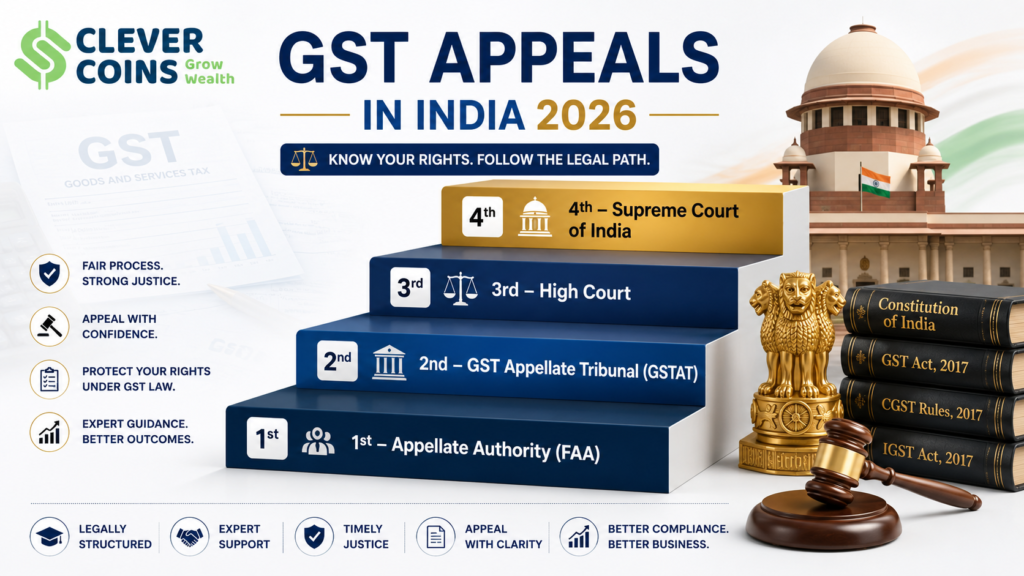
The GST law in India provides a structured, multi-tiered mechanism for taxpayers to challenge orders issued by tax authorities. The appellate machinery under the CGST Act, 2017 and respective SGST Acts creates a logical ladder that taxpayers must climb — starting from the first appellate authority and going up to the apex court.
The Four-Tier GST Appellate Structure
|
Tier |
Forum |
Authority |
Applicable Section |
|
1st |
Appellate Authority (AA) |
Commissioner/Joint Commissioner (Appeals) |
Section 107 |
|
2nd |
GST Appellate Tribunal (GSTAT) |
Judicial & Technical Members |
Section 109-111 |
|
3rd |
High Court |
Division Bench |
Section 117 |
|
4th |
Supreme Court of India |
Apex Court |
Section 118 |
First Appellate Authority (AA) – Section 107 of CGST Act
The First Appellate Authority (FAA) is the entry point for any taxpayer aggrieved by an order passed by a GST officer. Under Section 107 of the Central Goods and Services Tax Act, 2017, both taxpayers and the department have the right to file an appeal before the Appellate Authority.
Who is the Appellate Authority under GST?
Under CGST Rules, the Appellate Authority is typically the:
- Commissioner (Appeals) for orders passed by officers up to the rank of Additional Commissioner
- Additional Commissioner (Appeals) for orders issued by officers up to Deputy Commissioner
- Joint Commissioner (Appeals) — a new designation introduced to handle increased pendency
Time Limit for Filing Appeal Before FAA
As per Section 107(1) of CGST Act, an appeal must be filed within 3 months from the date of communication of the order. The appellate authority may condone delay up to an additional 1 month if sufficient cause is demonstrated.
|
Important: In cases of fraud or wilful misstatement, the time limits may differ. Always check specific provisions applicable to your case. |
Pre-Deposit Requirement under Section 107(6)
A taxpayer filing an appeal before the First Appellate Authority is required to mandatorily pre-deposit:
- 10% of the disputed tax amount as mandatory pre-deposit
- Full payment of undisputed tax, interest, penalty, fee or other charges arising from the order
|
Particulars |
Requirement |
|
Disputed Tax Amount (Example) |
₹10,00,000 |
|
Mandatory Pre-Deposit (10%) |
₹1,00,000 |
|
Undisputed Amount |
Full Payment Required |
|
Balance Disputed Amount |
Subject to Stay/Recovery Proceedings |
Documents Required for Filing Appeal Before FAA
- FORM GST APL-01 (Statement of Grounds of Appeal) — filed online on GST portal
- Certified copy of the order against which appeal is filed
- Proof of pre-deposit payment (Challan / DRC-03)
- Statement of facts and grounds of appeal
- Supporting evidence and documents relied upon
- Authorization letter if filed through Tax Advocate or CA
Departmental Appeal Before FAA
Under Section 107(2), the Commissioner or any officer authorized by him can also file an appeal against any order of an adjudicating authority within 6 months from the date of communication of the order. This is commonly referred to as a departmental appeal.
Powers of the Appellate Authority
The Appellate Authority under Section 107(11) has wide powers including:
- Confirming, modifying or annulling the order under challenge
- Remanding the matter back to the adjudicating officer for fresh decision
- Enhancing the assessment or penalty — but only after giving the appellant an opportunity of being heard
|
The principle of ‘no enhancement without notice’ is sacrosanct — the FAA cannot enhance demand or penalty without first issuing a notice to the taxpayer. |
GST Appellate Tribunal (GSTAT) – Sections 109 to 111
The GST Appellate Tribunal (GSTAT) is the second appellate forum under the GST law and represents a critical milestone in GST dispute resolution. After years of delay, GSTAT became fully operational in 2024-25, and by 2026, benches are functioning across multiple States and Union Territories in India.
Composition of GSTAT
As per Section 110 of CGST Act, GSTAT comprises:
- Principal Bench at New Delhi — headed by the President (who must be a retired Supreme Court Judge or a retired Chief Justice of a High Court)
- State Benches / Area Benches — each headed by a Judicial Member (retired High Court Judge) and a Technical Member (retired IRS/IAS officer of specified rank)
- National Bench — to handle matters involving divergence of opinions between State Benches
Filing Appeal Before GSTAT – Section 112
An aggrieved person may file an appeal before the Appellate Tribunal against an order passed by the Appellate Authority or the Revisional Authority within 3 months from the date of communication of the order.
Pre-Deposit for GSTAT Appeal – Section 112(8)
- Mandatory pre-deposit: 20% of the disputed tax amount (in addition to the 10% already deposited before FAA)
- Total cumulative pre-deposit for GSTAT appeal = 10% (for FAA) + 20% (for GSTAT) = 30% of disputed tax
|
Stage |
Pre-Deposit Requirement |
|
FAA Level (Section 107) |
10% of disputed tax |
|
GSTAT Level (Section 112) |
Additional 20% of disputed tax |
|
High Court (Section 117) |
No Mandatory Pre-Deposit (Court’s Discretion) |
|
Supreme Court (Section 118) |
No Mandatory Pre-Deposit (Court’s Discretion) |
Form for GSTAT Appeal
- Appeal is filed in FORM GST APL-05 on the GST common portal
- Cross-objections are filed in FORM GST APL-06
- Application for stay of recovery is filed separately
GSTAT Benches Operational in 2026
As of 2026, GSTAT benches are operational / being operationalized in the following jurisdictions:
- New Delhi – Principal Bench (Handles Central GST matters and inter-State disputes)
- Mumbai – Maharashtra Bench
- Chennai – Tamil Nadu Bench
- Kolkata – West Bengal & Sikkim Bench
- Bengaluru – Karnataka Bench
- Hyderabad – Andhra Pradesh & Telangana Bench
- Ahmedabad – Gujarat Bench
- Additional benches operationally expanding to other States in 2025-26
Powers of GSTAT
- Confirm, modify or annul the order of the Appellate Authority
- Refer questions of law to the High Court
- Grant stay of recovery of tax during pendency of appeal
- Hear cross-objections filed by the respondent
- Impose costs in frivolous appeals
Limitation Period & Condonation
GSTAT can condone delay in filing the appeal if sufficient cause is shown. The outer limit for condonation is an additional 3 months beyond the initial 3-month period.
Appeal to the High Court – Section 117 of CGST Act
Any person aggrieved by an order passed by the GST Appellate Tribunal may prefer an appeal to the High Court if the case involves a substantial question of law. This is a critical distinction — the High Court does not re-examine facts; it only adjudicates questions of law.
What Constitutes a ‘Substantial Question of Law’?
A substantial question of law generally refers to:
- A question that has not been settled by the Supreme Court or is open to doubt
- A debatable legal issue that significantly affects the rights of the parties
- Cases where different High Courts have taken conflicting views
- Constitutional validity of a GST provision
- Interpretation of statutory provisions not previously settled
Filing Procedure Before High Court
- Prepare the Memorandum of Appeal highlighting substantial questions of law
- File the appeal within 180 days from the date of communication of GSTAT order
- Pay court fees as prescribed by the respective High Court Rules
- File the appeal through an enrolled advocate of that High Court
- Serve notice on the opposite party
- Attend admission hearing — the court frames the substantial question(s) of law
- Proceed to final hearing after the question is admitted
|
High Courts can also be approached directly through Writ Petitions (under Article 226/227 of the Constitution) when there is no efficacious alternative remedy or when the order is passed without jurisdiction. |
Writ Jurisdiction of High Court in GST Matters
Taxpayers frequently approach High Courts via Writ Petitions in the following scenarios:
- Challenging the constitutional validity of a GST provision
- When the impugned order is passed without following principles of natural justice
- Cases where recovery proceedings are initiated without following proper procedure
- Challenges to seizures, arrests, or detention under GST
- When the GST portal is non-functional and the taxpayer is unable to comply with statutory requirements
- Challenging SCN (Show Cause Notices) that are vague or without jurisdiction
Stay of Recovery Before High Court
Unlike GSTAT (where no mandatory pre-deposit is required beyond what was already paid), the High Court may grant a conditional or unconditional stay of recovery based on the merits of the case. Courts typically consider:
- Prima facie merit in the taxpayer’s case
- Balance of convenience
- Whether the taxpayer will suffer irreparable harm if stay is not granted
Key High Court Rulings on GST Appeals in 2025-2026
- Provisional attachment of bank accounts under Section 83 requires a reasoned order — courts have consistently held that blanket attachment without application of mind is invalid
- Interest under Section 50 on ITC reversal — multiple High Courts have affirmed that interest is payable from the date of wrongful availment
- Time limit for GST refund applications — courts have held that Section 54 timelines are mandatory but subject to legitimate expectations
- Section 130 confiscation proceedings — proportionality principle must be applied
Appeal to the Supreme Court of India – Section 118 of CGST Act
The Supreme Court of India is the apex appellate forum under the GST appellate hierarchy. An appeal lies to the Supreme Court from any judgment or order of the High Court on a substantial question of law relating to GST matters.
Routes to the Supreme Court
- Appeal under Section 118 of CGST Act against a High Court order on a substantial question of law
- Special Leave Petition (SLP) under Article 136 of the Constitution of India — applicable in all civil and criminal matters
- Curative Petition — in extraordinary cases after a review petition has been dismissed
Certificate of Leave
A party wishing to appeal to the Supreme Court from a High Court order must:
- Apply for a certificate under Article 134A that the case involves a substantial question of law of general importance
- Alternatively, file an SLP directly before the Supreme Court
Landmark Supreme Court Judgments on GST (2024-2026)
- Union of India v. Safari Retreats Pvt. Ltd. (2024) — The Supreme Court gave a landmark ruling on ITC eligibility for immovable property used in the course of business, expanding the scope of Section 17(5)
- Interplay between CGST Act and IBC — The Supreme Court has been examining the priority of GST dues versus secured creditors under the Insolvency and Bankruptcy Code
- Electronic credit ledger blocking under Rule 86A — The Supreme Court has upheld that blocking must be supported by specific reasons and cannot be indefinitely continued
- Time limits under GST — The Supreme Court upheld the extended limitation periods granted during COVID-19 (in re: Cognizance for Extension of Limitation)
Revisional Authority – Section 108 of CGST Act
Apart from the regular appellate machinery, the GST law also provides for revisional proceedings. Under Section 108, the Commissioner may call for and examine the record of any proceedings and, if he considers the order to be erroneous in so far as it is prejudicial to the interests of revenue, he may modify, enhance or annul such order.
Key Features of Revisional Powers
- The Commissioner (CGST) or State Commissioner (SGST) can exercise revisional powers
- Revision can be done within 3 years from the date of the order
- A prior opportunity of hearing must be given to the person affected
- Revisional authority cannot exercise these powers if an appeal is pending before FAA or GSTAT
|
Important: A taxpayer cannot appeal against a revisional order directly to GSTAT — they must first approach the First Appellate Authority under Section 107. |
Step-by-Step GST Appeal Filing Process in India (2026)
Step 1: Receive and Analyse the Order
Once an order (e.g., ASMT-13, MOV-09, DRC-07, etc.) is received, carefully read and understand it. Identify the issues — whether factual, legal, or procedural. Engage a qualified GST practitioner or advocate.
Step 2: Determine the Appropriate Appellate Forum
Based on the nature of the order and the officer who passed it, determine whether to approach the FAA, GSTAT, or directly the High Court via writ.
Step 3: Calculate the Pre-Deposit Amount
Determine the disputed and undisputed components of the demand. Calculate the mandatory pre-deposit:
- 10% for FAA (minimum ₹25,000 — maximum ₹25 Crore for CGST)
- 20% for GSTAT (in addition to 10% already deposited)
Step 4: Make the Pre-Deposit Payment
Log in to the GST portal (www.gst.gov.in), navigate to Payment section, and pay the pre-deposit amount using Form DRC-03. The CPIN/challan number will be required while filing the appeal.
Step 5: File the Appeal Online
- FAA Appeal: FORM GST APL-01 on GST Portal
- GSTAT Appeal: FORM GST APL-05 on GST Portal
- Upload required documents — order copy, pre-deposit challan, statement of facts, grounds of appeal
Step 6: Attend Hearings
The appellant or their authorized representative must appear for hearings. Submit written submissions, additional documents, and reply to any queries raised by the Appellate Authority.
Step 7: Final Order and Post-Order Actions
Once the order is passed, assess whether to:
- Accept the order and comply
- File further appeal to the next tier
- Apply for rectification of the order under Section 161 if there is an apparent error
Summary of Time Limits for GST Appeals in India 2026
|
Forum |
Time Limit |
Condonation |
Form/Petition |
|
Adjudicating Authority (Demand Order) |
Not applicable — DRC-07 itself is the final order |
N/A |
GST DRC-01C / SCN |
|
First Appellate Authority (FAA) |
3 months from order date |
1 month additional |
GST APL-01 |
|
GST Appellate Tribunal (GSTAT) |
3 months from GSTAT order date |
3 months additional |
GST APL-05 |
|
High Court |
180 days from GSTAT order |
Subject to limitation & court discretion |
Civil Misc. Appeal / Writ |
|
Supreme Court (SLP) |
90 days from High Court order |
Subject to SC’s discretion |
SLP under Article 136 |
Stay of Recovery During Pending GST Appeals
A significant concern for taxpayers while appealing is whether the tax authority can recover the disputed demand during the pendency of the appeal. GST law provides important protections:
Recovery Stay Under Section 107 (FAA Level)
Once a taxpayer files an appeal before the FAA and pays the mandatory 10% pre-deposit, the recovery proceedings for the balance disputed amount are stayed (Section 107(7)). The stay is automatic upon filing the appeal.
Recovery Stay Under Section 112 (GSTAT Level)
Similarly, upon filing appeal before GSTAT and paying the mandatory 20% additional pre-deposit, recovery of the balance is stayed (Section 112(9)).
Stay Before High Court and Supreme Court
There is no automatic stay — the taxpayer must specifically apply for a stay of recovery before the High Court or Supreme Court. These courts exercise equitable discretion and may impose conditions while granting stay
GST Amnesty Schemes and Settlement of Disputes in 2025-2026
The Government of India has from time to time introduced amnesty and settlement schemes to reduce the litigation burden. In 2024-25, the GST Council announced the GST Amnesty Scheme under Section 128A (introduced by Finance Act, 2024) to allow taxpayers to settle disputes for the period July 2017 to March 2020 by paying only the principal tax without interest and penalty.
GST Amnesty Scheme under Section 128A (2025-26)
- Eligible Period: Tax demands for FY 2017-18, 2018-19, 2019-20
- Benefit: Waiver of interest and penalty if full tax is paid
- Deadline: Applications accepted up to March 31, 2026 (subject to notifications)
- Exclusions: Cases involving fraud, wilful misstatement, suppression of facts under Section 74 of CGST Act are excluded from the scheme in some notifications — verify the latest GST Council updates
|
Consult your GST consultant or Chartered Accountant to check eligibility for GST Amnesty before proceeding with a full-fledged appeal to save costs and time. |
Common Mistakes Made by Taxpayers During GST Appeals & How to Avoid Them
Mistake 1: Missing the Limitation Period
The most common and fatal mistake is missing the statutory time limit for filing an appeal. Condonation of delay is not a right — it is discretionary. Always calendar the appeal deadline immediately upon receiving an adverse order.
Mistake 2: Insufficient Pre-Deposit
Some taxpayers calculate the pre-deposit incorrectly, leading to defective appeals. Ensure the pre-deposit is calculated on the disputed tax only (not interest or penalty unless disputed separately).
Mistake 3: Incomplete or Vague Grounds of Appeal
The grounds of appeal must be specific, legally sound, and factually supported. Vague grounds like ‘the order is against facts and law’ without specifics weaken the appeal significantly.
Mistake 4: Not Preserving Evidence
Maintain a complete record of all correspondence — emails, letters, GST portal documents, invoices, ledgers, and reconciliation statements. Evidence gathered after the fact often lacks credibility.
Mistake 5: Ignoring Cross-Objections
When a departmental appeal is filed, the taxpayer has the right to file cross-objections (in FORM GST APL-06 before GSTAT) to protect their interests even without paying a pre-deposit.
Best Practices for Successful GST Appeals
- Engage a qualified GST advocate or Tax Consultant with experience in appellate proceedings
- Maintain a chronological file of all GST communications, orders, and replies
- File a detailed written submission with supporting case laws and judicial precedents
- Monitor GSTAT and High Court orders to cite favorable rulings
- Consider ADR (Alternative Dispute Resolution) mechanisms if available