GST on Petroleum Products: Will They Finally Be Included? (2026 Analysis)
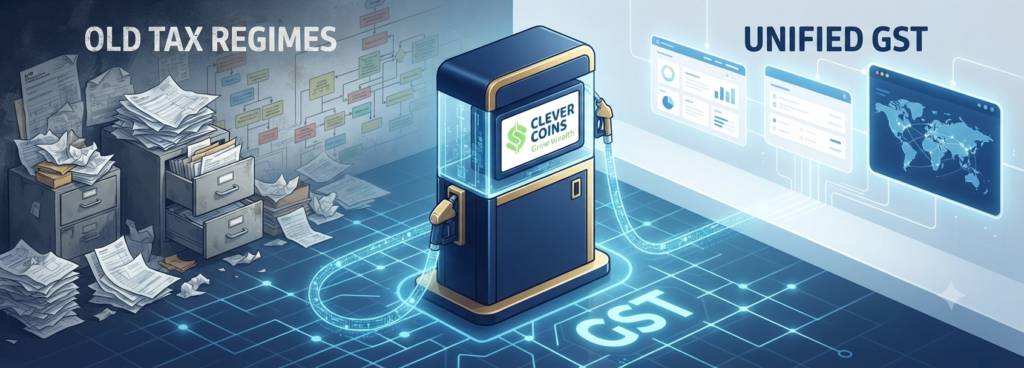
Despite sweeping indirect tax overhauls and the maturation of the modernized Goods and Services Tax (GST) framework, major petroleum products in India remain entirely outside the GST net. Legally governed by Article 279A(5) of the Constitution of India read alongside Section 9(2) of the CGST Act, five core petroleum products continue to be excluded from standard GST applicability:
- Petroleum Crude
- Motor Spirit (Petrol)
- High-Speed Diesel (HSD)
- Aviation Turbine Fuel (ATF)
- Natural Gas
While certain downstream petroleum derivatives (such as lubricants, greases, and engine oils under HSN 2710, or LPG) are integrated into standard tax slabs, primary energy and fuel carriers remain insulated under the traditional dual-taxation architecture of Central Excise Duty and State Value Added Tax (VAT).
Why Petroleum Products Remain Excluded
The persistent delay in bringing fuel under the GST framework is not due to a lack of administrative intent, but rather a complex web of fiscal, structural, and political hurdles:
- High Revenue Dependence for State Governments: Fuel taxation accounts for a massive chunk of individual states’ independent tax revenues through State VAT. Because states surrendered broad fiscal autonomy when adopting GST, VAT on liquor and fuel remain their primary discretionary levers to manage fiscal deficits.
- The Cascading Input Tax Credit (ITC) Dilemma: If petroleum products were brought under GST at a standard rate (e.g., 18% or 28%), businesses across manufacturing, logistics, and services would be legally entitled to claim massive amounts of Input Tax Credit on fuel expenses. This would drastically contract central and state indirect tax collections unless structured with extreme care.
- Lack of Consensus in the GST Council: Bringing fuel under GST requires a formal recommendation by the GST Council and subsequent constitutional/statutory amendments. Due to conflicting fiscal priorities between oil-producing states, consuming states, and the Centre, a political consensus has remained elusive.
The Business Impact: Cascading Costs and Inefficiencies
For modern enterprises, the continued exclusion of petroleum products creates severe economic frictions:
- Blocked Input Tax Credit: Because diesel and petrol used for captive power generation, fleet operations, or machinery are taxed under non-GST statutes (Central Excise and State VAT), businesses cannot claim ITC. This results in a heavy tax-on-tax cascade, inflating operational and logistics costs.
- Complex Multi-Tax Compliance: Companies operating pan-India must navigate divergent State VAT rates, varying surcharge structures, and complex cross-tax reconciliations just to manage fuel expenses, preventing the seamless “One Nation, One Tax” synergy promised by GST.
Will They Finally Be Included? The 2026 Outlook
As India’s digital tax infrastructure evolves with advanced AI scrutiny, automated reconciliation, and structural reforms (often discussed as part of prospective “GST 2.0” roadmaps), pressure is mounting to find a middle ground.
While a wholesale inclusion of petrol and diesel into standard GST slabs remains politically unfeasible in the near term due to state revenue sensitivities, fiscal experts anticipate gradual phased reforms—such as bringing Natural Gas or Aviation Turbine Fuel (ATF) under the GST net first to support cleaner energy adoption and rationalize airline operating costs. However, complete unification for petrol and high-speed diesel will likely require a legally binding compensation mechanism or revenue-sharing formula to safeguard state budgets.
Secure Your Corporate Compliance with CleverCoins
Navigating complex cross-tax reconciliations, optimizing corporate compliance, and managing indirect tax structures requires precise, forward-looking strategies. At CleverCoins, we transform complex regulatory frameworks into seamless compliance solutions for modern enterprises.
- Phone: +91 77389 59862
- Email: client@clevercoins.org
- Address: Ideal Market, Mumbra, Thane-400612
- Website: https://clevercoins.org/