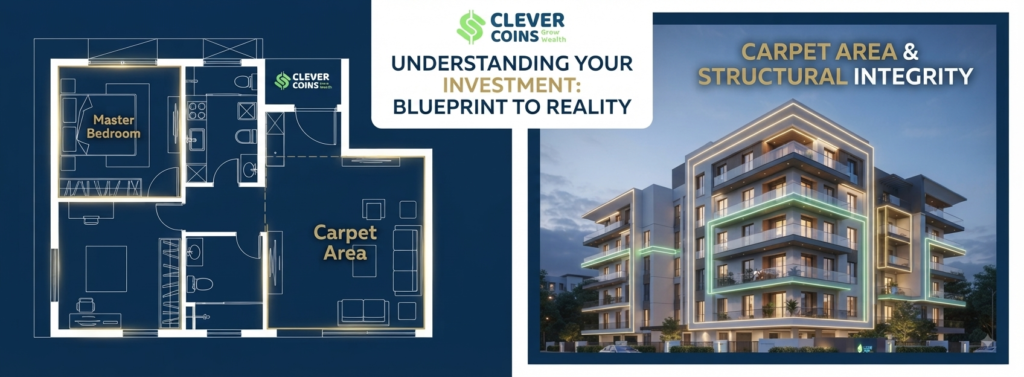
Carpet Area vs Built-up Area vs Super Built-up Area: The Ultimate Real Estate Buyer’s Guide
Purchasing a home is one of the most significant financial milestones in a person’s life. Whether you are buying your first cozy apartment or investing in a sprawling penthouse, stepping into the real estate market exposes you to a wave of industry jargon. Among the most critical yet frequently misunderstood terms are Carpet Area, Built-up Area, and Super Built-up Area.If you have ever looked at a real estate brochure and wondered why the price quoted doesn’t seem to match the actual rooms you can walk around in, you are not alone. Many homebuyers suffer massive financial shocks because they fail to understand how developers calculate property dimensions.In this comprehensive, deep-dive guide brought to you by our expert marketing and real estate advisory team, we will demystify these three terms, break down the exact mathematics behind them, explore legal frameworks like RERA, and arm you with the knowledge needed to make a bulletproof real estate investment.
1. Introduction: Why Real Estate Sizing Matters
When you see an advertisement for a “1,500 square feet apartment,” your natural assumption is that you will have 1,500 square feet of living space to arrange your furniture, walk your pets, and live comfortably. However, in reality, the space inside your actual rooms might only be 1,000 square feet.Where do the remaining 500 square feet go? Are you paying for space you cannot even use?Understanding the distinction between Carpet Area, Built-up Area, and Super Built-up Area is the single most effective way to protect your hard-earned money. Miscalculating these areas can lead to:
- Overpaying for unusable space.
- Facing unexpected maintenance charges.
- Misjudging interior design layouts and furniture spacing.
- Legal and financial discrepancies during property resale.
Let us examine each term individually, starting with the absolute core of your living space: the Carpet Area.
2. What is Carpet Area?
Definition
The Carpet Area is the net usable floor area of an apartment or house. By definition, it is the total area enclosed within the walls where you can literally spread a carpet.
What is Included in Carpet Area?
- Living room and dining room floor space.
- Bedrooms.
- Kitchen and utility spaces within the apartment.
- Bathrooms and toilets.
- Internal staircases (in duplex units).
- Balconies and dry terraces that are exclusively attached to the apartment (though regulations sometimes categorize balconies slightly differently, under RERA, exclusive balcony spaces are often accounted for under usable spaces).
What is Excluded from Carpet Area?
- The thickness of outer walls and internal partition walls.
- Common areas of the building such as the lobby, corridors, and elevator shafts.
- Service shafts, open ducts, and refuge areas.
- Clubhouses, swimming pools, and other recreational amenities.
Why Carpet Area Matters Most to Homebuyers
Under the Real Estate (Regulation and Development) Act (RERA), introduced in India to bring transparency to the real estate sector, builders are legally mandated to sell residential properties strictly based on Carpet Area. This reform changed the landscape of property buying, ensuring that buyers pay only for the exact space they occupy.If you want a true measure of your living comfort, always look at the carpet area. A higher carpet area percentage relative to the super built-up area means better value for your money.
3. What is Built-up Area?
Definition
The Built-up Area is a step wider than the carpet area. It includes the actual usable space of the apartment plus the area occupied by the walls and structural components.
The Mathematical Formula
Built-up Area=Carpet Area+Area of Outer and Internal Walls+Exclusive Balconies / Terraces
Understanding Wall Thickness
Typically, walls account for roughly 10% to 15% of an apartment’s built-up area. If a builder uses thick brick masonry instead of modern dry-walls or RCC structures, the wall thickness eats significantly into your living space. This means two apartments with the exact same carpet area can have entirely different built-up areas depending on structural design choices.
What is Excluded from Built-up Area?
- Lifts and elevator spaces.
- Common hallways, corridors, and stairwells.
- Underground water tanks, pump rooms, and security cabins.
- Open compound areas and parking lots.
4. What is Super Built-up Area?
Definition
The Super Built-up Area is the total built-up area plus the apartment’s proportionate share of all shared, common amenities and structural facilities in the residential complex. This is the figure that developers historically used (and sometimes still use in informal discussions) to market apartments.
What is Included in Super Built-up Area?
- The complete built-up area of your individual flat.
- Your proportionate share of common corridors, lobbies, and pathways on your floor.
- Elevator shafts, staircases, and fire escape exits.
- Clubhouse, gymnasiums, indoor games rooms, and swimming pool areas.
- Security rooms, entrance foyers, pump rooms, generator rooms, and solar panel installations.
- Terrace gardens and common utility areas.
The Loading Factor
The difference between the Super Built-up Area and the Carpet Area is known as the “Loading Factor.”
Loading Factor=Carpet AreaSuper Built-up Area
Typical Loading Range: In standard residential projects, a loading factor ranges between 1.20 to 1.35 (meaning a 20% to 35% markup over the carpet area).
If a project has luxury amenities like high-speed private elevators, massive lobbies, multiple clubhouses, and extensive concierge spaces, the loading factor can climb to 40% or higher.
5. Comparative Breakdown: Side-by-Side Analysis
To solidify your understanding, let’s look at a structured tabular comparison of these three core metrics:
| Feature / Parameter | Carpet Area | Built-up Area | Super Built-up Area |
|---|---|---|---|
| What does it measure? | Net usable floor space inside walls. | Carpet area + wall thickness + balconies. | Built-up area + share of all common spaces. |
| Inclusion of Walls | Excluded. | Included (inner and outer walls). | Included (via total aggregate calculation). |
| Inclusion of Common Areas | Excluded completely. | Excluded. | Included (proportionate share). |
| Primary Utility for Buyer | Practical living & furniture layout. | Assessing structural footprint and brickwork. | Determining maintenance bills and pricing scale. |
| Regulatory Status (RERA) | Mandatory for pricing & selling. | Used as a secondary reference metric. | Mostly deprecated or used cautiously due to transparency laws. |
6. A Practical Mathematical Example
Let us break down a real-world scenario to see how these numbers translate into actual apartment dimensions.Imagine you are looking at a 2BHK apartment advertised as 1,200 square feet (Super Built-up Area).
- Calculating the Loading Factor: Suppose the builder operates at a standard loading factor of 1.25 (25%).Carpet Area=1.25Super Built-up Area=1.251200=960 sq. ft.
So, your actual usable floor space is 960 sq. ft.
- Accounting for Walls & Balconies (Built-up Area):
- Suppose the walls take up 100 sq. ft. and the exclusive balcony takes up 140 sq. ft.
- Built-up Area=960+100+140=1,200 sq. ft. (Wait, in this adjusted example, let’s look at how the super built-up factors in common areas).
- Let’s refine: If Carpet Area = 900 sq. ft., Walls & Balconies = 150 sq. ft., then Built-up Area = 1,050 sq. ft.
- Adding a 150 sq. ft. proportionate share of common lobbies and amenities brings the Super Built-up Area to 1,200 sq. ft.
This example demonstrates how a 1,200 sq. ft. paper listing actually delivers only 900 sq. ft. of pure personal living space. Knowing this breakdown prevents unrealistic expectations when moving in your sofa sets, dining tables, and king-size beds.
7. The Golden Rules of Property Pricing: Carpet Area vs Super Built-up Area
Historically, developers quoted prices per square foot based on the Super Built-up Area.
- The Trap: If a builder quotes $100 per sq. ft. on a 1,500 sq. ft. super built-up apartment, your total cost is $150,000. However, if your actual carpet area is only 1,000 sq. ft., you are effectively paying $150 per sq. ft. for the actual space you live in.
- The RERA Transformation: Today, regulatory bodies require developers to transparently declare the carpet area price. Always ask your real estate agent or financial consultant: “What is the cost per square foot strictly calculated on the Carpet Area?” This allows for an apples-to-apples comparison between different builders and projects.
8. Impact on Maintenance Charges and Property Resale
The distinction between these measurements goes far beyond the initial purchase price. They directly dictate your ongoing financial obligations:
- Maintenance Fees: Society maintenance charges are almost always calculated based on the Super Built-up Area or Built-up Area. A larger super built-up footprint means you pay higher monthly maintenance fees toward security, corridor lighting, elevator upkeep, and amenity cleaning—regardless of how much time you spend using those amenities.
- Resale Value: When you decide to sell your property down the line, savvy buyers and real estate valuers look closely at the carpet-to-super-built-up ratio. Properties with low loading factors (more carpet area for less super built-up inflation) fetch higher resale demand because buyers recognize they are getting more value.
9. Essential Checklist for Homebuyers Before Signing
Before you sign an allotment letter or put down a token advance on a property, run through this tactical checklist:
- Demand a RERA Carpet Area Certificate: Never rely on verbal assurances or glossy brochure illustrations. Ask for the certified architect blueprint highlighting the exact carpet area.
- Scrutinize the Loading Percentage: Calculate the loading factor. If the loading factor exceeds 35% in a standard residential building without high-end luxury infrastructure, question why you are paying such a high markup.
- Verify Balcony and Utility Inclusion: Check whether external utility spaces and dry balconies are fully counted inside your carpet area or lumped into the built-up calculation.
- Inspect Wall Material: Understand whether internal partitions use space-saving drywall systems or thick brick masonry that eats into your usable floor plan.
- Consult Financial & Legal Experts: Real estate contracts are laden with complex clauses regarding common area maintenance and super-built calculations. Partnering with seasoned financial strategists and tax advisors ensures that your property acquisition aligns seamlessly with your overall wealth portfolio.
10. Conclusion
Navigating the real estate landscape requires a sharp eye, financial acumen, and a clear understanding of sizing metrics. While Super Built-up Area gives you a macro view of the building’s overall footprint and shared amenities, and Built-up Area accounts for structural walls, the Carpet Area remains the absolute metric of truth for your home.By focusing your investment decisions on the carpet area, calculating transparent loading factors, and leveraging regulatory frameworks like RERA, you can eliminate hidden costs, optimize your living space, and secure a property that truly delivers value for every coin you invest.Make informed choices, safeguard your capital, and build a secure real estate foundation for your future.
- Phone: +91 77389 59862
- Email: client@clevercoins.org
- Address: Ideal Market, Mumbra, Thane-400612
- Website: https://clevercoins.org/