The Ultimate Guide to GST on Transfer of Business and Slump Sale (SLMP)
In the dynamic landscape of modern commerce, businesses are constantly evolving. Whether through mergers, acquisitions, amalgamations, or restructuring, the transfer of a business is a strategic move for inorganic growth or financial realignment. However, when an entire business undertaking is transferred from one entity to another—commonly known as a “Slump Sale” or “Transfer of a Going Concern”—it triggers a complex web of tax implications.
Under the Goods and Services Tax (GST) regime in India, the transition of ownership requires meticulous compliance. Is the transfer categorized as a supply of goods, or is it a supply of services? Is it fully taxable, or does it enjoy exemptions? What happens to the accumulated Input Tax Credit (ITC) lying in the electronic credit ledger of the seller?
This comprehensive guide, brought to you by CleverCoins, dissects the GST implications on the transfer of business and slump sales, covering everything from statutory provisions and ITC-02 filing to valuation rules and compliance checklists.
Decoding the Jargon: What is a Slump Sale?
Before diving into the GST intricacies, it is crucial to understand what a “Slump Sale” (SLMP) actually entails. The concept originates primarily from the Income Tax Act but has profound overlapping implications under the GST framework.
According to Section 2(42C) of the Income Tax Act, 1961, a slump sale refers to the transfer of one or more undertakings as a result of the sale for a lump-sum consideration, without assigning individual values to the assets and liabilities contained within that undertaking.
Key characteristics of a Slump Sale include:
The sale involves an entire business undertaking or an independent division.
Both assets (movable and immovable) and liabilities are transferred to the purchaser.
The consideration is a single, predetermined lump-sum amount.
Individual assets are not cherry-picked or assigned specific, standalone values.
In the context of GST, a slump sale is intrinsically linked to the concept of a “Transfer of Business as a Going Concern.” When a business is transferred as a going concern, it implies that the business is active, operational, and will continue to function seamlessly under the new ownership.
Is Transfer of Business a Supply of Goods or Services?
To determine the GST applicability, the first step is to classify the transaction. Does selling a business amount to selling “goods” or providing a “service”?
According to the Central Goods and Services Tax (CGST) Act:
Goods are defined under Section 2(52) as every kind of movable property, excluding money and securities.
Services are defined under Section 2(102) as anything other than goods, money, and securities.
When an entire business is transferred, it is not merely a transfer of physical assets (like machinery or inventory). It includes intangible elements like goodwill, contracts, licenses, and intellectual property. Because it encompasses “anything other than goods,” the transfer of a business as a going concern is legally classified as a Supply of Service.
Schedule II Exceptions
Under Schedule II, Paragraph 4(c) of the CGST Act, if a person ceases to be a taxable person, any goods forming part of their business assets are deemed to be supplied by them immediately before they cease to be taxable. However, there are two monumental exceptions to this rule:
The business is transferred as a going concern to another person.
The business is carried on by a personal representative who is deemed to be a taxable person.
Because of this specific carve-out, transferring a running business bypasses the definition of a standard supply of goods, solidifying its status as a service.
The “Going Concern” Exemption: Notification 12/2017
This is the most critical aspect of GST on business transfers. Is this service taxable?
The Government of India provided major relief to businesses undergoing restructuring via Notification No. 12/2017-Central Tax (Rate) dated June 28, 2017. Under Entry No. 2 of this notification, “Services by way of transfer of a going concern, as a whole or an independent part thereof” are subject to a Nil rate of GST (i.e., exempted from tax).
What Constitutes a “Going Concern”?
The GST Act does not explicitly define the term “going concern”. Therefore, tax authorities and tribunals rely on accounting standards and judicial precedents to interpret it. A transfer qualifies as a going concern if:
The business is live, running, and functional on the date of transfer.
The buyer intends to continue the same business operations.
The transfer includes all necessary assets and liabilities required to run the business independently.
There is no intention to liquidate the business or immediately strip and sell off its assets.
If an entity sells merely a factory building and machinery but retains the employees, licenses, and brand name, it is not a transfer of a going concern. It will be treated as an itemized sale of assets, and standard GST rates will apply to each asset sold.
Slump Sale vs. Itemized Sale: A Comparative Analysis
To avoid severe tax liabilities, businesses must clearly distinguish between a slump sale (going concern) and an itemized sale. Here is a breakdown of how they differ under GST:
Feature | Slump Sale (Going Concern) | Itemized Asset Sale |
|---|---|---|
Nature of Transfer | Entire business or independent unit transferred as a whole. | Individual assets are cherry-picked and sold. |
Consideration | Single, lump-sum amount for the entire business. | Separate values assigned to each asset. |
Liabilities | Liabilities are generally transferred alongside assets. | Only assets are transferred; seller retains liabilities. |
GST Classification | Supply of Service. | Supply of Goods. |
GST Taxability | Exempt (Nil Rate) under Notification 12/2017. | Fully Taxable (GST rates depend on the specific asset). |
Continuity | Buyer continues the business operations. | Buyer may use assets for any different purpose. |
Input Tax Credit (ITC) Implications on Business Transfer
One of the primary concerns during a merger or slump sale is the fate of the unutilized Input Tax Credit (ITC) lying in the seller’s electronic credit ledger. Will the ITC be lost, or can it be passed on to the buyer?
Transferring Unutilized ITC (Section 18(3) and Rule 41)
The CGST Act is highly pragmatic in this regard. Section 18(3) allows the transferor (seller) to transfer their unutilized ITC to the transferee (buyer) in the event of a sale, merger, demerger, amalgamation, lease, or transfer of the business.
Mandatory Condition: The ITC can only be transferred if the legal agreement (Business Transfer Agreement) contains a specific provision for the transfer of liabilities. If the seller retains the liabilities, the ITC cannot be transferred.
The Mechanism: Filing Form GST ITC-02
To facilitate the transfer of ITC, the government has prescribed a specific form under Rule 41 of the CGST Rules: Form GST ITC-02. Both parties must ensure strict compliance with the portal procedures to execute this transfer successfully.
Step-by-Step Guide to Filing Form GST ITC-02
For the seamless transfer of accumulated credit, follow this operational workflow on the GST portal:
Prerequisites: Ensure both the transferor and transferee are registered under GST. The transferor must have filed all pending GST returns (GSTR-1 and GSTR-3B).
Log in to the Portal: The transferor logs into the GST portal and navigates to
Services > Returns > ITC Forms.Prepare Online: Click on
Prepare Onlineunder the “Transfer of ITC (Form GST ITC-02)” section.Enter Transferee Details: Input the GSTIN of the acquiring entity. The legal name will auto-populate.
Declare the ITC Amount: The system will display the available ITC under IGST, CGST, SGST, and Cess. The transferor must manually enter the amount of ITC they wish to transfer (it can be full or partial, especially in case of a demerger).
Attach the CA/CMA Certificate: The transferor must upload a certificate issued by a practicing Chartered Accountant (CA) or Cost and Management Accountant (CMA). This certificate explicitly validates that the business transfer has taken place along with the transfer of liabilities.
Submit and File: Complete the filing using EVC (OTP) or Digital Signature Certificate (DSC).
Acceptance by Transferee: Once filed, the transferee must log into their GST portal, navigate to the ITC-02 section, and either Accept or Reject the transfer. Upon acceptance, the ITC instantly credits to the transferee’s electronic credit ledger.
The Trap of ITC Reversal (Section 17 and Rule 42)
While transferring a business as a going concern is exempt from GST, this exemption creates a hidden compliance trap regarding ITC reversal.
Under Section 17(2) of the CGST Act, read with Rule 42, if a taxpayer provides both taxable and exempt supplies, they must proportionately reverse the ITC attributable to the exempt supplies.
Since the “transfer of a going concern” is officially classified as an exempt supply of service, the seller must account for this in their ITC calculations. The value of the business transfer must be included in the aggregate turnover for that particular tax period, and the common input tax credit utilized during that period must be proportionately reversed.
Strategic Tip: Businesses must carefully calculate the Rule 42 reversal amount prior to finalizing the business transfer agreement, as this directly impacts the net financial realization of the sale.
Registration Requirements for the Transferee
When a business changes hands, GST registration cannot simply be “handed over” like physical keys to a building. PAN-based registrations are strictly tied to the legal entity.
Section 22(3) & Section 22(4) of the CGST Act
Standard Sale: If an ongoing business is sold to a new owner, the buyer (transferee) is legally obligated to obtain a fresh GST registration from the date of the transfer.
Mergers and Amalgamations: If the transfer occurs via a High Court or Tribunal order (e.g., formal schemes of merger or demerger), the transferee must obtain registration from the date the Registrar of Companies (RoC) issues the formal certificate of incorporation giving effect to the order.
Until the new registration is active, the businesses must carefully coordinate their invoicing to avoid non-compliance or loss of tax credits.
Valuation Rules and Invoicing in a Slump Sale
Because a slump sale involves a single, indivisible price for the entire undertaking, standard valuation metrics based on transaction value can seem confusing.
However, since the transaction is categorized as an exempt supply, GST is payable at a Nil rate. Despite no tax being collected, valuation remains legally required for the following reasons:
Reporting in GSTR-1 and GSTR-3B as exempted turnover.
Calculating the exact aggregate turnover for determining audit applicability (GSTR-9/9C).
Calculating the denominator for the Rule 42 ITC reversal.
Invoicing Protocol: Since no tax is levied, the transferor must not issue a standard Tax Invoice. Instead, under Section 31(3)(c) of the CGST Act, the seller must issue a “Bill of Supply” to the buyer, explicitly mentioning the exemption notification (Notification 12/2017).
Transfer of Liabilities: Section 85 of CGST Act
A critical aspect of business acquisitions that buyers often overlook is historical tax liability. Does buying a business mean buying its past tax defaults? Under GST law, the answer is a resounding yes.
Section 85 of the CGST Act states that when a business is transferred as a going concern, both the transferor (seller) and the transferee (buyer) are jointly and severally liable for any unpaid GST dues (tax, interest, or penalties) that belong to the period prior to the transfer.
If the seller fails to pay the historical dues, the GST department has the absolute legal right to demand the money from the buyer.
This underscores the critical need for a robust Business Transfer Agreement (BTA) containing stringent indemnity clauses protecting the buyer from unforeseen historical tax demands.
Advance Rulings and Judicial Precedents
Because the term “going concern” is subjective, it has led to several disputes and Advance Rulings under GST:
Substance Over Form (SCV Sky Vision, AAR Andhra Pradesh): In this ruling, it was clearly established that merely pasting the phrase “Going Concern” into a contract does not automatically grant exemption. The department will look at the actual substance of the transaction. If the operational capacity of the business is not intact, the exemption will be denied.
Partial Transfers (Independent Units): Various rulings have confirmed that you do not need to sell your entire company to claim the exemption. If a company operates a hotel in Delhi and a software division in Bangalore, selling just the software division as a fully functional unit qualifies for the Nil rate under Notification 12/2017.
M&A Due Diligence: A GST Checklist for Buyers
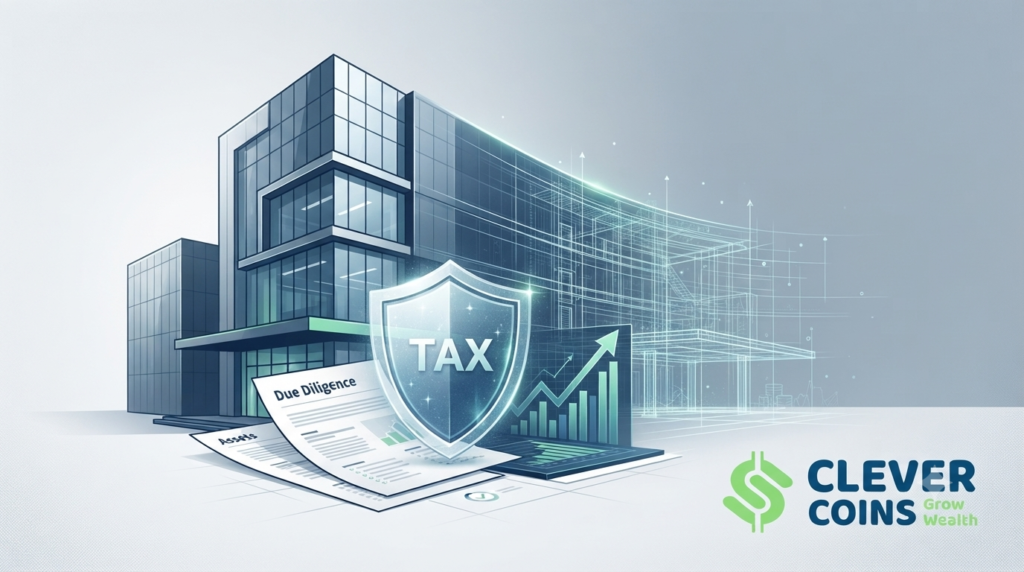
Acquiring a business is a high-stakes endeavor. Based on Section 85 (transfer of liabilities) and the requirements of Section 18 (ITC transfer), buyers must perform exhaustive GST due diligence before signing the BTA.
Checklist for the Acquiring Entity:
Verify the accurate filing status of the seller’s GSTR-1, GSTR-3B, and GSTR-9/9C.
Reconcile the ITC claimed in GSTR-3B with GSTR-2B to ensure no illegitimate credit is being transferred.
Download and scrutinize the seller’s Electronic Liability Ledger to ensure no pending, unpaid demands.
Check the portal for any pending notices, show-cause notices, audits, or scrutiny proceedings against the transferor.
Ensure the Business Transfer Agreement explicitly states the transfer of assets and liabilities to validate the ITC-02 transfer.
Insert an airtight Indemnity Clause in the BTA holding the seller financially responsible for any tax liabilities arising from periods prior to the acquisition.
Conclusion
The transfer of a business or a slump sale is a watershed moment for any corporation, opening doors to new synergies and growth. The GST law in India facilitates these structural changes by exempting the transfer of a going concern, recognizing it as a necessary economic activity rather than a standard commercial sale.
However, this exemption is not a blanket immunity from compliance. Proper drafting of the Business Transfer Agreement, strategic filing of Form GST ITC-02, precise calculation of ITC reversals, and rigorous due diligence are non-negotiable. By treating these transactions with the legal and financial respect they demand, businesses can ensure a seamless transition of ownership without inviting punitive actions from the tax authorities.
Frequently Asked Questions (FAQs)
1. Is GST applicable on a Slump Sale? No, provided the slump sale qualifies as a “transfer of a going concern” (a running business). It is treated as a supply of service and is exempted under Notification 12/2017-Central Tax (Rate).
2. Can we transfer ITC if only a part of the business is sold? Yes. If the part of the business sold operates as an independent division or unit, it qualifies as a going concern. The unutilized ITC can be proportionately transferred to the buyer using Form GST ITC-02.
3. What happens if the buyer does not want to take over the seller’s liabilities? If liabilities are not transferred, the transaction risks losing the “going concern” status and may be treated as an itemized sale of assets (which is fully taxable). Furthermore, without the transfer of liabilities, unutilized ITC cannot be legally transferred under Section 18(3).
4. Does the buyer need a new GST registration? Yes. GST registration is PAN-based and tied to the specific legal entity. The buyer must obtain a fresh GST registration to continue the business operations unless they are absorbing the business into an already registered entity.
5. Is a CA certificate mandatory for filing ITC-02? Yes. To successfully file Form GST ITC-02 on the portal, a certificate from a practicing Chartered Accountant or Cost Accountant certifying that the transfer includes a specific provision for the transfer of liabilities must be uploaded.
Navigating complex financial reports, tax filings, and corporate compliance requires precision. At CleverCoins, we turn financial data and regulatory complexities into a strategic advantage for your bottom line.
Email: client@clevercoins.org
Phone: +91 77389 59862
Address: Ideal Market, Mumbra, Thane-400612
Days
Hours
Minutes
Seconds
Related posts:
What is a Debenture? Types, Risks & Everything You Need to Know
GST
GST on Goods Transport Agency (GTA): The 2026 Compliance GuideWebsite Blog Header Image
GST
Comprehensive Blog Content: Compounding of Offences Under Companies Act
GST
Angel Tax – Post-2024 Rules & Impact: A New Era for Indian Startups
GST
GST on Goods Transport
GST
Leave Encashment Tax Exemption 2026: The Ultimate Guide to Section 10(10AA)
GST
GST Registration Cancellation: The 2026 Compliance Guide
GST
Comprehensive Blog Content: How to Analyse a Balance Sheet
GST
COMPLETE MARKETING PACKAGE Annual Compliance for Private Limited Companies
GST
Kids Education Planning: Child Plans vs Mutual Funds – The Ultimate Financial Roadmap
GST