Leave Encashment Tax Exemption 2026: The Ultimate Guide to Section 10(10AA)
As you navigate your career, plan your retirement, or transition to a new professional challenge, understanding how your hard-earned money is taxed is critical. Among the various components of a salary structure, leave encashment stands out as a significant financial milestone. Whether it is part of your Full and Final (F&F) settlement upon resignation or a reward for decades of service upon retirement, encashing your accumulated unutilized earned leaves can yield a substantial payout.1. What is Leave Encashment?
Throughout your employment, organizations grant various types of paid leaves—such as Earned Leave (EL), Privilege Leave (PL), Casual Leave (CL), and Sick Leave (SL). While casual and sick leaves typically lapse if unused, earned or privilege leaves often accumulate year after year.- During active employment (while you are still working).Tax Garden
- At the time of resignation or job transition.
- At the time of retirement, superannuation, or due to death.
2. Taxability Matrix: When is Leave Encashment Taxed?
Before diving into exemptions, it is vital to separate encashment during service from encashment upon exit.- Encashment During Active Employment: If your employer allows you to encash your leave while you are actively on their payroll and continuing your job, this amount is 100% taxable as “Income from Salary”. It is fully subject to Tax Deducted at Source (TDS) based on your applicable income tax slab rate. Section 10(10AA) offers no protection or exemption for encashments during service.Tax Garden+ 1
- Encashment Upon Separation (Retirement or Resignation): If you receive leave encashment at the time of leaving the organization (either via retirement or resignation), part or all of it can be completely tax-exempt under Section 10(10AA) of the Income Tax Act.Tax Garden
3. Government vs. Private Employees: The Fundamental Split
The Income Tax Act draws a sharp line between government and non-government (private sector) employees when determining tax exemptions.A. Central and State Government Employees
For employees of the Central Government, State Governments, or local authorities, any leave encashment received at the time of retirement or superannuation is 100% tax-exempt. There is no upper monetary ceiling or cap on this exemption. Even if a government official receives ₹40 Lakhs or ₹50 Lakhs as accumulated leave payout upon retirement, the entire sum remains completely free from income tax.B. Non-Government (Private Sector) Employees
For private sector employees, the rules are more structured. While leave encashment on retirement or resignation is eligible for tax exemption, it is bound by specific statutory limits and calculated formulas.4. The Cornerstone of 2026 Rules: The ₹25 Lakh Exemption Limit
For decades, the tax-exempt limit for private sector employees under Section 10(10AA)(ii) remained frozen at a paltry ₹3 Lakhs (set way back in 1998/2002). However, following the landmark amendments via CBDT notification, the upper cap for non-government employees was substantially raised to ₹25,00,000 (₹25 Lakhs).5. The Four-Component Calculation Formula for Private Employees
If you are a private sector employee calculating your tax exemption upon resignation or retirement, the exempt amount is strictly defined as the least of the following four parameters:- Actual Leave Encashment Received: The literal cash payout transferred to your account by your employer.Tax Garden
- The Statutory Lifetime Ceiling: ₹25,00,000.Tax Garden
- Cash Equivalent of Unutilized Earned Leave: Calculated based on a maximum cap of 30 days of leave for every completed year of service with that specific employer, minus the leaves actually taken or encashed.Tax Garden
- 10 Months’ Average Salary: The average of your basic salary plus dearness allowance (DA) drawn over the last 10 months immediately preceding retirement or exit.ResumeVera
Understanding the Salary Components
When computing the “average salary” for the 10-month window:- Basic Salary: Included fully.ResumeVera
- Dearness Allowance (DA): Included if it forms part of retirement benefits as per employment terms.
- Commissions and Bonuses: Generally excluded unless explicitly tied to a fixed percentage of turnover.
6. Practical Case Studies: Crunching the Numbers
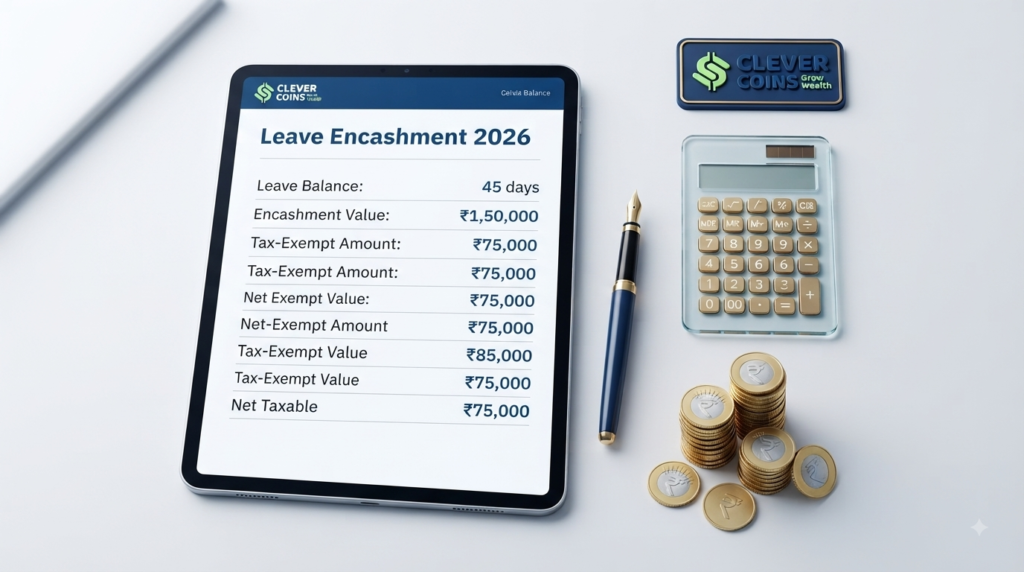
To visualize how this works in real life, let us examine two practical scenarios for professionals navigating tax filings.Scenario A: The Mid-Career Resignation (Private IT Sector)
- Profile: Software engineer resigning after 8 years of service.
- Last 10 Months Average Basic Salary: ₹75,000 per month.
- Accumulated Unused Leave: 60 days.
- Actual Encashment Received: ₹1,50,000.
- Actual Encashment: ₹1,50,000
- Statutory Ceiling: ₹25,00,000Tax Garden
- Cash Equivalent of Leave (60 days at daily rate of ₹75,000/30 = ₹2,500/day): 60×2,500=₹1,50,000
- 10 Months Average Salary: 10×₹75,000=₹7,50,000Tax Garden
Scenario B: High-Earner Retirement after Long Service
- Profile: Senior corporate executive retiring after 25 years of service.
- Last 10 Months Average Salary (Basic + DA): ₹2,50,000 per month.
- Accumulated Unused Leave: 400 days (capped legally at 30 days/year × 25 years = 750 days max eligibility; actual balance used is 400 days).
- Actual Encashment Received: ₹33,33,333 (calculated as 400×[2,50,000/30]).
- Actual Encashment: ₹33,33,333Tax Garden
- Statutory Ceiling: ₹25,00,000Tax Garden
- Cash Equivalent of 400 days: 400×8,333.33=₹33,33,333
- 10 Months Average Salary: 10×₹2,50,000=₹25,00,000Tax Garden
- Exempt Amount: ₹25,00,000Tax Garden
- Taxable Amount: ₹33,33,333−₹25,00,000=₹8,33,333
7. Is Leave Encashment Exempt Under the New Tax Regime?
A common point of confusion among taxpayers is whether tax exemptions tied to specific sections survive under the New Tax Regime.The good news is that Section 10(10AA) exemption is fully available under both the Old and the New Tax Regimes. You do not need to opt for the old tax structure solely to claim your leave encashment benefits. The statutory limits and calculations apply universally regardless of your chosen tax regime structure.8. What Happens if You Have Changed Multiple Jobs?
A critical trap for job switchers is understanding that the ₹25 Lakh limit is cumulative, not per-employer.If you resigned from Company A two years ago and claimed a tax exemption of ₹8 Lakhs on your leave encashment, that amount is logged against your PAN in the income tax database. When you eventually retire or resign from Company B, your remaining lifetime headroom will be:9. How to Claim Your Leave Encashment Exemption in ITR
When filing your Income Tax Return (ITR), ensuring proper reporting prevents unnecessary tax mismatch demands:- Verify Form 16: Check Part A and Part B of your Form 16 issued by your employer. Ensure that the gross leave encashment is correctly stated and that the exempt portion is accurately segregated under Section 10(10AA).ResumeVera
- Filing Schedules: Report the exempt portion under Schedule EI (Exempt Income). Any taxable portion above the limits automatically flows into Schedule S (Salary).ResumeVera
- TDS Correction: If your employer deducted excessive TDS because they miscalculated or applied outdated thresholds, do not panic. File your ITR correctly, declare the proper exemption under Section 10(10AA), and claim your rightful tax refund directly from the Income Tax Department.ResumeVera
10. Strategic Tax Planning Tips from Clever Coins
To optimize your financial footprint and protect your wealth during career transitions, keep these expert strategies in mind:- Plan Your Exit Timing: If you are nearing retirement, structure your exit cleanly to maximize your 10-month salary average calculation base.
- Keep Impeccable Documentation: Archive leave balance certificates provided by HR departments. In case of future assessments or queries, having proof of your earned leave accumulation history is invaluable.
- Consult Professionals Early: Tax codes evolve rapidly. Partnering with proactive consultancy experts like Clever Coins ensures that complex compliance rules turn into measurable savings for your bottom line.clevercoins.org
Frequently Asked Questions (FAQs)
Q1. Is leave encashment taxable if I resign instead of retiring?
Ans: Yes, for private sector employees, leave encashment received upon resignation is partially taxable, but you are entitled to claim an exemption under Section 10(10AA) up to a lifetime aggregate limit of ₹25 Lakhs.
Q2. Can sick leave and casual leave be included in tax-free encashment calculations?
Ans: No. Statutory tax exemptions under Section 10(10AA) apply strictly to Earned Leave (EL) or Privilege Leave (PL). Casual and sick leaves are generally non-encashable or do not qualify for this specific tax break.
Q3. What should I do if my employer deducts TDS on the full leave encashment amount?
Ans: If your employer deducts tax on an amount that should legally be exempt under the ₹25 Lakh limit, you can claim a direct refund by correctly declaring the exemption under Section 10(10AA) and Schedule EI while filing your annual ITR.
Disclaimer: Tax laws are subject to periodic updates. For personalized tax planning and litigation support tailored to your specific corporate structure, reach out to the experts at Clever Coins today.
clevercoins.org