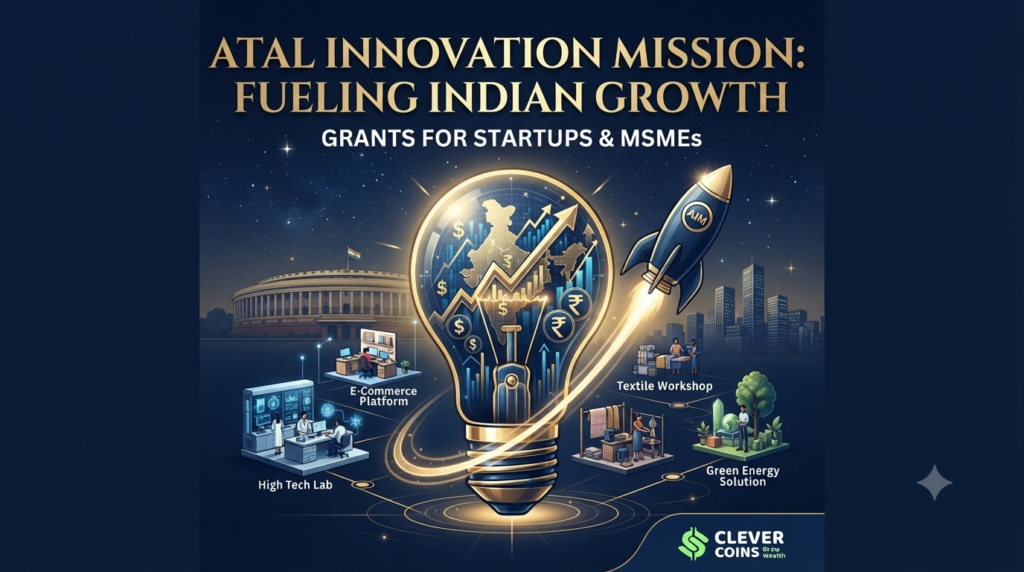
Atal Innovation Mission (AIM): Grants for Startups and MSMEs in 2026
The Atal Innovation Mission (AIM), an overarching initiative spearheaded by NITI Aayog, remains the Government of India’s flagship program to promote a culture of innovation and entrepreneurship. For startups and Micro, Small, and Medium Enterprises (MSMEs) operating in 2026, AIM presents a highly structured framework for securing non-dilutive government grants, world-class incubation support, and market-entry validation. Understanding the specific verticals, funding caps, and strict compliance requirements is critical for founders looking to leverage this sovereign backing.
Core Structure of the Atal Innovation Mission
AIM operates through distinct pillars, each targeting a specific segment of the Indian innovation ecosystem. For founders and MSME owners, the primary focus areas are the Atal New India Challenge (ANIC) and the Atal Incubation Centres (AICs).
Atal New India Challenge (ANIC): Direct technology challenge grants up to ₹1 crore for product commercialization.
Schemes In IndiaAtal Incubation Centres (AICs): Institutional grants up to ₹10 crores to establish world-class startup incubators.
Schemes In IndiaAtal Community Innovation Centres (ACICs): Focused on fostering innovation in Tier-2, Tier-3 cities, and underserved rural regions.
MyMoneyMantraAtal Tinkering Labs (ATLs): Foundational grants of ₹20 lakhs for schools to develop STEM infrastructure.
Schemes In India
Atal New India Challenge (ANIC): Direct Startup Funding
The Atal New India Challenge (ANIC) is the most relevant AIM initiative for active startups and MSMEs. It is designed to support innovators who have a working prototype and require funding for commercialization, market deployment, and scaling.
Funding Tiers and Disbursement
The ANIC provides a maximum grant-in-aid of up to ₹1 crore. This is non-dilutive funding, meaning the government does not take equity in your company. The disbursement is strictly milestone-based. Startups receive funding in tranches, and subsequent releases depend on achieving the key performance indicators (KPIs) and operational milestones agreed upon during the initial screening.
Eligibility Criteria for ANIC
To qualify for ANIC funding in 2026, applicants must meet precise institutional and operational criteria:
Entity Type: Must be a registered Indian startup recognized by the Department for Promotion of Industry and Internal Trade (DPIIT) or a registered MSME.
Ownership: The majority stake (more than 51%) of the applicant entity must be held by Indian citizens.
Development Stage: The startup must possess a working prototype or be in the process of commercializing an existing patent or technology. Pure ideation-stage startups without a prototype are generally not eligible.
Market Readiness: Applicants must demonstrate established partnerships or a clear willingness to establish partnerships for manufacturing, scaling, and market deployment.
Focus Sectors
ANIC routinely releases specific “challenge statements” aligned with national priorities. While these evolve, core sectors consistently receive backing:
HealthTech and Medical Devices
Agritech and Food Processing
Clean Energy and Smart Mobility
Fintech and Financial Inclusion
MyMoneyMantraWaste Management and Circular Economy
SpaceTech and Defence Technologies
Atal Incubation Centres (AICs): Building the Support Infrastructure
While ANIC offers direct funding to startups, the Atal Incubation Centres (AICs) provide the physical and strategic infrastructure. For academic institutions, R&D organizations, and corporate bodies looking to foster startups, the AIC grant is highly lucrative.
Grant Details
AIM provides a grant-in-aid of up to ₹10 crores over a maximum period of 5 years. This capital covers both capital expenditure (CAPEX) for setting up the facility and operational expenditure (OPEX) for running the incubator.
Startups Benefiting from AICs
As a startup founder, getting incubated at an AIC grants you access to specialized resources rather than direct cash from NITI Aayog. Startups incubated at AICs receive:
Fully equipped physical workspace and advanced lab infrastructure.
Direct mentorship from industry veterans and technical experts.
Networking opportunities with venture capitalists (VCs) and angel investors.
Legal, accounting, and compliance support for early-stage scaling.
Eligibility for Setting up an AIC
If you represent an institution aiming to secure the ₹10 crore AIC grant, the requirements include:
Entity Profile: Academic institutions, R&D organizations, corporate sector enterprises, or public-private partnerships (PPPs) registered in India.
MyMoneyMantraSpace Requirement: Minimum 10,000 sq. ft. of ready-to-use, built-up space, either owned or leased for at least 9 to 15 years.
MyMoneyMantraSustainability: A comprehensive 3 to 5-year sustainability plan demonstrating how the incubator will survive post-grant funding.
MyMoneyMantra
Atal Community Innovation Centres (ACICs)
The ACIC initiative focuses exclusively on regional development, specifically targeting unserved and underserved regions, including Tier-2/Tier-3 cities, rural areas, and tribal zones.
Key Features
Space Requirement: Minimum of 4,000 sq. ft. of net carpet area.
MyMoneyMantraEntity Structure: Must form a Special Purpose Vehicle (SPV)—a not-for-profit company registered under Section 8 of the Companies Act, 2013.
Funding Match: Requires proof of financial closure via a Board Decision or Commitment Letter for matching contributions.
MyMoneyMantra
The Application Process for Startups and MSMEs
Securing an AIM grant is a highly competitive, multi-stage process. Startups must move beyond generic pitch decks and provide data-backed documentation aligned with government procurement and evaluation standards.
DPIIT Recognition: Before accessing ANIC or incubation support, ensure your startup holds an active DPIIT recognition certificate. This is the foundational prerequisite.
Challenge Selection: Monitor the official AIM portal (aim.gov.in) for the latest ANIC challenge statements. Align your product’s value proposition directly with a specific challenge.
Detailed Project Report (DPR): Draft a comprehensive business plan outlining technical feasibility, commercial viability, and social impact. The DPR must include a detailed financial model projecting costs, revenue, and break-even points over 3 to 5 years.
Schemes In IndiaOnline Submission: Register on the AIM portal, fill out the detailed application form, and upload the required documentation.
Schemes In IndiaInitial Screening: Applications undergo a rigorous technical screening by domain experts.
Pitch Presentation: Shortlisted candidates are invited to present their business model and prototype to a high-level selection committee.
Schemes In IndiaDue Diligence and Disbursement: Successful pitches are followed by financial and legal due diligence. Upon clearance, the first tranche of the grant is released into a dedicated nodal bank account.
Required Documentation
Startups and MSMEs must maintain pristine corporate records to survive the due diligence phase. Key documents include:
DPIIT Startup Recognition Certificate.
Certificate of Incorporation and Memorandum/Articles of Association (MOA/AOA).
Audited financial statements for the past three financial years (if applicable).
Valid proof of intellectual property (IP) filings, patents, or technology validations.
Detailed Project Report (DPR) and milestone-based fund utilization plan.
Letters of intent (LOI) from potential B2B clients or manufacturing partners.
Financial Management and Utilization Certificates
Receiving the grant is only the first step. The Government of India enforces strict financial discipline on disbursed funds.
Dedicated Accounts: Grant funds must be held in a dedicated, interest-bearing bank account mapped to the Public Financial Management System (PFMS).
MyMoneyMantraUtilization Certificates (UCs): Startups must submit audited UCs at the end of each milestone or financial year. Future tranches are entirely dependent on the timely and accurate submission of these certificates.
Restricted Expenditure: Grant money cannot be used to pay off existing debts, fund massive founder salaries, or purchase unrelated real estate. Expenditures must strictly align with the approved milestone budget.
Common Pitfalls and Reasons for Rejection
Many technically sound startups fail to secure AIM funding due to administrative or strategic errors:
Lack of a Working Prototype: Applying to ANIC with only an idea or a non-functional wireframe guarantees rejection.
Poor Financial Projections: Evaluators look for sustainable business models. Unrealistic revenue projections or inflated valuation expectations create immediate red flags.
Misalignment with Challenge Statements: If your product does not directly solve the specific problem outlined in the open ANIC challenge, the application will not pass the initial screening.
Non-compliance with PFMS: Failure to understand government accounting standards and the PFMS architecture leads to operational bottlenecks during due diligence.
Post-Funding Compliance for Startups
Once funded, the relationship with NITI Aayog requires ongoing compliance:
Quarterly Reporting: Startups must submit detailed progress reports tracking their KPIs against the original proposal.
Audits: Be prepared for periodic technical and financial audits by empanelled government agencies.
Mentorship Participation: Grantees are expected to actively participate in AIM-sponsored networking events, investor connect programs, and industry showcases.
Related posts:
The Ultimate Guide to the Digital MSME Scheme: Unlocking a 50% Subsidy for Cloud Computing, ERP, and...
Credit Linked Capital Subsidy Scheme (CLCSS): The Ultimate Guide to MSME Technology Upgradation &...
MSME Samadhaan: Complete Legal Process for Recovering Delayed Payments from Buyers
ONDC Benefits for MSME Sellers: Govt's Free Alternative to Amazon & Flipkart
The Ultimate Guide to MIDC Land Allotment and Industrial Incentives: Package Scheme of Incentives (P...
Form AOC-4 and MGT-7 Filing Guide: Documents, Balance Sheet Attachments, and Penalties
Mahila Coir Yojana & Coir Udyami Yojana: Complete Guide to Government Schemes for Women MSMEs
CGTMSE Scheme Explained: Getting Collateral-Free Bank Loans Up to ₹5 Crore for MSMEs
Stand-Up India Scheme for SC/ST and Women Entrepreneurs: Full Guide
The Complete Guide to the MeitY SAMRIDH Scheme: Fueling India's Startup Ecosystem
Related posts:
 Udyam Registration Benefits: Top 10 Subsidies, Collateral-Free Loans, and Concessions
 Form AOC-4 and MGT-7 Filing Guide: Documents, Balance Sheet Attachments, and Penalties
 The Ultimate Guide to MIDC Land Allotment and Industrial Incentives: Package Scheme of Incentives (PSI)
 CGTMSE vs CGSS: The Ultimate Guide to Collateral-Free Business Loans in India