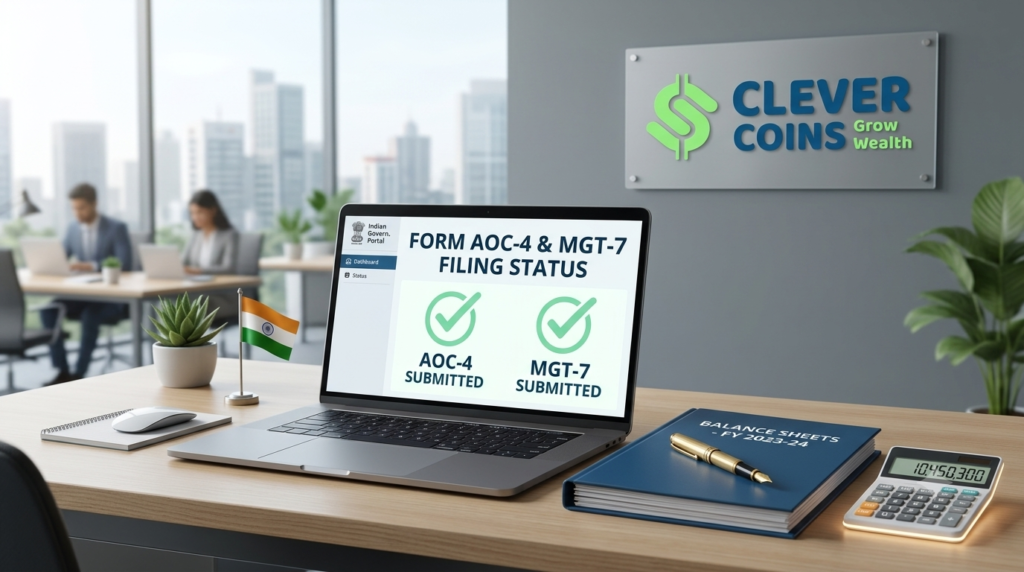
Form AOC-4 and MGT-7 Filing Guide: Documents, Balance Sheet Attachments, and Penalties
Introduction: The Annual Compliance Milestone Every Indian Company Must Master
Every registered company in India—whether a Private Limited Company, a One Person Company (OPC), or a Small Company—shares a recurring legal obligation under the Companies Act, 2013: annual corporate filings with the Ministry of Corporate Affairs (MCA). Operating a corporate entity brings immense credibility, limited liability, and capital-raising power, but it also demands strict adherence to statutory timelines and disclosure norms.
At the heart of this annual ritual are two foundational electronic forms: Form AOC-4 (for filing financial statements and allied documents) and Form MGT-7 / MGT-7A (for filing the annual return summarizing shareholding, management, and governance details). Missing these deadlines or submitting incomplete disclosures does not just invite monetary fines; it flags your Corporate Identification Number (CIN) as “Active Non-Compliant,” immobilizes structural changes, penalizes directors with disqualification risks, and erodes investor trust.
At CleverCoins, we assist founders, CFOs, and finance teams across Mumbai, Thane (Mumbra), and pan-India in navigating these statutory labyrinths seamlessly. In this exhaustive guide, we break down everything you need to know about Form AOC-4 and Form MGT-7: from exact due dates and mandatory attachments to balance sheet disclosures, fee structures, and severe penalty implications under the Companies Act.
1. Statutory Framework and Governing Provisions
The legal bedrock governing annual filings is embedded in the Companies Act, 2013, read alongside relevant rules established by the Ministry of Corporate Affairs:
-
Section 137 of the Companies Act, 2013: Mandates every company to file a copy of its financial statements (including consolidated financial statements, if any), along with all required documents annexed thereto, duly adopted at the Annual General Meeting (AGM), with the Registrar of Companies (RoC) within 30 days of the AGM. This filing is executed via Form AOC-4.
-
Section 92 of the Companies Act, 2013: Requires every company to prepare and file its Annual Return containing particulars of its registered office, principal business activities, particulars of holding, subsidiary and associate companies, shares, debentures, shareholding pattern, members, promoters, directors, key managerial personnel, meetings of members/board, and remuneration of directors and KMPs. This return is filed via Form MGT-7 (or MGT-7A for OPCs and Small Companies) within 60 days of the AGM.
-
The Companies (Accounts) Rules, 2014 & The Companies (Management and Administration) Rules, 2014: Provide operational guidelines, form structures, XBRL applicability criteria, and certification requirements.
2. Understanding Form AOC-4: Financial Statements Filing
Form AOC-4 is the electronic vehicle through which a company presents its financial health to the regulator and the public domain. It encapsulates the company’s financial position, performance, and cash flows for the preceding financial year (April 1 to March 31).
Who Must File Form AOC-4?
-
Every Private Limited Company incorporated in India.
-
Every Public Limited Company.
-
One Person Companies (OPCs).
-
Small Companies (paid-up capital not exceeding ₹4 crores and turnover not exceeding ₹40 crores, or as revised by recent notifications).
Key Components Disclosed in Form AOC-4
-
General Information: CIN, PAN, registered office address, email ID, business activity classification (NIC code), and particulars of the auditor.
-
Financial Parameters: Balance Sheet totals, fixed assets, intangible assets, investments, inventories, trade receivables, cash and bank balances, short-term and long-term borrowings, trade payables, revenue from operations, other income, total expenses, profit/loss before and after tax, and earnings per share (EPS).
-
Corporate Social Responsibility (CSR) Details: If applicable under Section 135 (net worth ₹500 crore+, turnover ₹1000 crore+, or net profit ₹5 crore+), details of CSR committee, policy, amount spent, and unspent amounts transferred to dedicated funds.
-
Auditor’s Observations: Disclosures regarding any qualifications, reservations, or adverse remarks made by the statutory auditor in their report, alongside management replies.
-
Related Party Transactions: Particulars of contracts or arrangements entered into with related parties under Section 188 in Form AOC-2.
3. Mandatory Attachments for Form AOC-4
An improperly annexed Form AOC-4 is routinely rejected or subjected to resubmission queries by the Central Processing Centre (CPC) of the MCA. To ensure flawless execution, verify that all mandatory documents are converted to PDF format and ready before filing:
-
Financial Statements (Balance Sheet, Statement of Profit & Loss, Cash Flow Statement, and Notes to Accounts): Must be duly authenticated and signed by directors (two directors, including MD/CEO if appointed, plus Company Secretary if applicable) and the statutory auditor.
-
Directors’ Report (Board’s Report): Prepared under Section 134, including annexures such as the Annual Return extract (MGT-9 where applicable), Secretarial Audit Report (MR-3 for applicable companies), CSR policy report, particulars of loans/guarantees/investments under Section 186, and internal financial controls statement.
-
Auditor’s Report: The clean or qualified report issued by the Chartered Accountant firm acting as statutory auditors.
-
Statement of Subsidiaries/Associate Companies/Joint Ventures (Form AOC-1): Mandatory if the company has one or more subsidiaries, associates, or joint ventures, detailing their financial contributions.
-
Corporate Social Responsibility (CSR) Report: If CSR provisions apply, the annual report on CSR activities executed during the financial year.
-
Approval Letters or Extension Orders: If the company obtained an extension for holding its AGM from the Registrar of Companies under Section 96, the formal RoC approval order must be attached.
-
Other Optional Attachments: Notice of AGM, shareholders’ resolution adopting accounts, or valuation reports if explicitly required.
4. Special Rules for XBRL Filing in Form AOC-4
Not all companies file Form AOC-4 in standard PDF formats. Certain categories must file their financial data using eXtensible Business Reporting Language (XBRL) taxonomy:
-
All companies listed with stock exchanges in India and their Indian subsidiaries.
-
All companies having a paid-up capital of ₹5 crores or above.
-
All companies having a turnover of ₹100 crores or above.
-
All companies compelled under the Companies (Filing of Documents and Forms in XBRL) Rules, 2015.
-
Note: Banking companies, insurance companies, power companies, and Non-Banking Financial Companies (NBFCs) are presently exempted from XBRL filing requirements even if they meet the capital/turnover thresholds.
5. Understanding Form MGT-7 and MGT-7A: Annual Return Filing
While Form AOC-4 reports what the company earned and owned, Form MGT-7 reports who owns the company, how it is governed, and what structural changes took place during the financial year.
Form MGT-7 vs. Form MGT-7A
-
Form MGT-7: Applicable to all companies other than One Person Companies (OPCs) and Small Companies. It is an extensive disclosure form covering detailed shareholding patterns, debenture holders, promoter group changes, meeting frequencies, and remuneration details.
-
Form MGT-7A: Introduced by the MCA to reduce compliance burdens, this simplified annual return form is exclusively meant for One Person Companies (OPCs) and Small Companies.
Key Disclosures in Form MGT-7 / MGT-7A
-
Registered Office & Principal Business Activities: Global location details, website URL, and principal products/services with turnover percentages.
-
Shares, Debentures, and Other Securities: Authorized, issued, subscribed, and paid-up capital breakdowns, calls in arrear, forfeiture of shares, and stock split/consolidation history.
-
Shareholding Pattern: Categorized breakup of promoters, public institutions, bodies corporate, foreign investors, and individuals holding equity or preference shares.
-
Indebtedness: Total secured and unsecured loans carrying interest as of the closure of the financial year.
-
Promoter, Director, and KMP Changes: Additions, cessations, retirements, or resignations of directors and Key Managerial Personnel during the financial year.
-
Meetings Compliance: Dates of Board Meetings, General Meetings (AGM/EGMs), and attendance percentages of directors.
-
Remuneration Details: Aggregate remuneration paid to Managing Directors, Whole-time Directors, and other executive/non-executive directors.
-
Penalties and Compounding: Details of any penal actions, compounding fees, or punishment imposed on the company, its directors, or officers in default during the financial year.
6. Mandatory Certification and Professional Attestation
Depending on the category and scale of the company, professional validation is legally mandated for annual filings:
-
Company Secretary in Practice (CS): For listed companies and companies having a paid-up share capital of ₹10 crores or more or a turnover of ₹50 crores or more, Form MGT-7 must be certified by a Company Secretary in Practice (MGT-8 certification).
-
Chartered Accountants (CA) / Cost Accountants (CMA): Statutory audit reports and financial statement attachments must be signed and certified by practicing Chartered Accountants holding a valid Peer Review Certificate.
-
Self-Certification: For small companies and OPCs, self-certification by directors or signing by practicing professionals as required by specific form instructions ensures smooth STP (Straight Through Process) approval.
7. Timeline, Due Dates, and AGM Rules
Understanding the sequence of corporate events is vital to avoiding default penalties:
-
Finalizing Accounts: Management closes books, prepares financial statements, and convenes the board to approve them.
-
Statutory Audit: Auditors complete examination and issue signed audit reports.
-
Annual General Meeting (AGM): Under Section 96, an AGM must be held within 6 months from the close of the financial year (i.e., by September 30 for companies following the April-March financial cycle). The gap between two AGMs cannot exceed 15 months.
-
Filing Deadlines:
-
Form AOC-4: Must be filed within 30 days of the AGM (typically by October 29).
-
Form MGT-7 / MGT-7A: Must be filed within 60 days of the AGM (typically by November 28).
-
8. Penalties, Additional Fees, and Default Implications
The Companies (Registration Offices and Fees) Rules, 2014 levy steep additional fees for delayed filings. Furthermore, Section 137 and Section 92 prescribe severe penal consequences for companies and officers in default.
Additional Fees Structure for Delayed Filing (MCA Portal)
If a company fails to file AOC-4 or MGT-7 within the statutory 30/60-day window, a standard flat fee applies initially, followed by heavy additional fees per day of delay:
-
Normal Filing Fee: Nominal based on authorized capital slabs (e.g., ₹200 to ₹600 for standard capital structures).
-
Additional Fee: ₹100 per day of delay for each form (AOC-4 and MGT-7). Over a span of a few months, accumulated additional fees often dwarf the initial filing cost.
Statutory Penalties Under the Law
-
Penalty under Section 137 (AOC-4 Delay):
-
Company: Penalty of ₹10,000, plus ₹100 per day during which the default continues, subject to a maximum of ₹2,00,000.
-
Managing Director, CFO, and Directors in Default: Imprisonment for a term up to 6 months or fine ranging from ₹1,00,000 to ₹5,00,000, or both.
-
-
Penalty under Section 92 (MGT-7 Delay):
-
Company: Penalty of ₹50,000, plus ₹100 per day during which default continues, up to a maximum of ₹5,00,000.
-
Officer in Default (including Company Secretary / Directors): Penalty of ₹50,000, imprisonment up to 6 months, or both.
-
Collateral Damage of Non-Filing
-
Active Non-Compliant Status: The MCA registry marks the company status as “Active Non-Compliant,” freezing structural filings such as director changes, capital increases, or charge creations.
-
Director Disqualification: Under Section 164(2), if a company fails to file financial statements or annual returns for 3 consecutive financial years, all its directors are disqualified from being appointed or reappointed as directors in any company for 5 years.
-
DIN Deactivation: Director Identification Numbers (DINs) of defaulting directors get deactivated, blocking banking operations and statutory signatures.
9. Step-by-Step Checklist for Founders and Accountants
To ensure your annual filing is error-free, follow this vetted 10-step protocol:
-
Close Books & Reconcile Ledgers: Ensure bank reconciliation, GST return reconciliation (GSTR-1 vs GSTR-3B vs GSTR-2B), TDS reconciliations, and inventory valuation are finalized.
-
Hold Board Meeting: Convene a board meeting to approve the audited financial statements, Board’s Report, and notice of AGM.
-
Dispatch AGM Notice: Send notices to all shareholders, directors, and auditors giving clear statutory notice (usually 21 clear days).
-
Conduct AGM: Pass ordinary resolutions adopting accounts, appointing/ratifying auditors, and declaring dividends (if any).
-
Obtain Auditor Sign-offs: Ensure the Independent Auditor’s Report is signed with UDIN (Unique Document Identification Number) generated on the ICAI portal.
-
Draft Board’s Report: Ensure all mandatory disclosures under Section 134 (CSR, MGT-9 extract, internal controls) are complete.
-
Pre-fill and Validate Forms: Download current XML/e-form schematics from the MCA portal, pre-fill using CIN, and attach all certified PDFs.
-
Digital Signature (DSC): Affix valid Class 3 Digital Signature Certificates of directors and practicing professionals (CA/CS).
-
Upload and Pay Fee: Upload forms on the MCA V3 portal, clear normal and additional fees, and download the Service Request Number (SRN) challan.
-
Archive Records: Store the filed challan, forms, and receipts in your permanent corporate compliance binder.
Conclusion: Let CleverCoins Handle Your Annual Compliance
Annual filings are not just bureaucratic tick-boxes; they are the mirror of your corporate governance and financial integrity. Lapses due to oversight can trigger disproportionate financial penalties and paralyze business operations.
At CleverCoins, we specialize in end-to-end corporate compliance, accounting book-closes, audit readiness, and MCA filings for startups and established enterprises across Mumbra, Thane, and pan-India.
Ready to file your AOC-4 and MGT-7 without stress?
-
Website: clevercoins.org
-
Call / WhatsApp Our Experts: +91 77389 59862 / +91 87791 59862
-
Connect with CleverCoins today for a professional compliance audit!
Related posts:
CGTMSE Scheme Explained: Getting Collateral-Free Bank Loans Up to ₹5 Crore for MSMEs
Mahila Coir Yojana & Coir Udyami Yojana: Complete Guide to Government Schemes for Women MSMEs
Government e-Marketplace (GeM) Registration Guide for MSMEs in 2026
State Government MSME Schemes Compared: Maharashtra, Gujarat, TN, UP 2026
Stand-Up India Scheme: Bank Loans for Women and SC/ST Entrepreneurs Explained
PMEGP Loan Scheme 2026: How to Get 35% Subsidy for New Business
Top 10 Central Govt Subsidies Every MSME Should Apply in 2026
PLI Scheme 2026: Sector-Wise List and Benefits for MSME Vendors
SIDBI SMILE Scheme: Soft Loan for MSME Growth Explained
Credit Linked Capital Subsidy Scheme (CLCSS) Upgraded to MSME Champions (TECH): The Ultimate Strateg...
Related posts:
 Udyam Registration Benefits: Top 10 Subsidies, Collateral-Free Loans, and Concessions
 Section 43B(h) 45-Day MSME Payment Rule: Impact on Purchases, Deductions, and Working Capital
 PMEGP Loan Scheme: How to Secure Up to 35% Government Subsidy on New Business Projects
 CGTMSE Scheme Explained: Getting Collateral-Free Bank Loans Up to ₹5 Crore for MSMEs