
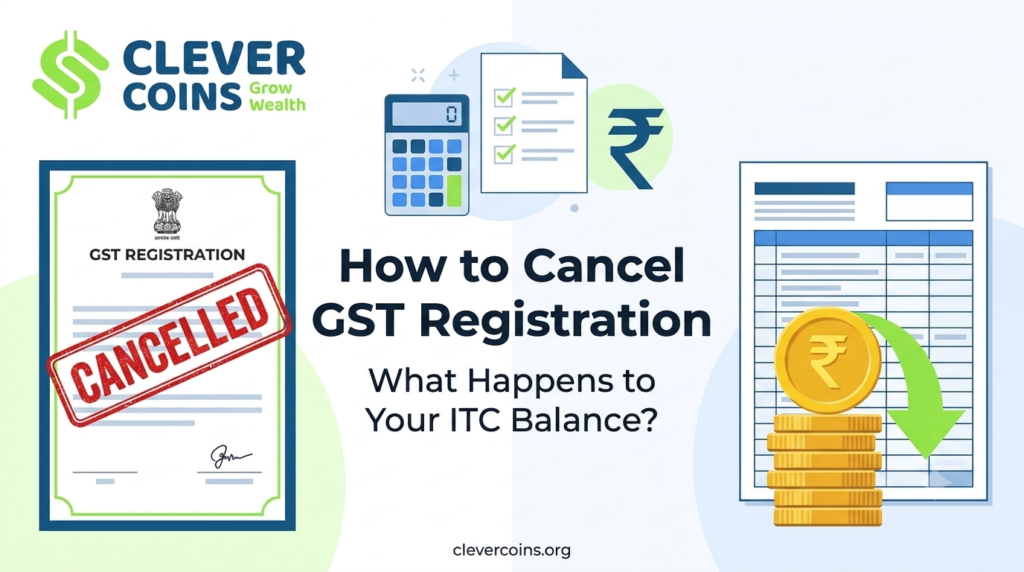
How to Cancel GST Registration and What Happens to ITC Balance? (2026 Complete Guide)
By the CleverCoins Tax Team | Updated November 2026
Closing a business, crossing below the turnover limit, switching to the composition scheme or simply no longer needing a GSTIN are all common reasons to cancel GST registration. The form is easy to file. The part that confuses almost everyone is what happens to the Input Tax Credit (ITC) balance sitting in the electronic credit ledger and the ITC embedded in your closing stock and capital goods.
Get it wrong and you can face a notice, interest at 18% per annum, a late fee on the final return, or a fresh demand years after you thought the file was closed. Get it right and you exit cleanly, with no future liability.
This guide explains the entire process in plain language: who can cancel, the brand-new rules that apply from 1 November 2026, step-by-step filing, ITC reversal formulas with worked examples, the final return GSTR-10, revocation, penalties, mistakes to avoid and answers to the questions taxpayers ask us most.
Quick answer: When you cancel GST registration, any unutilised ITC in your electronic credit ledger lapses (it is not refunded), and you must pay an amount equal to the ITC on your closing stock, semi-finished goods, finished goods and capital goods, or the output tax on them, whichever is higher. This is reported in FORM GST REG-16 / ITC-03 and finally in GSTR-10.
Table of Contents
- What is GST registration cancellation?
- Who can cancel GST registration?
- Types of cancellation: voluntary, officer-initiated and by legal heirs
- Big change: the new Rule 20 effective 1 November 2026
- Conditions and documents before you apply
- Step-by-step: how to cancel GST registration online
- What happens to your ITC balance after cancellation?
- ITC reversal on stock: formula and example
- ITC reversal on capital goods: formula and example
- Special cases: transfer of business, death of proprietor, composition switch
- GSTR-10, the final return
- Can you refund the cash ledger balance?
- Revocation of cancelled registration
- Penalties, interest and late fees
- Common mistakes to avoid
- Post-cancellation checklist
- FAQs
- Conclusion
1. What Is GST Registration Cancellation?
GST registration cancellation means your GSTIN is made inactive in the GST system from a specific date, called the effective date of cancellation. From that date you can no longer:
- Collect GST from customers or issue a tax invoice
- Claim or pass on input tax credit
- File regular returns such as GSTR-1 and GSTR-3B for periods after cancellation
The legal basis is Section 29 of the CGST Act, 2017, with the procedure laid down in Rules 20 to 23 of the CGST Rules, 2017. The ITC consequences come from Section 18(4) and Section 29(5) read with Rule 44.
Important: cancellation is not an amnesty. Your obligation to pay tax, interest and penalty for all periods before cancellation continues, and Section 29(3) specifically says cancellation does not affect liabilities for earlier periods.
2. Who Can Cancel GST Registration?
A registered person can apply for cancellation when any of the following events happens:
- Discontinuance or closure of business: the business has permanently shut down.
- Transfer of business: sale, merger, demerger, amalgamation or any other disposal of the business.
- Change in constitution: for example a proprietorship converting into a company or LLP, where a new GSTIN is needed.
- Turnover below the threshold: you are no longer liable to register. The general limits are ₹40 lakh for goods suppliers (₹20 lakh in some states) and ₹20 lakh for service providers (₹10 lakh in special category states), though state-specific limits vary.
- Opting out of voluntary registration: you registered although you were not required to, and you now wish to exit.
- Death of the sole proprietor: the legal heirs can apply, and the usual 30-day time limit does not apply.
- Switch to an exempt-only business: you now deal only in wholly exempt or non-GST supplies.
If your registration was taken by mistake, or for a business that never started, cancelling it quickly stops late fees on returns you never needed to file.
3. Types of Cancellation
a) Voluntary cancellation (on the taxpayer’s application)
You file FORM GST REG-16 on the GST portal. This is the route this article focuses on.
b) Cancellation by the proper officer (suo motu)
The tax officer can start proceedings through a show cause notice in FORM GST REG-17 and, if unsatisfied with your reply (REG-18), pass a cancellation order in FORM GST REG-19. Typical grounds include not filing returns for a continuous period (six months for regular taxpayers, or for composition taxpayers, a period of three consecutive tax periods), obtaining registration by fraud or wilful misstatement, or issuing invoices without supplying goods or services. The grounds for such cancellation have been rationalised with effect from 1 November 2026.
c) Cancellation by legal heirs
If the proprietor dies, the heirs can apply for cancellation, or continue the business by transferring the registration to the heir by amendment.
4. Big Change: New Rule 20 Effective 1 November 2026
The cancellation procedure has just been overhauled. Based on Notification No. 05/2026-Central Tax dated 26 October 2026, issued after the recommendations of the 57th GST Council meeting, Rule 20 has been substituted with effect from 1 November 2026. Here is what matters for taxpayers:
- Application timeline stays at 30 days. FORM GST REG-16 must be filed within 30 days of the event that warrants cancellation. The limit does not apply on death of a sole proprietor.
- Details of stock and capital goods must be filed with the application. REG-16 must carry details of inputs held in stock, inputs contained in semi-finished or finished goods, capital goods held, the liability on them and the payment made, along with supporting documents.
- Pre-filing condition. You cannot apply unless all returns due up to the date from which cancellation is sought have been filed. If GSTR-1 or IFF has been filed for a period, the GSTR-3B for that same period must also be filed first.
- Suspension. Once you apply, your registration stands suspended until the proceedings are complete. Returns for the residual period up to the date of cancellation must still be filed by their due dates.
- Automatic cancellation by the portal. If returns are filed on time and all dues are paid, the system cancels the registration electronically from the requested date and communicates it in the new FORM GST REG-38, provided either (a) your output tax liability declared on supplies to registered persons did not exceed ₹2.5 lakh in any month from registration till the date of application, or (b) you have filed GSTR-10 within the specified time.
- Officer route for other cases. If returns are pending or dues are unpaid, the application goes to the proper officer. The officer has 15 days to cancel (REG-19) or raise a deficiency notice (REG-03). You get 15 days to reply (REG-04), and the officer then has 15 days to approve or reject (REG-05). If the officer does not act in time, the application is deemed approved.
- Changing the effective date. If the department later believes the cancellation date should be earlier, it must issue a show cause notice, give you 30 days to reply, and pass a reasoned order. The related forms REG-34 to REG-37 are notified from 1 April 2027.
- ITC reversal inside REG-16 (from 1 December 2026). FORM GST REG-16 and Rule 44 are being amended so that the ITC reversal on stock and capital goods is determined and furnished in REG-16 itself, in addition to FORM GST ITC-03.
What this means for you: the cleanest way to exit is to file every pending return, pay all dues, and then apply. A tidy file can now be cancelled without any officer involvement. Because portal functionality is rolled out in phases, always check the latest GST portal advisories before filing.
5. Conditions and Documents Before You Apply
Before opening the portal, get these in order:
- All returns filed: GSTR-1/IFF, GSTR-3B (and CMP-08 for composition taxpayers) up to the date of application.
- All dues paid: tax, interest, late fees and any penalty.
- Closing stock statement: item-wise quantity and value as on the cancellation date.
- ITC register: invoice-wise record of ITC claimed on inputs and capital goods still held.
- Capital goods register: purchase date, invoice value, ITC claimed and current status of each asset.
- Reason for cancellation and proof: closure letter, sale agreement, death certificate (for heirs), incorporation certificate of the new entity, etc.
- Login access: valid portal login and a registered mobile number or email for OTP, plus DSC or EVC where applicable.
- Bank details for any refund of the cash ledger balance.
Tip: make sure your GSTR-2B and purchase books are reconciled before you calculate the reversal. A wrong ITC figure at this stage is the number one reason for later notices.
6. Step-by-Step: How to Cancel GST Registration Online
Step 1: File pending returns. Clear every GSTR-1/IFF and GSTR-3B (and CMP-08 if you are under composition) up to the date of application. File nil returns where there is no activity.
Step 2: Log in to the GST portal. Go to gst.gov.in, log in, and navigate to Services → Registration → Application for Cancellation of Registration.
Step 3: Fill in the basic details. Verify your legal name, address and GSTIN, then enter your current address and the reason for cancellation.
Step 4: Enter the cancellation date and the last tax details. Mention the date from which cancellation is required, and where applicable the value and tax on supplies made up to that date.
Step 5: Declare stock and ITC. Enter the details of inputs in stock, inputs in semi-finished and finished goods, and capital goods, along with the ITC claimed and the liability payable. From 1 December 2026 these tables are being recast in REG-16.
Step 6: Pay the liability. Pay the ITC reversal amount (and any other dues) using the electronic cash ledger or, to the extent permitted, the credit ledger, through the proper challan or the ledger-offset facility.
Step 7: Verify and submit. Sign using DSC (companies and LLPs) or EVC (others). An ARN is generated and the registration is marked as suspended.
Step 8: Track the status. Under the new rule, a clean application is cancelled automatically and you receive FORM GST REG-38. Otherwise watch for a notice in REG-03, reply in REG-04, and look for the order in REG-19.
Step 9: File GSTR-10. After cancellation, file the final return within three months.
Step 10: Download the cancellation order. Keep the order and all filings safely. You will need them if a notice comes later.
7. What Happens to Your ITC Balance After Cancellation?
This is the question that brings most readers to this page. The answer has four parts.
a) Unutilised ITC in the electronic credit ledger lapses
The balance in your electronic credit ledger on the date of cancellation is not refundable just because you are closing. Section 54(3) of the CGST Act allows refund of unutilised ITC only in limited cases, such as zero-rated supplies and inverted duty structure. A closing business does not fit either. In practice the credit lapses and the ledger is frozen.
So before you apply, ask a simple question: can I use this ITC against my outstanding liability? If yes, use it. The credit ledger can be used to pay output tax, including the reversal liability, subject to the usual rules on which tax head can pay which. Any surplus after that is lost.
b) ITC embedded in closing stock must be paid back
Under Section 18(4) and Section 29(5), you must pay an amount equal to the ITC on inputs held in stock, inputs contained in semi-finished or finished goods, and capital goods, or the output tax payable on those goods, whichever is higher. The logic is straightforward: you took credit expecting to use the goods in a taxable business. If the business ends, the credit has to be returned.
c) ITC on services and consumed inputs needs no reversal
The reversal applies only to goods (inputs and capital goods) physically in stock on the cancellation date. ITC on services, and on inputs already consumed or sold, is not reversed because the benefit has already been used.
d) Cash ledger balance can be refunded
Cash in your electronic cash ledger, such as an excess deposit, can be claimed back through a refund application (see Section 12).
Here is the whole picture at a glance:
Item on cancellation date | What happens |
|---|---|
ITC balance in electronic credit ledger | Lapses (no refund); use against liability first |
ITC on inputs in stock | Reverse the higher of ITC or tax on value |
ITC on semi-finished and finished goods | Same as above |
ITC on capital goods | Reverse after 5% per quarter reduction, or tax on value, whichever is higher |
ITC on services | No reversal |
ITC on consumed or sold inputs | No reversal |
Cash ledger balance | Refundable on application |
8. ITC Reversal on Closing Stock: Formula and Example
For inputs held in stock, and inputs contained in semi-finished or finished goods, the payable amount is:
Amount payable = Higher of (A) ITC claimed on the stock, as per books, or (B) GST on the market value (transaction value) of the stock.
The ITC is worked out in proportion for partly used inputs, and the tax rate used for (B) is the rate applicable to the goods.
Worked example
Priya runs a small trading business and decides to close it on 31 December 2026. Her closing stock has the following details:
- Purchase value of stock: ₹5,00,000
- ITC claimed on that stock at 18%: ₹90,000
- Current market value of the stock: ₹5,50,000
- GST on market value at 18%: ₹99,000
Here (A) is ₹90,000 and (B) is ₹99,000. She must pay the higher amount, ₹99,000.
This is why a reconciled stock register matters. If the stock value is understated, the department can recompute the liability later and add interest.
9. ITC Reversal on Capital Goods: Formula and Example
Capital goods are treated differently because their benefit is spread over time. The rule works as follows:
- Take the ITC originally claimed on the capital good.
- Reduce it by 5 percentage points for every quarter, or part of a quarter, from the date of the invoice up to the cancellation date.
- Compare the result with the GST on the transaction value of the asset.
- Pay the higher of the two.
After 20 quarters (five years) the ITC is treated as fully consumed, and no reversal is required on that asset on this count. Apply the calculation asset by asset, never as a blanket percentage.
Worked example
A workshop owner bought a machine for ₹10,00,000 plus 18% GST. The ITC claimed was ₹1,80,000. The invoice is dated 14 months before the cancellation date.
- 14 months covers 5 quarters (the fifth is a part quarter and still counts as a full quarter)
- Reduction = 5 × 5% = 25%
- Remaining ITC = ₹1,80,000 × 75% = ₹1,35,000
- Current transaction value of the machine = ₹7,00,000, so GST at 18% = ₹1,26,000
The higher figure is ₹1,35,000, so that is the amount payable for this machine.
Repeat the calculation for each asset, and add the results to the reversal on stock to arrive at the total.
10. Special Cases
Transfer of business, merger or demerger
If you are not closing but transferring the business as a going concern, with the liabilities, you do not lose the ITC. Under Section 18(3), the unutilised ITC can be transferred to the new entity by filing FORM GST ITC-02, together with a certificate from a chartered accountant or cost accountant, where required. The transferee then claims it. This is often far better than letting the credit lapse, so plan for it before you file REG-16.
Death of the proprietor
The legal heirs can apply for cancellation, with no 30-day time limit, or continue the business under the same GSTIN by updating the details. The same ITC reversal rules apply if the registration is cancelled.
Switching to the composition scheme
When a regular taxpayer opts for composition, no GSTIN is cancelled, but ITC on stock and capital goods must still be reversed under Section 18(4) through FORM GST ITC-03, within 30 days of the date the option takes effect. The mechanism is the same as in a cancellation.
Change of constitution
If your proprietorship converts into a company or LLP, the new entity obtains a new GSTIN. The old GSTIN is cancelled, with the ITC transferred through ITC-02 where the business is carried on as a continuing concern.
Registration surrendered because turnover fell below the limit
You must still reverse the ITC on stock and capital goods, even though the business is running. Your stock continues to exist, but you can no longer collect GST on it.
11. GSTR-10: The Final Return
GSTR-10 is the last return you will ever file for that GSTIN. It is governed by Section 45 of the CGST Act and Rule 81.
- Who files it: every registered person whose registration is cancelled or surrendered, including composition taxpayers. Input service distributors, non-resident taxable persons and persons paying TDS or TCS are excluded.
- Due date: within three months of the date of cancellation or the date of the cancellation order, whichever is later.
- What it contains: details of the closing stock, the ITC reversed, the tax paid on stock and capital goods, and any other liability up to the cancellation date.
- Nil return: if you hold no stock, no capital goods and no liability, you can file a nil GSTR-10.
- Late fee: ₹200 per day (₹100 CGST plus ₹100 SGST), subject to a cap of ₹10,000. Interest at 18% per annum applies to any tax paid late.
Date example
Suppose your cancellation is effective from 30 November 2026, but the order is passed on 15 December 2026. The later date is 15 December, so GSTR-10 is due by 15 March 2027.
Note: under the new automatic route, filing GSTR-10 on time can also help you satisfy the condition for automatic cancellation where your monthly output tax on B2B supplies has crossed ₹2.5 lakh. Do not leave this filing to the last minute.
Do not forget the annual return. Check whether a GSTR-9 (and, if applicable, GSTR-9C) is required for the part of the financial year before cancellation, since the annual return obligation does not disappear automatically.
12. Can You Get a Refund of the Cash Ledger Balance?
Yes. If your electronic cash ledger still shows money after the final return, you can claim it through FORM GST RFD-01 under the refund of excess balance in the electronic cash ledger option. To avoid a rejection:
- File the claim before your login access is restricted, and keep your bank account active.
- Make sure every return, including GSTR-10, is filed.
- Ensure there is no pending demand against the same GSTIN.
Remember, this is only for cash. Unused ITC in the credit ledger is a separate matter, and it lapses.
13. Revocation of Cancelled Registration
What if you change your mind, or the department cancelled your registration unfairly?
- Under Section 30 and Rule 23, the person whose registration was cancelled by the proper officer can apply for revocation in FORM GST REG-21 within 30 days of the date of the cancellation order.
- Where there is sufficient cause, the period can be extended by a senior officer, up to a total of roughly 90 days, based on the 2023 amendments. Check the current provisions and any amnesty window notified by the government before relying on the extension.
- Before applying, you must usually file all pending returns and clear dues, including late fees.
- The officer then approves the revocation in FORM GST REG-22, or rejects it in REG-05 after a notice in REG-23.
Revocation is generally meant for cancellations initiated by the department. If you voluntarily surrendered your GSTIN and later need one, the safe route is usually to apply for a fresh registration, subject to the conditions on the portal. Reversed ITC paid on stock cannot simply be reclaimed, but on a fresh registration you may claim ITC on stock held through ITC-01 within the permitted time, subject to conditions.
14. Penalties, Interest and Late Fees
Here is what can go wrong if you miss a step:
Default | Consequence |
|---|---|
Late GSTR-3B | ₹50 per day (₹20 per day for nil returns), subject to caps, plus 18% interest on tax |
Late GSTR-10 | ₹200 per day, capped at ₹10,000, plus notice and best judgement assessment risk |
Short payment of ITC reversal | Interest at 18% per annum and possible penalty under Section 73 or 74 |
Wrong stock valuation | Recomputation of liability and demand notice |
Not filing the application in 30 days | Continued return obligations, late fees and risk of department-initiated cancellation |
The interest cost can build up silently. Ignoring a dormant GSTIN does not make the liability disappear: it keeps accumulating late fees on every unfiled return until the registration is cancelled.
15. Common Mistakes to Avoid
- Applying before filing all returns. Under the new rule the portal will not accept the application. Under the officer route you will get a deficiency notice.
- Forgetting the “higher of” rule. Many taxpayers reverse only the ITC amount, when the tax on market value is actually higher.
- Ignoring capital goods. Machinery, computers and furniture are often missed, creating a demand later.
- Letting ITC lapse unnecessarily. Use it against liabilities, or transfer it through ITC-02 where the business is being sold.
- Missing the GSTR-10 deadline. The three-month window is short, and many people believe cancellation ends the compliance.
- Not reconciling with GSTR-2B. Reverse ineligible credits properly before the closing exercise.
- Disposing of stock quietly after applying. Supplies after the cancellation date remain taxable. Sell stock before the effective date and report the sales.
- Not keeping records. Section 36 requires you to keep books for 72 months from the due date of the annual return for the year, even after cancellation.
- Choosing a back-dated effective date. The department can challenge an unreasonable date and move it earlier, which can create liabilities for the added period.
- Closing the bank account too early. A refund of the cash ledger needs a working bank account.
16. Post-Cancellation Checklist
- Download the cancellation order and the REG-16 acknowledgment
- File GSTR-10 within three months
- File the annual return if applicable
- Claim the cash ledger refund, if any
- Stop issuing GST invoices and update your website, letterheads and vendor details
- Inform customers and suppliers so they can stop expecting GST invoices
- Keep records for 72 months
- Monitor the portal and your registered email for any notice for at least two years
- If you plan to restart, evaluate fresh registration and ITC-01 claims for stock
17. Frequently Asked Questions
Q1. Is there any fee to cancel GST registration on the portal?
No government fee is charged for filing the application. Professional fees depend on the complexity of your file, and late fees apply only if returns are overdue.
Q2. How long does GST cancellation take?
Under the earlier procedure the officer had 30 days to pass the order, and delays were common. From 1 November 2026, clean applications are meant to be cancelled automatically by the portal. In officer-reviewed cases, timelines of 15 days apply at each stage, with deemed approval if the officer fails to act.
Q3. Will I lose my ITC if I cancel GST registration?
Yes, any unutilised balance in the electronic credit ledger lapses. You also have to pay back the ITC contained in your closing stock and capital goods. If you are transferring the business, ITC-02 lets you pass the credit to the new owner instead.
Q4. Can I use my ITC balance to pay the reversal liability?
To the extent the credit ledger rules allow, yes. The reversal is treated as a tax liability, and credit can be used against it, with the balance paid in cash. Using the credit first avoids a cash outflow, so check this before paying.
Q5. Do I have to file GSTR-10 even if I have no stock?
Yes. If your registration is cancelled, you generally need to file GSTR-10, and you can file it as nil if there is nothing to report.
Q6. Can I cancel the GST registration if I have a pending notice or demand?
You can apply, but the application will usually go through the officer, who may ask you to clear the dues first. Cancellation does not wipe out earlier liabilities.
Q7. What if I filed the cancellation application and then want to withdraw it?
Before the order is passed you can generally request withdrawal, and under the new rules registration stays suspended during the process, so act quickly. Contact a professional immediately because the portal functionality can differ.
Q8. Is cancellation different for composition taxpayers?
The process is the same, but the ITC reversal logic is different because composition dealers cannot claim ITC. You mainly need to reverse any ITC claimed earlier on stock before switching to composition, and file CMP-08 and GSTR-10.
Q9. Can I get a new GSTIN after cancelling the old one?
Yes, but it will be a fresh registration, and the portal may check the history of the PAN. Clear every dues and returns for the old GSTIN first.
Q10. Can the department cancel my GST registration without notice?
No. An order of cancellation must be preceded by a show cause notice, and you must be given a chance to reply, except in specific situations such as the cancellation of a registration obtained by fraud, where the process is still governed by Section 29 and Rule 22.
Q11. Do I need a CA to cancel GST registration?
Not legally. But the ITC reversal on stock and capital goods, the valuation and the final return are technical, and an error can cost far more than professional fees. Most business owners prefer expert help.
Q12. Does cancelling GST affect my Income Tax or Udyam registration?
No. They are separate laws. However, you must still report the business income, and the GST turnover in the final year must match your books and income tax return.
18. Conclusion
Cancelling a GST registration is a straightforward online procedure, but the financial consequences sit below the surface. Remember the four points that decide whether your exit is smooth:
- File every return and pay every due before you apply. From 1 November 2026 this is what unlocks automatic cancellation.
- Treat the ITC balance with care. Unused credit in the electronic credit ledger lapses, so use it against liabilities or transfer it through ITC-02 where the business is sold.
- Reverse ITC on stock and capital goods correctly. Pay the higher of the ITC or the tax on value, and calculate capital goods asset by asset.
- File GSTR-10 on time and keep records for 72 months.
Rules and portal features are changing fast. The new Rule 20 is live from 1 November 2026, while amendments to REG-16 and Rule 44 follow from 1 December 2026, so confirm the current position on the GST portal or with a professional before you file.
Need Help to Cancel Your GST Registration?
At CleverCoins, our tax experts handle end-to-end GST cancellation: return clean-up, closing stock and capital goods ITC calculation, REG-16 filing, replies to department notices and the final GSTR-10. With 1,500+ clients served and 135+ GST registrations handled, we help you exit without surprises.
- WhatsApp / Call: +91 77389 59862
- Email: client@clevercoins.org
- Explore our services: GST Registration | GST Annual Return Filing | More GST articles
Related posts:
Decoding GST Notices: Key Differences Between ASMT-10, DRC-01, DRC-01A, and REG-17
Demystifying GSTR-7: The Ultimate Guide to TDS Under GST Returns
Receipt, Payment, and Refund Vouchers: When Are They Legally Required?
GSTR-2B: The Definitive Guide to the Auto-Drafted ITC Statement for Businesses
Ultimate Guide to GST On Vehicles: Cars, Trucks, Two-wheelers & Comprehensive Tax Compliance
Bull Market vs Bear Market – Key Differences
How to Obtain Multiple GST Registrations in the Same State: The Ultimate Compliance Guide
How to Check RERA Status of Your Project in India — Step-by-Step Guide (2026)
CIBIL SCOREHow It's Calculated & How to Fix It
GST Valuation Rules – Explained with Cases
Related posts:
 The Deemed Acceptance Trap in GST IMS: How Unattended Invoices Trigger Penalties on the 14th
 How to Handle Rejected vs. Pending Invoices in GST IMS Without Blocking Working Capital
 How to Respond to GST Notice DRC-01 for Input Tax Credit Mismatches: Step-by-Step Draft
 GST on Commercial Rent: RCM Applicable for MSME Tenants in 2026

