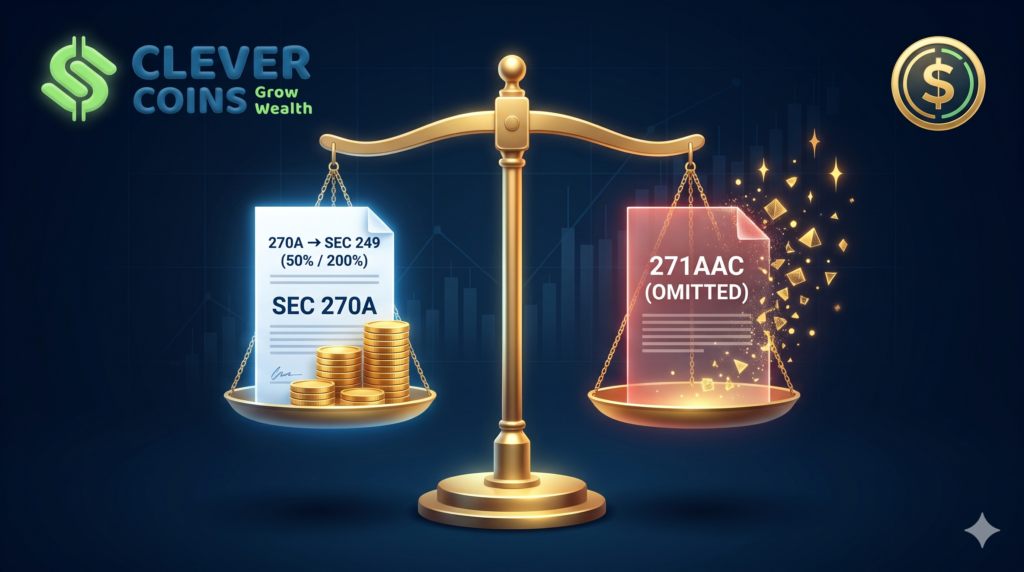
Under the Income-tax Act, 2025 (effective April 1, 2026, as amended by the Finance Act, 2026), India’s direct tax penalty architecture has undergone a structural consolidation: old Section 270A is re-enacted as Section 439 (retaining the 50% under-reporting and 200% misreporting rates), while standalone Section 271AAC (the 10% penalty on unexplained income) has been completely omitted and folded directly into the 200% misreporting regime under Section 439(11)(g).
For over six decades, taxpayers, Chartered Accountants, and tax litigators navigated a fragmented maze of penalty sections scattered across Chapter XXI of the Income-tax Act, 1961. Whenever an assessment order resulted in an income addition, the first battle was rarely about the numbers alone—it was about which competing penalty provision applied, whether a levy was automatic or discretionary, and whether an assessee could settle the dispute without spending a decade before the Income Tax Appellate Tribunal (ITAT) and High Courts.
With the enforcement of the Income-tax Act, 2025 from Tax Year 2026-27 (April 1, 2026) onward, alongside the sweeping rationalization introduced by the Finance Act, 2026, the rules of tax compliance have changed fundamentally. Nowhere is this transformation more dramatic—or financially consequential—than in the overhaul of Section 270A and Section 271AAC.
In this comprehensive guide by CleverCoins, we dissect every statutory nuance of the new penalty structure in the Income-tax Act, 2025. We will examine how Section 439 replaces Section 270A, why Section 271AAC was abolished, how unexplained income under Sections 102 to 106 is now taxed at 30% under Section 195, and how the expanded Section 440 immunity window allows taxpayers to buy peace even in misreporting cases.
1. The Architectural Shift: From the 1961 Act to Chapter XXI of the Income-tax Act, 2025
To understand why Section 270A and Section 271AAC were reshaped, it helps to look at the structural philosophy behind the Income-tax Act, 2025. Under the 1961 statute, penalty rules evolved through piecemeal budget amendments over 64 years—creating overlapping clauses like Section 271(1)(c), Section 270A, Section 271AAB, Section 271AAC, and Section 271AAD.
The Income-tax Act, 2025 consolidates all civil penalty provisions into a single, logically sequenced chapter: Chapter XXI (Sections 439 to 472), separated cleanly from criminal prosecution provisions in Chapter XXII (Sections 473 to 494).
Transition Rules & Master Statutory Mapping
Transition Rule (Section 536(2)(c)): Financial years up to FY 2025-26 remain governed by the Income-tax Act, 1961 (citing Sections 270A, 270AA, and 271AAC). Tax Year 2026-27 onward is governed strictly by the Income-tax Act, 2025 (utilizing Section 439 and Section 440), replacing the dual “Previous Year / Assessment Year” system with a unified “Tax Year” framework.
- Statutory Crosswalk:
Under-reporting: Sec 270A(7) maps to Sec 439(9) (50% penalty rate retained).
Misreporting: Sec 270A(8)/(9) maps to Sec 439(10)/(11) (200% penalty rate retained, expanded via clause (g) to include unexplained income).
Unexplained Income Penalty: Sec 271AAC is omitted (abolishing the standalone 10% penalty and merging it into Sec 439(11)(g)).
Special Tax on Unexplained Sums: Sec 115BBE (60% rate) maps to Sec 195 (30% basic rate).
Immunity / Waiver: Sec 270AA maps to Sec 440 via Form No. 161 (extending waiver options to misreporting cases for the first time).
False Entries: Sec 271AAD maps to Sec 444 (100% penalty retained).
Limitation Period: Sec 275 maps to Sec 472 (standardized 6-month quarterly clock).
2. Core Mechanics: Under-Reporting (Sec 439) vs. Misreporting (Sec 439(11))
Under-Reporting (Section 439(2)): Triggered when assessed income exceeds processed returns, non-filers exceed basic exemption limits, reassessments exceed prior orders, MAT/AMT deemed income increases, or losses are reduced/converted to positive income. The baseline penalty is 50% of the tax payable on the under-reported income. Section 439(8) provides protective exclusions for bona fide disclosures, estimate-based additions, self-estimated disallowances, and transfer pricing arm’s-length adjustments.
Misreporting (Section 439(11)): Overrides exclusions and levies a 200% penalty across seven specific limbs: (a) misrepresentation/suppression of facts, (b) unrecorded investments, (c) unsubstantiated/bogus claims or fake receipts, (d) false book entries, (e) unrecorded receipts, (f) unreported international/domestic transfer pricing transactions, and (g) unexplained income under Sections 102 to 106 determined by the AO and omitted from the return.
3. The Abolition of Section 271AAC & The Section 195 Shift
Under the 1961 Act, unexplained income under Section 68–69C faced a 60% tax rate u/s 115BBE (totalling ~78% with cess/surcharge) plus a standalone 10% penalty u/s 271AAC (~84% total outflow).
In the Income-tax Act, 2025 (as amended by the Finance Act, 2026):
Self-Disclosed Unexplained Income (Section 195(1)(a)): Taxed at a reduced 30% base rate, with no penalty u/s 439 (~31.2% total liability).
Scrutiny-Detected Unexplained Income (Section 195(1)(b) + Section 439(11)(g)): Retains the 30% base tax but slaps a 200% misreporting penalty on that tax, driving total outflow to over 91.2%.
4. Financial Impact Comparison (₹10 Lakh Unexplained Income Case Study)
Regime & Scenario | Base Tax Rate | Surcharge & Cess | Penalty Component | Total Cash Outflow |
|---|---|---|---|---|
Old Regime (Sec 115BBE + Sec 271AAC) | 60% (₹6,00,000) | ₹1,80,000 | ₹60,000 (10% u/s 271AAC) | ₹8,40,000 (84.0%) |
New Regime — Self-Disclosed (Sec 195(1)(a)) | 30% (₹3,00,000) | ₹12,000 | ₹0 (Exempt from penalty) | ₹3,12,000 (31.2%) |
New Regime — Caught in Scrutiny (Sec 439(11)(g)) | 30% (₹3,00,000) | ₹12,000 | ₹6,00,000 (200% u/s 439(10)) | ₹9,12,000 (91.2%) |
New Regime — Settled via Sec 440 Waiver (Form 161) | 30% (₹3,00,000) | ₹12,000 | ₹3,60,000 (120% additional tax u/s 440(1)(c)) | ₹6,72,000 (67.2%) |
5. Extended Penalty Waiver & Immunity: Section 440 & Form No. 161
Expanding beyond old Section 270AA (which was restricted to 50% under-reporting), Section 440 of the Income-tax Act, 2025 (operationalized via Form No. 161 under CBDT Notification No. 134/2026) allows taxpayers to settle penalties and bar prosecution across all tiers:
Ordinary Under-Reporting (Sec 439(9)): Pay assessed tax/interest; receive a 100% penalty waiver (0% penalty) and prosecution immunity.
- General Misreporting (Sec 439(11)(a)–(f)): Pay assessed tax/interest plus 100% additional income-tax; receive a 50% penalty reduction (200% penalty waived) and prosecution immunity.
Unexplained Income Misreporting (Sec 439(11)(g)): Pay assessed tax/interest plus 120% additional income-tax; receive a 40% penalty reduction and prosecution immunity.
Strict Conditions for Section 440 Approval:
Settle demand (tax, interest, and additional tax) within the stipulated demand notice period (typically 30 days).
- Forgo filing any appeal before the CIT(A)/JCIT(A) or revision petition.
- File Form No. 161 electronically within 1 month from the end of the month of order receipt.
Barred entirely if criminal prosecution under Chapter XXII has already commenced. The AO must dispose of Form 161 within 3 months after granting a hearing.
6. Actionable Compliance Checklist for Businesses & Taxpayers
Reconcile AIS, TIS & 26AS: Prevent unintentional non-reporting under Section 439(11)(a)/(e) by matching real-time data feeds before filing.
- Substantiate Loans & Credits: Under Section 102 (old Sec 68), maintain identity, creditworthiness, and source-of-source proofs to avoid Section 195(1)(b) scrutiny reclassifications.
- Audit Expense Vouchers: Eliminate unsupported claims or bogus vendor invoices that trigger Section 439(11)(c) misreporting.
- Demand Specific Sub-Clause Citations: Challenge vague penalty notices; tribunals regularly dismiss orders that fail to pinpoint the exact sub-clause of Section 439(11).
- Evaluate Section 440 Timelines: Assess Form 161 viability within 15 days of receiving an adverse assessment to weigh 100%/120% settlement costs against litigation.
For full legislative text, complete FAQ breakdowns, and tailored advisory support on Section 439, Section 440, and Form 161, visit CleverCoin