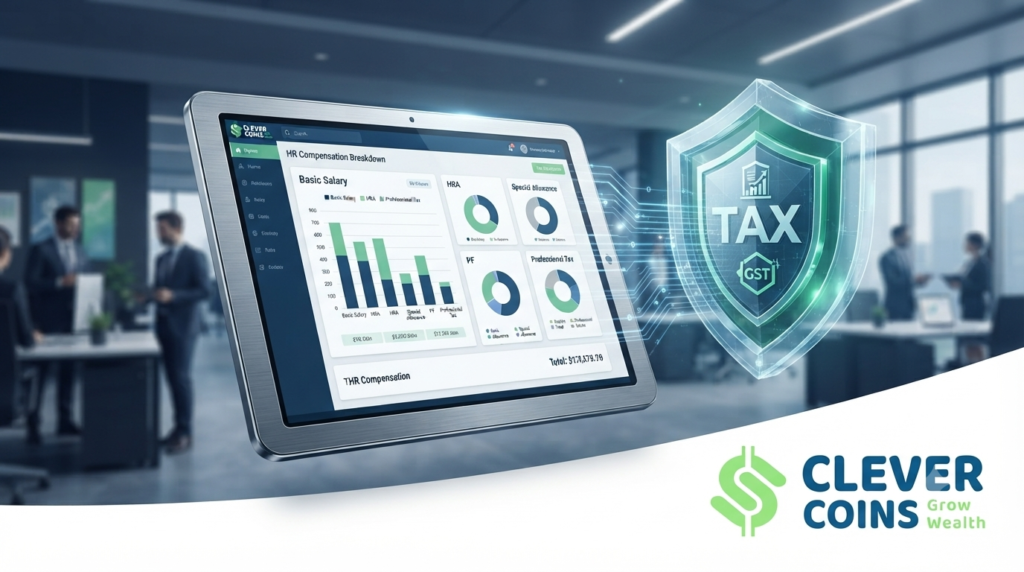
Comprehensive Blog Content: GST on Employee Benefits & CTC Components
Introduction: Unraveling the Intersection of Corporate HR and Indirect Taxation
Modern compensation structuring is a dynamic balancing act. HR leaders, Chief Financial Officers (CFOs), and tax professionals constantly strive to design a Cost to Company (CTC) framework that attracts top talent while remaining tax-efficient. However, since the introduction of the Goods and Services Tax (GST) in India, a critical question has frequently surfaced across corporate boardrooms: How does GST impact employee benefits and CTC components?
While employers often assume that transactions internal to an organization—specifically those between an employer and an employee—are entirely outside the purview of indirect taxation, the legal reality under the Central Goods and Services Tax (CGST) Act, 2017, is far more intricate. Certain perquisites, recovery of costs, canteen services, and corporate gifts occupy a complex grey area where tax authorities scrutinize whether a transaction constitutes a “supply” or falls squarely within the employer-employee shield.
Brought to you by the expert multidisciplinary team at Clever Coins, this comprehensive guide dives deep into the statutory provisions, Schedule III carve-outs, Advance Rulings, and compliance obligations surrounding GST on employee benefits and CTC components, safeguarding your business from unexpected tax liabilities and litigation.
1. The Statutory Anchor: Schedule III and the Employer-Employee Relationship
To evaluate any tax liability under GST, one must first test whether the activity qualifies as a “supply” under Section 7 of the CGST Act, 2017.
A. Schedule III, Paragraph 1 – The Exemption Shield
Paragraph 1 of Schedule III to the CGST Act explicitly states that:
“Services by an employee to the employer in the course of or in relation to his employment” shall not be treated as a supply of goods or services.
Consequently, any service rendered by an employee in exchange for a salary, wages, or direct components of their CTC package is completely outside the scope of GST. There is no tax applicable on the standard employer-employee remuneration cycle.
B. The Perquisite Dilemma: Section 7(2) and Schedule I
While services by an employee to an employer are shielded, what about supplies by an employer to an employee?
-
Gifts by Employers: According to Entry 2 of Schedule I, supplies made without consideration can sometimes be deemed taxable supplies. However, a crucial proviso protects employers: Gifts up to INR 50,000 in a financial year by an employer to an employee are not treated as supply and thus attract no GST.
-
If a gift exceeds INR 50,000, the entire value (or the value exceeding the threshold, depending on judicial interpretations) may invite GST scrutiny.
2. Deep Dive: CTC Components and Their Specific GST Treatment
A standard CTC package comprises multiple components—basic salary, allowances, reimbursements, perquisites, and facility provisions. Let us analyze how GST interacts with each of these structural elements:
A. Basic Salary, Dearness Allowance, and Standard Monetary Allowances
-
GST Status: Not Taxable.
-
These are direct remunerations paid in exchange for employment services. They fall squarely under Schedule III, rendering them immune to GST.
B. Corporate Canteen and Food Services
Providing subsidized or free food and beverages at the workplace is a staple employee benefit.
-
GST Status: Taxable with Input Tax Credit (ITC) Restrictions.
-
When an employer engages an external third-party caterer to provide food services, the caterer levies GST (typically at 5% without ITC or 18% with ITC).
-
Crucial Legal Caveat: Under Section 17(5)(b)(i) of the CGST Act, Input Tax Credit (ITC) on food, beverages, and catering is generally blocked, except where an inward supply of goods or services of a particular category is used by a registered taxable person for making an outward taxable supply of the same category or as an element of an taxable composite supply. However, if the law mandates the provision of canteen facilities under any statute (such as the Factories Act, 1948), judicial precedents and recent clarifications indicate that ITC may be available if the cost is recovered from employees or treated as part of the composite CTC without separate profit margins.
C. Transportation and Cab Facilities
-
GST Status: Taxable (5% with limited ITC or 12% with full ITC).
-
If an employer provides cab services for employee pickup and drop-off, the transport operator charges GST. Similar to catering, ITC on motor vehicles used for transporting employees is generally blocked under Section 17(5) unless the government makes such transport obligatory for employers under any special law.
D. Corporate Health Insurance and Medical Benefits
-
GST Status: Exempt or Taxable depending on structure, with blocked ITC.
-
Group Medical Insurance (GMC) policies procured by employers for employees attract GST when purchased from insurance providers.
-
Under Section 17(5)(g) or (h), ITC on personal consumption or insurance services is typically restricted unless it is obligatory for the employer to provide such insurance under statutory provisions (like the Employees’ State Insurance Act).
3. The Controversy of Recoveries: Notice Pay, Notice Period, and Employee Loan Recoveries
One of the most heavily litigated areas concerning employee benefits involves recoveries made by employers from employees. When an employee leaves a firm without serving the mandatory notice period, the employer frequently recovers “Notice Pay.” Are these monetary recoveries subject to GST?
A. Notice Pay Recoveries
-
The Departmental View: Tax authorities have historically argued that recovering notice pay is a consideration for tolerating an act or refraining from an act (i.e., breaching the employment contract prematurely), making it taxable as a “service” under Entry 5 of Schedule II at 18% GST.
-
The Industry Standpoint & Legal Logic: Industry experts and various judicial trends argue that notice pay recovery is essentially a breach-of-contract compensation mechanism or an adjustment within the overall employment exit settlement, and not a separate taxable service. Because the employment contract itself is covered under Schedule III, adjustments or deductions made within that framework should not attract standalone GST. However, due to divergent Advance Rulings across states, many corporations face ambiguity and continue to evaluate risk management strategies.
B. Recovery of Noticeable Damages or Asset Costs
If an employer recovers costs for damaged company assets, laptop losses, or unadjusted salary advances, these are generally treated as financial recoveries rather than commercial supplies, provided they do not camouflage an independent commercial transaction.
4. Input Tax Credit (ITC) Blockades on Employee Perks: Section 17(5) Analysis
The holy grail of GST optimization is maximizing Input Tax Credit. However, Section 17(5) of the CGST Act acts as a major roadblock regarding employee-related expenses. Section 17(5)(g) blocks ITC on goods or services used for personal consumption.
The table below outlines how common CTC and employee welfare perks stack up regarding ITC eligibility:
| Benefit / Expense Category | GST Rate Applicable | ITC Eligibility Status | Statutory Reference / Condition |
| Basic Salary & Allowances | Nil | N/A | Covered under Schedule III (Not a supply) |
| Mandatory Factory Canteen | 5% / 18% | Eligible in specific cases | Available if statutory obligation under Factories Act |
| Voluntary Office Cafeteria | 5% / 18% | Blocked | Section 17(5)(b)(i) blocks food/beverage ITC |
| Employee Health Insurance | 18% | Blocked | Blocked unless statutory compulsion exists |
| Cab / Transport Facility | 5% / 12% | Blocked | Blocked unless legally mandated transport |
| Corporate Gifts (> INR 50k) | Variable | Blocked / Taxable | Treated as supply of goods if > INR 50,000 |
5. Compliance Best Practices for HR and Finance Teams
To prevent unexpected tax demands during GST audits, corporate finance and human resources departments must implement rigorous internal controls:
-
Map CTC Components Clearly: Ensure that employment agreements explicitly distinguish between direct remuneration (exempt under Schedule III) and optional welfare perquisites.
-
Monitor the INR 50,000 Gift Limit: Track all festive gifts, performance tokens, and milestone awards given to individual employees annually to ensure they do not breach the threshold without proper tax accounting.
-
Audit Canteen and Transport Recoveries: If nominal amounts are recovered from employees for food or transport, evaluate whether such recoveries trigger output tax liability under reverse charge or forward charge mechanisms.
-
Stay Updated on Advance Rulings: Because judicial interpretations regarding notice pay and welfare perks vary, consult specialized indirect tax advisors regularly.
6. Strategic Summary & Expert Guidance from Clever Coins
Navigating the intricate boundaries of GST on employee benefits and CTC components requires a balanced approach combining labor law understanding with rigorous indirect tax compliance. Misinterpreting perquisite rules or improperly claiming blocked ITC can lead to severe penalties during departmental audits.
At Clever Coins, our specialized indirect tax consultants help enterprises optimize their compensation structures, mitigate litigation risks, and ensure bulletproof compliance across all operational verticals. Let us help you turn complex tax frameworks into strategic savings.
Contact Clever Coins today to review your organization’s CTC tax architecture and unlock complete compliance peace of mind.
Need Professional Guidance?
Navigating complex financial reports, tax filings, and corporate compliance requires precision. At CleverCoins, we turn financial data and regulatory complexities into a strategic advantage for your bottom line.
- Email: client@clevercoins.org
- Phone: +91 77389 59862
- Address: Ideal Market, Mumbra, Thane-400612