GST on Healthcare & Hospitals in India 2026: Rates, Exemptions, ITC Rules & Compliance Guide
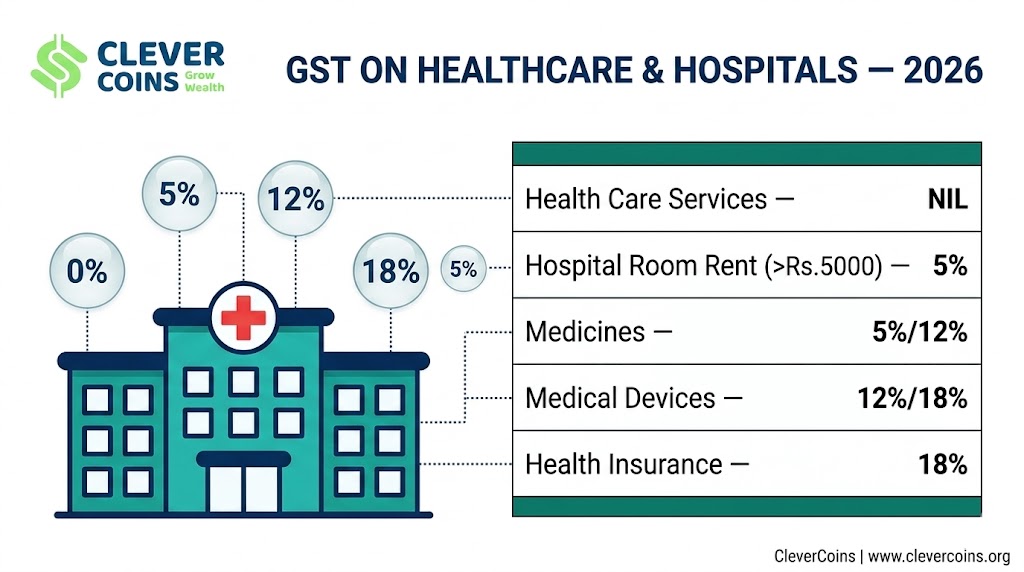
India’s healthcare sector is one of the most complex areas under the Goods and Services Tax (GST) framework. With a unique mix of fully exempt services, partially taxable supplies, varied rates on medicines and equipment, and special rules on hospital room rent — GST compliance for hospitals, clinics, diagnostic centres, and other healthcare providers requires precise understanding.
In 2022, a landmark change was introduced: GST on hospital room rent for non-ICU rooms above Rs. 5,000 per day was made applicable at 5%. This change, combined with the evolving GST council decisions in 2024 and 2025, has made it critical for every healthcare provider to stay updated.
This comprehensive 2026 guide by CleverCoins — India’s trusted tax consultancy firm — covers every aspect of GST on healthcare: exempt services, taxable services, GST rates on medicines and equipment, ITC eligibility, composite supply rules, GST registration requirements, compliance obligations, and the latest updates as of 2026.
Why GST and Healthcare is Complex
The healthcare sector presents unique GST challenges because:
- It involves a mixture of exempt and taxable supplies within the same hospital
- Medicines, devices, services, room rent, and diagnostic tests all carry different GST treatments
- Hospitals are generally not eligible for Input Tax Credit (ITC) on most inputs since their primary service is exempt
- The 2022 room rent change created new compliance obligations for hospitals charging above Rs. 5,000/day
- Cosmetic and aesthetic procedures are fully taxable at 18%, while genuine medical treatment is exempt
- Composite vs. mixed supply rules determine whether food, accommodation, and treatment are taxed together or separately
- GST registration threshold rules differ for healthcare providers depending on turnover and state
⚠️ Key Principle: GST exemption in healthcare is intended for genuine medical treatment. Anything cosmetic, aesthetic, or non-medical in nature attracts standard GST rates.
Who is Covered Under GST Healthcare Provisions?
The healthcare GST framework applies to the following types of entities:
- Government hospitals and public health institutions
- Private hospitals, multi-specialty hospitals, and nursing homes
- Clinics and polyclinics — single-specialty or multi-specialty
- Diagnostic centres — pathology labs, radiology centres, imaging centres
- Dental clinics and orthodontic centres
- Ayurveda, Unani, Siddha, Naturopathy, Yoga, and Homeopathy (AYUSH) practitioners
- Physiotherapy centres and rehabilitation centres
- Mental health clinics and psychiatric hospitals
- Blood banks and cord blood banks
- Ambulance services — government and private
- Medical device manufacturers, traders, and importers
- Pharmaceutical companies, distributors, and retailers
- Health insurance companies
Complete GST Rate Chart for Healthcare Services & Supplies — 2026
The table below provides a comprehensive reference for GST rates applicable across all major categories of healthcare services and supplies in India as of 2026:
Category of Healthcare Service / Supply | GST Rate | SAC / HSN Code | Key Notes |
Health care services by a clinical establishment, authorised medical practitioner or paramedics | NIL (Exempt) | 9993 | Core medical treatment — fully exempt |
Services by a veterinary clinic in relation to health care of animals or birds | NIL (Exempt) | 9993 | Animal healthcare also exempt |
Services by cord blood banks by way of preservation of stem cells | NIL (Exempt) | 9993 | Stem cell storage exempt |
Transportation of patient in an ambulance | NIL (Exempt) | 9991 | Life-saving transport exempt |
Services by way of training or coaching in recreational activities | 18% | 9992 | Non-medical training — taxable |
Room rent (excluding ICU) in hospitals — per day > Rs. 5,000 | 5% (No ITC) | 9993 | Budget 2022 change — effective 18 July 2022 |
ICU / CCU / ICCU / NICU room rent | NIL (Exempt) | 9993 | Critical care rooms always exempt |
Medical devices, equipment (HSN Chapter 90) | 5% / 12% / 18% | Chapter 90 | Rate depends on specific device |
Medicines and drugs (HSN Chapter 30) | Nil / 5% / 12% | Chapter 30 | Life-saving drugs may be NIL or 5% |
Food supplied to patients by hospital canteen / cafeteria | 5% (if composite supply) | 9963 | Composite with treatment = exempt |
Cosmetic / plastic surgery not for illness or injury | 18% | 9993 | Non-therapeutic procedures taxable |
Hair transplant, liposuction, Botox (non-medical) | 18% | 9993 | Beauty / aesthetic procedures taxable |
Health insurance premium | 18% | 9971 | Insurance services taxable at 18% |
Diagnostic services (pathology, radiology) by clinical establishment | NIL (Exempt) | 9993 | When part of treatment — exempt |
Yoga or naturopathy services — clinical establishment | NIL (Exempt) | 9993 | Recognised systems of medicine — exempt |
Rental of medical equipment to hospitals | 12% or 18% | 9973 | Depends on type of equipment |
✅ CleverCoins Note: The exemption applies specifically to ‘health care services’ as defined under GST law. The service must be provided by a ‘clinical establishment’ or ‘authorised medical practitioner’. Services provided outside these definitions may attract GST even if related to health.
Detailed Understanding of Key Exemptions
- Clinical Establishment — Definition Under GST
Under GST law, a ‘clinical establishment’ means a hospital, nursing home, clinic, sanatorium, or any other institution by whatever name called, that offers services or facilities requiring diagnosis, treatment, or care for illness, injury, deformity, abnormality, or pregnancy, AND which has been registered/licensed under any applicable law. This includes AYUSH institutions if recognised under applicable statutes.
- Authorised Medical Practitioner — Definition
An ‘authorised medical practitioner’ means a medical practitioner registered with any of the medical councils established under law. This includes:
- Doctors registered with Medical Council of India (now National Medical Commission — NMC)
- Dental surgeons registered with Dental Council of India
- AYUSH practitioners registered under respective state boards
- Veterinary doctors and pharmacists under applicable law
- Health Care Services — What is Covered?
Health care services include any service by way of diagnosis, treatment, or care for illness, injury, deformity, abnormality, or pregnancy in any recognised system of medicines in India. Recognised systems include:
- Allopathy (Modern medicine)
- Ayurveda
- Unani
- Siddha
- Naturopathy
- Yoga
- Homoeopathy
- What is NOT Covered as Healthcare Service?
- Cosmetic surgery or plastic surgery — except when required due to disease, illness, or injury
- Hair transplant, Botox, liposuction, teeth whitening (aesthetic/non-medical)
- Gym membership, weight loss programmes (non-clinical)
- Spa and wellness services (non-clinical)
- Non-licensed medical practitioners or alternative healing not recognised under law
⚠️ Important Ruling: The GST Authority for Advance Rulings (AAR) has clarified in multiple cases that procedures like hair transplant, Botox, cosmetic teeth procedures, and liposuction — when not medically necessary — attract 18% GST.
GST on Hospital Room Rent — The 2022 Change & Its 2026 Status
One of the most debated and impactful changes in healthcare GST came into effect from 18th July 2022, following the 47th GST Council meeting. This change introduced GST on hospital room rent for non-ICU rooms above Rs. 5,000 per day.
Current Rule (Effective 18 July 2022 — Applicable in 2026)
- Room Rent ABOVE Rs. 5,000 per day per patient (excluding ICU/CCU/NICU/ICCU): 5% GST — NO Input Tax Credit
- ICU / CCU / ICCU / NICU room rent: FULLY EXEMPT — regardless of amount
- Room Rent BELOW or EQUAL to Rs. 5,000 per day: FULLY EXEMPT
✅ Example: A patient is admitted to a private hospital room at Rs. 7,000 per day. GST at 5% is applicable on the ENTIRE Rs. 7,000 — not just on the excess above Rs. 5,000. This means Rs. 350 per day in GST is charged to the patient.
Key Controversies and Practical Issues
- Since ITC is blocked on the 5% room rent GST, hospitals cannot recover ITC on inputs used for taxable rooms — increasing their cost
- Mixed billing: When room rent is bundled with meals, nursing charges, and treatment — determining the taxable component requires careful bifurcation
- Hospitals must maintain room-wise records of charges to determine taxability threshold correctly
- Patients without GST registration cannot recover the GST charged — it becomes an out-of-pocket healthcare cost
- GST on room rent creates inflationary pressure on private hospital costs for the middle-income segment
⚠️ Note for Hospitals: If your hospital charges any room above Rs. 5,000/day, you are now under the GST compliance radar. You must register for GST (if not already), maintain room-wise billing records, issue GST invoices, and file returns accordingly.
GST on Medicines and Pharmaceuticals — 2026 Rate Structure
Medicines, drugs, and pharmaceutical products are classified under HSN Chapter 30 and are taxed based on their type and specific HSN code. The GST rate structure as of 2026 is as follows:
- NIL GST: Human blood, blood components, and contraceptives
- 5% GST: Most common medicines, life-saving drugs notified by the government, vaccines, oral rehydration salts, diagnostic kits, insulin
- 12% GST: Ayurvedic, Unani, Siddha, Homeopathic medicines not covered under lower rates
- 18% GST: All other medicines, pharmaceutical products, and preparations not specifically covered
Hospitals generally purchase medicines and consumables for inpatients. Since inpatient treatment is exempt, the GST paid on such medicines becomes a cost (ITC blocked). However, medicines sold directly from the hospital pharmacy to outpatients on a standalone basis (retail sales) may attract standard GST rates.
✅ CleverCoins Tip: For hospitals operating both exempt healthcare services AND taxable pharmacy retail, proper books of account must be maintained to separately track taxable and exempt supplies for correct ITC computation under Rule 42 and 43 of the CGST Rules.
GST on Medical Devices and Equipment — 2026
Medical devices and equipment are classified under HSN Chapter 90 and various other chapters. GST rates applicable in 2026 include:
- 5% GST: Wheelchairs, tricycles for disabled persons, hearing aids, intraocular lens, coronary stents, orthopaedic implants
- 12% GST: Medical, surgical, dental, or veterinary instruments (Chapter 90) — general rate for most equipment
- 18% GST: High-end diagnostic and imaging equipment — CT scanners, MRI machines, X-ray equipment (specific HSN codes)
Note: Hospitals that import medical equipment may face Integrated GST (IGST) in addition to basic customs duty. However, certain life-saving equipment may qualify for customs duty exemptions, and the IGST paid on imports can potentially be claimed as ITC if the equipment is used for taxable output — subject to the ITC restrictions discussed below.
Input Tax Credit (ITC) for Hospitals — The Blocked Credit Problem
One of the most significant GST challenges for hospitals is the restriction on Input Tax Credit. Since the primary output of a hospital (healthcare services) is exempt from GST, the hospital cannot claim ITC on most of its inputs. This is a fundamental principle of GST: ITC is available only to the extent it relates to taxable supplies.
Input / Expense | ITC Eligible? | Reason |
Medicines, drugs used in exempt treatment | NO | Used for exempt supply — blocked u/s 17(2) |
Medical equipment used in treatment (exempt) | NO | Attributable to exempt output — blocked |
Hospital construction / renovation services | NO | Immovable property — blocked u/s 17(5)(c)/(d) |
Ambulance vehicle | NO | Motor vehicle — blocked u/s 17(5)(a) |
Medicines / supplies for taxable supply (>Rs.5,000 room) | YES (partial) | ITC on proportion attributable to taxable supply |
Office supplies, IT systems, admin expenses | YES | Used for business — eligible |
Canteen food for staff (not patient) | NO | Personal consumption — blocked u/s 17(5)(b) |
Diagnostic equipment used for taxable diagnostic services | PARTIAL | Proportionate ITC as per Rule 42/43 |
Insurance premium paid on hospital assets | YES | Business expense — eligible |
⚠️ The ITC blockage significantly increases the operational cost of hospitals. A hospital that pays GST on medicines, equipment, construction, ambulances, and consumables cannot recover any of this GST through ITC — it becomes a sunk cost embedded in healthcare costs.
Proportionate ITC — Rule 42 and Rule 43
Where a hospital has BOTH taxable and exempt outputs (e.g., a hospital that charges more than Rs. 5,000/day room rent AND provides exempt treatment), it must compute the proportion of ITC attributable to taxable supplies versus exempt supplies using the formula prescribed under Rule 42 (for inputs and input services) and Rule 43 (for capital goods) of the CGST Rules, 2017.
This proportionate ITC computation is complex and must be done monthly and corrected annually. CleverCoins helps hospitals set up the correct ITC computation mechanism to ensure compliance and avoid exposure to ITC reversal demands.
Composite Supply in Healthcare — Critical Concept
A hospital provides multiple services together: room rent, food, nursing, medicines, diagnosis, surgery — all as part of a single admission package. Under GST, when services are naturally bundled together, the concept of ‘Composite Supply’ determines the overall GST treatment.
Supply Type | Definition | GST Treatment | Example |
Composite Supply | Two or more supplies naturally bundled, principal supply determines GST | Rate of principal supply applies | Room rent + food + nursing — treatment is principal — NIL |
Mixed Supply | Two or more supplies combined artificially, highest rate applies | Rate of highest-rated supply applies | Hospital gift hamper + medicine — 18% on full value |
✅ Practical Rule: In an inpatient hospital admission, the principal supply is ‘health care service’ (treatment). All ancillary services — food, nursing, room, diagnostic tests — are part of the composite supply. Therefore, the ENTIRE inpatient package is exempt from GST, regardless of whether individual components might otherwise be taxable.
⚠️ Exception — Room Rent above Rs. 5,000/day: Even in a composite supply scenario, the specific provision for room rent above Rs. 5,000/day has been introduced as a carve-out. This specific item is taxable at 5%, even when bundled with an otherwise exempt healthcare composite supply.
GST Registration — Is Your Hospital or Clinic Required to Register?
Mandatory Registration Threshold
Under Section 22 of the CGST Act, GST registration is mandatory if the aggregate annual turnover exceeds:
- 40 lakh for goods suppliers — in most states
- 20 lakh for service providers — in most states
- 10 lakh for special category states (Manipur, Mizoram, Nagaland, Tripura)
For a hospital or healthcare provider, ‘aggregate turnover’ includes ALL receipts — both exempt and taxable. So, even if 95% of your services are exempt, the total receipts determine whether you cross the registration threshold.
Voluntary Registration
Hospitals or clinics below the threshold can opt for voluntary GST registration if they want to claim ITC on capital goods or if their suppliers require a GSTIN. However, given ITC restrictions in healthcare, voluntary registration has limited benefits for fully exempt providers.
When Registration Becomes Mandatory for Hospitals
- When aggregate turnover exceeds Rs. 20 lakh (service threshold)
- When hospital charges room rent above Rs. 5,000/day — creating a taxable supply
- When inter-state supply of taxable goods or services is made (regardless of turnover)
- When the hospital acts as an agent or commission-based intermediary
- When TDS is to be collected (government hospitals procuring from registered suppliers)
GST Compliance Obligations for Hospitals & Healthcare Providers
GST Returns to be Filed
- GSTR-1: Monthly (if turnover > Rs. 5 crore) or Quarterly (if turnover <= Rs. 5 crore) — outward supply details
- GSTR-3B: Monthly self-assessment summary return — tax liability, ITC, and payment
- GSTR-9: Annual GST return — filed by 31st December of the next financial year
- GSTR-9C: Reconciliation statement and certification — mandatory if turnover > Rs. 5 crore
Key Compliance Requirements
- Maintain separate accounts for taxable and exempt supplies
- Issue proper GST invoices for all taxable supplies (room rent above Rs. 5,000, pharmacy retail, cosmetic procedures)
- Bill of Supply to be issued for exempt healthcare services — not a GST invoice
- Reconcile ITC monthly with GSTR-2B
- Compute and reverse proportionate ITC attributable to exempt supplies under Rule 42/43
- Maintain room-wise records for room rent billing above Rs. 5,000/day
- Ensure GSTIN is quoted on all purchase invoices to track ITC correctly
- E-invoicing: Mandatory for hospitals with turnover above Rs. 5 crore from 1st August 2023
GST on Diagnostic Services — Pathology, Radiology, and Imaging
Diagnostic services are among the most common healthcare services after clinical treatment. The GST treatment is as follows:
- Diagnostic services provided BY a clinical establishment as PART OF healthcare treatment: EXEMPT (Nil GST)
- Standalone diagnostic centre services — where the patient comes solely for a test and there is no treatment involved: Generally EXEMPT under Notification 12/2017-CT(R) as health care service
- Diagnostic services provided by a LABORATORY that is NOT a clinical establishment and NOT run by an authorised medical practitioner: May be TAXABLE — subject to the specific facts of the case
✅ Multiple AAR rulings have confirmed that pathology labs, radiology centres, and diagnostic imaging centres run by qualified doctors or registered clinical establishments qualify for GST exemption as ‘health care services’.
GST on Ayurveda, Yoga & AYUSH Healthcare — 2026
Services provided by AYUSH healthcare providers (Ayurveda, Yoga, Naturopathy, Unani, Siddha, Homeopathy) qualify for the healthcare GST exemption under Notification 12/2017-CT(R), provided they are:
- Provided by a registered clinical establishment under any law
- Provided by an authorised practitioner registered under the respective AYUSH council/board
However, the following AYUSH-related services DO attract GST:
- Yoga or wellness programmes provided by non-registered centres or as recreational services: 18% GST
- Sale of Ayurvedic products (not medicines) — supplements, cosmetics: 12% or 18% depending on product
- Panchakarma treatment at luxury wellness resorts (not clinical): 18% GST
- Manufacture and sale of AYUSH medicines: GST as per pharmaceutical HSN codes
GST on Health Insurance — 2026
Health insurance services — whether individual mediclaim, group health insurance for employees, or critical illness cover — attract GST at 18% on the premium. This applies to:
- General insurance companies providing health insurance products
- Life insurance companies providing health riders on life policies
- Third Party Administrators (TPAs) providing claims processing services
The high GST rate of 18% on health insurance has been a subject of policy debate, with healthcare advocacy groups repeatedly demanding a reduction to make health insurance more affordable. As of 2026, the GST Council has not formally reduced this rate, though discussions on rationalisation continue.
⚠️ GST on health insurance premiums increases the effective cost of healthcare coverage for individuals and businesses. Employers paying group health insurance for employees also pay 18% GST on the premium — but this is available as ITC for the employer (subject to Section 17(5) restrictions).
Recent GST Council Decisions Affecting Healthcare — 2024 to 2026
- 54th GST Council (September 2024): Discussions on rationalising GST slabs — healthcare was a focus area for possible restructuring
- GST on health insurance: Persistent demand for reduction from 18% — interim relief expected; final decision pending as of early 2026
- E-invoicing expansion: Hospitals with turnover above Rs. 5 crore now mandatorily covered under e-invoicing
- GST on telemedicine: Online consultations by registered doctors via telemedicine platforms continue to be exempt as health care services
- GST on medical tourism: Foreign patients receiving treatment in India — export of services — 0% GST (IGST refund mechanism available)
- GST on pharma sector: Enhanced scrutiny on ITC claims by pharmaceutical manufacturers — affecting hospital-pharma supply chain compliance
✅ CleverCoins keeps all its healthcare clients updated on every GST Council decision, notification, and circular — so your hospital never faces a surprise tax demand.
Special Issues in Hospital GST — Frequently Asked Questions
Q1: Does a small clinic with less than Rs. 20 lakh turnover need GST registration?
No. If the annual aggregate turnover is below the threshold (Rs. 20 lakh for services), GST registration is not mandatory. However, if the clinic grows or provides any interstate services, registration becomes required.
Q2: Is food provided to admitted patients taxable under GST?
Food provided to inpatients as part of the healthcare package is treated as part of the composite supply of health care services. Since the principal supply (treatment) is exempt, the food component is also exempt. However, food sold by the hospital canteen/cafeteria to visitors or standalone retail food sales is taxable.
Q3: Can a hospital claim ITC on construction of a new wing?
No. ITC on construction, renovation, or expansion of immovable property is specifically blocked under Section 17(5)(c) and (d) of the CGST Act, 2017 — regardless of whether the building is used for taxable or exempt purposes.
Q4: Is blood and blood products stored by blood banks taxable?
Human blood and blood components are exempt from GST. Blood banks providing blood storage and supply services to hospitals are providing an exempt supply.
Q5: What about COVID-19 testing and vaccination services?
COVID-19 testing conducted by authorised clinical establishments is exempt as a healthcare service. COVID-19 vaccines are taxable at the applicable GST rate (5% as per the notification) — but services of vaccination (administering the vaccine) at a healthcare provider are exempt.
Q6: Is telemedicine or online doctor consultation taxable?
No. Telemedicine consultation services provided by registered medical practitioners via any digital platform continue to be treated as ‘health care services’ and are exempt from GST under the relevant notification.
How CleverCoins Helps Healthcare Providers with GST Compliance
- GST Registration: We handle complete GST registration for hospitals, clinics, and diagnostic centres
- Rate Classification: We correctly classify all services, medicines, devices, and supplies under the applicable GST rates — avoiding misclassification and demand notices
- ITC Computation: We compute proportionate ITC under Rule 42/43 every month — ensuring maximum legitimate ITC is claimed and reversed amounts are minimised
- Room Rent Compliance: We implement systems for hospitals to identify and correctly bill the Rs. 5,000+ room rent threshold, generate compliant GST invoices, and maintain required records
- Return Filing: We file GSTR-1, GSTR-3B, GSTR-9, and GSTR-9C — on time, every time
- Advance Rulings: Where classification is uncertain, we advise on Advance Ruling applications to get legal certainty
- GST Audits & Notices: We represent hospitals before GST authorities during audits, departmental audits, and adjudication proceedings
- Health Insurance GST: We advise employers on managing 18% GST on group health insurance premiums and ITC implications
Is Your Hospital Fully GST Compliant in 2026? Let CleverCoins Check!
www.clevercoins.org | DM on Instagram @clevercoins
Conclusion — GST Compliance is a Healthcare Priority in 2026
GST compliance for the healthcare sector is not just about filing returns — it is about understanding a complex web of exemptions, taxable supplies, ITC restrictions, composite supply rules, and evolving GST council decisions. A single classification error can lead to lakhs of rupees in demand notices, interest, and penalties.
For hospitals navigating the Rs. 5,000 room rent rule, for diagnostic centres unsure of their GST status, for AYUSH practitioners wondering about their obligations, and for pharmaceutical supply chains managing ITC correctly — CleverCoins provides expert, accurate, and affordable GST advisory services.
Stay compliant, stay focused on patient care, and let CleverCoins handle your GST journey with precision and professionalism.