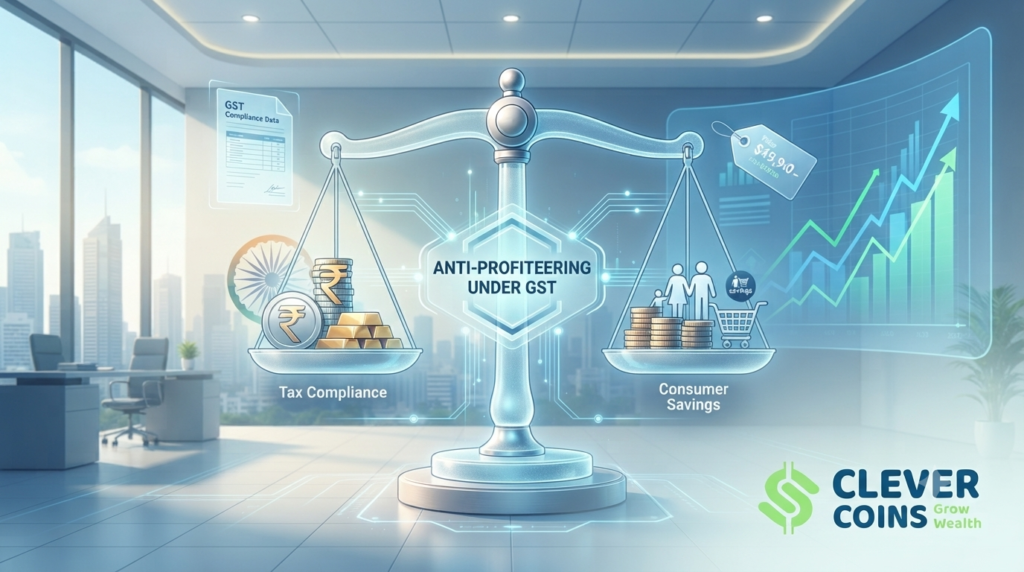
Comprehensive Guide: Anti-Profiteering Under GST in India
1. Introduction: The Vision of Tax Fairness
When the Goods and Services Tax (GST) was introduced in India on July 1, 2017, it was hailed as the most monumental tax reform in the nation’s history. The core promise of GST was simple yet transformative: “One Nation, One Tax, One Market.” By subsuming a web of cascading indirect taxes—such as central excise duty, service tax, value-added tax (VAT), and entry tax—GST aimed to eliminate the “tax-on-tax” phenomenon.
Under the old indirect tax regime, hidden cascading taxes inflated the cost of production. Under GST, seamless input tax credit (ITC) flows freely across the supply chain, significantly reducing the overall tax burden for manufacturers and service providers.
However, a fundamental economic question arose with this transition: Whose pocket does this tax saving actually go into?
If the government reduces the tax rate on a commodity from 28% to 18%, or if a business unlocks massive savings through Input Tax Credit, basic economic equity dictates that the economic benefit must be passed down to the ultimate consumer through lower maximum retail prices (MRP). If businesses pocket these reductions instead of transferring them, inflation remains unchecked, defeating the consumer welfare objective of the reform.
To prevent corporate profiteering at the expense of common citizens, the Indian legislature introduced a vital statutory safeguard: The Anti-Profiteering Provision under Section 171 of the Central Goods and Services Tax (CGST) Act, 2017.
As a business owner, tax professional, or consumer, understanding the scope, mechanism, and severe legal consequences of anti-profiteering regulations is crucial. Let us dive deep into the legal architecture, operational framework, landmark case laws, and compliance best practices surrounding Anti-Profiteering under GST.
2. Statutory Foundation: What is Section 171 of the CGST Act?
The legal bedrock of the anti-profiteering mechanism is enshrined compactly yet powerfully in Section 171 of the CGST Act, 2017.
The Exact Text of the Law
Section 171(1): “Any reduction in rate of tax on any supply of goods or services or the benefit of input tax credit shall be passed on to the recipient by way of commensurate reduction in prices.”
Let us break down this statutory mandate into actionable legal components:
Trigger Events: The provision activates under two distinct scenarios:
A formal reduction in the GST rate announced by the GST Council on specific goods or services.
The realization of structural benefits derived from Input Tax Credit (ITC) utilization, which lowers the cost of goods/services.
Mandatory Obligation: The business entity is legally barred from keeping the financial margin. The law uses the mandatory term “shall”, leaving no room for corporate discretion.
The Mechanism: The benefit must be passed on via a “commensurate reduction in prices” for the consumer purchasing that specific supply.
Supporting Rules: Rule 122 to 137 of CGST Rules, 2017
While Section 171 provides the substantive law, the procedural machinery is detailed under Chapter XVII (Rules 122 to 137) of the CGST Rules, 2017, which outline the establishment, powers, and operational workflow of the anti-profiteering investigation and adjudication machinery.
3. The Institutional Architecture: From NAA to CCI
Enforcing a complex anti-profiteering mandate requires a dedicated institutional framework. Over the years, India’s anti-profiteering apparatus has undergone structural evolution to streamline dispute resolution and enforcement.
A. The National Anti-Profiteering Authority (NAA)
Initially, the government established the National Anti-Profiteering Authority (NAA) as a statutory body under Rule 127. For over five years, the NAA served as the apex watchdog responsible for examining whether input tax credits availed by any registered person or the reduction in the tax rate had actually resulted in a commensurate reduction in the price of goods or services.
B. Transition to the Competition Commission of India (CCI)
With the evolving legal landscape and the expiration of the NAA’s initial tenure, the GST Council restructured the framework. Effective December 1, 2022, the statutory responsibility to handle anti-profiteering complaints was transferred to the Competition Commission of India (CCI), supported by the Directorate General of Anti-Profiteering (DGAP)—which was subsequently re-designated as the investigation arm under the CCI.
4. The Multitiered Investigation and Adjudication Process
How does an allegation of profiteering transform into a formal investigation and penalty? The process follows a strict judicial hierarchy designed to protect consumer rights while ensuring natural justice for businesses.
[Consumer / Welfare Association / Screening Committee]
                       │
                       ▼
         [State Level / Central Screening]
                       │
                       ▼
        [Standing Committee on Anti-Profiteering]
                       │
                       ▼
       [DGAP Investigation & Report Generation]
                       │
                       ▼
        [CCI Adjudication & Final Order]
Step 1: Filing a Complaint
A complaint can be initiated by:
An individual consumer who feels shortchanged.
Consumer welfare associations or trade bodies.
Suo motu (self-initiated) observations by tax authorities.
Applications are generally classified into two categories:
State-Level Screenings: For complaints of a local nature, handled by the State Level Screening Committee.
Central Screening Committee: For pan-India or multi-state operational entities.
Step 2: The Standing Committee Evaluation
If the screening committee finds a prima facie case of profiteering, the matter is referred to the Standing Committee on Anti-Profiteering. If the Standing Committee is satisfied that evidence warrants a detailed factual verification, it forwards the case to the investigative wing.
Step 3: DGAP Investigation
The Directorate General of Anti-Profiteering (DGAP) initiates a detailed forensic audit. They:
Issue notices to the accused business entity demanding invoices, financial statements, profit-and-loss accounts, pre-and-post GST rate structures, and ITC reconciliation data.
Calculate the exact profiteered amount by comparing profit margins before and after the tax rate reduction or ITC expansion.
Submit a comprehensive report back to the adjudicating authority (CCI).
Step 4: Final Hearing and Adjudication by the CCI
The CCI reviews the DGAP report, extends an opportunity for a personal hearing to the business entity, allows them to present defense arguments or counter-audits, and finally issues an official order.
5. How Is Profiteering Mathematically Calculated?
One of the most frequent challenges businesses face is the lack of a rigid formula defined explicitly inside the statute text. Because business models, costing sheets, and pricing strategies vary wildly across sectors (FMCG, real estate, pharmaceuticals, hospitality), the calculation relies on financial and cost-accounting principles.
The Core Comparative Principle
Profiteering is fundamentally calculated by evaluating whether the base price (price excluding tax) was unjustifiably inflated following a tax reduction or ITC benefit.
Basic Illustration:
Scenario A (Pre-Rate Cut):
Product Base Price: ₹100
GST Rate: 18% (₹18)
Consumer MRP: ₹118
Scenario B (Post-Rate Cut to 12%):
If the business keeps the base price frozen at ₹100, the new tax is 12% (₹12), making the new MRP ₹112. The consumer gets the exact benefit of the 6% rate reduction.
The Violation (Profiteering):
If the business maintains the final consumer price at ₹118 despite the tax dropping to 12%, the new base price secretly jumps to ₹105.36 ($118 / 1.12$).
The differential increase in base price (₹105.36 – ₹100 = ₹5.36 per unit) represents illegal profiteering that must be disgorged.
The Input Tax Credit (ITC) Matrix
In sectors like real estate, calculating anti-profiteering requires matching the “ITC benefit accrued” due to the removal of indirect taxes on raw materials (like cement, steel, and services) against the contractual prices charged to home buyers. If construction costs drop because builders can now claim credits they couldn’t under the legacy regime, those savings must translate into proportional price cuts or equivalent customized discounts for home buyers.
6. Landmark Case Laws and Judicial Precedents
Judicial interpretation has heavily shaped the scope and boundaries of anti-profiteering rules in India. Several landmark judgments from various High Courts and appellate authorities have clarified critical nuances of Section 171.
A. The Reckitt Benckiser Case & Constitutional Validity
Several major corporations challenged the constitutional validity of Section 171, arguing that the absence of a mathematical formula makes the provision arbitrary, violating Article 14 (Equality before law) and Article 19(1)(g) (Freedom to practice any profession or carry on any occupation) of the Constitution of India.
The Ruling: Various judicial bodies upheld the constitutional validity of anti-profiteering provisions, ruling that consumer protection during sweeping structural economic reforms supersedes absolute corporate pricing freedom. However, courts have repeatedly emphasized that investigations must rely on transparent, mathematically sound cost accounting rather than arbitrary guesswork.
B. Real Estate Sector Scrutiny (Builders and Developers)
The real estate sector faced massive scrutiny following GST council adjustments (such as reducing rates on affordable housing to 1% without ITC and residential housing to 5% without ITC).
Key Learnings: Real estate developers were penalized heavily in early rulings when they failed to pass on transition-period ITC benefits to flat buyers. Courts established that builders must maintain transparent project-wise ledger accounts proving that ITC gains were credited either via reduced installment demands or structural credit notes.
7. Penalties and Consequences of Non-Compliance
Failing an anti-profiteering investigation is not just a mild compliance hiccup; it attracts severe financial and legal repercussions.
Disgorgement of Profiteered Amount:
The primary order requires the business to return the illegally collected money.
If the exact consumer can be identified, the amount must be refunded directly to them with interest.
If the consumer cannot be traced, the amount must be deposited into the Consumer Welfare Fund (CWF) established under Section 57 of the CGST Act.
Interest Penalty:
Interest at the rate of 18% per annum is calculated from the date the higher amount was collected from the consumer until the date of actual deposit or refund.
Imposition of Monetary Penalties:
Under Section 125 (General Penalty) or specific penalty clauses introduced via amendments, a penalty equal to 10% of the profiteered amount can be levied.
Crucial Note: If the profiteered amount is not deposited within 30 days of the order, proceedings for the cancellation of GST registration can be initiated under Section 29.
8. Compliance Checklist for Businesses
To safeguard your enterprise from unexpected anti-profiteering notices, audits, and multi-lakh-rupee penalties, internal financial controls must be robust. Follow this strategic compliance checklist:
[ ] Maintain Detailed Costing Sheets: Document pre- and post-rate-change cost analyses for every SKU or service portfolio item.
[ ] Track ITC Reversals and Enhancements: Keep an accurate trail of how input tax credits impact your cost of goods sold (COGS) when transition rules or rate modifications occur.
[ ] Issue Transparent Price Adjustments: When a tax cut happens, immediately update ERP systems, billing software, and POS terminals to reflect the lower prices to end consumers.
[ ] Audit Marketing and Promotional Materials: Ensure MRP stickers, digital catalogs, and e-commerce listings are updated instantly to prevent misrepresentation.
[ ] Retain Audit Trails for 6+ Years: Preserve documentation proving that cost savings were genuinely passed down via reduced consumer bills or transparent discounts.
9. Conclusion: Ethical Commerce and Consumer Trust
Anti-Profiteering under GST is much more than a rigid bureaucratic obligation—it is a vital legislative bridge connecting systemic tax reform directly to the welfare of the common citizen. While navigating complex costing audits and tracking minute price adjustments demands meticulous attention from finance teams, compliance ensures long-term market reputation, corporate integrity, and insulation from severe legal penalties.
By maintaining total transparency in pricing frameworks and partnering with seasoned tax experts, businesses can thrive under the GST regime while honoring the foundational promise of economic fairness.
Phone: +91 77389 59862
Email: client@clevercoins.org
Address: Ideal Market, Mumbra, Thane-400612
Days
Hours
Minutes
Seconds
Related posts:
How to Read an Annual Report: A Complete Masterclass for Smart Investors and Business Leaders
GST
Comprehensive Guide to GST Audit by Tax Authorities: Process, Preparation, and Compliance
GST
GST on Food & Restaurants in India 2026
GST
GST on Financial Services: The Definitive Guide to Compliance, Rates, and Input Tax Credit
GST
Joint Development Agreement & RERA: The Ultimate Legal, Financial, and Compliance Masterclass
GST
What is Futures & Options (F&O) Trading? A Complete Guide to Derivative Markets
GST
The Ultimate Guide to Systematic Transfer Plan (STP): Master Your Wealth Growth
GST
Introduction: The Recurring Revenue Boom and Indirect Taxation
GST
UNION BUDGET 2026
GST
GST Registration in India 2026: Eligibility, Documents Required, Process & Benefits Explained
GST