Comprehensive Guide to GST on Entertainment & Events: Slabs, Rules, and Compliance
The entertainment and events industry is one of the most vibrant sectors, driving massive economic growth, cultural expression, and community engagement. From local theater productions and live musical gigs to blockbuster movie releases and high-profile sporting fixtures, entertainment brings people together. However, navigating the fiscal architecture governing this sector requires careful attention, particularly following the rollout and subsequent evolution of the Goods and Services Tax (GST) regime.
Before the implementation of GST, India’s entertainment landscape was heavily fragmented. Multiple state-level entertainment taxes, local body levies, and service taxes created a labyrinth of compliance hurdles. The introduction of GST aimed to unify these taxes into a single, structured system.
This comprehensive guide explores everything event organizers, venue owners, service providers, and consumers need to know about GST on entertainment and events, including tax slabs, input tax credits, ticket pricing structures, and compliance mandates.
1. The Evolution of Taxation on Entertainment: Pre-GST vs. Post-GST
Historically, entertainment taxes were levied by state governments under Entry 62 of the State List of the Indian Constitution, while service tax was levied by the Centre. This duality resulted in:
Cascading Tax Effects: Taxes were levied on top of taxes, inflating the final cost of event tickets.
Compliance Complexity: Organizers hosting multi-state tours had to register and comply with distinct tax laws, tax rates, and filing formats across every state.
Lack of Uniformity: A movie ticket or amusement park entry priced similarly could attract drastically different tax rates depending on the state boundaries.
Under the unified GST framework, most state-level entertainment taxes were subsumed, though certain local municipal bodies still retain powers to levy specific local amusements or entertainment taxes over and above GST in select states. Overall, the framework has streamlined interstate commerce, digital ticketing, and event production services.
2. Breaking Down GST Rates on Entertainment & Events
The GST Council categorizes entertainment and recreational services across distinct tax slabs depending on the nature of the activity, the cost of admission, and the commercial scale of the event.
A. Cinema and Movie Tickets
Cinemas represent a massive chunk of the entertainment economy. The GST rate applied to movie tickets is directly indexed to the face value of the ticket:
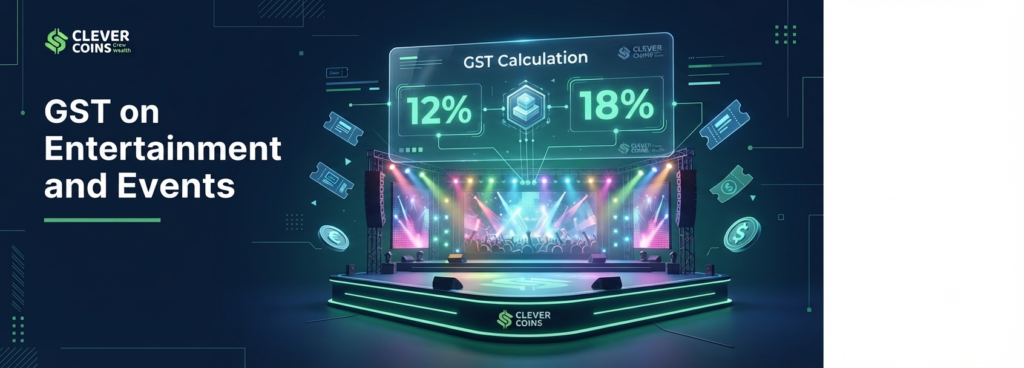
Tickets priced up to ₹100: Attract a lower GST rate of 12%, designed to keep regional and budget-friendly cinema accessible to lower-income groups.
Tickets priced above ₹100: Attract a standard GST rate of 18%.
B. Live Concerts, Theatrical Performances, and Cultural Events
Live events—including music concerts, stand-up comedy shows, dance performances, and theatrical plays—generally attract an 18% GST rate when organized as commercial services. However, exemptions or lower thresholds apply if the performance is organized by specified cultural bodies or charitable trusts promoting classical arts, subject to specific turnover limits and registration statuses.
C. Sporting Events
Sporting events have a nuanced tax architecture:
Grassroots and Recognized Sporting Events: Tickets priced up to ₹500 for recognized sporting events are completely exempt from GST, promoting sports participation and accessibility.
Standard Priced Tickets: Tickets priced above ₹500 for recognized events attract an 18% GST rate.
Premium Commercial Sporting Events: High-profile commercial tournaments, such as the Indian Premier League (IPL) and other luxury entertainment sports variants, attract a higher levy structure (including specialized luxury slabs up to 40% on premium hospitality and high-end tickets) to curb conspicuous consumption and generate higher public revenue.
D. Amusement Parks, Water Parks, and Theme Parks
Entry tickets and rides at amusement parks, theme parks, and joy-rides generally attract an 18% GST rate. The availability of Input Tax Credit (ITC) on capital goods and maintenance infrastructure helps operators offset a portion of their massive infrastructure expenditure.
E. Online Gaming, Betting, and Casinos
Activities involving high-risk staking, gambling, casinos, and specified online gaming platforms attract the peak GST rate of 28% on the full face value or gross gaming revenue, depending on recent statutory amendments.
3. Event Management and Support Services
Hosting a successful corporate event, wedding, product launch, or music festival involves hiring various independent vendors, including event management companies, decorators, caterers, sound and light rental agencies, and security contractors.
Event Management Services: Professional event planners and management agencies charge an 18% GST on their overall service fees (SAC code usually falling under 9996 or 9985).
Hotel and Banquet Spaces: Renting hotel banquet halls or open lawns for events attracts GST based on room tariffs or composite service packages. If catering and food services are bundled with hall rentals, the tax rate aligns with composite supply rules, typically standing at 18%.
Advertising and Sponsorship: Corporate sponsorships, brand placements, and promotional advertising associated with events attract an 18% GST rate.
4. The Power of Input Tax Credit (ITC) for Event Organizers
One of the biggest advantages of the GST regime for commercial event planners is the seamless flow of Input Tax Credit (ITC).
When an event organizer pays GST to various vendors (such as sound system renters, digital marketers, stage designers, and venue owners), they can claim credit for this tax against the output GST collected from ticket sales or corporate client billing.
Key Conditions for Claiming ITC:
Mandatory Registration: The event organizer must be registered under GST.
Tax Invoices: Valid tax invoices containing the vendor’s GSTIN, recipient details, and clear tax breakdowns must be archived.
GSTR-2B Matching: The credit claimed must reflect accurately in the auto-populated GSTR-2B statement matching supplier filings.
B2B vs. B2C Distinction: For Business-to-Consumer (B2C) ticket sales (like public concerts), issuing individual tax invoices to every attendee is not mandatory, but aggregate summary reporting must be managed cleanly in GSTR-1.
5. Challenges and Compliance Roadblocks in the Entertainment Sector
Despite digitization, event organizers face unique compliance bottlenecks:
Multiple State Registrations (POS Rules): If a live entertainment company hosts events across five different states, determining the Place of Supply (POS) is crucial. Under GST, services directly relating to an event or immovable property have specific POS rules, often requiring casual taxable person registrations in states where temporary events are hosted.
Ticketing Aggregators and TCS/TCS Compliance: Online booking platforms acting as electronic commerce operators must collect Tax Collected at Source (TCS) where applicable, altering cash flows for independent ticket vendors.
Complimentary Passes and Freebies: Distributing free VIP tickets or complimentary passes to influencers and sponsors can trigger tax implications under Section 17(5) or valuation rules regarding gifts and supplies made without consideration.
6. Best Practices for Event Organizers and Entertainment Businesses
To stay clear of audits, penalties, and tax shortfalls, businesses in the entertainment and events ecosystem should implement these internal controls:
Automate Billing Systems: Integrate modern POS software and enterprise resource planning (ERP) tools that dynamically apply correct GST rates based on ticket price brackets (e.g., separating tickets above and below ₹100 or ₹500).
Maintain Robust Digital Trails: Archive contracts, vendor invoices, sponsorship agreements, and electronic ticketing logs securely for the mandatory statutory period (usually 6 years from the annual return due date).
Audit Vendor Compliance: Regularly verify that hired subcontractors and technical partners are filing their GSTR-1 and GSTR-3B returns on time. A default by a major staging vendor can block your ITC claims.
Consult Indirect Tax Professionals: Due to frequent amendments by the GST Council regarding ticket thresholds, online gaming classifications, and sporting event slabs, retaining an indirect tax expert ensures proactive adaptation.
Conclusion
The taxation of entertainment and events under GST has transformed from a chaotic multi-layered structure into a streamlined, tech-enabled framework. While tax rates ranging from 12% to 28% (and specialized slabs for luxury sports) require careful financial modeling, the availability of Input Tax Credit empowers businesses to optimize their operating expenditures. By prioritizing rigorous compliance, clear ticketing architecture, and automated tax accounting, event planners can focus on what they do best: creating unforgettable experiences for
- Phone: +91 77389 59862
- Email: client@clevercoins.org
- Address: Ideal Market, Mumbra, Thane-400612