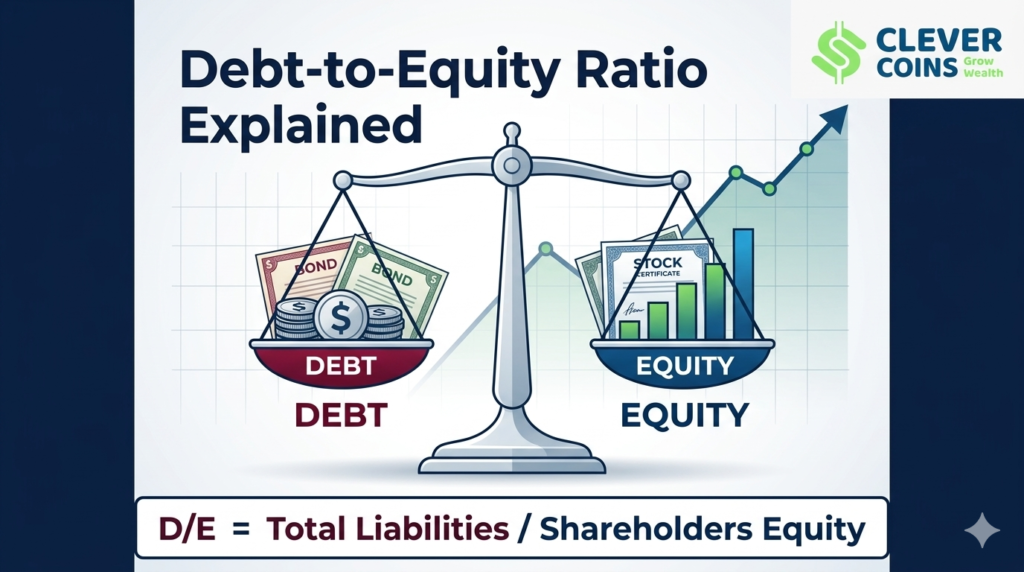
When evaluating a company’s financial health, one of the most important metrics investors, analysts, and creditors look at is the Debt-to-Equity (D/E) Ratio. This single number can reveal a tremendous amount about how a company finances its operations — and whether it’s taking on too much risk.
Whether you’re a seasoned investor, a business owner, a finance student, or simply someone curious about how companies manage their money, understanding the debt-to-equity ratio is essential. In this comprehensive guide, we’ll break down everything you need to know — from the basic definition and formula to real-world applications, industry benchmarks, common mistakes, and much more.
What Is the Debt-to-Equity Ratio?
The Debt-to-Equity Ratio (D/E Ratio) is a financial leverage metric that compares a company’s total liabilities (debt) to its shareholders’ equity. It measures the proportion of financing that comes from creditors versus owners.
In simple terms: How much debt does a company carry for every rupee (or dollar) of equity owned by shareholders?
A high D/E ratio indicates that a company relies heavily on borrowed money to finance its activities, while a low D/E ratio suggests that the company is primarily funded by shareholder equity.
Key Takeaway
- It is a leverage ratio — part of a broader family of financial ratios
- It reflects capital structure decisions made by management
- It helps assess financial risk and stability
- It is used by investors, lenders, and analysts worldwide
The Debt-to-Equity Ratio Formula
The formula is straightforward:
D/E Ratio = Total Liabilities / Shareholders’ Equity
OR, in a more granular version:
D/E Ratio = (Short-term Debt + Long-term Debt + Other Fixed Payments) / Shareholders’ Equity
Components Explained
Total Liabilities: All financial obligations a company owes — including short-term debt (credit lines, current portion of long-term debt), long-term debt (bonds, mortgages), and other fixed obligations.
Shareholders’ Equity: The residual interest in assets after subtracting liabilities. It includes common stock, retained earnings, additional paid-in capital, and treasury stock adjustments.
How to Calculate the Debt-to-Equity Ratio — Step by Step
Step 1: Find Total Liabilities
Locate the balance sheet in the company’s annual report or financial statements. Look for the line item ‘Total Liabilities’. This is typically composed of:
- Accounts payable
- Short-term borrowings
- Current portion of long-term debt
- Long-term debt
- Deferred tax liabilities
- Other obligations
Step 2: Find Shareholders’ Equity
On the same balance sheet, find ‘Total Shareholders’ Equity’ or ‘Stockholders’ Equity’. This includes:
- Common stock par value
- Additional paid-in capital (APIC)
- Retained earnings (or accumulated deficit)
- Accumulated other comprehensive income/loss
- Less: Treasury stock (if any)
Step 3: Divide
Divide the total liabilities by the total shareholders’ equity. The result is your D/E ratio.
Practical Example
Balance Sheet Item | Amount (in Crores INR) |
Total Liabilities | Rs. 500 Cr |
Shareholders’ Equity | Rs. 250 Cr |
D/E Ratio | 500 / 250 = 2.0 |
This means that for every Rs. 1 of equity, the company has Rs. 2 of debt — a ratio of 2:1.
How to Interpret the Debt-to-Equity Ratio
Interpretation depends on several factors including the industry, economic cycle, business model, and the company’s growth stage. Here’s a general framework:
D/E Ratio Range | Signal | What It Means |
Below 0.5 | Very Low Risk | Company is nearly debt-free. Very conservative financing. May indicate missed growth opportunities. |
0.5 – 1.0 | Low Risk | Balanced financing. Company uses moderate debt. Generally considered healthy. |
1.0 – 2.0 | Moderate Risk | Company uses more debt than equity. Acceptable in many industries. Requires monitoring. |
Above 2.0 | High Risk | Heavily leveraged. Vulnerable to economic downturns. May struggle to service debt. |
Negative | Danger Zone | Negative equity — liabilities exceed assets. Company may be insolvent. |
Industry-Wise D/E Ratio Benchmarks
One of the most important rules when using the D/E ratio is: always compare within the same industry. Different sectors naturally operate at different leverage levels due to their business models, asset requirements, and cash flow patterns.
Industry / Sector | Typical D/E Range | Why? |
Banking & Financial Services | 5x – 20x+ | High leverage by nature; regulated capital structure |
Utilities | 1.5x – 3x | Stable cash flows support higher debt loads |
Real Estate / REITs | 1x – 2.5x | Capital-intensive assets financed by debt |
Technology (IT) | 0.1x – 0.8x | High cash generation, low physical asset needs |
Manufacturing | 0.5x – 1.5x | Moderate capital requirements |
Retail | 0.5x – 2x | Varies based on inventory financing strategies |
Pharmaceuticals | 0.2x – 1x | R&D driven; cautious debt use |
Telecom | 1x – 3x | Infrastructure investments financed by debt |
Oil & Gas | 0.5x – 2x | High capex offset by commodity revenue |
Consumer Goods / FMCG | 0.3x – 1x | Brand-driven, strong cash flows, low leverage |
Debt-to-Equity Ratio vs. Other Financial Ratios
While the D/E ratio is powerful, it works best when used in conjunction with other metrics. Here’s how it compares to related financial ratios:
Debt Ratio: Total Liabilities / Total Assets. While D/E compares debt to equity, the Debt Ratio compares debt to total assets. Gives a broader picture of leverage.
Interest Coverage Ratio: EBIT / Interest Expense. Tells you how easily a company can pay its interest obligations. A complement to D/E — high D/E + low interest coverage = danger.
Equity Multiplier: Total Assets / Total Equity. Closely related to D/E and used in the DuPont Analysis framework.
Current Ratio: Current Assets / Current Liabilities. Measures short-term liquidity. High D/E with a low current ratio signals immediate financial stress.
DSCR (Debt Service Coverage Ratio): Net Operating Income / Total Debt Service. Widely used by lenders to assess repayment capacity.
What Causes a High Debt-to-Equity Ratio?
A rising D/E ratio can result from multiple business scenarios — not all necessarily negative:
- Aggressive expansion funded by borrowing
- Acquisition of another company financed by debt
- Decline in profitability reducing retained earnings
- Share buybacks reducing shareholders’ equity
- Economic downturn causing accumulated losses
- Industry norms requiring heavy capital investment
- Strategic use of financial leverage to amplify returns (ROE)
What Causes a Low Debt-to-Equity Ratio?
- Strong profitability and high retained earnings
- Conservative management philosophy
- Asset-light business model
- Recent equity issuance (IPO, follow-on offering)
- Debt repayment over time
- Negative goodwill or strong intangible asset monetization
Advantages of Using the Debt-to-Equity Ratio
- Simple and quick to calculate using publicly available data
- Offers insight into financial risk and leverage
- Useful for comparing companies within the same industry
- Helps lenders assess creditworthiness
- Tracks changes in capital structure over time
- Integrated easily into broader financial models (DuPont, DCF)
- Universally used across markets globally — from NSE/BSE to NYSE/NASDAQ
Limitations and Pitfalls of the Debt-to-Equity Ratio
As useful as it is, the D/E ratio has several important limitations that every analyst should understand:
Limitation 1: Not comparable across industries: A D/E of 3.0 is perfectly normal for a bank but alarming for a software company.
Limitation 2: Doesn’t consider off-balance-sheet liabilities: Operating leases (before IFRS 16/ASC 842) and other contingent liabilities may be excluded.
Limitation 3: Book value vs. market value mismatch: The ratio uses book value of equity, which may differ significantly from market capitalization.
Limitation 4: Ignores profitability and cash flow: A company can have high D/E but excellent cash flows to service that debt — or vice versa.
Limitation 5: Static snapshot: A balance sheet captures one moment in time. The ratio can change dramatically quarter to quarter.
Limitation 6: Negative equity distortions: If equity is negative, the D/E ratio becomes meaningless or misleading.
Limitation 7: Accounting method differences: Different depreciation methods, capitalization policies, and GAAP vs IFRS standards can affect both components.
How Investors Use the Debt-to-Equity Ratio
For retail and institutional investors alike, the D/E ratio serves multiple purposes:
- Stock Screening: Many investors filter stocks based on D/E thresholds. For example, Warren Buffett is famously known to prefer companies with low debt.
- Risk Assessment: Before investing, checking whether a company’s debt is sustainable under different economic scenarios.
- Sector Comparison: Ranking companies within an industry based on their leverage profile.
- Credit Analysis: Bond investors use D/E to assess default risk and the likelihood of coupon payments being met.
- M&A Due Diligence: Understanding the target company’s leverage before an acquisition is critical for deal valuation and financing structure.
- Trend Analysis: Watching the D/E ratio over multiple quarters or years reveals management’s financial philosophy.
Real-World Examples of Debt-to-Equity Ratios
Example 1: Technology Company (Low D/E)
A leading Indian IT services firm may have total liabilities of Rs. 2,000 Cr and shareholders’ equity of Rs. 20,000 Cr, giving a D/E of just 0.1. This reflects the asset-light nature of software businesses.
Example 2: Public Sector Bank (Very High D/E)
A large public sector bank may have total liabilities of Rs. 10,00,000 Cr (primarily deposits, which are liabilities) and equity of Rs. 80,000 Cr, giving a D/E of 12.5. This is normal for banking due to the nature of their business model.
Example 3: Infrastructure Company (High but Justified D/E)
A major roads or ports infrastructure company may report D/E of 3–5x due to project-based debt financing. These companies often have long-term concession revenues that justify the leverage.
Example 4: FMCG Company (Ideal D/E)
A large consumer goods company with a strong brand and consistent cash flows may maintain D/E below 0.5, reflecting prudent financial management and strong equity accumulation through retained earnings.
Debt-to-Equity Ratio in the Context of ROE — The DuPont Framework
The DuPont Analysis decomposes Return on Equity (ROE) into three components:
ROE = Net Profit Margin x Asset Turnover x Equity Multiplier
The Equity Multiplier is directly related to D/E:
Equity Multiplier = 1 + D/E Ratio
This shows that a higher D/E ratio amplifies ROE — which can be good when profits are growing but dangerous when business declines. This is the essence of financial leverage.
Good vs. Bad Debt: Qualitative Analysis Beyond the Number
Not all debt is equal. Before judging a company’s D/E ratio, consider the nature of its debt:
Good Debt Characteristics: Fixed interest rates; Long-term maturity; Tied to income-generating assets; Used for expansion in growing markets; Covered by strong operating cash flows
Bad Debt Characteristics: Floating rates in rising interest environments; Short-term maturity pressure; Used for operational cash shortfalls; Covenant-heavy with restrictive terms; Concentrated in one lender
How Lenders and Creditors Use the D/E Ratio
Banks and financial institutions examine D/E ratios as part of credit appraisal:
- Sets maximum acceptable D/E thresholds for loan eligibility
- Higher D/E may result in higher interest rates (risk premium)
- Used in debt covenants — if D/E exceeds a limit, the borrower may face penalties or accelerated repayment
- Informs decisions on secured vs. unsecured lending
- Factored into credit ratings assigned by agencies like CRISIL, ICRA, Moody’s, S&P
D/E Ratio for Startups vs. Established Companies
Startups: Often have negative or extremely high D/E ratios early on as they raise debt before generating profits. VC-backed startups may have equity-heavy structures initially.
Growth-stage companies: May temporarily increase D/E to fund rapid expansion — investor scrutiny focuses on whether the growth justifies the leverage.
Mature companies: Expected to maintain stable, moderate D/E ratios. Sudden spikes often signal acquisition activity or financial distress.
Declining companies: D/E may rise as equity erodes due to losses, even without additional borrowing — a red flag investors should monitor.
Tax Implications of High vs. Low D/E Ratio
Debt financing has an interesting tax advantage over equity financing:
- Interest on debt is tax-deductible, reducing a company’s taxable income
- This is known as the ‘Interest Tax Shield’ — a key concept in corporate finance
- Companies may deliberately use higher debt to reduce their tax burden (within limits)
- This trade-off between tax benefits and financial risk is central to the ‘Trade-off Theory of Capital Structure’
Formula: Interest Tax Shield = Interest Expense x Tax Rate. Example: If interest = Rs. 100 Cr and tax rate = 30%, the tax shield = Rs. 30 Cr.
Global Perspective: D/E Norms Across Markets
India (NSE/BSE): SEBI and RBI guidelines set sector-specific leverage norms. PSU banks and NBFCs are regulated differently.
USA (NYSE/NASDAQ): US GAAP reporting; tech giants often have near-zero debt while utilities and banks carry high leverage.
Europe: IFRS standards; European companies in automotive and energy often maintain moderate D/E ratios.
Japan: Japanese companies historically carried very high D/E ratios due to the keiretsu banking relationships; modern norms have shifted toward lower leverage.
Common Mistakes Investors Make with D/E Ratio
- Comparing D/E ratios across different industries
- Ignoring off-balance-sheet liabilities
- Using it in isolation without checking cash flow coverage
- Not adjusting for accounting differences (GAAP vs. IFRS)
- Treating all debt equally — ignoring maturity profiles
- Overlooking the impact of goodwill and intangibles on equity
- Ignoring seasonal fluctuations in debt levels
How Companies Can Improve Their D/E Ratio
- Retain earnings instead of paying dividends
- Issue new equity (rights issue, follow-on public offer)
- Retire debt through cash generation
- Restructure debt — extend maturities to reduce near-term pressure
- Sell non-core assets and use proceeds to repay debt
- Improve operational efficiency to boost profitability and retained earnings
Debt-to-Equity Ratio in Financial Modeling
The D/E ratio plays a critical role in several financial models:
Discounted Cash Flow (DCF): Optimal capital structure (target D/E) is used to derive the WACC (Weighted Average Cost of Capital), which discounts future cash flows.
Leveraged Buyout (LBO) Models: Private equity firms intentionally use high D/E ratios in LBOs to amplify returns — targeting D/E of 4x–6x or more.
Credit Models: Rating agencies and banks use D/E as a key input in probability of default models.
Comparable Company Analysis (Comps): D/E is used to normalize financial comparisons across peer groups.
Frequently Asked Questions (FAQs)
Q1: What is a good debt-to-equity ratio?:
Generally, a D/E ratio below 1.0 is considered conservative and healthy. However, this varies by industry. Banks can have D/E ratios of 10–20x and still be considered sound.
Q2: Can D/E ratio be negative?:
Yes. If a company has negative shareholders’ equity (accumulated losses exceeding paid-in capital), the D/E ratio becomes negative. This is a serious red flag.
Q3: Is a higher or lower D/E ratio better?:
It depends. A lower ratio means less risk and more financial stability. A higher ratio can mean higher potential returns (leverage effect) but also higher risk.
Q4: How often should investors check D/E ratio?:
At minimum, check quarterly (with each balance sheet release). Track the trend over 3–5 years for meaningful analysis.
Q5: Does the D/E ratio affect stock price?:
Indirectly, yes. A rising D/E ratio can signal financial stress, which may cause investors to sell shares. Rating downgrades triggered by high D/E can increase borrowing costs, squeezing profits.
Q6: How is D/E different from debt ratio?:
Debt Ratio = Total Liabilities / Total Assets, while D/E = Total Liabilities / Equity. Both measure leverage but from different angles.
Q7: What is a ‘safe’ D/E ratio for home loan applicants?:
For individuals, lenders typically prefer a debt-to-income ratio below 40–50%. For businesses, it depends on the type of loan and sector.
Conclusion
The Debt-to-Equity Ratio is one of the most fundamental and widely used financial metrics in the world of investing, lending, and corporate finance. It provides a clear window into how a company balances its use of debt and equity to fund its operations and growth.
However, like all financial ratios, it should never be used in isolation. The D/E ratio is most powerful when:
- Compared to industry peers
- Analyzed alongside profitability, liquidity, and cash flow metrics
- Tracked as a trend over multiple periods
- Adjusted for off-balance-sheet items and accounting policy differences
Whether you’re an investor evaluating a stock, a banker assessing a loan, or a business owner managing your finances, the debt-to-equity ratio is an indispensable tool in your financial toolkit.
Remember: The best capital structure is not about having zero debt — it’s about having the right amount of debt that your business can comfortably manage while maximizing value for shareholders.