Decoding GST on Del-Credere Agents (DCAs): The Ultimate Compliance and Legal Framework
Navigating the labyrinth of Indian Indirect Taxation requires more than just a surface-level understanding of standard supply chains. In modern commerce, manufacturers and principal suppliers frequently rely on specialized intermediaries to expand their market footprint, mitigate credit risks, and accelerate cash flow. Among these intermediaries, the Del-Credere Agent (DCA) occupies a unique, highly strategic position.
However, because a DCA bridges the gap between sales execution, financial guarantees, and potential short-term credit extension, their tax treatment under the Goods and Services Tax (GST) regime is uniquely intricate. Misinterpreting these rules can trigger severe tax liabilities, interest penalties, and litigation.
Brought to you by the tax engineering and compliance experts at CleverCoins, this exhaustive guide breaks down every legal nuance, circular clarification, valuation mechanism, and registration mandate associated with GST on Del-Credere Agents.
1. Defining the Core: Who is a Del-Credere Agent (DCA)?
To understand the taxation mechanics, we must first establish the legal identity of a DCA. Under Section 2(5) of the Central Goods and Services Tax (CGST) Act, 2017, an “agent” is defined broadly to include a factor, broker, commission agent, arhatia, an auctioneer, or any other mercantile agent—by whatever name called—who carries on the business of supply or receipt of goods or services on behalf of another.
A Del-Credere Agent, specifically, is a distinctive type of mercantile agent. In addition to negotiating sales and procuring orders on behalf of the principal supplier, a DCA provides a financial guarantee to the principal that the buyer will pay for the goods or services.
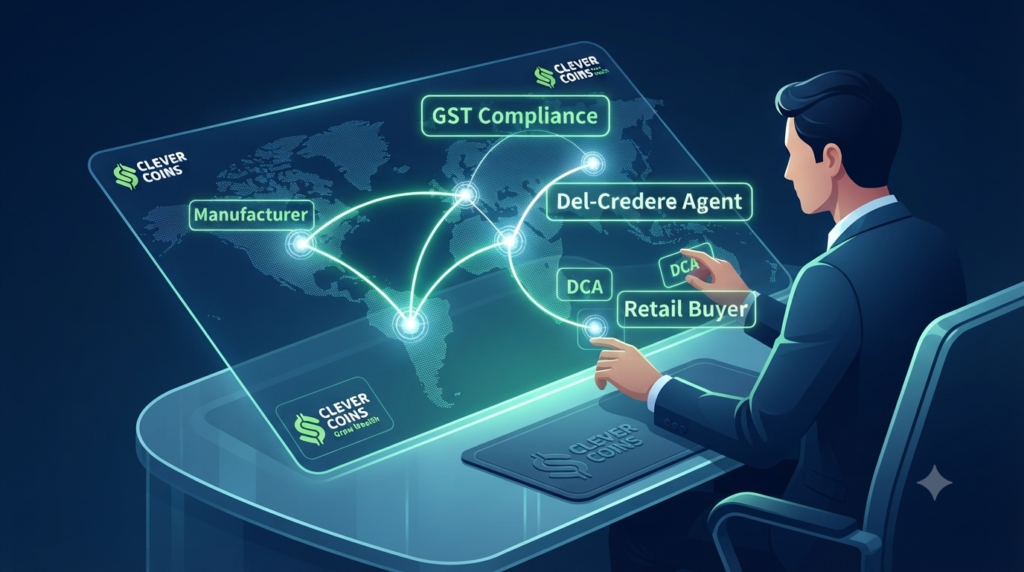
The Tripartite Commercial Dynamic
The Principal (Supplier): The manufacturer or primary owner of goods looking to sell products safely across domestic or regional markets.
The Del-Credere Agent (DCA): The intermediary who markets the goods, guarantees buyer solvency, and assumes the risk of default.
Rajput Jain & AssociatesThe Recipient (Buyer): The end customer or retailer acquiring the goods, often requiring short-term credit lines or deferred payment structures.
Goods and service tax | latest tax updates | latest updates of gst …
Because the DCA guarantees payment, they shoulder a higher degree of commercial risk. Consequently, they command a higher commission rate (known as Del-Credere commission) compared to standard brokers.
2. The Crucial Legal Turning Point: Invoice Trail & Schedule I Analysis
The applicability of GST on transactions involving a DCA hinges fundamentally on how the invoice is raised. The Central Board of Indirect Taxes and Customs (CBIC), via Circular No. 73/47/2018-GST, clarified the exact scope of the principal-agent relationship under Schedule I of the CGST Act.
Depending on documentation trails, a DCA can operate in one of two distinct legal capacities:
Scenario A: DCA is NOT an Agent under Schedule I (Independent Intermediary)
The Mechanics: The invoice for the supply of goods is issued directly by the principal supplier to the customer (buyer), even if routed or facilitated through the DCA. The DCA does not issue invoices for the goods in their own name.
Goods and service tax | latest tax updates | latest updates of gst …+ 1Tax Implication: The DCA acts merely as an agent facilitating a service. The commission charged by the DCA to the principal is treated as a supply of service taxable at 18% GST under standard SAC codes.
OnlineTaxUpdate
Scenario B: DCA IS an Agent under Schedule I (Principal-to-Third-Party Model)
The Mechanics: The invoice for the supply of goods is issued by the DCA in their own name to the recipient.
Goods and service tax | latest tax updates | latest updates of gst …Tax Implication: Under Schedule I (Para 3) of the CGST Act, the supply of goods by the principal to the DCA (without consideration) and the subsequent supply by the DCA to the end consumer are treated as taxable supplies. Here, the DCA becomes an active participant in the chain of supply, requiring careful valuation tracking.
fintaxadvice
3. Mandatory GST Registration Rules for Agents
Under standard GST provisions, suppliers enjoy a threshold exemption limit (typically ₹20 Lakhs or ₹10 Lakhs depending on the state/nature of supply). However, agents operate under strict statutory overrides.
Pursuant to Section 24(vii) of the CGST Act, 2017, persons who make taxable supplies of goods or services on behalf of other taxable persons (whether as an agent or otherwise) are subject to compulsory registration, irrespective of their aggregate turnover.
The Core Mandate: If you act as a commission agent or DCA making taxable supplies on behalf of a principal, you must obtain a GST registration from day one. Threshold limits do not apply.
OnlineTaxUpdateCompliance Burden: Registered DCAs must file regular monthly/quarterly returns, including GSTR-1 (outward supplies) and GSTR-3B (summary return), alongside annual compliance filings like GSTR-9.
OnlineTaxUpdate
4. Taxation of Del-Credere Commission
The remuneration received by a DCA for rendering agency services and taking on default risk is termed commission.
Tax Rate: Agency and brokerage services generally attract a standard GST rate of 18% (9% CGST + 9% SGST for intra-state supplies, or 18% IGST for inter-state supplies).
OnlineTaxUpdateTime of Supply: The GST on the commission must be paid based on the time of supply rules—typically when the invoice is issued by the DCA to the principal or when the payment for the commission is entered into the books, whichever is earlier.
Input Tax Credit (ITC): The principal supplier paying the 18% GST on the DCA’s commission invoice is generally eligible to claim ITC, provided the underlying supply of goods or services is a taxable outbound supply in the course of business.
5. The Complex Interplay: GST on Interest Charged by DCAs
One of the most litigated aspects of DCA operations revolves around short-term financing and interest charges.
Often, when a buyer fails to pay the principal on time, or requests deferred payment terms, the DCA steps in. The DCA pays the principal on behalf of the buyer (honoring the del-credere guarantee) and subsequently extends a short-term credit line or loan to the buyer, charging interest for the delayed settlement period.
How is this interest taxed? The answer depends entirely on the legal classification established earlier:
Case 1: When DCA is NOT an Agent (Independent Transaction)
If the DCA is not categorized as an agent under Schedule I (i.e., invoices are raised directly by the principal), the short-term financing provided by the DCA is treated as an independent supply of financial service.
Goods and service tax | latest tax updates | latest updates of gst …Exemption Application: According to Entry No. 27 of Notification No. 12/2017-Central Tax (Rate), services by way of extending deposits, loans, or advances where the consideration is represented by way of interest or discount are exempt from GST.
Rajput Jain & AssociatesRuling Precedents: Advance Ruling authorities (such as in the landmark Gujarat AAR case of Shreenath Polyplast Pvt. Ltd.) have consistently affirmed that interest charged by a DCA for a transaction-based short-term loan extended to the buyer is separate from the supply of goods and remains exempt from GST.
Rajput Jain & Associates
Case 2: When DCA IS an Agent under Schedule I (Subsumed Value)
If the DCA acts as an agent under Schedule I and issues invoices in their own name, the credit extension does not retain its character as an independent service.
Goods and service tax | latest tax updates | latest updates of gst …Tax Implication: Any interest or late fee charged to the buyer gets subsumed into the total value of the supply of goods. Consequently, it forms part of the composite value and is taxed at the applicable GST rate of the underlying goods.
Goods and service tax | latest tax updates | latest updates of gst …
6. Valuation Challenges under GST for DCAs
Determining the taxable value of goods supplied through a DCA requires careful calculation, particularly when secondary supplies or open market valuations are triggered.
According to the GST Valuation Rules, when goods are supplied through an agent who issues invoices in their own name, the value of the supply is not merely the invoice price. The principal’s taxable value can be determined using:
The open market value of the goods being supplied.
fintaxadviceAlternatively, 90% of the price charged by the DCA for goods of like kind and quality supplied to their independent customers.
Proper documentation prevents double taxation and ensures that pure agent reimbursements (if any) are legally segregated from the primary consideration pool.
7. Strategic Compliance Checklist for Businesses & DCAs
To safeguard your business from sudden audits, mismatches, and avoidable tax liabilities, follow this strategic roadmap curated by CleverCoins:
[ ] Review Agency Agreements: Audit all contracts between principals and agents to explicitly define whether the DCA operates as a Schedule I agent or a pure intermediary.
Goods and service tax | latest tax updates | latest updates of gst …[ ] Monitor Invoice Flows: Ensure that invoicing trails strictly match the intended contractual structure. Misaligned invoicing can accidentally trigger compulsory agent provisions.
OnlineTaxUpdate[ ] Mandatory Registration Check: Verify that all DCAs register under GST immediately, ignoring standard turnover thresholds.
OnlineTaxUpdate[ ] Isolate Financial Intermediation: If interest is charged on short-term credit lines by non-agent DCAs, ensure proper documentation is maintained to claim the exemption under Notification No. 12/2017-CT(Rate).
Rajput Jain & Associates[ ] Reconcile GSTR-2B and GSTR-3B: Ensure seamless flow of Input Tax Credit on commission payments to optimize cash flow.
Conclusion: Streamline Your Tax Operations with CleverCoins
The operational framework governing Del-Credere Agents under GST is a delicate balancing act of contract law, valuation rules, and specific circular clarifications. A minor misstep in invoice formatting or credit interest accounting can lead to prolonged disputes with tax authorities.
At CleverCoins, we transform complex tax codes into strategic advantages for your bottom line. Whether you are a manufacturer scaling your distribution network or a DCA optimizing your financial workflows, our experts deliver comprehensive compliance support tailored to your enterprise.
Stop reacting to compliance friction—let CleverCoins secure your financial future today.
Contact CleverCoins:
Email:
client@clevercoins.orgCleverCoinsWebsite: clevercoins.org
CleverCoins