Mastering the Invoice Management System (IMS) on the GST Portal: The Ultimate Business Guide
Introduction: The Evolution of GST Compliance in India
The Goods and Services Tax (GST) framework in India has undergone continuous technological and procedural evolution since its inception. From the early days of manual GSTR-1 and GSTR-3B matching to the introduction of automated Invoice Furnishing Facilities (IFF) and the Electronic Way (E-Way) Bill systems, the objective has always been clear: transparency, seamless data flow, and minimization of tax evasion.
Despite these advancements, one persistent challenge faced by businesses of all sizes has been the reconciliation of Input Tax Credit (ITC). Mismatches between auto-populated GSTR-2B statements and purchase registers often led to compliance bottlenecks, notices from tax authorities, and delayed working capital cycles.
To bridge this crucial gap, the Goods and Services Tax Network (GSTN) introduced a game-changing feature: the Invoice Management System (IMS).
Integrated directly into the GST portal, the Invoice Management System is designed to reshape how taxpayers interact with incoming supplies, accept or reject invoices, and communicate actions back to their suppliers in real-time. Brought to you by the tax advisory experts at Clever Coins, this comprehensive guide explores every facet of the GST IMS, explaining how businesses can leverage it to turn regulatory compliance into a distinct strategic advantage.
What is the Invoice Management System (IMS) on the GST Portal?
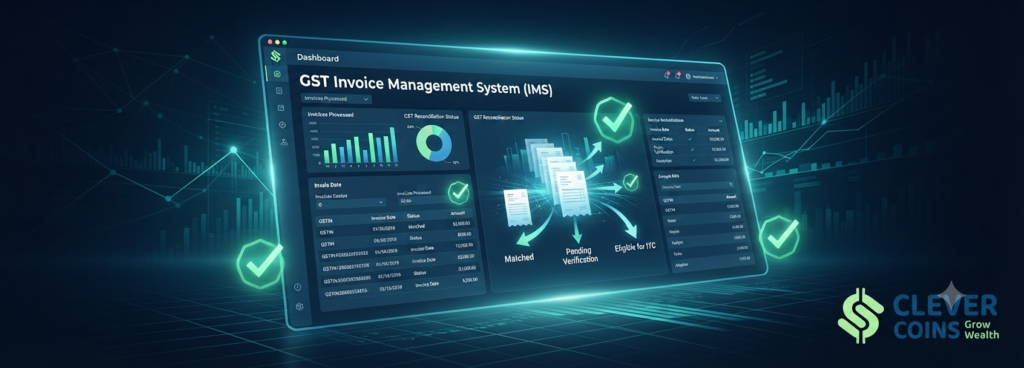
The Invoice Management System (IMS) is an interactive, communication-driven utility on the GST portal that allows recipients (buyers) to take definitive action on invoices, debit notes, and credit notes uploaded by their suppliers (sellers).
In simple terms, IMS acts as a digital negotiation and reconciliation desk between buyers and suppliers. When a supplier files their GSTR-1, GSTR-1A, or IFF, the details flow directly into the buyer’s IMS dashboard. Here, the buyer can review the records and perform one of three actions:
Accept the invoice.
Reject the invoice.
Keep Pending the decision for a later tax period.
Why Was IMS Introduced?
Prior to IMS, if a supplier made an error in an invoice (such as entering an incorrect GSTIN, wrong tax rate, or erroneous taxable value), the buyer had limited options. The erroneous credit would either reflect in GSTR-2B, forcing the buyer to reverse it later, or lead to cascading discrepancies during annual reconciliations.
IMS shifts the control point to the pre-filing stage of GSTR-2B. By acting on invoices before they lock into the final GSTR-2B statement, businesses can ensure that only valid, verified, and accepted data influences their Input Tax Credit calculations.
How the IMS Workflow Operates: Step-by-Step
Understanding the technical journey of an invoice through the IMS ecosystem is essential for seamless financial operations. The lifecycle follows a structured pathway:
Step 1: Supplier Uploads Document
The supplier files their outward supplies via GSTR-1, IFF, or GSTR-1A. Once submitted, these records instantly populate the respective buyers’ IMS dashboards.
Step 2: Buyer Reviews and Takes Action
The buyer logs into the GST portal, navigates to the Returns dashboard, and opens the IMS module. Here, records are categorized by document type (Invoices, Debit Notes, Credit Notes) and supplier details. The buyer evaluates each document against physical or digital purchase orders and goods receipt notes (GRN).
Step 3: Real-time Communication with Suppliers
Depending on the action taken by the buyer, the system updates dynamically:
Accepted Invoices: Move forward to populate the buyer’s GSTR-2B for ITC claim computation.
Rejected Invoices: Do not form part of the GSTR-2B ITC calculation. Simultaneously, they are flagged back to the supplier, notifying them to amend the record in their subsequent GSTR-1 filing.
Pending Invoices: Remain in limbo, rolling over to subsequent tax periods until the buyer takes a definitive ‘Accept’ or ‘Reject’ decision.
Step 4: Auto-Drafting GSTR-2B
Based on the cumulative actions taken within the IMS dashboard throughout the tax period, the system auto-drafts the GSTR-2B statement on the specified date. Only ‘Accepted’ (and unacted records treated as deemed accepted, depending on rules) dictate the final eligible ITC.
Deep Dive Into Buyer Actions: Accept, Reject, or Keep Pending
Navigating the choices inside the IMS requires a clear internal policy within your accounts payable department. Let us look at what each action triggers:
1. Acceptance (Accept)
Definition: You verify that the supply has been received, the invoice details match your purchase register, and the tax has been paid or is payable to the vendor.
Result: The ITC associated with this invoice becomes eligible and reflects in your GSTR-2B table for claiming in GSTR-3B.
2. Rejection (Reject)
Definition: You choose to reject an invoice because the GSTIN is wrong, the transaction does not belong to your business, the goods/services were never ordered or received, or the invoice is a duplicate entry.
Result: The invoice is excluded from your GSTR-2B. The supplier receives an alert in their GSTR-1/IMS return view, prompting them to rectify or issue a credit/debit note.
3. Keeping Pending (Keep Pending)
Definition: You are unsure about the invoice—perhaps because goods are in transit, matching documents are missing from the warehouse, or internal verification is delayed.
Result: The invoice is held back and does not calculate into the current month’s GSTR-2B ITC. It remains available in your IMS for action in subsequent tax periods.
Key Benefits of the Invoice Management System (IMS)
The integration of IMS brings transformative advantages to corporate tax management and compliance structures:
1. Elimination of Post-Filing Disputes
In the past, correcting an erroneous supplier upload required complex credit-debit note cycles after returns were already filed. IMS allows real-time pushback, ensuring suppliers correct errors proactively before final tax liabilities crystalize.
2. Precise Input Tax Credit (ITC) Optimization
By filtering out fake invoices, duplicate entries, and incorrect GSTIN entries before they hit GSTR-2B, businesses protect themselves from unwarranted tax notices, interest penalties, and sudden demand orders from tax authorities.
3. Enhanced Working Capital Management
Working capital is the lifeblood of any growing enterprise. By managing pending invoices and ensuring accurate matching, finance teams can optimize cash outflows, ensuring taxes are paid strictly on verified transactions.
4. Better Vendor Performance Tracking
With IMS analytics, businesses can track which suppliers consistently upload invoices on time versus those who frequently cause discrepancies. This transparency helps organizations build reliable vendor ecosystems.
Common Scenarios and Handling Complex Edge Cases
Even with advanced automation, real-world business scenarios can introduce complexities. Here is how tax professionals handle edge cases within IMS:
Scenario A: What happens if no action is taken before GSTR-2B generation?
If a buyer fails to take any explicit action (Accept, Reject, or Pending) on an invoice before the GSTR-2B generation cutoff, the system generally treats regular invoices as Deemed Accepted. Consequently, the ITC auto-populates into GSTR-2B. However, relying on deemed acceptance defeats the active reconciliation purpose of IMS. Best practices dictate active monthly reviews.
Scenario B: Supplier amends an invoice after rejection
If a supplier amends an invoice based on a rejection flagged through IMS, the revised invoice flows back into the buyer’s dashboard as a fresh entry or an update, requiring a fresh review cycle.
Scenario C: Dealing with Credit and Debit Notes
Credit notes reduce tax liability while debit notes increase it. In IMS, managing credit notes is vital because accepting a credit note reduces your eligible ITC. Finance teams must carefully verify return-of-goods documentation before accepting supplier credit notes.
Strategic Recommendations by Clever Coins
To maximize the benefits of the GST Invoice Management System, businesses should adopt a proactive framework:
Establish Weekly Review Cycles: Do not wait until the end of the month. Train your accounts team to log into the GST portal bi-weekly to process IMS actions.
Integrate ERP with GST APIs: Manual tracking of thousands of invoices is error-prone. Integrate your enterprise resource planning (ERP) software or billing systems with authorized GST Suvidha Providers (GSPs) to pull IMS data directly.
Vendor Communication Protocols: Share automated mismatch reports with your suppliers early in the cycle so they can correct GSTR-1 errors ahead of deadlines.
Periodic Professional Audits: Partner with experienced tax consultants like Clever Coins to run periodic diagnostic health checks on your GSTR-2B, IMS actions, and GSTR-3B filings to eliminate systemic risks.
Conclusion: Turning Compliance Into Competitive Advantage
The Invoice Management System (IMS) on the GST portal is more than just another technical compliance mandate—it is a powerful tool for financial control. By shifting tax management from a reactive scramble into an active, structured workflow, businesses can secure their supply chains, eliminate revenue leakages, and protect their bottom lines.
Embrace the power of automated tax engineering today. For tailored guidance, seamless GST registration, and advanced tax consultancy, reach out to the experts at Clever Coins and let us turn tax compliance into your strategic asset.
Consult Us Now
Phone: +91 77389 59862
Email: client@clevercoins.org
Address: Ideal Market, Mumbra, Thane-400612
Days
Hours
Minutes
Seconds
Related posts:
The Ultimate Guide to ELSS Tax Saving Mutual Funds
GST
GST Annual Return Reconciliation
GST
GST on Electricity: Decoding the Taxability for 2026
GST
GST on Entertainment & Events: The Complete 2026 Compliance Guide
GST
Carpet Area vs Built-up Area vs Super Built-up Area: The Ultimate Real Estate Buyer’s Guide
GST
How to Start an Export Business in India: The Ultimate Step-by-Step Guide
GST
GST ON CHARITABLE ACTIVITIES
GST
Emergency Fund
GST
Patent Filing in India – Step by Step: The Ultimate Guide for 2026
GST
GST on Del-Credere Agent: The Definitive Compliance Guide (2026)
GST