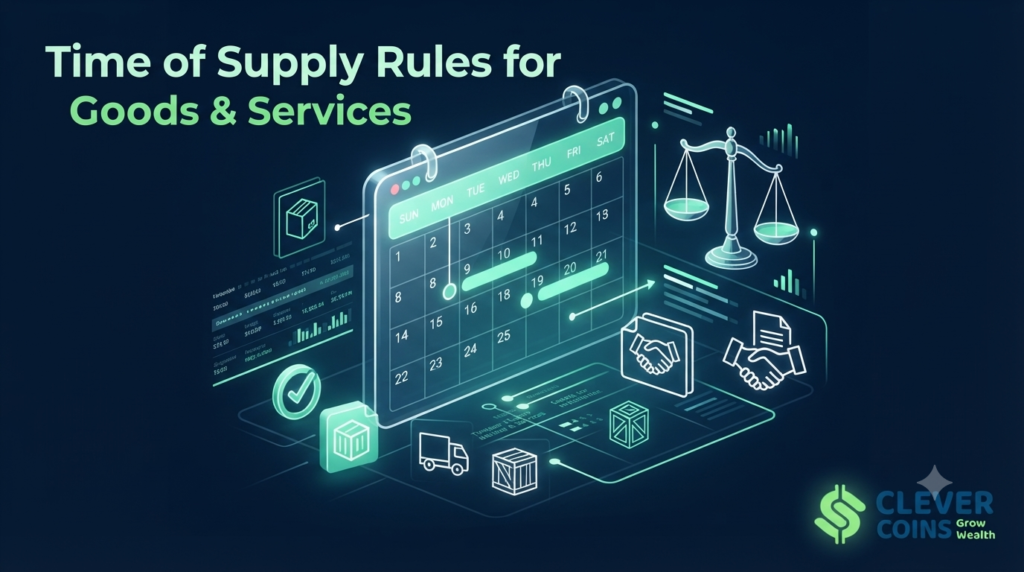
Decoding the Time of Supply Rules for Goods & Services: A Comprehensive Compliance Guide
Introduction: Why Timing is Everything in Taxation
In the intricate framework of modern tax architecture—particularly under Goods and Services Tax (GST) regimes worldwide—understanding when a transaction occurs is just as vital as knowing how much tax is due. This critical milestone is legally defined as the Time of Supply.
For business owners, CFOs, and tax professionals, miscalculating the time of supply can lead to severe cash flow bottlenecks, interest penalties, and painful compliance audits. At Clever Coins, we specialize in transforming these complex legislative mechanics into structured, strategic advantages for your bottom line.
This exhaustive guide breaks down the statutory rules governing the time of supply for both goods and services under standard forward charge, reverse charge mechanisms (RCM), vouchers, continuous supplies, and special scenarios.
Core Concept: What is the Time of Supply?
The Time of Supply refers to the specific point in time when goods or services are officially deemed to have been supplied for tax purposes. Legally, it fixes the exact moment the tax liability crystallizes.
Even if payment is delayed or goods are delivered across multiple phases, the time of supply dictates:
-
Which tax period the transaction must be declared in.
-
When the tax liability legally shifts to the government treasury.
-
The applicable tax rate in situations where statutory rates experience sudden revisions.
Section 1: Time of Supply for Goods (Section 12)
The rules governing physical commodities and movable property are structured around the movement of goods, invoice issuance, and statutory compliance limits.
1. Forward Charge Mechanism (Standard Transactions)
For the supply of goods under forward charge, the time of supply is determined by Section 12(2) of the CGST Act. It is traditionally evaluated as the earlier of the following dates:
-
The date of issue of the invoice by the supplier, or the last date legally required under Section 31 to issue said invoice.
-
The date on which the supplier receives payment for the supply.
Crucial Legislative Exception (The Advance Payment Relief for Goods):
Through statutory notifications (such as Notification No. 66/2017), registered taxpayers supplying goods under forward charge are generally exempt from paying GST on advance receipts. Consequently, for standard goods, the time of supply defaults to the invoice date or the final due date for invoice issuance, easing the advance-tax burden on product-based businesses.
2. Reverse Charge Mechanism (RCM) for Goods
When the buyer (recipient) is mandated to pay the tax directly to the government instead of the supplier, Section 12(3) applies. The time of supply is the earliest of:
-
The date the goods are actually received.
-
The date the payment is debited from the recipient’s bank account or recorded in their books.
-
The 31st day from the date of the supplier’s invoice.
If none of these parameters can determine the timeline, the date of entry in the recipient’s books of accounts acts as the fallback metric.
Section 2: Time of Supply for Services (Section 13)
Services possess an intangible nature, making their tracking distinct from physical products. Governed by Section 13 of the CGST Act, service timelines require rigorous tracking of milestone events and payment receipts.
1. Forward Charge Mechanism for Services
Under normal circumstances, the time of supply for services is the earlier of:
-
Date of Invoice Issuance: Provided the invoice is issued within the legally prescribed window (usually within 30 days of service provision).
-
Date of Payment Receipt: The date payment is entered into the supplier’s books or credited to their bank account, whichever comes first.
What if the invoice is delayed?
If the supplier fails to issue an invoice within the statutory timeframe, the time of supply shifts to the date of provision of service or the date of payment receipt, whichever is earlier. Unlike goods, advances received for services are strictly taxable immediately upon receipt.
2. Reverse Charge Mechanism (RCM) for Services
For B2B service imports or specified services under reverse charge, the time of supply under Section 13(3) is the earlier of:
-
The date of payment.
-
The 61st day from the date of the invoice (or alternative document) issued by the supplier.
Section 3: Special Scenarios and Complex Transactions
1. Vouchers (Single-Purpose vs. Multi-Purpose)
Vouchers act as instruments of consideration. Under GST frameworks:
-
Single-Purpose Vouchers: If the supply is completely identifiable at the issuance stage, the time of supply is the date of the voucher’s issuance.
-
Multi-Purpose Vouchers: If the exact nature of the supply cannot be identified upfront, the time of supply is strictly deferred to the date of redemption.
2. Interest, Late Fees, and Penalties for Delayed Payments
If a client delays payment and incurs a contractual penalty, late fee, or interest charge, Section 12(6) and 13(6) dictate that the time of supply for this additional amount is the exact date the supplier receives the additional amount. Note that these amounts are treated as inclusive of tax.
3. Change in Rate of Tax (Section 14)
When a tax rate changes mid-cycle, determining the exact time of supply prevents under-reporting or double-taxation. The matrix evaluates the chronological relationship between the date of supply, invoice issuance, and payment receipt, giving precedence to older rates if two out of three critical milestones occurred prior to the rate notification.
Practical Compliance Checklist for Businesses
To safeguard your company from compliance defaults, implement these core practices within your ERP and accounting workflows:
-
Automate Date Tracking: Ensure your accounting software simultaneously records invoice generation, dispatch/delivery logs, and bank clearing dates.
-
Monitor Service Milestones: Tie service billing strictly to completion dates to prevent late-invoice penalties.
-
Audit RCM Entries Regularly: Review reverse charge liabilities monthly to catch the 31-day (goods) and 61-day (services) thresholds before they trigger interest penalties.
-
Partner with Experts: Tax codes evolve continuously. Engaging specialized consultants like Clever Coins ensures your filings remain optimized and audit-proof.
Conclusion
Mastering the time of supply rules for goods and services is an essential pillar of proactive financial management. By synchronizing your billing habits with statutory thresholds, you protect your working capital, avoid punitive interest charges, and turn tax compliance into a strategic operational advantage.
Ready to optimize your tax structure and secure your financial future? Contact Clever Coins today to schedule your comprehensive compliance review.
- Phone: +91 77389 59862
- Email: client@clevercoins.org
- Address: Ideal Market, Mumbra, Thane-400612