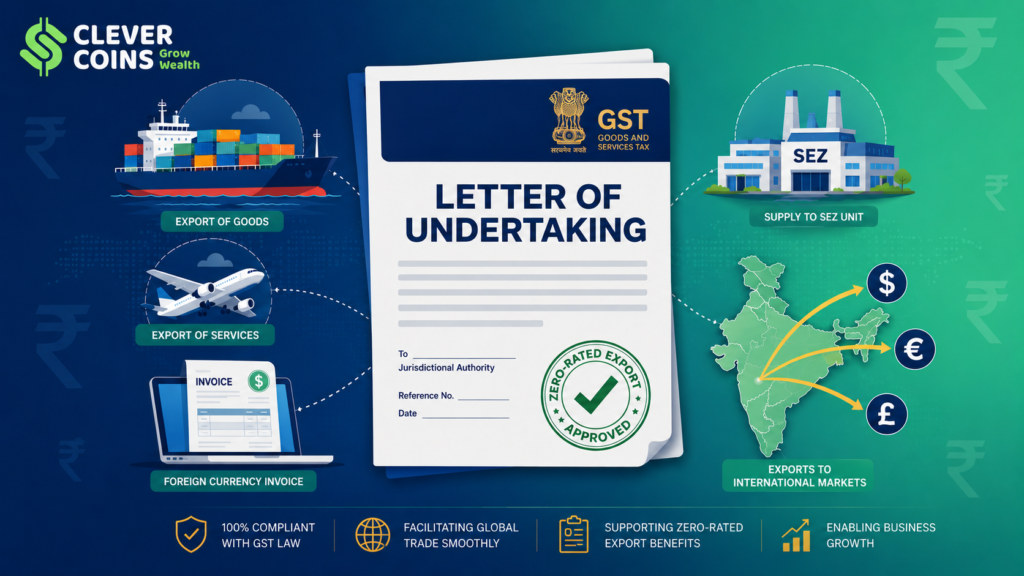
If you export goods or services from India, supply to a Special Economic Zone (SEZ), or freelance for foreign clients, then the Letter of Undertaking — popularly called LUT — is the single most important GST compliance document you must understand. Filing the LUT correctly means you can invoice clients in USD, EUR, GBP or AED without charging 18% IGST and without blocking your working capital in refund claims that can take months to settle.
This comprehensive guide, prepared by the team at CleverCoins, walks you through every aspect of LUT under GST for FY 2026-27 — what it is, who needs it, the latest eligibility rules, the step-by-step filing process on the GST portal, common mistakes, penalties for non-compliance, and answers to the most asked questions by Indian exporters and freelancers.
What is a Letter of Undertaking (LUT) under GST?
A Letter of Undertaking (LUT) is a legal declaration submitted by a registered taxpayer to the GST department, undertaking that they will fulfil all the export-related obligations under the GST law — primarily realisation of export proceeds in convertible foreign exchange within the prescribed period. In simple terms, it is a written promise that allows you to make zero-rated supplies without paying Integrated GST (IGST) at the time of supply.
As per Section 16 of the IGST Act, 2017, exports of goods and services and supplies to SEZ units or developers are treated as ‘zero-rated supplies’. This means GST is not chargeable on such supplies. However, the exporter has two options to claim this zero-rated benefit:
- Pay IGST at the time of supply and later claim a refund of the IGST paid, or
- Furnish a Letter of Undertaking (LUT) or Bond and supply without payment of IGST.
Option 2 — filing an LUT — is the smarter and more popular choice because it preserves working capital. The LUT is filed in Form GST RFD-11 through the GST portal and is valid for the entire financial year for which it is furnished.
Legal Framework Governing LUT under GST
LUT is not just a procedural document — it is grounded in solid statutory provisions. Understanding the legal backbone helps you stay compliant and defend your position in case of any departmental query.
Section 16 of the IGST Act, 2017
This section classifies exports of goods/services and supplies to SEZ as ‘zero-rated supplies’ and entitles the supplier to make such supplies without payment of tax, subject to prescribed conditions and safeguards.
Rule 96A of the CGST Rules, 2017
Rule 96A lays down the specific conditions for furnishing the LUT — including the time limit for receipt of payment (one year for services, three months for goods) and the consequences of failure to realise export proceeds within the prescribed period.
Notification No. 37/2017 – Central Tax dated 04.10.2017
This is the landmark notification that liberalised LUT filing. It extended the LUT facility to all registered taxpayers (except those prosecuted for tax evasion exceeding ₹2.5 crore), removing the earlier restrictive condition of ₹1 crore foreign inward remittance or 10% export turnover.
Circular No. 8/8/2017 – GST dated 04.10.2017
The CBIC issued this clarificatory circular explaining the procedure, format and operational aspects of LUT filing — including the requirement of two witnesses and the use of digital signatures.
Who Should File LUT under GST?
The LUT facility is available to every registered person who makes zero-rated supplies. In 2026, the following categories of taxpayers commonly file LUT:
Exporters of Goods
Manufacturers, traders, garment exporters, handicraft exporters, pharma exporters, jewellery houses and any registered business shipping goods outside India must file LUT to ship without paying IGST.
Exporters of Services
IT and ITES companies, software developers, BPOs, KPOs, digital marketing agencies, content creators, online tutors, animation studios, consultancy firms and chartered accountants serving foreign clients all benefit from filing LUT — provided the supply qualifies as ‘export of service’ under Section 2(6) of the IGST Act.
Freelancers Working with Foreign Clients
Individual freelancers registered under GST who provide services like web development, graphic design, content writing, video editing, social media management or virtual assistance to clients abroad must file LUT to invoice them in foreign currency without GST. This is one of the fastest-growing user groups in FY 2026-27.
Suppliers to SEZ Units and SEZ Developers
Any registered taxpayer supplying goods or services to a Special Economic Zone unit or developer can file LUT to make such supplies without payment of IGST, since these supplies are treated as zero-rated under Section 16.
EOUs, STPI and EHTP Units
Export Oriented Units, Software Technology Park units and Electronic Hardware Technology Park units making zero-rated supplies also fall within the LUT framework.
Eligibility Criteria for Filing LUT in 2026
Post the 2017 liberalisation, the eligibility criteria for filing LUT have remained extremely taxpayer-friendly. As of FY 2026-27, the rules are as follows:
- Registered under GST: The applicant must hold a valid GSTIN.
- Intention to make zero-rated supplies: The taxpayer must be engaged in or intend to engage in export of goods/services or SEZ supplies.
- No prosecution for serious tax evasion: The applicant should not have been prosecuted for any offence under the CGST Act, IGST Act or any existing law where the amount of tax evaded exceeds ₹2.5 crore (Rupees Two Crore Fifty Lakh).
Important — Who CANNOT file LUT? Only one category is barred — taxpayers who have been prosecuted for tax evasion of more than ₹2.5 crore under the GST law or any earlier indirect tax law. Such taxpayers must furnish a Bond along with a Bank Guarantee equal to 15% of the bond amount. Mere issuance of a show-cause notice does NOT disqualify you — actual prosecution proceedings must have been initiated. |
Validity Period of LUT and Renewal
This is one of the most misunderstood aspects of LUT compliance and a major reason for unintended non-compliance among small exporters and freelancers.
- Validity: The LUT is valid for one financial year, i.e., from 1st April to 31st March of the year for which it is filed.
- Renewal: A fresh LUT must be filed every financial year. The LUT for FY 2026-27 should ideally be filed on or before 31st March 2026 so that you can issue zero-rated export invoices from 1st April 2026 without interruption.
- Auto-expiry: There is no automatic renewal. If you forget to file for the new year, every export invoice raised after 1st April becomes taxable at 18% IGST until you file the new LUT.
- Retrospective effect: If you file the LUT mid-year, it is generally valid from the date of submission, not retrospectively. Invoices raised before that date in the new financial year may attract IGST liability.
Step-by-Step Process to File LUT Online (Form GST RFD-11)
Filing the LUT is a fully online process on the GST portal and typically takes 10–15 minutes. Here is the complete walkthrough as it works in 2026:
Step 1 — Login to the GST Portal
Visit www.gst.gov.in and log in using your GSTIN, username and password. Ensure your DSC (Digital Signature Certificate) is registered if your business is a company or LLP, or that your mobile number linked to Aadhaar is active for EVC.
Step 2 — Navigate to Services → User Services → Furnish Letter of Undertaking (LUT)
From the dashboard, click on Services, then User Services, and select ‘Furnish Letter of Undertaking (LUT)’. The form GST RFD-11 will open.
Step 3 — Select the Financial Year
Choose the financial year for which you want to file the LUT — for example, ‘2026-27’. If you have already filed an LUT for the previous year and it is available on the portal, you can upload it as a reference document, though this is optional.
Step 4 — Read and Accept the Self-Declaration
The form contains three self-declaration checkboxes that you must tick:
- Commitment to complete export of goods/services within 3 months/1 year of issuing the export invoice (as applicable).
- Commitment to comply with all GST law provisions in respect of exports.
- Commitment to pay IGST along with interest @ 18% per annum if the export obligation is not fulfilled within the prescribed time.
Step 5 — Enter Witness Details
Provide the name, occupation and complete address of two independent witnesses. The witnesses can be your employees, friends, family members, or your chartered accountant — but they should not be the same as the authorised signatory. PAN of witnesses is not mandatory but recommended.
Step 6 — Select Authorised Signatory
Choose the name of the authorised signatory from the dropdown — this should match the person registered as primary or additional authorised signatory under your GST registration.
Step 7 — Sign and Submit using DSC or EVC
Companies and LLPs must sign with a Class 3 DSC. Proprietors, partnership firms and individuals can submit using EVC (One-Time Password sent to the Aadhaar-linked mobile number). Once submitted, an Acknowledgement Reference Number (ARN) is generated instantly.
Step 8 — Download the Filed LUT
After submission, download the acknowledgement and the signed LUT in PDF format. Save it in your compliance folder — you may be required to produce it before customs at the port of export, before banks for foreign remittance, or during GST audits.
Documents and Information Required to File LUT
The LUT filing process is paperless, but you should keep the following information handy before you start:
- GSTIN and login credentials of the registered taxpayer
- PAN of the entity
- Name, address, occupation and ID proof of two witnesses
- Name and designation of the authorised signatory
- Active DSC (for companies/LLPs) or Aadhaar-linked mobile number (for EVC)
- Previous year’s LUT acknowledgement, if available (optional)
- Import Export Code (IEC) — useful but not mandatory for filing the LUT itself
LUT vs Bond — Key Differences You Must Know
Taxpayers ineligible for LUT must furnish a Bond with a Bank Guarantee. Here is a side-by-side comparison so you understand which one applies to you:
Parameter | Letter of Undertaking (LUT) | Bond |
Eligibility | Available to almost all registered exporters and SEZ suppliers | Mandatory for those prosecuted for tax evasion exceeding ₹2.5 crore |
Bank Guarantee | Not required | Required — minimum 15% of the bond amount |
Form Used | GST RFD-11 (online, paperless) | GST RFD-11 (offline submission with bank guarantee) |
Validity | One financial year — must be renewed yearly | Continuous till tax liability is met or revoked |
Stamp Paper | Not required | Required — non-judicial stamp paper as per state law |
Cost to Taxpayer | Zero (only your time) | Bank guarantee charges + stamp duty |
Filing Mode | Fully online on GST portal | Manual filing with the jurisdictional GST officer |
Benefits of Filing LUT under GST
For an Indian exporter or freelancer, filing the LUT is not just a tick-box compliance — it is a strategic working-capital tool. Here are the concrete benefits:
- Zero IGST outflow: Export invoices can be raised without charging 18% IGST, meaning no funds are blocked with the government.
- Improved cash flow: Without LUT, you would pay IGST first and then wait 2–6 months for the refund. LUT eliminates this lag entirely.
- Competitive pricing for foreign clients: Since no IGST is added to invoices, your quote to foreign clients stays clean and competitive.
- Simpler accounting: No need to track IGST refund claims, RFD-01 applications and ledger reconciliations on each export invoice.
- Faster banking: Foreign Inward Remittance Certificates (FIRC) issued by banks align cleanly with zero-rated invoices.
- Smoother customs clearance: For physical exports, the shipping bill is treated as a deemed refund application — and with LUT, this entire mechanism becomes simpler.
Consequences of Not Filing LUT under GST
Many small exporters and freelancers assume that since exports are ‘tax-free’, no LUT is needed. This is a costly misconception. If you do not have an active LUT and you raise an export invoice, the following consequences kick in:
- IGST becomes payable: Every export invoice attracts 18% IGST that must be paid to the government at the time of filing GSTR-3B for that month.
- Cash flow blockage: On an export of ₹50,00,000, you would have to pay ₹9,00,000 as IGST and then wait for the refund — a significant working-capital hit for small businesses.
- Interest on delayed payment: If you fail to pay the IGST and later realise the lapse, interest at 18% per annum applies under Section 50 of the CGST Act.
- Penalty exposure: A general penalty of up to ₹25,000 under Section 125 of the CGST Act may be levied for non-compliance with procedural provisions.
- Refund delays and scrutiny: Refund claims for IGST paid in absence of LUT often face additional scrutiny, document requests and processing delays from the department.
- Loss of zero-rating benefit if proceeds not realised: Even with LUT, if you fail to realise the foreign exchange within 1 year (services) or 3 months (goods), you must pay IGST plus 18% interest within 15 days of the deadline.
Common Mistakes Exporters Make While Filing LUT
Based on our experience at CleverCoins handling LUT filings for hundreds of Mumbra and pan-India exporters, here are the top mistakes you must avoid:
- Forgetting to renew on 1st April: By far the most common mistake. Calendar your LUT renewal for March every year.
- Using the same person as witness and authorised signatory: The two witnesses must be different from the authorised signatory.
- Selecting wrong financial year: Always double-check the financial year dropdown before submitting.
- Not tracking export proceeds realisation: The 1-year (services) / 3-month (goods) deadline is your responsibility — non-realisation triggers IGST + interest.
- Ignoring the export of services definition: If your foreign client has an Indian establishment, your supply may not qualify as ‘export of service’ even if paid in foreign currency.
- DSC expiry: Many companies discover their DSC has expired only at the moment of filing — renew it well in advance.
Recent Updates and 2026 Changes You Should Know
The LUT framework has been largely stable since 2017, but FY 2026-27 brings a few important points exporters should keep on their radar:
- E-Invoicing threshold and LUT: Businesses crossing the e-invoicing turnover threshold (₹5 crore) must report export invoices on the IRP portal as well. The LUT remains the underlying authorisation.
- GSTR-1 export columns: Tables 6A and 9 of GSTR-1 must accurately reflect LUT-based exports with the correct LUT ARN reference.
- Tighter scrutiny on services exports: The department in 2026 is closely examining whether ‘place of supply’ for service exporters meets the conditions of Section 2(6) IGST Act — especially for digital, consulting and freelance services.
- Faster RFD-11 acknowledgements: The GST portal now generates LUT acknowledgements within minutes — gone are the days of officer-level approvals.
- Integration with ICEGATE: For goods exporters, shipping bill data now flows seamlessly between ICEGATE customs and the GST portal, making refund reconciliation faster.
Frequently Asked Questions on LUT under GST
Is LUT mandatory for all exporters?
Not technically mandatory, but practically indispensable. Without LUT, every export attracts 18% IGST which blocks your working capital. Almost every active exporter chooses to file LUT.
Can a proprietorship file LUT?
Yes. Proprietors registered under GST can file LUT using EVC (OTP on Aadhaar-linked mobile number) and do not necessarily need a DSC.
Is LUT required for a freelancer earning in USD?
Yes, if the freelancer is registered under GST (turnover exceeds ₹20 lakh, or ₹10 lakh in special category states). LUT enables zero-rated invoicing to the foreign client without 18% IGST.
What if I file LUT after 1st April?
The LUT is valid from the date of filing, not retrospectively. Export invoices raised between 1st April and the LUT filing date may attract IGST liability. Always file before 31st March.
Can LUT be cancelled or revoked?
There is no formal cancellation process. The LUT auto-expires at the end of the financial year. If proceeds are not realised within the prescribed time, the benefit lapses and IGST + interest becomes payable.
Do I need an IEC code to file LUT?
IEC is not mandatory for LUT filing itself, but it is mandatory to physically export goods or services. For service exporters, IEC is recommended but not always required by banks for FIRC issuance.
Can I file LUT for SEZ supplies even if I am not an exporter?
Absolutely. Supplies to SEZ units and developers are also zero-rated under Section 16 of the IGST Act and qualify for LUT-based zero-rated supply.
What is the fee for filing LUT?
The government does not charge any fee for filing LUT. The entire process on the GST portal is free of cost. If you engage a professional firm like CleverCoins to file it for you, only their service charges apply.
Final Word — Get Your LUT in Place Before 31st March
The Letter of Undertaking is one of the simplest, cheapest and highest-impact GST compliances available to Indian exporters and freelancers in 2026. A 15-minute filing on the GST portal can unlock crores in working capital and protect you from a 18% IGST hit on every foreign invoice.
If you are an exporter, IT firm, freelancer or SEZ supplier and have not yet filed your LUT for FY 2026-27 — make it a priority this week. And if you would prefer the CleverCoins team to handle it end-to-end, including witness arrangement, DSC support and post-filing compliance reminders, we are just a WhatsApp message away.
Need help filing your LUT? CleverCoins handles LUT filing for exporters and freelancers across India — completely online, with same-day acknowledgement, witness coordination and a yearly renewal reminder built in. Visit clevercoins.org or message us on Instagram @clevercoins_official to get started. |