Micro, Small, and Medium Enterprises (MSMEs) are the backbone of India’s economy — contributing over 30% of GDP, accounting for nearly 50% of exports, and providing employment to more than 11 crore people across manufacturing, services, trade, and agriculture-allied sectors. Yet, access to affordable credit remains one of the most persistent challenges for MSME owners across India.
The Government of India — through the Ministry of MSME, RBI, SIDBI, NABARD, and various public sector banks — has launched over a dozen targeted loan schemes specifically designed for MSMEs. From the landmark MUDRA scheme (with over 40 crore loans disbursed since 2015) to the Credit Guarantee Fund (CGTMSE) to Stand-Up India for SC/ST and women entrepreneurs — the ecosystem for MSME lending has never been richer or more accessible.
This comprehensive 2026 guide by CleverCoins — India’s trusted tax and financial advisory firm — covers every major MSME loan scheme: classification criteria, 15 loan schemes with rates and eligibility, MUDRA deep-dive, CGTMSE explained, step-by-step application process, documents required, CIBIL score requirements, and expert tips to maximise your loan approval chances.
What is an MSME? — Revised 2020 Classification
Before applying for any MSME loan, you must verify whether your business qualifies as an MSME under the revised Aatmanirbhar Bharat Abhiyan criteria introduced in 2020. The classification was significantly revised to expand eligibility — the key change being that BOTH manufacturing AND service enterprises are now classified under the same criteria, and the investment and turnover limits were substantially raised.
Category | Investment in Plant & Machinery / Equipment | Annual Turnover | Applicable To |
Micro Enterprise | Up to Rs. 1 crore | Up to Rs. 5 crore | Manufacturing AND Services — both |
Small Enterprise | Above Rs. 1 crore but up to Rs. 10 crore | Above Rs. 5 crore but up to Rs. 50 crore | Manufacturing AND Services — both |
Medium Enterprise | Above Rs. 10 crore but up to Rs. 50 crore | Above Rs. 50 crore but up to Rs. 250 crore | Manufacturing AND Services — both |
⚠️ Both conditions must be satisfied: For a business to qualify as MSME, it must meet BOTH the investment AND turnover criteria simultaneously. Exceeding either limit means the business moves to the next higher category. A company with Rs. 8 crore investment but Rs. 60 crore turnover would be classified as MEDIUM (turnover exceeds Small limit of Rs. 50 crore).
Udyam Registration — The Gateway to All MSME Benefits
Udyam Registration (earlier known as Udyog Aadhaar) is the OFFICIAL, FREE, and mandatory registration for all MSMEs in India — launched on 1st July 2020 on the Udyam portal (udyamregistration.gov.in). Without Udyam Registration, a business CANNOT access most government MSME loan schemes, subsidies, or priority sector lending benefits.
- Self-declaration based — no documents to upload (uses PAN and GST data auto-fetch)
- Instant registration — generates a unique Udyam Registration Number (URN)
- FREE of cost — no government fee
- Linked to PAN and GSTIN — auto-verified by the system
- Single registration for all activities of the enterprise
- Dynamic classification — updates automatically based on annual income tax return and GST data
✅ If you have not registered on Udyam yet — do it today at udyamregistration.gov.in. It takes less than 30 minutes and is completely free. Without Udyam Registration, you will be denied access to MUDRA loans, CGTMSE guarantee, PMEGP, Stand-Up India, and dozens of other government MSME benefits.
Master Table — All MSME Loan Schemes 2026
The following comprehensive table covers all 15 major MSME loan schemes available in India as of 2026:
Scheme Name | Implementing Body | Loan Amount | Interest Rate | Collateral? | Target / Eligibility |
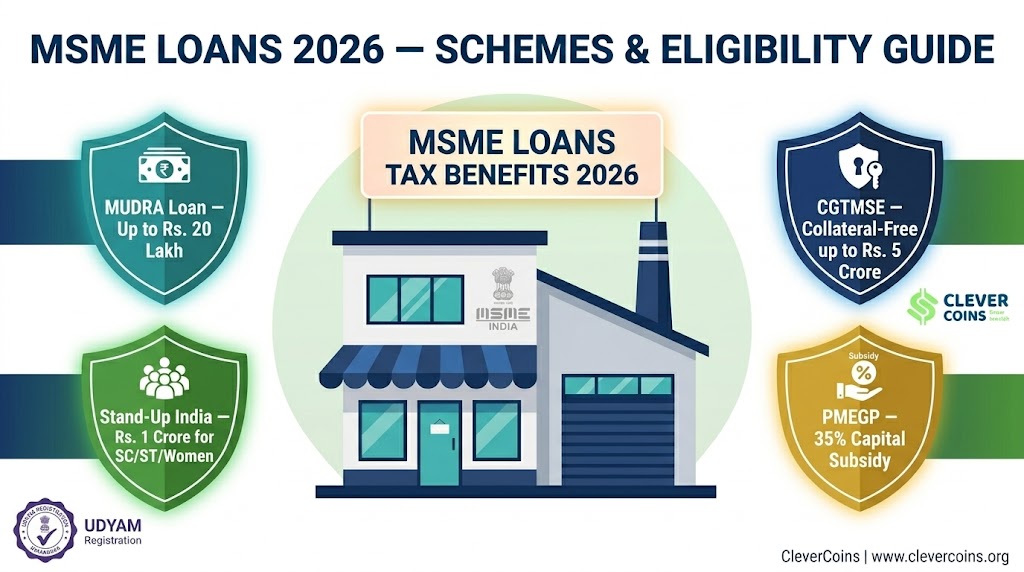
MUDRA Loan — Shishu | Banks / MFIs / NBFCs (PM Mudra Yojana) | Up to Rs. 50,000 | 7% – 12% p.a. | No collateral | Micro enterprises, street vendors, first-time borrowers |
MUDRA Loan — Kishore | Banks / MFIs / NBFCs | Rs. 50,001 – Rs. 5 lakh | 8% – 13% p.a. | No collateral | Growing micro businesses — expansion stage |
MUDRA Loan — Tarun | Banks / MFIs / NBFCs | Rs. 5 lakh – Rs. 10 lakh | 9% – 14% p.a. | Partial collateral may apply | Established micro businesses needing working capital |
MUDRA Tarun Plus (2024) | Banks / MFIs | Rs. 10 lakh – Rs. 20 lakh | As per bank + subsidy possible | Collateral may be required | Successful Tarun graduates — new category from FY 2024-25 |
CGTMSE — Credit Guarantee Fund | SIDBI + Ministry of MSME | Up to Rs. 5 crore (micro: Rs. 2 crore) | Bank rate + 1% guarantee fee | NO collateral (guaranteed scheme) | All MSMEs — manufacturing and service; no collateral required |
Stand-Up India Scheme | SIDBI / Scheduled Commercial Banks | Rs. 10 lakh to Rs. 1 crore | Base Rate + 3% (max) | No collateral via CGTMSE | SC/ST and Women entrepreneurs — one per bank branch |
PM SVANidhi — Street Vendor Loan | Urban Local Bodies / Banks | Rs. 10,000 → Rs. 50,000 (3 tranches) | 7% p.a. (interest subsidy) | No collateral | Urban street vendors and hawkers |
SIDBI Direct Lending (SMILE) | SIDBI | Rs. 10 lakh to Rs. 25 crore | SIDBI PLR + spread | Collateral or CGTMSE | New and existing MSMEs; start-ups; manufacturing and services |
Emergency Credit Line Guarantee (ECLGS) — legacy | NCGTC / Banks | 20% of outstanding credit (legacy) | Max 9.25% p.a. (WC); 9.75% (term) | No additional collateral | MSMEs with pre-existing loans; COVID-era scheme — closures ongoing |
PMEGP — Prime Minister Employment Generation | KVIC / KVIB / DIC | Manufacturing: up to Rs. 50 lakh; Service: up to Rs. 20 lakh | Bank rate; subsidy 15%-35% of project cost | Collateral for loans above Rs. 10 lakh | New enterprise promoters; educated unemployed youth; artisans |
Credit Linked Capital Subsidy Scheme (CLCSS) | Ministry of MSME / SIDBI | No fixed cap — subsidy on technology upgrade | 15% subsidy on institutional credit up to Rs. 1 crore | As per lending bank | Existing micro and small enterprises for technology upgradation |
Udyam Mudra (MUDRA for Udyam-registered) | Banks under MUDRA | Up to Rs. 10 lakh | Concessional rate for Udyam registrants | No collateral | Udyam-registered MSMEs — all sectors |
NABARD — Agricultural MSMEs and Food Processing | NABARD / RRBs | Project-based — up to crores | Concessional refinance rate | Depends on project size | Rural agro-MSMEs, food processing units, artisans |
RBI Priority Sector Lending (PSL) — MSME sub-category | All Scheduled Commercial Banks | Micro: up to Rs. 1 crore; Small: up to Rs. 10 crore | Competitive lending rates | Depends on loan size | All MSMEs — automatic under PSL category; banks must lend target % |
Weaver Credit Cards / Artisan Credit Cards | Textile Ministry / NABARD | Rs. 2 lakh (revolving) | Subsidised rate | No collateral | Handloom weavers, artisans, craft workers in MSMEs |
📌 CleverCoins Note: The above table reflects the most current scheme parameters as of April 2026. Interest rates may vary by bank and the RBI repo rate. Always verify specific rates with the lending institution at the time of application. Scheme-specific subsidy components are subject to Ministry announcements.
MUDRA Loan — PM Mudra Yojana: The Most Accessible MSME Loan
Pradhan Mantri MUDRA Yojana (PMMY), launched in April 2015, is India’s most popular and widely-disbursed MSME loan scheme. ‘MUDRA’ stands for Micro Units Development & Refinance Agency — a subsidiary of SIDBI. MUDRA loans are provided through commercial banks, RRBs (Regional Rural Banks), MFIs (Microfinance Institutions), NBFCs, and Co-operative Banks.
Key Features of MUDRA Loan
- No minimum loan amount — starts from Rs. 1,000 and goes up to Rs. 10 lakh (Rs. 20 lakh for Tarun Plus)
- No collateral or security required for Shishu and Kishore categories
- No processing fee for Shishu category; nominal fees for higher categories
- No penalty for prepayment
- Loan available for all non-agricultural income-generating activities
- Available to all citizens — no caste, religion, gender, or sector restriction (unlike Stand-Up India which is targeted)
- Loan can be used for working capital (term loan, CC, OD), equipment purchase, vehicle purchase for business
Category | Loan Amount | Who Should Apply | Key Purpose | Collateral | Processing Time |
Shishu | Up to Rs. 50,000 | Street vendors, artisans, first-time micro borrowers, home-based businesses | Initial working capital, raw material purchase, small equipment | None required | 7–15 working days |
Kishore | Rs. 50,001 – Rs. 5 lakh | Expanding micro businesses, self-employed professionals, food stalls, small retailers | Business expansion, machinery purchase, new product lines | None required typically | 10–20 working days |
Tarun | Rs. 5 lakh – Rs. 10 lakh | Established micro businesses needing larger capital for growth | Plant & equipment, larger working capital, diversification | Partial collateral may be asked | 15–25 working days |
Tarun Plus (NEW FY24-25) | Rs. 10 lakh – Rs. 20 lakh | Successful Tarun graduates — good repayment track record required | Scale up operations, larger equipment, new premises | Collateral or CGTMSE guarantee | 20–30 working days |
✅ MUDRA Tarun Plus (Introduced FY 2024-25): This new sub-category was announced in the Union Budget 2024-25 — providing loans between Rs. 10 lakh and Rs. 20 lakh to successful Tarun borrowers with good repayment track records. This bridges the gap between MUDRA (up to Rs. 10 lakh) and mainstream bank loans (Rs. 25 lakh+), addressing the critical ‘missing middle’ in MSME lending.
Who Can Apply for MUDRA Loan?
- Any Indian citizen who has a viable business plan for a non-agricultural income-generating activity
- Existing micro businesses needing working capital or expansion capital
- Shopkeepers, traders, vendors, artisans, small manufacturers
- Service providers: repair shops, salons, tutors, freelancers, technicians
- Women entrepreneurs, SC/ST entrepreneurs (priority lending)
- Small food vendors, dhabas, tiffin services, bakeries
- Agriculture-allied activities (dairy, poultry, beekeeping, fisheries — not crop cultivation)
How to Apply for MUDRA Loan
- Get Udyam Registration (free at udyamregistration.gov.in)
- Prepare a simple business plan / project report
- Approach your nearest public sector bank, private bank, RRB, MFI, or NBFC
- Fill the MUDRA loan application form (available at all banks and on the Udyami Mitra portal: udyamimitra.in)
- Submit documents: PAN, Aadhaar, Udyam Certificate, 6 months bank statement, business proof
- Bank officer assesses the application and visits the business (for larger amounts)
- Sanction letter issued — funds disbursed within 7-25 working days
⚠️ MUDRA Loans are NOT directly applied on the MUDRA website. The MUDRA.org.in portal is informational only. Actual loan applications are made at individual lending institutions. Use the Udyami Mitra portal (udyamimitra.in) for online applications across multiple banks simultaneously.
CGTMSE — Credit Guarantee Fund Trust for Micro and Small Enterprises
CGTMSE is one of the most important schemes for MSMEs — not a loan scheme itself, but a CREDIT GUARANTEE scheme that enables MSMEs to get COLLATERAL-FREE loans from banks by guaranteeing a portion of the loan against default. Without CGTMSE, most banks would require property or asset collateral before lending to small businesses.
How CGTMSE Works
- CGTMSE is a trust set up jointly by the Government of India and SIDBI
- Member lending institutions (banks, NBFCs) can avail the CGTMSE guarantee for their MSME borrowers
- The guarantee covers 75% to 85% of the loan amount in case of default — reducing bank’s risk
- The MSME borrower pays an annual guarantee fee (typically 0.75% to 1.5% of the loan amount) — included in loan cost
- Loan amount: Up to Rs. 5 crore (with enhanced limits for specific sectors and women/SC/ST borrowers)
- Micro enterprises: Up to Rs. 2 crore — enhanced guarantee coverage
- Woman entrepreneurs and NE states: Higher guarantee coverage
CGTMSE — What It Means for MSME Borrowers
- You can get business loans WITHOUT pledging your house, land, or personal assets
- The bank cannot demand collateral security for loans covered under CGTMSE
- All commercial banks, most NBFCs, RRBs, and SFBs (Small Finance Banks) are CGTMSE members
- CGTMSE guarantee is available on Term Loans AND Working Capital Facilities
✅ Practical Tip: When applying for an MSME loan, specifically ask your bank: ‘Can this loan be covered under CGTMSE?’ If yes, you should not be asked for collateral security. If the bank insists on collateral for a loan that qualifies for CGTMSE coverage — this is against RBI guidelines and CGTMSE scheme rules. Escalate to the bank’s MSME desk.
Stand-Up India — Empowering SC/ST and Women Entrepreneurs
Stand-Up India is a flagship scheme launched in 2016 with the explicit purpose of promoting entrepreneurship among Scheduled Caste (SC), Scheduled Tribe (ST), and Women borrowers — categories that have historically been underserved by formal banking credit.
Key Features
- Loan Amount: Rs. 10 lakh to Rs. 1 crore per borrower
- Purpose: Setting up a greenfield enterprise in manufacturing, services, or trading
- One loan per SC borrower and one per ST borrower per bank branch
- At least one loan per woman borrower per bank branch (in addition to SC/ST)
- Loan covers 75% of the project cost — promoter’s contribution is 25% (can include capital from other sources)
- Composite loan (includes both term loan for capex and working capital)
- Repayment period: Up to 7 years with maximum moratorium of 18 months
- Collateral: May be covered under CGTMSE; or primary security of assets financed
- Interest rate: Competitive — Base Rate + 3% (maximum)
⚠️ Eligibility Restriction: Stand-Up India is ONLY for NEW (greenfield) enterprises by SC/ST or Women promoters. If you are an SC/ST entrepreneur with an existing business seeking expansion — you must use MUDRA, SIDBI, or regular MSME bank loans. Stand-Up India is specifically for first-time enterprise creation.
PMEGP — Prime Minister Employment Generation Programme
PMEGP (Prime Minister Employment Generation Programme) is a credit-linked subsidy scheme implemented by KVIC (Khadi and Village Industries Commission) — offering significant upfront capital subsidies for new manufacturing and service businesses. It is one of the most financially attractive schemes for first-time entrepreneurs.
PMEGP Loan and Subsidy Structure
- Manufacturing units: Maximum project cost Rs. 50 lakh; maximum bank loan Rs. 40 lakh (after 20% promoter margin)
- Service and trading units: Maximum project cost Rs. 20 lakh; maximum bank loan Rs. 16 lakh (after 20% margin)
PMEGP Subsidy Rates
- General category (urban): 15% subsidy on project cost; promoter’s margin: 10%
- General category (rural): 25% subsidy on project cost; promoter’s margin: 10%
- Special category (SC/ST/OBC/Women/Minority/Ex-Servicemen/PH/Hill & Border areas — urban): 25% subsidy
- Special category (rural): 35% subsidy on project cost
💡 Example: Special category rural applicant sets up a food processing unit with total project cost Rs. 20 lakh. Bank loans Rs. 16 lakh. Subsidy = 35% × Rs. 20 lakh = Rs. 7 lakh. Applicant’s margin = Rs. 2 lakh (10%). Effective loan remaining after subsidy = Rs. 9 lakh to repay. The Rs. 7 lakh subsidy is kept in TDR for 3 years as margin money — essentially reducing the real loan burden by 35%.
PMEGP Eligibility
- Age: 18 years and above
- For manufacturing projects above Rs. 10 lakh and service projects above Rs. 5 lakh: Minimum 8th pass qualification
- Assistance only to new enterprises — existing units or units that have availed state/central government assistance not eligible
- Project should be new — expansions, modernisations not covered under PMEGP
- Applicant can apply as individual, SHG, institution, or co-operative society
⚠️ PMEGP 3-year lock-in: The subsidy amount is ‘locked in’ as a TDR (Term Deposit Receipt) with the bank for 3 years. During this period, the business must continue to operate. If the business closes or fails to continue, the subsidy is recovered by the bank. After 3 years of successful operation — the subsidy is released to the promoter’s account.
PM SVANidhi — Loan for Street Vendors
PM Street Vendor’s AtmaNirbhar Nidhi (PM SVANidhi) is a special micro-credit scheme launched in June 2020 to provide affordable loans to India’s 50 lakh+ urban street vendors and hawkers who were severely impacted by COVID-19 and associated lockdowns.
- First loan: Rs. 10,000 (working capital; 1-year repayment)
- Second loan: Rs. 20,000 (on timely repayment of first loan)
- Third loan: Rs. 50,000 (on timely repayment of second loan)
- Interest subsidy: 7% per annum — claimed back by borrower through quarterly credit to bank account
- Digital transaction incentive: Up to Rs. 1,200 per year for digital payment adoption
- No collateral; no guarantor required
- Apply via the PM SVANidhi app or through Urban Local Body
✅ PM SVANidhi Success: Since its launch, PM SVANidhi has disbursed over 68 lakh loans worth Rs. 10,000+ crore to street vendors across India. The scheme has been highly successful — particularly in tier 2, tier 3 cities and smaller towns.
SIDBI — Small Industries Development Bank of India
SIDBI is India’s principal development finance institution for the MSME sector. While SIDBI primarily refinances banks and NBFCs, it also provides DIRECT lending to eligible MSMEs through its SMILE (SIDBI Make in India Loans for Enterprises) scheme.
SIDBI SMILE Scheme
- Loan amount: Rs. 10 lakh to Rs. 25 crore (higher amounts under enhanced schemes)
- Type: Term loans for equipment, technology upgrade, working capital term loans
- Target: New and existing MSMEs; businesses in manufacturing, services, trading, and infrastructure
- Interest rate: SIDBI PLR (Prime Lending Rate) + spread — typically competitive vs commercial banks
- Tenure: Up to 10 years (equipment/capex loans)
- Collateral: Required for larger amounts; CGTMSE guarantee for smaller amounts
- Special schemes for Women MSMEs (SIDBI Mahila Udyam Nidhi), Start-Up MSME funding, and Green/Sustainable business financing
SIDBI Programmes Worth Knowing in 2026
- SIDBI-CGTMSE Collaboration: Priority guarantee coverage for SIDBI-financed MSMEs
- Co-lending Model: SIDBI co-lends with banks to offer lower interest rates
- NEF (National Equity Fund): For tiny sector units — equity finance substitute at concessional cost
- MSME Pulse Reports: Quarterly MSME credit health data published by SIDBI — useful for market intelligence
Interest Subvention Schemes for MSMEs
Several government schemes provide interest rate subsidies (subventions) to reduce the effective cost of MSME borrowing:
- Interest Subvention Scheme for Mudra Shishu Loans: 2% interest subvention on Shishu loans of up to Rs. 50,000 for prompt payers — reducing effective interest by 2%
- PMEGP Subsidy (not interest subvention but capital subsidy): As detailed above — 15%–35% capital subsidy effectively reduces the loan principal
- CLCSS — Credit Linked Capital Subsidy: 15% upfront capital subsidy on technology upgrade loans (up to Rs. 1 crore) for micro and small enterprises
- Textile Industry specific schemes: Ministry of Textiles has separate interest subvention schemes for textile MSMEs — particularly handloom and power loom sectors
- Export Credit Subvention: MSME exporters may qualify for interest equalisation scheme at 3%–5% on export credit
- State Government Schemes: Most state governments have their own MSME interest subvention programmes — often 3%-7% p.a. subsidy for registered MSMEs
💡 CleverCoins State Scheme Advisory: State-level MSME loan schemes can be MORE generous than central schemes in some states. Maharashtra, Gujarat, Tamil Nadu, Karnataka, and Telangana have significant state-level MSME interest subvention, capital subsidy, and stamp duty exemption programmes. Contact CleverCoins for state-specific scheme identification for your business.
MSME Loan Eligibility — Key Factors That Determine Approval
- Udyam Registration — Non-Negotiable
Without Udyam Registration, no government-backed MSME loan scheme is accessible. Register at udyamregistration.gov.in before applying for any loan.
- CIBIL / Credit Score
For loans above Rs. 5-10 lakh, most banks check the CIBIL score of the promoter / business:
- CIBIL 700+ (Consumer Score): Strong approval probability
- CIBIL 650-699: Borderline — some banks will lend; interest rate may be higher
- CIBIL 600-649: Difficult to get from mainstream banks; MUDRA/MFI route possible
- CIBIL below 600: Very difficult; microfinance or community-based lending may be needed
- No CIBIL history (first loan): Not a disqualifier for MUDRA Shishu — zero credit history applicants are welcome
- Business Vintage
- New businesses (0-2 years): MUDRA, PMEGP, Stand-Up India, SVANidhi — all designed for new businesses
- 2-3 year old businesses: Can access CGTMSE, SIDBI, regular bank loans with 2-3 years of financials
- 3+ year old businesses: Full range of bank loans, OD/CC facilities, term loans available
- Financial Health
- Profitability: Positive net profit (PAT) strengthens approval
- Debt Service Coverage Ratio (DSCR): Banks want DSCR > 1.25 — meaning EBITDA covers 1.25x the annual loan repayment
- Current Ratio: > 1 is desirable — indicates adequate working capital
- Turnover Growth: Increasing annual turnover demonstrates business viability
- Purpose of Loan (End-Use)
- Clearly defined purpose — working capital, equipment purchase, premises renovation, etc.
- Supported by quotations, plans, or project reports (especially for term loans)
- Loan amount linked to business size and repayment capacity — not arbitrary
- No Default / NPA Status
Being classified as an NPA (Non-Performing Asset) with any bank, or having a history of default, significantly reduces approval chances. Regularise any overdue loans before applying.
⚠️ CIBIL Score Improvement Before Loan Application: If your CIBIL score is below 650, delay your loan application and spend 3-6 months improving it: pay all existing EMIs on time, reduce credit card utilisation below 30%, close old unused credit cards, and avoid multiple loan enquiries simultaneously. CleverCoins offers CIBIL score advisory for MSME clients.
Documents Required for MSME Loan Application
The following comprehensive checklist covers all documents typically required for MSME loan applications:
Document Category | Specific Documents Required | Purpose / Notes |
Business Identity | Udyam Registration Certificate (mandatory), GST Registration Certificate (if applicable), Shop & Establishment Act License, Trade License / Factory License | Proves business existence and legal status. Udyam Registration is now the primary MSME identity document. |
Promoter / Owner Identity | PAN card of proprietor/partners/directors, Aadhaar card, Voter ID or Passport, Photographs (passport size) | KYC compliance — mandatory for all bank loans. |
Business Address Proof | Utility bill in business name, Rent agreement / lease deed, Property tax receipt, NOC from landlord | Verifies registered office and actual business location. |
Residence Address Proof of Owners | Aadhaar, utility bill, bank statement, passport, driving licence | KYC for individual promoters. |
Financial Statements | Last 3 years audited P&L, Balance Sheet, Auditor’s Report (if applicable), Last 3 years ITR with computation and acknowledgement | Assesses business profitability, repayment capacity, and financial health. |
Bank Statements | Last 12 months bank statements (all business accounts), Last 6 months personal bank statements of promoters | Analyses cash flow, turnover pattern, and existing EMI obligations. |
Existing Loan Documents | Sanction letters and repayment statements for all existing loans (business and personal), NOC from existing lenders (for some schemes) | Assesses total debt obligation and FOIR (Fixed Obligation to Income Ratio). |
Project / Business Plan | Detailed project report (for new businesses or PMEGP), Machine / equipment quotations, Vendor/supplier details, Sales projections | Required for term loans, PMEGP, and new business loans. Shows viability of the proposed use of funds. |
Collateral Documents (if applicable) | Property ownership documents (title deed, registered sale deed), Valuation certificate from bank-approved valuer, Property tax receipts | For loans above CGTMSE coverage or when collateral is offered. |
Sector-Specific Documents | Food license (FSSAI) for food businesses, Drug license for pharmaceuticals, Import-Export Code (IEC) for exporters, MSME cluster documents | Additional licenses / registrations depending on the business sector. |
📌 CleverCoins Document Preparation Service: Preparing a complete, accurate, and banker-friendly loan application package is one of the most critical success factors for MSME loan approval. CleverCoins helps MSMEs prepare professionally structured loan applications — including financial statements, project reports, CMA (Credit Monitoring Arrangement) data, and loan application dossiers — significantly improving approval probability.
Eligibility Quick-Check Matrix — Which Scheme Is Right for You?
Business Stage / Type | Recommended Scheme | Max Loan | Key Eligibility Criterion | Priority? |
Brand-new startup — first business loan | MUDRA Shishu / Kishore | Up to Rs. 5 lakh | New business idea; no CIBIL requirement for Shishu | HIGH |
Street vendor / hawker in urban area | PM SVANidhi | Up to Rs. 50,000 in 3 tranches | Registered with Urban Local Body (ULB) | HIGH |
SC / ST or Women entrepreneur — new venture | Stand-Up India | Rs. 10 lakh to Rs. 1 crore | First-time entrepreneur; SC/ST/Women category | HIGH |
Existing micro business — needs to scale | MUDRA Tarun / CGTMSE | Up to Rs. 10 lakh (MUDRA); Rs. 2 crore (CGTMSE) | Udyam registration; existing business; good repayment record | HIGH |
Small business — technology upgrade needed | CLCSS (Credit Linked Capital Subsidy) | 15% subsidy on up to Rs. 1 crore credit | Existing MSE; for purchase of approved technology | MEDIUM |
New employment generation project — manufacturing or service | PMEGP | Manufacturing: Rs. 50 lakh; Service: Rs. 20 lakh | New project promoter; educated; rural/urban applicants | HIGH |
Established MSME — large working capital need | Bank CC / OD under PSL + CGTMSE | Up to Rs. 5 crore | Udyam registered; 3 years of financials; good CIBIL | MEDIUM |
Export-oriented MSME | SIDBI / Bank Export Credit + PSL | Project-based | MSME exporter; Udyam registration; export order | HIGH |
Handloom / Artisan / Handicraft worker | Artisan Credit Card / NABARD scheme | Rs. 2 lakh (revolving) | Registered artisan; Udyam or textile sector registration | HIGH |
Agro-MSME / Food processing unit in rural area | NABARD / NHB / PSL schemes | Project-based — up to crores | Agro-processing; rural location; Udyam + FSSAI | MEDIUM |
MSME with growth beyond Rs. 10 lakh need | SIDBI SMILE / Commercial Bank Term Loan | Rs. 10 lakh to Rs. 25 crore | 3 years of financials; Udyam; CIBIL 650+; viable project | MEDIUM |
Step-by-Step MSME Loan Application Process
Step 1 — Complete Udyam Registration
Go to udyamregistration.gov.in. Use your Aadhaar number (OTP-based verification) and PAN. The system auto-fetches GST and ITR data. Free, instant, and generates your Udyam Registration Number.
Step 2 — Assess Your Loan Requirement
Calculate the exact amount you need. Separate it into working capital (recurring — for inventory, salaries, raw materials) and term loan (one-time — for equipment, renovation, vehicles). Lenders are more comfortable with well-defined, purpose-backed loan requests.
Step 3 — Identify the Right Scheme
Use the eligibility matrix above to identify 2-3 schemes that fit your business stage, category, and loan size requirement. Prioritise government-backed schemes (MUDRA, CGTMSE, Stand-Up India, PMEGP) before approaching commercial bank products — government schemes have lower rates and better terms.
Step 4 — Improve CIBIL Score if Needed
Check your CIBIL score at the CIBIL website or through free tools. If below 650, take 3-6 months to improve before applying. If above 700 — proceed immediately.
Step 5 — Prepare Your Application Package
- Collate all documents from the checklist above
- Prepare a simple project report / business plan (1-2 pages for small loans; detailed DPR for PMEGP and large loans)
- For PMEGP: Download and fill the specific PMEGP application form from the KVIC portal (kviconline.gov.in)
- For MUDRA: Use udyamimitra.in for multi-bank applications
- Prepare CMA data (Credit Monitoring Arrangement) if applying for loans above Rs. 10 lakh — CleverCoins can prepare this
Step 6 — Submit at Bank / Online Portal
- PSU Banks (SBI, PNB, BOB, Canara): Strong MSME lending programmes; MUDRA, CGTMSE, Stand-Up India
- Private Banks (HDFC, ICICI, Axis, Kotak): Faster processing; digital-first; higher rates than PSBs
- Small Finance Banks (Ujjivan, AU SFB, Jana SFB): Better for micro and small loans; more flexible
- NBFCs (Lendingkart, Flexiloans, NeoGrowth, IIFL Finance, Ugro Capital): Faster, tech-driven; higher rate but minimal paperwork for small loans
- Online Portals: udyamimitra.in (SIDBI portal) allows multi-bank applications; psbloansin59minutes.com for loans up to Rs. 5 crore
Step 7 — Bank Due Diligence
- Bank officer may visit your business premises for loans above Rs. 1-2 lakh
- Bank prepares credit appraisal report internally
- Bank credit committee sanctions the loan
- Sanction letter issued with all loan terms
Step 8 — Documentation and Disbursement
- Execute loan agreement and related documents
- For CGTMSE coverage: Bank registers the loan on the CGTMSE portal — no action needed from borrower
- For PMEGP: Bank locks in subsidy as TDR for 3 years
- Loan disbursed to your bank account or directly to vendor (for equipment loans)
✅ PSBLoansin59Minutes Portal: The government-launched portal psbloansin59minutes.com enables in-principle approval of MSME loans from Rs. 1 lakh to Rs. 5 crore within 59 minutes. It uses bank statements, ITR, GST data, and CIBIL for instant credit scoring. Use this portal to get pre-approved before approaching banks for final sanction.
2026 Budget Updates for MSMEs — What’s New?
- MUDRA Tarun Plus: New sub-category launched in FY 2024-25 Budget — loans up to Rs. 20 lakh for successful Tarun graduates
- CGTMSE Enhancement: Guarantee coverage limit enhanced to Rs. 5 crore for micro enterprises; enhanced coverage for women entrepreneurs
- Cluster Development: New MSME cluster schemes under Scheme of Fund for Regeneration of Traditional Industries (SFURTI) expanded
- Digital MSME: SIDBI digital lending platforms and digital co-lending models accelerated
- PM Vishwakarma Scheme (2024): New scheme for traditional artisans — credit support of Rs. 1 lakh (first tranche) and Rs. 2 lakh (second tranche) at 5% concessional rate; covers 18 traditional crafts
- Credit Guarantee for MSME Loans: Expanded guarantee corpus; enhanced for Manufacturing sector MSMEs
- TReDS (Trade Receivables Electronic Discounting System): Mandatory for buyers with turnover above Rs. 500 crore to onboard on TReDS — helping MSMEs get invoice discounting
- RBI MSME Priority Sector Target: Banks must ensure 7.5% of total ANBC goes to micro enterprises under Priority Sector Lending
💡 PM Vishwakarma Yojana (2024): If you are a traditional craftsman — blacksmith, goldsmith, carpenter, potter, weaver, shoemaker, barber — the PM Vishwakarma Scheme offers concessional credit at 5% interest (Rs. 1 lakh first + Rs. 2 lakh second), free skill training, and toolkit support. Register at pmvishwakarma.gov.in.
Common Reasons for MSME Loan Rejection — and How to Avoid Them
- No Udyam Registration — First step; register before applying for any government scheme
- Low or No CIBIL Score — Improve score 3-6 months before applying; pay all EMIs on time
- Incomplete documentation — Use the checklist above; missing a single document can cause rejection or delay
- Insufficient financial history (for loans above Rs. 5 lakh) — Maintain proper books; file ITR every year even if below threshold
- Overestimated loan requirement — Banks sanction what cash flow supports; ask for what you realistically need
- Existing NPA / Overdue — Regularise all existing loans; clear any outstanding dues before applying
- Unclear purpose / no project report — Banks want to know exactly how money will be used; prepare a clear plan
- GST non-compliance — Non-filers of GST returns have lower credibility with bank; file all pending returns
- Mismatch in income declared to IT vs actual bank deposits — Consistent financial reporting is crucial
- Applying at multiple banks simultaneously without strategy — Multiple hard enquiries can hurt CIBIL score; be strategic
How CleverCoins Helps MSMEs Secure Loans
- Udyam Registration: Free guidance for Udyam Registration and classification verification
- Scheme Identification: Matching your business profile with the most appropriate government and bank schemes for maximum subsidy and lowest rate
- Loan Application Preparation: Professionally prepared project reports, CMA data, financial projections, and complete documentation dossier
- CIBIL Score Advisory: Reviewing credit report, identifying improvement opportunities, and advising pre-application credit strategy
- PSBLoansin59Minutes Facilitation: Guiding MSME clients through the online portal for quick in-principle approval
- CA Certification for Loans: Required Form 15CA/15CB for specific schemes; audited financial statements; income certificates
- GST Compliance Setup: Ensuring GST registration and return compliance — improving banker’s credit assessment of the business
- ITR Filing for MSME: Ensuring accurate and timely ITR filing — which is a key document in loan appraisal
- Post-Loan Compliance: PMEGP 3-year operation compliance, CGTMSE annual compliance, TReDS onboarding for invoice discounting
Grow Your MSME — CleverCoins Helps You Find the Right Loan Scheme!
www.clevercoins.org | Instagram @clevercoins
Frequently Asked Questions — MSME Loans 2026
Q1: Can a new business with no ITR get an MSME loan?
Yes. MUDRA Shishu loans (up to Rs. 50,000) and PM SVANidhi (street vendors) do not require ITR. PMEGP and Stand-Up India also accommodate new businesses without financials — based on project viability. For loans above Rs. 2-5 lakh, a simple business plan and 6 months bank statement are usually sufficient for new businesses at the micro level.
Q2: Is collateral mandatory for all MSME loans?
No. Under the CGTMSE scheme and MUDRA (Shishu and Kishore), collateral-free loans are specifically provided. Banks are mandated NOT to ask for collateral for CGTMSE-covered loans. If a bank insists on collateral for a loan that qualifies for CGTMSE, you can escalate to the Bank’s MSME Desk or the CGTMSE grievance mechanism.
Q3: What is the maximum MSME loan available without collateral?
Under CGTMSE, collateral-free guarantee coverage is available up to Rs. 5 crore. Micro enterprises can access up to Rs. 2 crore without collateral. Women entrepreneurs and NE state MSMEs get enhanced coverage. For MUDRA, collateral-free up to Rs. 10 lakh (Tarun category).
Q4: Can I apply for MSME loan online?
Yes. Multiple platforms now offer online MSME loan applications: udyamimitra.in (SIDBI portal), psbloansin59minutes.com (PSB loans up to Rs. 5 crore in-principle), individual bank portals (SBI e-Mudra, HDFC Business Loan, ICICI iMobile), and NBFC platforms (Lendingkart, NeoGrowth, Flexiloans).
Q5: What is the interest rate on MUDRA loans?
MUDRA loan interest rates vary by bank and category. Approximate ranges: Shishu (up to Rs. 50,000): 7%-12% p.a. | Kishore (up to Rs. 5 lakh): 8%-13% p.a. | Tarun (up to Rs. 10 lakh): 9%-14% p.a. PSBs typically offer lower rates than private banks and NBFCs. Interest subvention of 2% is available on Shishu loans for prompt repayers.
Q6: I am a woman entrepreneur — what extra benefits are available?
Women MSME borrowers get several additional advantages: Preference in Stand-Up India (one loan per woman per bank branch); higher guarantee coverage under CGTMSE; concessional rates under many state government schemes; priority under PM SVANidhi; preference in PMEGP (special category with 25%-35% subsidy); SIDBI Mahila Udyam Nidhi scheme for equity assistance. Women entrepreneurs should specifically ask their bank for women-focused MSME products.
Conclusion — 2026 is the Best Year Ever for MSME Financing in India
India’s MSME financing ecosystem has never been more accessible, diverse, or well-funded. From the micro entrepreneur in a rural village accessing Rs. 10,000 via PM SVANidhi to the growing medium enterprise securing Rs. 5 crore collateral-free via CGTMSE — the government and banking system have created a comprehensive ladder of credit support for every stage of MSME growth.
The key is to know which scheme fits your profile, ensure your Udyam registration and compliance are in order, and present a compelling, complete loan application that gives your banker confidence in your business and repayment capacity.
At CleverCoins, we help MSMEs navigate this complex landscape — from Udyam registration and GST compliance to professional loan application preparation, scheme identification, and post-loan compliance. Your business growth is our mission.