The Future of Marketing Automation Setup in India: The Complete 2026 Blueprint for Hyper-Growth
Indian digital marketing has crossed a point of no return. For nearly a decade, “marketing automation” in India meant scheduling a few bulk emails, setting up basic drip sequences, or blasting generic promotional SMS messages during Diwali and Independence Day. That playbook is officially dead.
Today, India boasts over 700 million active internet users—the vast majority mobile-first, price-conscious, culturally diverse, and impatient with generic brand communication. Meanwhile, India’s marketing automation software market is expanding at a compound annual growth rate (CAGR) of 17.4% between 2025 and 2030, outpacing the global average of 11.5% and surging toward a projected valuation of over $2.05 billion by 2030.
For Indian startups, D2C brands, SaaS companies, real estate developers, edtech platforms, and MSMEs, the question is no longer whether to automate. The real competitive battleground is how your marketing automation setup is architected. A fragmented stack of disconnected tools glued together with fragile webhooks will bleed budget, violate data privacy laws, and frustrate buyers. Conversely, an AI-native, India-first automation architecture turns customer acquisition into a predictable, self-optimizing revenue engine.
This comprehensive guide breaks down the exact anatomy, technology stack, compliance guardrails, and step-by-step implementation roadmap defining the future of marketing automation setup in India.
1. Why Traditional Marketing Automation Fails in the Indian Market
Before building the future-ready stack, it is crucial to understand why legacy Western automation setups underperform when deployed blindly in India.
The Email-First Fallacy
Traditional enterprise platforms (built primarily for North American and European B2B/B2C markets) treat email as the primary nervous system of customer communication. In India, outside of formal B2B corporate environments, consumer email open rates routinely hover in the single digits. Indian consumers live on WhatsApp, Instagram, YouTube, and UPI apps. An automation setup that treats WhatsApp as an afterthought plugin rather than the core orchestration layer misses where buying decisions actually happen.
The English-Only Bottleneck
Over 68% to 75% of Indian internet users prefer consuming content and interacting with brands in regional languages—Hindi, Tamil, Telugu, Bengali, Marathi, Kannada, Gujarati, and Malayalam. Worse, Indian buyers code-switch mid-conversation (e.g., starting a query in English and switching to Hinglish or Tamil when discussing pricing or trust). Legacy rule-based bots break immediately when confronted with Hinglish or regional nuances.
Disconnected “Glue-Tool” Chaos
Many growing Indian businesses run a patchwork stack: Facebook/Google Ads feeding into a spreadsheet, a separate telecalling dialer, a standalone WhatsApp broadcast tool, a basic CRM, and a payment gateway that never talks back to the ad platform. Every manual CSV upload introduces latency. In high-intent Indian verticals like real estate, healthcare, education, and financial services, a lead contacted after 30 minutes has a fraction of the conversion probability of a lead engaged within 10 seconds.
Ignoring DPDP Act Compliance
With the enforcement of India’s Digital Personal Data Protection (DPDP) Act, scraping contact lists, buying third-party databases, or messaging users without verifiable, granular consent carries severe financial and reputational penalties. Modern automation setups must treat consent architecture as foundational infrastructure rather than a legal footnote.
2. The Seven Pillars of a Future-Ready Marketing Automation Setup in India
To win in 2026 and beyond, Indian businesses must transition from linear drip automation to autonomous, event-driven orchestration. Here are the seven pillars powering next-generation Indian marketing stacks.
Pillar 1: Conversational Commerce & WhatsApp-First Orchestration
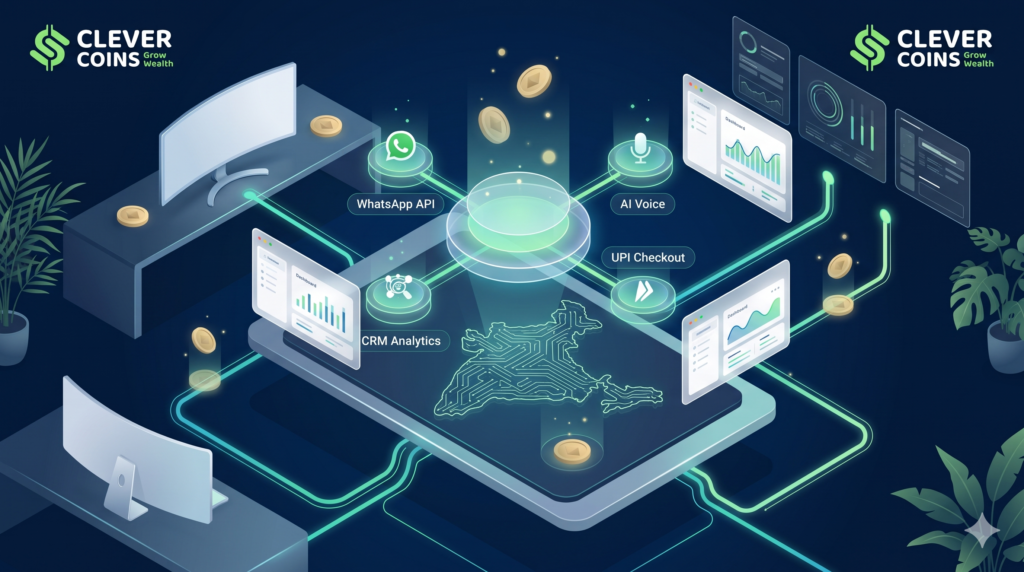
WhatsApp is no longer just a notification channel for shipping updates; it is India’s premier full-funnel storefront. Modern setups integrate the WhatsApp Business API directly with product catalogs, AI shopping assistants, and native WhatsApp Pay / UPI checkout flows.
Click-to-WhatsApp Ads (CTWA): Instead of sending paid Meta ad traffic to slow-loading mobile landing pages where drop-off exceeds 70%, high-converting setups route clicks straight into an automated, personalized WhatsApp conversation pre-populated with the exact product or offer the user clicked on.
In-Chat Catalogs & Cart Recovery: When a shopper abandons a cart on Shopify, WooCommerce, or ONDC, the automation engine triggers a rich interactive WhatsApp message containing the exact product image, dynamic discount code, and a one-tap UPI payment link.
Interactive Flows: Using native WhatsApp Flows, users can book test drives, schedule tax consultations, calculate loan EMIs, or select clinic appointment slots without ever leaving the chat window.
Pillar 2: Autonomous AI Voice Agents & Instant Speed-to-Lead
Text automation alone cannot close high-ticket Indian purchases. Whether someone is inquiring about a ₹1.5 crore apartment in Bengaluru, an MBA program in Pune, or a B2B compliance package in Mumbai, Indian buyers still value human-like reassurance over a phone call.
Sub-10-Second AI Voice Response: The moment a lead submits a form at 10:45 PM on a Sunday, an AI voice agent initiates an outbound call within seconds.
Real-Time Qualification & Code-Switching: Powered by India-tuned speech models (such as Sarvam AI and advanced multilingual LLMs), modern voice agents converse naturally in English, Hindi, Tamil, Telugu, and regional dialects. They verify intent, ask qualifying questions (budget, timeline, location), handle basic objections, and tag the lead in the CRM as
HOT,WARM, orCOLD.Smart Human Handoff:
HOTleads are immediately routed via warm transfer or instant Slack/WhatsApp alert to a human closer with a complete AI-generated summary of the call, ensuring human salespeople spend 100% of their time on qualified buyers.
Pillar 3: Hyper-Vernacular & Cultural Localization at Scale
Future automation setups do not simply run English copy through basic machine translation. True localization adapts tone, cultural references, festival calendars, and regional purchasing triggers.
Dynamic Geo-Language Routing: Based on IP address, phone number circle, pincode, or past interaction language, your Customer Data Platform (CDP) automatically assigns a preferred language attribute to every profile.
Hyperlocal Festival & Payday Triggers: Instead of sending a single generic “Mega Sale” blast across India, intelligent workflows trigger regional campaigns aligned with Onam in Kerala, Durga Puja in West Bengal, Pongal in Tamil Nadu, Gudi Padwa in Maharashtra, and salary-credit windows (1st to 7th of every month) for urban salaried segments.
Pillar 4: Unified Customer Data Platforms (CDP) & First-Party Data Engines
With third-party cookies crumbling and iOS/Android privacy restrictions tightening signal visibility, first-party data is the single most valuable asset an Indian business owns.
Identity Resolution: A modern setup unifies fragmented touchpoints—website visits, mobile app events, WhatsApp replies, offline POS store purchases, UPI transactions, and customer support tickets—into a single 360-degree Golden Customer Record.
Behavioral Event Streaming: Rather than static lists (“all users who signed up in January”), segments update dynamically in real time (e.g., “Users in Tier-2 cities who viewed the pricing page twice in 48 hours, opened the WhatsApp brochure, but haven’t booked a demo”).
Pillar 5: Predictive AI Scoring, Churn Prevention & Dynamic Budgeting
Basic automation reacts to what a user did. Predictive AI automation anticipates what a user will do next.
Propensity-to-Buy Modeling: Machine learning models analyze historical conversion patterns to assign a dynamic purchase probability score to every visitor. High-intent visitors see streamlined checkout flows without margin-killing discounts, while hesitant browsers receive targeted social proof or limited-time incentives.
Predictive Churn & LTV Expansion: In subscription businesses, SaaS, and D2C consumables (skincare, health supplements, coffee), predictive workflows spot declining engagement or delayed reorder cycles early—automatically launching win-back sequences before the customer churns.
Algorithmic Ad Budget Reallocation: Advanced setups connect CRM revenue data directly to ad engines, automatically shifting ad spend away from fatigued creatives or low-LTV audiences toward high-converting regional segments in real time.
Pillar 6: Closed-Loop Attribution via Server-Side Tracking & CAPI
One of the biggest leaks in Indian performance marketing is optimizing ad algorithms for cheap, low-intent leads. If you tell Meta or Google Ads to optimize for “form fills,” their algorithms will happily find thousands of people who fill out forms and never pick up the phone.
Server-Side Tracking (GTM Server-Side): Bypasses browser ad-blockers and signal loss by sending clean conversion events directly from your server to ad platforms.
Meta Conversions API (CAPI) & Google Enhanced Conversions for Leads: When a lead moves from
New Enquiry→Qualified on Call→Site Visit / Demo Completed→Paid Customerinside your CRM, the automation pipeline fires those offline milestone events back to Meta and Google. Within weeks, your ad algorithms stop hunting for cheap clicks and start targeting lookalike audiences of actual paying customers.
Pillar 7: DPDP-Compliant Consent & Preference Governance
Under India’s Digital Personal Data Protection framework, businesses act as Data Fiduciaries and must prove explicit, informed, and revocable consent before processing personal data for marketing.
Granular Consent Capture: Automation forms and WhatsApp opt-ins clearly separate transactional permissions (order updates, tax invoices) from promotional marketing permissions.
Automated Suppression & Opt-Out Sync: If a user types
"STOP"on WhatsApp or unsubscribes via email, a unified consent ledger suppresses that user across every connected ad audience, SMS gateway, and outbound dialer within milliseconds.
3. Comparing Legacy vs. Modern Indian Marketing Automation Setups
| Dimension | Legacy Automation Setup (2018–2023) | Future-Ready Indian Setup (2026 & Beyond) |
| Primary Channel | Email-centric with manual SMS blasts | WhatsApp-first omnichannel (WhatsApp + RCS + Voice + Email + In-App) |
| Lead Response Time | Hours or next business day via manual telecallers | Under 10 seconds via AI Voice & WhatsApp conversational agents |
| Language Capability | English-only or static pre-translated templates | Real-time multilingual & Hinglish code-switching across 10+ Indian languages |
| Logic & Triggers | Linear, time-based drip sequences (“Wait 2 days, send Email B”) | Event-driven & AI-predictive based on real-time intent and behavior |
| Ad Attribution | Pixel-based front-end tracking (optimizing for raw leads) | Server-side CAPI closed-loop CRM sync (optimizing for qualified pipeline & revenue) |
| Checkout & Payments | Redirects to external web pages with high drop-off | Native in-chat UPI, Razorpay, and ONDC zero-friction checkout |
| Data Privacy | Unstructured spreadsheets and manual opt-outs | Centralized DPDP-compliant consent engine with automated audit logs |
| Stack Architecture | Fragmented “glue tools” prone to webhook breakage | Unified composable CDP + CRM + AI orchestration core |
4. Recommended Tech Stack Architecture for Indian Businesses
Choosing the right tools depends heavily on your business model, transaction volume, and internal technical maturity. Over-buying enterprise software early leads to shelfware, while under-investing creates scaling bottlenecks.
Tier 1: Lean & Agile Stack for Startups & SMBs (₹5 Cr – ₹25 Cr Revenue)
Ideal for fast-moving teams that need rapid deployment without a dedicated DevOps team.
CRM & Core Automation: Zoho CRM Plus, HubSpot Starter/Pro, or India-built unified platforms like TeleCRM / LeadSquared.
WhatsApp Business API & Chat Automation: Wati, Interakt, AiSensy, or Gallabox.
Payment & Checkout Integration: Razorpay Magic Checkout or Cashfree linked via native webhooks.
Middleware & Glue: Make.com or Pabbly Connect (an Indian SaaS favorite for cost-effective multi-step workflows).
Estimated Monthly Software Investment: ₹15,000 – ₹45,000/month.
Tier 2: Growth & D2C Scale-Up Stack (₹25 Cr – ₹150 Cr Revenue)
Designed for high-volume e-commerce, edtech, fintech, and consumer brands needing deep behavioral segmentation.
Omnichannel Marketing Automation & CDP: WebEngage, MoEngage, or CleverTap (all Indian-born global leaders engineered specifically for mobile-first, high-concurrency Indian traffic).
Conversational AI & WhatsApp Commerce: Gupshup, Yellow.ai, or Haptik for enterprise-grade AI bots and WhatsApp Flows.
AI Voice & Tele-Qualification: Sarvam AI-powered voice stacks, SquadStack, or Branofy.
Server-Side Tracking & Attribution: Stape.io (GTM Server-Side) + Meta CAPI + GA4 BigQuery export.
Estimated Monthly Software Investment: ₹75,000 – ₹2,50,000/month.
Tier 3: Enterprise & Regulated Financial/Healthcare Stack (₹150 Cr+ Revenue)
Built for banks, NBFCs, insurance providers, hospital chains, and large conglomerates requiring strict data localization and custom ML models.
Enterprise Cloud & CDP: Salesforce Marketing Cloud + Data Cloud, Adobe Experience Platform, or RudderStack (for warehouse-native CDP architecture).
Data Warehouse & BI: Snowflake or Google BigQuery paired with Looker / Power BI.
Custom AI & Vernacular LLM Layer: Azure OpenAI / Vertex AI hosted in Mumbai (
asia-south1) or Hyderabad (asia-south2) regions to guarantee strict Indian data residency compliance.
5. Step-by-Step Implementation Roadmap: Setting Up Your Automation Engine
Even the best software fails without disciplined implementation. Follow this five-phase blueprint to deploy a high-ROI marketing automation setup in 90 days.
Phase 1: Data Hygiene, Schema Design & Consent Audit (Days 1–15)
Before connecting a single automation workflow, fix your data foundation.
Standardize Contact Identifiers: In India, phone numbers are the true primary key—not email addresses. Enforce strict E.164 formatting (
+91XXXXXXXXXX) across all forms, landing pages, and imports to prevent duplicate records.Define Lifecycle Stages: Establish clear, unambiguous CRM stages:
Subscriber→Lead→Marketing Qualified Lead (MQL)→Sales Qualified Lead (SQL)→Opportunity→Customer→Repeat Advocate.Implement Consent Tags: Add explicit opt-in checkboxes on all lead capture points with timestamps and source URLs logged automatically to satisfy DPDP audit requirements.
Phase 2: Core Pipeline & Speed-to-Lead Integration (Days 16–35)
Connect All Lead Sources: Wire Meta Lead Ads, Google Lead Form Extensions, website forms, WhatsApp QR codes, and marketplace inquiries directly into your CRM via real-time webhooks.
Deploy Instant Acknowledgement: Configure an immediate (under 5 seconds) WhatsApp welcome message personalized with the user’s name and requested resource (e.g., brochure, price sheet, or consultation link).
Activate Automated Lead Routing: Set up round-robin or territory-based assignment rules (e.g., routing Mumbai inquiries to the West Zone pod and Bengaluru inquiries to the South Zone pod) alongside automated AI voice qualification for high-intent tiers.
Phase 3: High-Impact Lifecycle Workflows (Days 36–60)
Focus on the four workflows that generate 80% of immediate revenue lift rather than building dozens of complex edge-case journeys:
The Interactive Welcome & Onboarding Journey: Educate new sign-ups over 5 days using a mix of short vertical videos, WhatsApp carousels, and trust-building case studies.
Multi-Channel Cart / Application Drop-Off Recovery: Trigger a 3-step sequence (30 minutes via WhatsApp, 6 hours via dynamic email/RCS, 24 hours via incentive or human callback) for abandoned carts or incomplete KYC/application forms.
Post-Purchase Delight & Cross-Sell Engine: Automate GST invoice delivery on WhatsApp, real-time courier tracking updates, a 7-day product usage tip, and a 30-day replenishment reminder.
Dormant Customer Win-Back: Automatically detect users with zero engagement for 60–90 days and trigger a personalized re-engagement offer or preference check-in.
Phase 4: Closed-Loop Attribution & Server-Side CAPI (Days 61–75)
Configure Server-Side GTM: Route website behavioral events through a first-party subdomain (
metrics.yourdomain.com) to eliminate tracking blind spots.Enable CRM-to-Ad-Platform Sync: Map your CRM’s
Qualified LeadandClosed Wonstages to Meta CAPI and Google Offline Conversion Tracking. Pass back actual transaction values (in INR) so ad platforms optimize for Return on Ad Spend (ROAS) rather than raw lead volume.
Phase 5: AI Optimization, A/B Testing & Governance (Days 76–90+)
Continuous Experimentation: Run structured A/B tests on WhatsApp message hooks, send-time optimization, regional language variants, and AI voice scripts.
Human-in-the-Loop Guardrails: Establish weekly quality audits of AI chatbot transcripts and voice call recordings to catch hallucinations, cultural tone mismatches, or broken logic branches early.
6. Industry-Specific Automation Blueprints in India
Different Indian sectors require tailored automation mechanics to match buyer psychology and regulatory norms:
D2C & E-Commerce: Focus on COD-to-Prepaid conversion flows. Because Cash-on-Delivery (COD) orders in India suffer high Return-to-Origin (RTO) rates, top D2C brands trigger an automated WhatsApp confirmation immediately after a COD order is placed—offering an instant ₹50 discount or free gift if the buyer converts to UPI payment within 15 minutes.
B2B SaaS, Tax, Legal & Business Consulting: High-trust advisory businesses rely on diagnostic lead magnets and automated consultation scheduling. When a founder downloads a compliance checklist or uses an online entity-structure calculator, automation scores their company size, sends tailored regulatory insights via email and WhatsApp, and guides them into a pre-qualified calendar slot with zero back-and-forth emails.
Real Estate & Automotive: Long consideration cycles demand automated site-visit reminders, hyperlocal Google Maps location pins on WhatsApp, virtual walkthrough videos, and post-visit feedback loops synced with field sales apps.
EdTech & Healthcare: Combine vernacular voice outreach for parents/patients with automated webinar/appointment reminders (24 hours, 2 hours, and 15 minutes prior) to slash no-show rates by up to 40%.