The e-Invoice Revolution That Every Business Must Understand in 2026
India’s Goods and Services Tax (GST) regime has undergone one of its most transformative upgrades in recent years with the mandatory implementation of the electronic invoicing (e-Invoice) system. What began as a pilot for large corporations has now cascaded down to cover businesses with turnovers as low as ₹5 Crore, making it one of the most far-reaching compliance changes in the history of Indian taxation.
In 2026, the GST e-Invoice system is no longer optional for the vast majority of B2B businesses in India. Whether you run a mid-size manufacturing unit in Pune, a trading company in Surat, a service firm in Bengaluru, or a wholesale distributor in Delhi – if your aggregate annual turnover crosses the mandatory threshold, you are legally required to generate e-Invoices through the government’s Invoice Registration Portal (IRP).
This comprehensive guide breaks down everything you need to know: the current mandatory thresholds, who is covered, who is exempt, how the system works technically, what happens if you don’t comply, and exactly how to get started. All information is updated as per the latest CBIC notifications and GST Council decisions applicable in 2026.
Quick-Glance Summary – e-Invoice in India 2026
Parameter | Current Status (2026) |
Mandatory Turnover Threshold | ₹5 Crore Aggregate Annual Turnover |
Applicability | All registered taxpayers above threshold (B2B, B2G, Exports) |
Applicable Transactions | B2B Invoices, Debit Notes, Credit Notes, Export Invoices |
Portal for Generation | Invoice Registration Portal (IRP) – NIC & GSTN operated |
Unique Reference | IRN (Invoice Reference Number) – 64-character hash |
QR Code | Mandatory on every e-Invoice |
Time Limit for Reporting (≤₹100 Cr) | 30 days from invoice date |
Time Limit for Reporting (>₹100 Cr) | 7 days from invoice date (effective March 2024, still in force 2026) |
Penalty for Non-Compliance | ₹10,000 per invoice (under Section 122 of CGST Act) |
Governing Body | Central Board of Indirect Taxes & Customs (CBIC) |
What Is GST e-Invoicing? – A Complete Conceptual Understanding
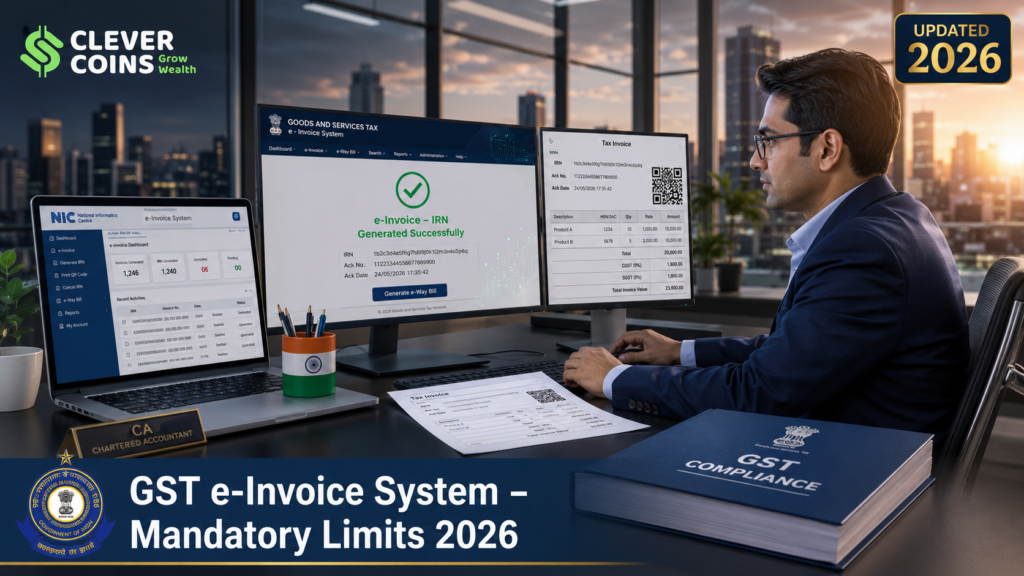
The term ‘e-Invoice’ in the GST context does NOT mean a PDF invoice sent over email or a digitally created bill. It refers to a highly specific process where a business uploads its invoice details in a standardised JSON format to the government’s Invoice Registration Portal (IRP), which then authenticates the invoice, assigns a unique Invoice Reference Number (IRN), embeds a digitally signed QR Code, and returns the validated invoice back to the supplier.
This entire process happens in real time – typically within seconds. The validated e-Invoice is then shared with the buyer, and the data flows automatically into both the supplier’s GSTR-1 and the buyer’s GSTR-2A/2B, dramatically reducing manual data entry and the risk of fraudulent input tax credit (ITC) claims.
The Core Philosophy Behind e-Invoicing
- Eliminate fake invoices and fraudulent ITC claims – estimated to be ₹50,000+ Crore annually
- Create a seamless, pre-filled GST return ecosystem – reducing compliance burden
- Enable real-time tax monitoring by the government
- Facilitate faster loan processing for businesses using invoice data (e-Invoice as financial proof)
- Reduce tax evasion through automated cross-matching of buyer and seller data
- Support India’s goal of becoming a fully digital tax administration system
e-Invoice vs Traditional Invoice – Key Differences
Aspect | Traditional Invoice | GST e-Invoice |
Creation | Any format/software | Standardised schema (GSTN format) |
Validation | None (self-declared) | Government-validated via IRP |
Unique ID | Invoice number only | IRN – 64-character unique hash |
QR Code | Optional | Mandatory (digitally signed) |
GSTR-1 Auto-fill | Manual entry required | Automatic – no manual entry |
Buyer ITC | Buyer manually claims | Auto-reflected in GSTR-2B |
Cancellation | Simple internal process | Must cancel on IRP within 24 hours |
Audit Trail | Depends on business | Complete, tamper-proof trail |
Legal Validity | Physically signed | Digitally authenticated by IRP |
GST e-Invoice Mandatory Thresholds – The Complete Timeline (2020 to 2026)
Understanding how the threshold has evolved is critical for businesses to assess their compliance obligations. The government has progressively lowered the turnover threshold, expanding e-Invoice applicability in a phased manner to ensure smooth implementation.
Historical Rollout Timeline – e-Invoice Threshold Reduction
Phase | Effective Date | Turnover Threshold | Notification Reference |
Phase 1 | 01 October 2020 | ₹500 Crore & above | CBIC Notification 13/2020-CT |
Phase 2 | 01 January 2021 | ₹100 Crore & above | CBIC Notification 88/2020-CT |
Phase 3 | 01 April 2021 | ₹50 Crore & above | CBIC Notification 05/2021-CT |
Phase 4 | 01 April 2022 | ₹20 Crore & above | CBIC Notification 01/2022-CT |
Phase 5 | 01 October 2022 | ₹10 Crore & above | CBIC Notification 17/2022-CT |
Phase 6 | 01 August 2023 | ₹5 Crore & above | CBIC Notification 10/2023-CT |
Current (2026) | Ongoing | ₹5 Crore & above | Continuing per GST Council decision |
Expected Next Step | TBD by GST Council | ₹2 Crore (under consideration) | GST Council – Pending notification |
⚠️ 2026 STATUS: The mandatory threshold currently stands at ₹5 Crore aggregate annual turnover. The GST Council has been deliberating on lowering it further to ₹2 Crore and potentially ₹1 Crore in future phases. Businesses in the ₹2–5 Crore range should prepare their systems now.
Understanding ‘Aggregate Annual Turnover’ – How to Calculate
The threshold is based on Aggregate Annual Turnover (AATO) in any preceding financial year. This is NOT just your taxable turnover – it includes all of the following computed on a PAN-India basis across all GST registrations:
- Taxable supply value
- Exempt supply value
- Zero-rated supply (exports, SEZ supplies)
- Inter-state supply value
- Nil-rated supply value
- Non-GST supply value
Note: Inward supplies on which tax is paid on reverse charge basis (RCM) are EXCLUDED from AATO calculation.
Practical Examples – Are You Covered?
Business Scenario | AATO | e-Invoice Required? |
Manufacturer in Gujarat – ₹8 Cr taxable + ₹2 Cr exempt = ₹10 Cr | ₹10 Crore | YES ✅ |
Trader in Delhi – ₹4 Cr taxable + ₹0.5 Cr exempt = ₹4.5 Cr | ₹4.5 Crore | NO ❌ (Below ₹5 Cr) |
IT Company in Bengaluru – ₹6 Cr services (all taxable) | ₹6 Crore | YES ✅ |
Restaurant (B2C only) – ₹12 Cr turnover | ₹12 Crore | NO ❌ (B2C exempt – see exemptions) |
Exporter in Mumbai – ₹3 Cr domestic + ₹3 Cr exports = ₹6 Cr | ₹6 Crore | YES ✅ (Exports included in AATO) |
Freelance Consultant – ₹90 Lakh turnover | ₹90 Lakh | NO ❌ (Below threshold) |
Who Must Generate e-Invoices – Applicability & Scope (2026)
e-Invoice applicability is determined by two factors: (1) whether the taxpayer crosses the turnover threshold, and (2) the type of transaction or document being issued.
Types of Transactions That Require e-Invoicing
Document Type | e-Invoice Required? | Notes |
B2B Tax Invoice (Supply to registered person) | YES ✅ | Core applicability |
B2G Invoice (Supply to Government bodies) | YES ✅ | Govt. treated as registered person |
Export Invoice (Zero-rated supply) | YES ✅ | Required even for zero-tax exports |
SEZ Supply Invoice (With/without payment) | YES ✅ | Both with and without tax payment |
Credit Note (Against B2B invoice) | YES ✅ | Must reference original IRN |
Debit Note (Against B2B invoice) | YES ✅ | Must reference original IRN |
B2C Invoice (Supply to unregistered person) | NO ❌ | Exempt from e-Invoice mandate |
Nil-Rated Supply Invoice (B2B) | YES ✅ | Even if no tax, e-Invoice needed |
Exempt Supply Invoice (B2B) | YES ✅ | Exempt value but still needs IRN |
Delivery Challan | NO ❌ | Not an invoice – no IRN needed |
Bill of Supply (Composition/Exempt) | NO ❌ | Different document type |
Self-Invoice (RCM) | NO ❌ | e-Invoice not applicable to self-invoices |
Input Service Distributor (ISD) Invoice | NO ❌ | Specifically excluded |
Who Is EXEMPT from GST e-Invoice – Complete Exemption List 2026
Despite crossing the ₹5 Crore threshold, certain categories of registered taxpayers are specifically exempted from e-Invoice requirements under CBIC notifications. This exemption list is critical – misunderstanding it can lead to either unnecessary compliance burden or genuine non-compliance.
Category-Wise Exemptions (As Per CBIC Notification 13/2020-CT & Subsequent Amendments)
Exempted Category | Reason / Basis |
Banking Companies & Financial Institutions | Issue unique financial instruments, not standard invoices |
Non-Banking Financial Companies (NBFCs) | Regulated by RBI; separate documentation norms |
Insurance Companies | Policy documents differ from tax invoices |
Goods Transport Agencies (GTA) | Issue consignment notes, not standard invoices |
Passenger Transport Service Providers | Tickets are the primary document (not GST invoices) |
Multiplex Cinema Owners | Movie tickets are the receipt documents |
Special Economic Zone (SEZ) Units | SEZ units specifically exempted (not SEZ developers) |
Government Departments & PSUs (as suppliers) | Specifically exempted as suppliers (can be buyers) |
Input Service Distributors (ISD) | Distributes ITC via ISD invoice – different format |
Composition Scheme Taxpayers | Not eligible for ITC; issue Bill of Supply only |
Taxpayers under AATO ₹5 Crore | Below mandatory threshold |
Persons registered under Section 51 (TDS) | Tax Deductors – not regular suppliers |
Persons registered under Section 52 (TCS) | Tax Collectors (e-commerce operators) |
⚠️ IMPORTANT NOTE: Even if your primary business is exempt (e.g., GTA), if you have other taxable B2B supplies crossing ₹5 Crore, those specific supplies may still require e-Invoicing. Consult your GST practitioner for mixed-category businesses.
How the GST e-Invoice System Works – Technical Process Explained
The e-Invoice system operates through a standardised digital workflow involving your accounting/ERP software, the Invoice Registration Portal (IRP), and the GST Network (GSTN). Understanding this workflow is essential for smooth implementation.
Step-by-Step e-Invoice Generation Process
- INVOICE CREATION: Supplier creates the invoice in their accounting software (Tally, Busy, Zoho Books, SAP, etc.) or ERP system in the prescribed schema format
- JSON GENERATION: The software converts invoice data into a standardised JSON (JavaScript Object Notation) file as per GSTN’s e-Invoice schema (Version 2.1, 2026)
- UPLOAD TO IRP: The JSON is uploaded to the Invoice Registration Portal via API integration, direct upload, or through GSP (GST Suvidha Provider) / ASP (Application Service Provider)
- IRP VALIDATION: The IRP validates the JSON for: (a) format correctness, (b) GSTN validity of both supplier and buyer, (c) duplicate invoice check, (d) schema compliance
- IRN GENERATION: Upon successful validation, IRP generates the unique IRN (Invoice Reference Number) – a 64-character alphanumeric hash based on Supplier GSTIN + Financial Year + Invoice Series + Invoice Number
- QR CODE EMBEDDING: IRP generates a digitally signed QR Code containing key invoice details (IRN, Supplier GSTIN, Buyer GSTIN, Invoice No., Date, Value, HSN Code, IRN Date)
- SIGNED JSON RETURN: IRP returns the digitally signed JSON with IRN and QR Code to the supplier’s system
- PRINT & SHARE: Supplier prints the e-Invoice (with IRN and QR Code prominently displayed) and shares with the buyer
- AUTO-POPULATION: Invoice data auto-populates in Supplier’s GSTR-1 and Buyer’s GSTR-2A/2B – no separate data entry needed
Invoice Registration Portals (IRP) – 2026
IRP Portal | URL | Operated By |
NIC IRP 1 (Primary) | einvoice1.gst.gov.in | National Informatics Centre (NIC) |
NIC IRP 2 | einvoice2.gst.gov.in | National Informatics Centre (NIC) |
GSTN IRP | einvoice3.gst.gov.in | GST Network (GSTN) |
Cygnet IRP | einvoice4.gst.gov.in | Cygnet Infotech |
Clear IRP | einvoice5.gst.gov.in | ClearTax (Defmacro Software) |
EY IRP | einvoice6.gst.gov.in | Ernst & Young LLP |
Deloitte IRP | einvoice7.gst.gov.in | Deloitte Haskins & Sells LLP |
✅ All 7 IRPs are inter-operable. An IRN generated from any IRP is valid across all portals and is accepted universally by GSTN. Choose any IRP based on your software integration or preference.
Understanding IRN and QR Code – The Heart of e-Invoice
What Is an IRN (Invoice Reference Number)?
The IRN is a unique 64-character alphanumeric code generated by the IRP using a SHA-256 hash algorithm. It is derived from four parameters:
- Supplier’s GSTIN (15 characters)
- Financial Year (in YYYY-YY format, e.g., 2025-26)
- Document Type (INV for Invoice, CRN for Credit Note, DBN for Debit Note)
- Supplier’s own Invoice Number/Document Number
Once an IRN is generated for a specific invoice, the same IRN cannot be regenerated. If an invoice is cancelled and re-issued, a new IRN must be generated for the new invoice.
Mandatory Fields in the QR Code
QR Code Field | Description |
Supplier GSTIN | 15-digit GST Identification Number of supplier |
Buyer GSTIN | 15-digit GST Identification Number of buyer |
Invoice Number | As per supplier’s document numbering |
Invoice Date | Date of invoice generation |
Invoice Value | Total invoice amount including GST (in ₹) |
Number of Line Items | Count of distinct goods/services in the invoice |
Main HSN Code | HSN/SAC of the primary goods or service |
IRN | Unique 64-character Invoice Reference Number |
IRN Generation Date & Time | Timestamp of IRP authentication |
Digital Signature | IRP’s digital signature validating authenticity |
How to Verify an e-Invoice QR Code
Any buyer, auditor, or tax officer can verify the authenticity of an e-Invoice by scanning the QR Code using: (1) the NIC e-Invoice QR Code Verifier App, (2) the GSTN e-Invoice portal search, or (3) any standard QR Code scanner that can read the JSON payload. The verification confirms that the invoice was authenticated by the government’s IRP and has not been tampered with.
Time Limits for Reporting Invoices to IRP – 2026 Rules
One of the most critical recent changes in the e-Invoice system is the introduction of strict time limits for reporting invoices to the IRP. Previously, there was no time restriction – invoices from any past date could be reported. This has now changed.
Current Time Limit Rules (2026)
Taxpayer Category (by Turnover) | Time Limit to Upload Invoice to IRP | Effective From |
Turnover > ₹100 Crore | 7 days from invoice date | 1 November 2023 (continues in 2026) |
Turnover ₹5 Crore to ₹100 Crore | 30 days from invoice date | 1 April 2025 onwards (updated) |
Turnover below ₹5 Crore | Not applicable (below threshold) | — |
🚨 CRITICAL: If you fail to upload the invoice within the prescribed time limit, the IRP will REJECT the upload. You will be unable to generate an IRN for that invoice. A rejected e-Invoice means no valid ITC for your buyer and potential penalty for you.
What Happens When You Miss the Time Limit?
- The IRP portal rejects the JSON upload with an error message citing the time limit breach
- The invoice cannot be reported as an e-Invoice after the deadline
- The buyer cannot claim ITC on that invoice (even if actual supply was made)
- The supplier may be penalised under Section 122 of the CGST Act – ₹10,000 per invoice
- The transaction may be flagged during GST audit and annual return reconciliation
- Solution: Always upload invoices to IRP on the same day as issuance or within 24-48 hours maximum
e-Invoice Cancellation and Amendment Rules
Cancellation of e-Invoice – Rules & Process
Once an IRN is generated, it is PERMANENT in the IRP system – it cannot be modified. However, it can be cancelled under specific conditions:
Cancellation Rule | Detail |
Time Limit for Cancellation | Within 24 hours of IRN generation ONLY |
Cancellation Portal | Same IRP where IRN was originally generated |
Partial Cancellation | NOT allowed – entire invoice must be cancelled |
Goods Already Moved | Cannot cancel if goods are already in transit (e-Way Bill active) |
Cancellation After 24 Hours | ONLY through issuing a Credit Note (no direct IRN cancellation possible) |
GSTR-1 Impact | Cancellation reflects automatically in GSTR-1 as cancelled |
Re-Issuance | Must generate a new invoice with a new invoice number and new IRN |
Amendment of e-Invoice
Direct amendment of an e-Invoice is NOT possible in the IRP system. If any field needs correction after IRN generation:
- Cancel the original e-Invoice within 24 hours (if cancellation window is open)
- Issue a fresh correct invoice with a new invoice number
- Generate new IRN for the corrected invoice
- If cancellation window (24 hours) has passed: Issue a Credit Note to nullify the original e-Invoice, then issue a fresh correct invoice with new IRN
e-Invoice and e-Way Bill Integration – How They Connect
The e-Invoice and e-Way Bill systems are tightly integrated. When an e-Invoice is generated for a transaction involving movement of goods (consignment value above ₹50,000), the e-Way Bill is automatically generated simultaneously, eliminating the need for separate e-Way Bill generation.
Key Integration Points
- When generating an e-Invoice with transportation details (transporter ID, vehicle number), the system auto-generates e-Way Bill
- The IRN from the e-Invoice is automatically linked with the e-Way Bill Number (EWB No.)
- If transport details are not available at the time of e-Invoice generation, Part-B of e-Way Bill can be filled separately later
- Cancellation of e-Invoice within 24 hours also cancels the linked e-Way Bill (if not already in transit)
- The e-Way Bill cannot be cancelled if goods are already being transported – IRN linked to it also becomes non-cancellable
✅ PRO TIP: This integration eliminates a major pain point for businesses. Previously, two separate portals (einvoice1.gst.gov.in and ewaybill.nic.in) had to be accessed. Now, a single API call to IRP with transport details generates both the IRN and the EWB No. simultaneously.
Penalties & Consequences for Non-Compliance with e-Invoice Rules
Non-compliance with e-Invoice requirements carries significant financial and legal consequences under the CGST Act, 2017, as reinforced by CBIC circulars. The penalties are designed to be deterrent enough to ensure universal compliance.
Penalty Structure for e-Invoice Non-Compliance
Violation | Applicable Penalty | Section / Rule |
Non-generation of e-Invoice (IRN) for applicable transaction | ₹10,000 per invoice (minimum) | Section 122(3)(e), CGST Act |
Incorrect e-Invoice (wrong GSTIN, wrong value, etc.) | ₹25,000 per invoice (if intentional) | Section 122, CGST Act |
Buyer claiming ITC on invoice without IRN | Full ITC reversal + 18% interest p.a. | Section 16, CGST Act |
Non-display of IRN/QR Code on printed invoice | ₹10,000 per invoice | Rule 48(4), CGST Rules |
Failure to cancel incorrect e-Invoice within 24 hours | Reconciliation discrepancy + potential scrutiny | GST Audit risk |
GTA or exempt entity wrongly generating e-Invoice | Procedural warning + correction required | CBIC Circular |
Late reporting beyond 7-day / 30-day time limit | IRP rejects upload; invoice non-compliant | Rule 48, GSTN System |
🚨 BUYER ALERT: If a supplier is required to generate an e-Invoice but has not done so, the buyer’s Input Tax Credit (ITC) on that invoice is at RISK. GSTN may flag such invoices during GSTR-2B auto-population. Always demand IRN and verify QR Code before processing supplier payments.
Technical Requirements for e-Invoice Implementation
Setting up e-Invoice generation requires both software and operational readiness. Here is a complete technical checklist for businesses.
Software & System Requirements
- GST-compliant accounting/ERP software with e-Invoice API integration (Tally Prime, Busy Accounting, Zoho Books, QuickBooks India, SAP, Oracle Financials, Microsoft Dynamics, Marg ERP, etc.)
- API credentials from NIC/GSTN or through a GST Suvidha Provider (GSP)
- Stable internet connectivity (e-Invoice generation is a real-time online process)
- HSN/SAC code master data updated in your software (mandatory field in e-Invoice schema)
- Correct GSTIN data for all registered customers (buyer GSTIN mandatory for B2B)
- e-Invoice JSON Schema Version 2.1 compliance (latest as of 2026
Mandatory Fields in e-Invoice Schema (Key Fields)
Field Category | Mandatory Fields |
Document Details | Document Type, Document Number, Document Date, Reverse Charge (Y/N) |
Supplier Details | Supplier GSTIN, Legal Name, Trade Name, Address, State, PIN, Phone, Email |
Buyer Details | Buyer GSTIN, Legal Name, Trade Name, Address, State, PIN, POS (Place of Supply) |
Invoice Item Details | Line Item Serial, Product Description, HSN/SAC Code, Quantity, Unit, Unit Price, Taxable Value |
Tax Details | IGST/CGST/SGST Rate, Tax Amount per line, Total Tax Amount |
Total Value | Assessable Value, Total Tax, Total Invoice Value (₹), Value in Words |
Export Details (if applicable) | Shipping Bill No., Port Code, Currency Type, Country Code |
Transport Details (if applicable) | Transporter GSTIN, Transport Mode, Vehicle No., Distance (km) |
GST Suvidha Providers (GSPs) and Application Service Providers (ASPs) – Your e-Invoice Partners
For businesses that cannot directly integrate with the IRP API (typically smaller businesses or those without dedicated IT teams), GSPs and ASPs offer a middleware solution.
Difference Between GSP and ASP
Parameter | GSP (GST Suvidha Provider) | ASP (Application Service Provider) |
What it is | Licensed intermediary connected to GSTN API | Software solution that connects through GSP |
Who it serves | Large enterprises, tech platforms | Small-medium businesses, individual taxpayers |
Direct GSTN Connection | YES – direct API licence from GSTN | NO – connects through a GSP |
Examples | ClearTax, Tally, Marg, Cygnet, Masters India | Zoho Books, Busy, Biz Analyst (use GSPs) |
Cost | API subscription charges | Included in accounting software subscription |
Best For | High-volume invoice generators (1000+ daily) | SME businesses (10-500 invoices daily) |
Top GSPs/ASPs for e-Invoice in India (2026)
- ClearTax (cleartax.in) – One of India’s largest; excellent API and bulk upload features
- Tally Prime – Most widely used by Indian SMEs; built-in e-Invoice integration
- Zoho Books – Cloud-based; automatic e-Invoice and e-Way Bill generation
- Masters India – Strong enterprise API connectivity
- Busy Accounting Software – Popular among traders; offline+online e-Invoice
- Marg ERP – Widely used in pharma, FMCG distribution
- GSTN’s own portal (einvoice1.gst.gov.in) – Free bulk upload for up to 100 invoices/day
Sector-Specific e-Invoice Guidance for 2026
Manufacturing Sector
Manufacturers with AATO > ₹5 Crore must generate e-Invoices for all B2B supplies. Multi-GST registration manufacturers must maintain separate invoice series per GSTIN. HSN codes at 4-digit or 8-digit level (as applicable by turnover) must be accurate. Job-work challans do NOT require e-Invoice; only the final supply invoice does.
Trading / Wholesale Distribution Sector
Traders must ensure GSTIN data of all registered customers is up-to-date. Invoices for registered buyers must always carry IRN. For cash sales to end consumers (B2C), e-Invoice is not required. However, dynamic QR Code (not the IRP-generated one) must be displayed on B2C invoices above ₹500 for traders with AATO > ₹500 Crore.
Services Sector (IT, Consulting, Professional Services)
Service providers must use SAC (Service Accounting Code) instead of HSN. Reverse charge mechanism (RCM) self-invoices do NOT require e-Invoice. Export of services invoices DO require e-Invoice (since they are zero-rated supplies). Subscription-based recurring invoices must each get a separate IRN.
Healthcare & Pharmaceutical Sector
Pharma manufacturers and distributors above ₹5 Crore must generate e-Invoices. Hospitals providing composite services (medical + bed charges) – the taxable component’s B2B invoices require e-Invoice. Medicine supply to hospitals (B2B) mandatorily needs IRN. HSN codes for Schedule H/H1 drugs must be precisely mentioned.
Real Estate & Construction
Developers supplying under-construction properties to B2B buyers (investors, commercial buyers) require e-Invoice for the taxable portion. Pure residential under-construction properties supplied to individuals (B2C) are exempt. Works contract services billed to registered entities require e-Invoice.
E-Commerce & Retail
E-commerce operators registered under Section 52 (for TCS) are exempt from e-Invoice as operators. However, sellers on e-commerce platforms who have AATO > ₹5 Crore must generate e-Invoices for their B2B sales on and off the platform. B2C invoices on platforms like Amazon, Flipkart, Meesho, etc. do not require IRP-generated e-Invoice.
Impact of e-Invoice on Input Tax Credit (ITC) Claims – 2026
The e-Invoice system has fundamentally changed how Input Tax Credit works in India. The implications for buyers are profound and non-compliance by suppliers directly impacts buyer ITC eligibility.
How e-Invoice Strengthens ITC Claims
- Auto-populated GSTR-2B: Invoice data flows automatically from seller’s IRP upload to buyer’s GSTR-2B – making ITC claims more reliable and audit-proof
- No manual data entry errors: Eliminates mismatch between GSTR-1 of supplier and GSTR-3B of buyer
- ITC Blocked for Non-Compliant Invoices: Rule 36(4) of CGST Rules – ITC available only for invoices reflected in GSTR-2B (which requires valid IRN)
- Faster ITC reconciliation: Finance teams spend significantly less time on purchase invoice matching
- Reduced fraudulent ITC: GSTN system cross-validates both supplier and buyer GSTIN, invoice value, and tax amount
What Buyers Must Do to Protect Their ITC
- Always request IRN and QR Code on every B2B invoice from suppliers above ₹5 Crore
- Scan and verify QR Code before making supplier payments
- Reconcile your purchase register with GSTR-2B monthly
- Do NOT claim ITC on any B2B invoice without a valid IRN if supplier is mandatorily covered
- If supplier disputes e-Invoice requirement, verify their AATO and report to GST helpdesk if needed
Step-by-Step Compliance Roadmap – How to Implement e-Invoice in Your Business
Phase 1 – Assessment (Week 1-2)
- Calculate your Aggregate Annual Turnover (AATO) for the immediately preceding financial year
- Confirm whether you cross the ₹5 Crore threshold
- Check if your business falls under any exemption category
- Identify all GST registrations under your PAN (multi-state businesses)
- Review your existing accounting/ERP software for e-Invoice capability
Phase 2 – Software Setup (Week 3-4)
- Contact your accounting software vendor (Tally, Zoho, Busy, SAP, etc.) for e-Invoice module activation
- Alternatively, register on einvoice1.gst.gov.in directly for API credentials
- Update all customer master data with correct GSTINs
- Update product/service master data with correct HSN/SAC codes
- Configure invoice numbering series (must be unique across your GSTIN)
Phase 3 – Testing (Week 5)
- Test e-Invoice generation using the Sandbox environment: einvoice1.gst.gov.in (Sandbox mode)
- Generate at least 20-30 test IRNs to ensure system stability
- Test e-Invoice cancellation workflow
- Verify QR Code scanning using NIC’s verifier app
- Train accounts and finance team on the new workflow
Phase 4 – Go-Live (Week 6 onwards)
- Switch to Live mode on IRP
- Generate IRN for every B2B invoice from the go-live date
- Print IRN and QR Code on all invoices shared with buyers
- Set up daily monitoring – check for failed IRN generations and resolve within time limit
- Reconcile e-Invoice data with GSTR-1 monthly
Frequently Asked Questions – GST e-Invoice 2026
Q1. Do I need e-Invoice even for zero-GST or nil-rated B2B supplies?
YES. Even if the invoice carries 0% GST (nil-rated or zero-rated), if it is a B2B transaction and you cross ₹5 Crore AATO, e-Invoice (IRN) is mandatory. The system validates the transaction, not just the tax amount.
Q2. My software is down on the invoice date. Can I generate IRN later?
PARTIALLY. You can generate the IRN up to the time limit (7 days for >₹100 Cr; 30 days for ₹5–100 Cr). However, the invoice date on the e-Invoice must match the actual invoice date. You cannot back-date to avoid penalties. Always have a backup upload method (NIC portal manual upload) ready.
Q3. Can I show IRN on a separate page/attachment instead of the main invoice?
- As per Rule 48(6) of CGST Rules, the IRN (and QR Code) must be printed ON the invoice itself. A separate attachment is not acceptable. Failure to display IRN on the invoice face constitutes non-compliance.
Q4. I cancelled an invoice after 24 hours. What should I do?
Issue a Credit Note against the original e-Invoice. The Credit Note must also be generated as an e-Invoice (with its own IRN), referencing the original invoice number. This effectively nullifies the original invoice in the GST system.
Q5. Is e-Invoice required for advance payment receipts?
- Advance receipts (for which a receipt voucher is issued) do not require e-Invoice. Only Tax Invoices, Credit Notes, and Debit Notes for B2B transactions require IRN.
Q6. What is the GSTN’s Sandbox environment for?
The Sandbox is a test environment at einvoice1.gst.gov.in where businesses can test their e-Invoice generation software integration without generating actual IRNs. Any IRN generated in Sandbox is not valid for GST purposes and will not appear in GSTR-1. Use it extensively before going live.
Key Government Resources & Portals for e-Invoice (2026)
Resource | URL / Contact | Purpose |
NIC e-Invoice Portal (Primary IRP) | einvoice1.gst.gov.in | IRN generation, cancellation, verification |
GSTN e-Invoice Portal | einvoice3.gst.gov.in | Alternative IRP operated by GSTN |
GST Portal | gst.gov.in | GST registration, returns, payment |
e-Way Bill Portal | ewaybill.nic.in | e-Way Bill generation (also integrated with IRP) |
CBIC Official Website | cbic.gov.in | All notifications, circulars, clarifications |
GST Council Secretariat | gstcouncil.gov.in | GST Council meeting outcomes & updates |
GST Helpdesk | 1800-103-4786 (Toll-Free) | Technical and compliance queries |
e-Invoice Sandbox | einvoice1.gst.gov.in (Sandbox tab) | Testing before live integration |
GST QR Verifier App | Available on Android / iOS | Verify e-Invoice QR Code authenticity |
Conclusion – e-Invoice Is Not Optional, It Is the New Standard for Indian Business
The GST e-Invoice system in 2026 represents the maturation of India’s digital tax administration. With over 40 crore e-Invoices being generated monthly across the country, the system has proven its scale, reliability, and effectiveness in curbing tax evasion while simultaneously simplifying compliance for honest businesses.
For businesses currently above the ₹5 Crore threshold, e-Invoice compliance is non-negotiable. For businesses approaching this threshold – in the ₹2–5 Crore range – the writing is on the wall. The GST Council has consistently shown its intent to bring all B2B transactions under the e-Invoice umbrella, and the ₹2 Crore threshold is expected to be notified in the near future.
The good news: once properly implemented, the e-Invoice system actually reduces your compliance burden significantly. Your GSTR-1 fills itself. Your buyer’s ITC is protected. Audit risk drops dramatically. And your business gains a layer of digital credibility that banks and investors increasingly value.
Do not wait for a notice or penalty to push you toward compliance. Implement e-Invoice today, train your team, and turn a mandatory requirement into a competitive advantage.
“In the digital economy, your e-Invoice is your business’s digital identity. Protect it, perfect it.”