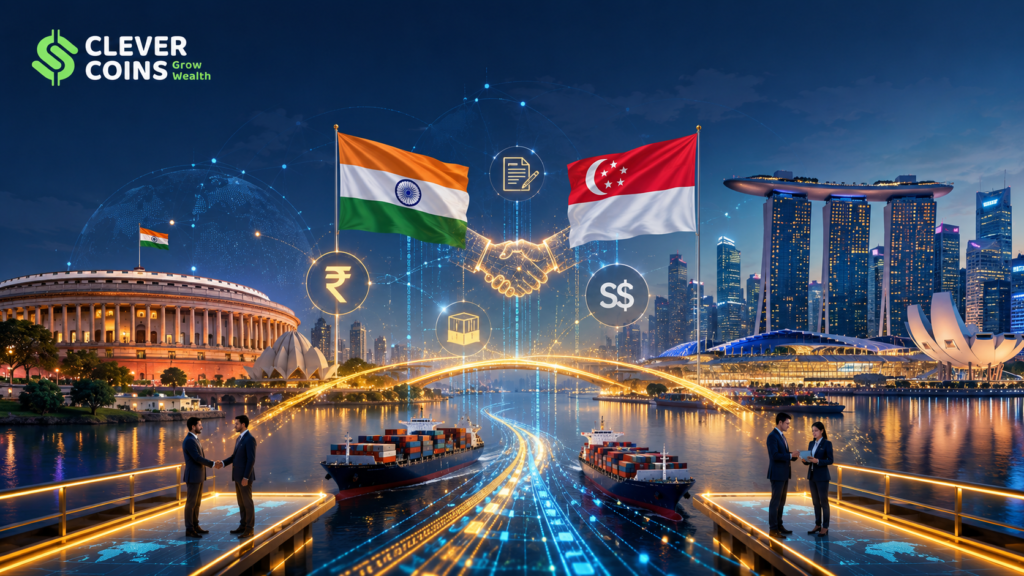
The India–Singapore CECA at a Glance
The Comprehensive Economic Cooperation Agreement (CECA) between India and Singapore, signed on 29 June 2005 and enforced from 1 August 2005, remains one of India’s most strategically significant bilateral free trade agreements. Now in its third decade of operation and continuously reviewed, the CECA has evolved from a trade-liberalisation framework into a full-spectrum economic partnership covering goods, services, investments, intellectual property, and professional mobility.
As of 2026, with India’s GDP surpassing ₹3,50,000 crore (approximately USD 4.2 trillion at current exchange rates) and Singapore retaining its position as Asia’s premier financial and logistics hub, the CECA has never been more relevant for Indian businesses seeking global expansion. Bilateral merchandise trade between the two nations stood at approximately ₹1,10,000 crore (USD 13.2 billion) in 2025–26, with services trade adding another ₹75,000 crore to the equation.
This comprehensive blog explores every dimension of the India–Singapore CECA — its structure, business benefits, sector-specific advantages, 2026 updates, compliance requirements, and how Indian entrepreneurs, SMEs, and large corporates can leverage it for sustainable growth.
What is the India–Singapore CECA?
Historical Background & Legal Framework
The CECA is a comprehensive bilateral economic treaty negotiated under the Ministry of Commerce and Industry, Government of India, and Singapore’s Ministry of Trade & Industry. It covers:
- Trade in Goods (tariff concessions, rules of origin, customs procedures)
- Trade in Services (market access, national treatment)
- Investment (protection, promotion, dispute resolution)
- Intellectual Property Rights (IPR)
- Competition Policy
- Movement of Natural Persons (MNP) — professional mobility
- e-Commerce provisions
- Government Procurement transparency
The Agreement aligns with India’s WTO obligations and the ASEAN-India Free Trade Agreement (AIFTA), but goes significantly further in several domains, particularly services and investment.
2026 Amendments & Review Status
The CECA underwent its fourth comprehensive review cycle in 2024–25. The updated framework, which came into effect from April 2026, includes:
- Enhanced tariff concessions on 95% of traded goods (up from 81% under the original schedule)
- Expanded Positive List for services under Mode 3 (commercial presence) and Mode 4 (natural persons)
- New digital trade provisions aligned with India’s Digital India 3.0 and Singapore’s Digital Economy Agreement (DEA) framework
- Revised dispute resolution timelines (reduced to 18 months from 24 months)
- Updated investment safeguard clauses reflecting India’s Foreign Exchange Management Act (FEMA) 2024 amendments
Trade in Goods: Tariff Benefits & Opportunities
Tariff Reduction Schedule (2026 Status)
Under the CECA’s tariff liberalisation schedule, Indian exporters enjoy significant duty advantages in the Singapore market, and vice versa. Singapore, being a free port, already maintains near-zero Most Favoured Nation (MFN) tariffs. However, CECA’s value lies in facilitating India-to-Singapore-to-ASEAN supply chains.
|
Sector |
MFN Duty (Non-CECA) |
CECA Preferential Duty |
Annual Indian Export (₹ Cr) |
|
Petroleum Products |
0% |
0% |
₹38,500 Cr |
|
Pharmaceuticals |
0% |
0% |
₹12,200 Cr |
|
Machinery & Equipment |
0–5% |
0% |
₹8,700 Cr |
|
Textiles & Garments |
12% |
0% |
₹5,400 Cr |
|
Gems & Jewellery |
0% |
0% |
₹9,100 Cr |
|
IT Hardware |
0% |
0% |
₹6,800 Cr |
|
Chemicals |
0–3% |
0% |
₹4,200 Cr |
|
Food Products |
0–5% |
0% |
₹2,900 Cr |
Note: Figures are approximate estimates for FY 2025–26 based on DGFT and MCI data.
Rules of Origin (RoO) Under CECA
To claim CECA preferential tariffs, goods must satisfy Rules of Origin criteria. The primary RoO tests under the 2026 framework are:
- Change in Tariff Classification (CTC): The product must undergo a specified change in HS code during manufacturing in the exporting country.
- Value Addition (VA): Minimum 35% local content / value addition in India or Singapore (reduced from 40% for select sectors under 2026 review).
- Specific Process Rule (SPR): Applicable to chemicals, textiles, and electronics — specific manufacturing processes must be performed.
The Certificate of Origin (CoO) for CECA must be issued by an authorised body such as the Export Inspection Council (EIC), FIEO, or Directorate General of Foreign Trade (DGFT) regional offices.
Trade in Services: India’s Biggest CECA Advantage
Why Services Matter More Than Goods for India
India’s comparative advantage under CECA is most pronounced in services. India’s IT, financial services, healthcare, education, and professional services sectors have immensely benefitted from CECA’s services liberalisation framework. In 2025–26, India’s services exports to Singapore were valued at approximately ₹42,000 crore (USD 5 billion), making Singapore India’s fourth-largest services export destination.
Key Services Sectors Benefitting from CECA
Information Technology & IT-Enabled Services (IT/ITES):
- Indian IT majors like Infosys, Wipro, HCL, and TCS have established significant Singapore operations under CECA.
- CECA enables Indian IT professionals to work in Singapore with reduced regulatory barriers.
- Singapore’s Smart Nation initiative and India’s Digital Public Infrastructure (DPI) create complementary demand-supply dynamics.
Financial Services:
- Indian banks — SBI, Bank of Baroda, Indian Overseas Bank — operate Singapore branches under CECA’s financial services commitments.
- GIFT City (Gujarat International Finance Tec-City) – Singapore corridor is growing; GIFT City banks enjoy preferential access to Singapore’s financial markets.
- Singapore acts as a gateway for Indian FinTech firms accessing ASEAN markets.
Healthcare & Pharmaceuticals:
- Indian generic pharmaceutical companies access Singapore distribution networks for ASEAN-wide reach.
- Telemedicine and digital health services between India and Singapore are governed under CECA’s Mode 1 (cross-border supply).
Education & Professional Training:
- Indian educational institutions can establish campuses in Singapore under Mode 3 (commercial presence).
- Mutual Recognition Agreements (MRAs) under CECA for qualifications in engineering, nursing, and accountancy.
Movement of Natural Persons (MNP) — Professional Visa Benefits
One of CECA’s most discussed provisions — and one that has been subject to political debate — is the MNP chapter, which governs short-term professional mobility. Under the 2026 framework:
- Intra-Company Transferees (ICTs): Indian professionals transferred to a Singapore-based entity of their Indian employer can obtain an Employment Pass (EP) with streamlined processing.
- Business Visitors: Indian nationals can conduct business activities in Singapore for up to 90 days without a work permit.
- Contractual Service Suppliers (CSS): Professionals contracted to supply services in Singapore under a commercial contract can work for up to 12 months.
- Independent Professionals: Self-employed Indian professionals (lawyers, consultants, architects) can provide services under specified conditions.
Important 2026 Clarification: The MNP provisions do NOT override Singapore’s domestic immigration laws, the Employment Pass (EP) framework, or the Fair Consideration Framework (FCF). All intra-company transfers remain subject to Singapore’s Ministry of Manpower (MOM) approval. The CECA MNP chapter provides facilitation, not guarantee, of entry.
Investment Benefits: Protecting & Growing Your Capital
Singapore as India’s Top FDI Source — CECA’s Role
Singapore has consistently been among the top two sources of Foreign Direct Investment (FDI) into India. In FY 2025–26, FDI equity inflows from Singapore into India stood at approximately ₹1,32,000 crore (USD 15.8 billion), accounting for ~23% of India’s total FDI inflows, according to DPIIT data.
Singapore → India FDI is driven by CECA’s investment protection framework, double taxation elimination, and Singapore’s status as a tax-efficient holding company jurisdiction for investments into India.
Key Investment Protections Under CECA
- Most Favoured Nation (MFN) Treatment: Investments from Singapore must receive treatment no less favourable than India accords to any third-country investor.
- National Treatment: Post-establishment, Singapore investors are treated on par with Indian investors (subject to negative list).
- Fair and Equitable Treatment (FET): Protection against arbitrary, discriminatory, or disproportionate government actions.
- Protection from Expropriation: Any nationalisation or expropriation must be for public purpose, non-discriminatory, and with prompt and adequate compensation at fair market value in freely convertible currency.
- Free Transfer of Funds: Investors can freely repatriate profits, dividends, royalties, and proceeds from sale of investments, subject to FEMA 2024 provisions.
- Investor-State Dispute Settlement (ISDS): Access to international arbitration (UNCITRAL rules) for dispute resolution, with timelines capped at 18 months under 2026 amendments.
FEMA 2024 & CECA Compliance for Indian Investors Going to Singapore
For Indian companies investing in Singapore, the following FEMA 2024 (Foreign Exchange Management Act) provisions are relevant:
- Overseas Direct Investment (ODI): Indian companies can invest up to 400% of their net worth in Singapore under the automatic route, enhanced under FEMA (Overseas Investment) Rules 2022.
- LRS (Liberalised Remittance Scheme): Indian individuals can remit up to USD 2,50,000 (approximately ₹2.07 crore at 2026 exchange rates) per financial year for investment purposes.
- RBI Reporting: All ODI transactions must be reported to RBI through the Overseas Investment reporting portal within 30 days.
- Dividend Repatriation: Dividends from Singapore subsidiaries are repatriated subject to withholding tax provisions under the India-Singapore Double Taxation Avoidance Agreement (DTAA).
Taxation Benefits: India–Singapore DTAA & CECA Synergy
The India–Singapore Double Taxation Avoidance Agreement (DTAA)
The India–Singapore DTAA, as amended by the Protocol of 2005 (alongside CECA) and further revised in 2016 and 2024, provides critical tax clarity for cross-border business. The DTAA and CECA together form India’s most comprehensive economic engagement with any single country.
|
Income Type |
India Tax (Domestic) |
Singapore Tax (Domestic) |
DTAA Rate |
|
Dividends |
20% + surcharge |
0% (tax exempt) |
10% or 15% |
|
Interest |
20% + surcharge |
15% |
10% |
|
Royalties |
20% + surcharge |
10% |
10% |
|
Capital Gains (listed equities) |
10–15% STT-paid |
0% |
Taxed in country of residence |
|
Capital Gains (unlisted shares) |
20% (with indexation) |
0% |
Per protocol — India may tax |
|
Business Income |
Progressive/22–30% |
17% (headline rate) |
Only taxed in country of PE |
|
Professional Fees/FTS |
20% |
Varies |
10% or as per PE rules |
2024 DTAA Protocol — Critical Changes for 2026 Business
- Principal Purpose Test (PPT): From 1 April 2024, treaty benefits are denied if the principal purpose of an arrangement is to obtain tax benefits. Businesses must ensure genuine commercial substance in Singapore.
- Limitation on Benefits (LoB): Stricter LoB clauses prevent treaty shopping through shell companies.
- Permanent Establishment (PE) risks: Digital businesses must carefully assess PE triggers following BEPS Action 7 adoption by Singapore and India.
- Pillar Two (Global Minimum Tax): Singapore has enacted a 15% Qualifying Domestic Minimum Top-up Tax (QDMTT) from 2025. Indian MNEs with Singapore subsidiaries having group revenue > EUR 750 million must account for this.
GST Implications for India–Singapore Trade
Under India’s GST framework (as amended up to Finance Act 2026):
- Exports of goods to Singapore: Zero-rated under IGST (0% GST with ITC refund or LUT-based export).
- Export of services to Singapore: Zero-rated if payment is received in foreign currency and conditions of export of service under IGST Act are met.
- Import of services from Singapore: Subject to Reverse Charge Mechanism (RCM) under IGST — the Indian recipient pays GST.
- OIDAR Services: Online/digital services from Singapore to Indian consumers are taxable in India; Singapore-based providers must register under India’s GST if turnover exceeds ₹20 lakh.
Sector-Wise Business Opportunities Under CECA in 2026
1. Technology & Digital Economy
The India–Singapore Digital Connectivity Initiative (2025) complements CECA by creating regulatory cooperation in AI governance, cybersecurity, and data flows. Indian tech startups can benefit from:
- Singapore’s EntrePass visa for innovative entrepreneurs (streamlined under CECA MNP facilitation).
- Access to Singapore’s S$1 billion National Productivity Fund for tech collaboration.
- Bilateral Fintech Bridge allowing Indian UPI-linked fintech companies to test and deploy in Singapore.
- Singapore as a base for South-East Asian expansion — 10 ASEAN countries with combined GDP of USD 3.8 trillion.
2. Manufacturing & Make in India → Export via Singapore
India’s Production Linked Incentive (PLI) schemes across 14 sectors dovetail with CECA to create a powerful export proposition:
- PLI beneficiaries in electronics, pharmaceuticals, textiles, and food processing can route ASEAN exports through Singapore’s free trade zones (Jurong Island, Tuas, etc.).
- Singapore’s role as a re-export hub: goods manufactured in India under CECA RoO can be stored, re-packaged, and re-exported to ASEAN markets at ASEAN-Singapore FTA rates.
- Indian MSME manufacturers can establish Singapore distribution entities to service ASEAN buyers without maintaining warehousing across 10 countries.
3. Infrastructure & Real Estate
Temasek Holdings, GIC, and Mapletree (Singapore’s sovereign and sovereign-linked investment entities) are major investors in Indian infrastructure:
- ₹45,000+ crore invested by Singapore entities in Indian logistics parks, data centres, and commercial real estate in FY 2025–26.
- India’s National Infrastructure Pipeline (NIP) — with ₹1,11,00,000 crore investment target by 2030 — actively courts Singapore institutional capital.
- CECA’s investment protection framework provides Singapore investors the confidence to participate in long-gestation Indian infrastructure projects.
4. Financial Services & Wealth Management
- GIFT City – Singapore Corridor: GIFT City International Financial Services Centre (IFSC) and Singapore Exchange (SGX) have a bilateral framework for cross-listing, mutual funds, and bond markets.
- Indian asset management companies can establish Singapore-based funds targeting global LPs, with pass-through CECA protections.
- SEBI–MAS (Monetary Authority of Singapore) Regulatory Cooperation: streamlined licensing for Indian brokers and fund managers in Singapore.
- India’s IFSCA Act 2019 (as amended 2024) enables GIFT City entities to operate under CECA’s financial services commitments.
5. Healthcare & Life Sciences
- Indian pharmaceutical companies — Sun Pharma, Dr. Reddy’s, Cipla — use Singapore as their APAC headquarters, benefitting from CECA’s services and investment protections.
- Clinical trial data sharing under CECA’s IPR framework facilitates faster drug approvals.
- Medical tourism: Singapore healthcare providers partner with Indian hospitals under CECA’s Mode 3 provisions.
- Biomedical hub: Singapore’s Biopolis — Hyderabad/Pune pharma cluster collaborations attract CECA-facilitated R&D investment.
6. Education & Skilling
- Indian private universities and skilling institutions can establish campuses in Singapore under CECA’s education services provisions.
- Singapore’s Institute of Technical Education (ITE) – NSDC India partnerships for vocational training.
- Scholarship mobility and faculty exchange simplified under MNP provisions.
How Indian Businesses Can Leverage CECA: Step-by-Step Guide
Step 1: Determine Your Mode of Engagement
Understand which CECA chapter is most relevant:
- Exporter of Goods → Trade in Goods chapter (tariff concessions, CoO)
- Service Provider → Trade in Services chapter (Mode 1/2/3/4)
- Investor → Investment chapter (FDI protections, ODI facilitation)
- Professional → MNP chapter (visa and work permit facilitation)
Step 2: Verify Rules of Origin & Obtain Certificate of Origin
- Register with DGFT (Directorate General of Foreign Trade) online portal: dgft.gov.in
- Apply for CoO through FIEO (Federation of Indian Export Organisations) or your regional Export Promotion Council (EPC).
- CoO fee: Approximately ₹500–₹2,000 per certificate depending on the issuing body.
- CECA CoO must cite the correct HS codes and declare the applicable RoO criterion.
Step 3: Incorporate a Singapore Entity (if required)
- Private Limited Company (Pte Ltd) in Singapore: Minimum paid-up capital SGD 1 (approximately ₹62). Incorporation fee: SGD 315 (approximately ₹19,500) via ACRA (Accounting & Corporate Regulatory Authority).
- Indian companies can be 100% shareholders in a Singapore Pte Ltd — Singapore allows 100% foreign ownership across most sectors.
- Mandatory: At least one locally resident director (can be a professional director service provider).
Step 4: Tax Planning Under DTAA
- Engage a CA/tax advisor with cross-border experience in Indian and Singapore tax law.
- Ensure the Singapore entity has genuine substance (office, employees, management decisions) to satisfy PPT under the 2024 DTAA protocol.
- Apply for Tax Residency Certificate (TRC) from the Inland Revenue Authority of Singapore (IRAS) to claim DTAA benefits in India.
- Indian entity must deduct TDS at DTAA rates on payments to Singapore entity — submit Form 15CA/15CB via Indian Income Tax portal.
Step 5: Compliance & Reporting
- FEMA compliance: File ODI forms with AD Category-I bank; report to RBI annually via Form APR (Annual Performance Report).
- Transfer Pricing: India-Singapore related-party transactions are subject to Indian Transfer Pricing regulations (Section 92 of Income Tax Act) — maintain Form 3CEB documentation.
- GST: File GSTR-1, GSTR-3B monthly/quarterly; claim LUT for zero-rated exports.
- Singapore ACRA: File Annual Returns; maintain XBRL-formatted financial statements for revenue > SGD 5 million.
Challenges & Common Misconceptions About CECA
Misconception 1: CECA Guarantees Unlimited Work Rights in Singapore
Reality: CECA’s MNP chapter provides facilitation mechanisms, NOT automatic work rights. All Singapore work passes (Employment Pass, S Pass, Work Permit) are issued by Singapore’s MOM under Singapore’s domestic immigration framework. The Fair Consideration Framework (FCF) requires Singapore employers to fairly consider local workers before hiring foreign nationals. CECA does not override FCF.
Misconception 2: Any Singapore Subsidiary Can Claim CECA Treaty Benefits
Reality: With the PPT and LoB provisions in the 2024 DTAA Protocol, shell companies or letterbox subsidiaries in Singapore will NOT qualify for treaty benefits. A genuine Singapore entity with real operations, employees, decision-making, and economic substance is required.
Misconception 3: CECA Eliminates All Import Duties on Indian Goods
Reality: Singapore already has near-zero MFN tariffs as a free port. CECA’s tariff benefit is primarily significant for Indian imports from Singapore (not vice versa). For Indian exporters, CECA’s value is in the Singapore-ASEAN re-export facilitation and services/investment provisions.
Practical Challenges
- Rules of Origin compliance can be complex for multi-country supply chains.
- Singapore’s tight labour market and high wage requirements can challenge Indian businesses setting up operations.
- IRAS scrutiny of transfer pricing in India-Singapore transactions is increasing.
- India’s capital controls (ODI limits, FEMA reporting) add compliance burden.
Recent Developments & 2026 Policy Updates
India–Singapore Ministerial Meeting (2025)
The Joint Ministerial Committee meeting in October 2025 agreed to:
- Initiate a CECA+ framework extending digital economy provisions.
- Expand Mutual Recognition Agreements (MRAs) to include data engineering, cybersecurity, and green energy professionals.
- Establish a joint India-Singapore Supply Chain Resilience Initiative with focus on semiconductors, critical minerals, and pharmaceuticals.
UPI–PayNow Linkage (Full Scale, 2025)
The bilateral UPI–PayNow real-time payment linkage, operationalised under the Payments MoU complementing CECA, now processes over ₹8,500 crore per month in India–Singapore remittances and business payments, significantly reducing transaction costs for Indian SMEs operating in Singapore.
India’s New FTA Policy Framework (2025)
India’s Department for Promotion of Industry and Internal Trade (DPIIT) released an updated FTA utilisation framework in January 2026, mandating that exporters claiming CECA benefits maintain a digital record of CoO applications, RoO calculations, and value addition documentation for 5 years (increased from 3 years). Non-compliance attracts a penalty of ₹1,00,000 to ₹5,00,000 per violation.
Singapore’s Forward Singapore Economic Strategy (2025)
Singapore’s Forward Singapore economic restructuring plan, which emphasises green economy, digital economy, and advanced manufacturing, creates new CECA-leverageable opportunities for:
- Indian cleantech and renewables companies (solar, EV batteries, green hydrogen).
- Indian advanced manufacturing firms (precision engineering, aerospace components).
- Indian AI and data analytics companies under Singapore’s National AI Strategy 2.0.
Conclusion: Making the Most of India–Singapore CECA in 2026
The India–Singapore CECA, now in its 21st year, is far more than a tariff reduction treaty. It is a comprehensive economic partnership that enables Indian businesses to access one of the world’s most business-friendly environments, leverage Singapore as an ASEAN gateway, attract Singapore-origin capital, and facilitate professional mobility for skilled Indian talent.
In 2026, with India’s economy on an accelerated growth trajectory and Singapore actively seeking to deepen its India engagement under the Forward Singapore strategy, the CECA’s potential has never been greater. However, maximising CECA’s benefits requires careful attention to compliance — Rules of Origin documentation, DTAA substance requirements, FEMA reporting, and GST obligations.
Indian businesses — whether SMEs seeking their first international expansion, IT companies scaling their APAC presence, manufacturers building Singapore-linked supply chains, or investors seeking capital protection — will find CECA to be a powerful and well-structured framework for achieving their goals.
The key is not just knowing that CECA exists — it is understanding precisely which provisions apply to your business, structuring your India–Singapore operations correctly from Day 1, and staying updated with annual CECA review outcomes and DTAA protocol changes.
Consult a qualified international trade attorney, a cross-border CA/CPA, and a Singapore corporate service provider to design your CECA strategy. The investment in professional advice at the outset will pay multiples in tax savings, tariff benefits, and investment protection over time.