GST on Employee Benefits & CTC Components: The Ultimate Corporate Compliance Guide
Navigating the intersection of Goods and Services Tax (GST) and corporate compensation structures is one of the trickiest responsibilities facing modern human resources and finance departments. When the Indian tax regime rolled out GST, it fundamentally shifted how businesses view operational expenditures. Yet, a persistent gray area remains: How does GST impact employee benefits and Cost to Company (CTC) structures?
Whether it is corporate-provided transport, subsidized cafeteria meals, health insurance, or performance gifts, employers must carefully evaluate whether these provisions attract GST, whether Input Tax Credit (ITC) can be claimed, and how they alter the real-time layout of a worker’s CTC.
Brought to you by the tax strategy experts at CleverCoins, this definitive guide breaks down everything HR leaders, CFOs, and business owners need to know about GST on employee benefits.
Understanding the Foundation: CTC vs. Employee Benefits vs. GST
To understand the tax mechanics, we first need to unpack the core architecture of employee remuneration.
What is CTC?
Cost to Company (CTC) represents the total annual expenditure an employer incurs for retaining an employee. It includes:
Direct Benefits: Basic salary, Dearness Allowance (DA), House Rent Allowance (HRA), and special allowances.
Retiral Benefits: Provident Fund (PF), Gratuity, and Superannuation.
In-Kind Benefits / Perquisites: Health insurance, company-leased cars, food coupons, gym memberships, and electronic gadgets.
The Legal Nexus: Schedule III of the CGST Act
Under Section 7 of the Central Goods and Services Tax (CGST) Act, 2017, a supply must be made “in the course or furtherance of business” to attract GST. However, Schedule III of the CGST Act explicitly states that services provided by an employee to an employer in the course of or in relation to their employment do not constitute a supply of goods or services.
Consequently, standard salaries paid to employees are out of the scope of GST. No tax is levied on regular monthly payroll disbursements. The complication arises not from regular salaries, but from perquisites, employer-provided goods, and third-party corporate services.
Key Employee Benefits and Their GST Applicability
Let’s dissect individual CTC components to see how tax authorities evaluate them under current GST provisions.
1. Health and Life Insurance Group Policies
Providing group medical (mediclaim) and life insurance is standard practice for corporate retention.
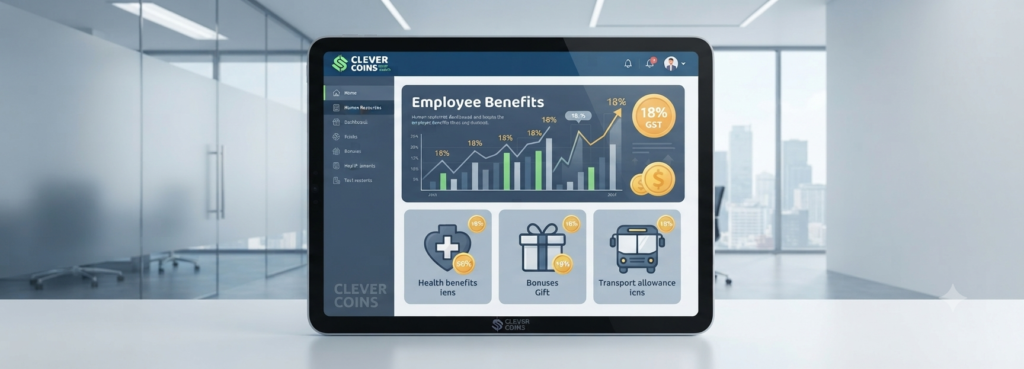
GST Impact: When a company purchases a group insurance policy for its employees, insurance companies levy an 18% GST on the premium.
ITC Availability: Section 17(5) of the CGST Act blocks Input Tax Credit on health and life insurance unless the government mandates such insurance under any prevailing law (e.g., specific factory act provisions or temporary mandates). If it is purely voluntary welfare, the 18% GST becomes an absolute business cost that cannot be offset.
2. Canteen and Subsidized Food Facilities
With offices running full-scale cafeterias or outsourcing meals, food-related perquisites are heavily scrutinized.
GST Impact: Outdoor catering services or restaurant services procured by a company to run a cafeteria attract GST (typically 5% without ITC or 18% with ITC, depending on the vendor arrangement).
Employer Recovery: If an employer recovers a nominal amount from the employee’s salary for meals, does it attract GST? Under clarification circulars, if the provision of food is treated as a natural part of employment conditions and is not an independent business activity, it generally escapes fresh GST levies, though rigid structures can trigger supply classification debates.
3. Corporate Transport and Cab Facilities
Transporting employees safely—especially during night shifts or across major metro hubs—is critical.
GST Impact: Cab aggregators or bus fleet operators charge 5% (without ITC) or 12% (with ITC) GST on passenger transportation services.
ITC Blockade: Under Section 17(5)(a) of the CGST Act, ITC on motor vehicles for transportation of persons is generally blocked unless the employer is legally obligated to provide transport under any special statute (such as mandatory women safety transport laws during night shifts in specific states).
4. Corporate Gifts and Festive Perquisites
From Diwali gold coins to high-end performance gadgets, gifting employees is a cultural cornerstone.
GST Impact: Section 17(5)(h) of the CGST Act blocks ITC on goods disposed of by way of gifts or free samples. If a company purchases laptops or gift hampers and hands them out for free, no ITC can be claimed on the purchase. Furthermore, if the gift exceeds ₹50,000 in value per employee in a financial year, Schedule I provisions regarding transactions between related parties without consideration can sometimes complicate corporate tax assessments.
5. Notice Pay Recovery and Recovery of Loans
When employees resign without serving their notice period, companies often recover “Notice Pay” from their final settlement. Conversely, companies may recover asset damages.
GST Impact: Tax authorities have historically argued that recovering notice pay is a consideration for tolerating an act or refraining from an act (breach of employment contract), classifying it under “services” attracting 18% GST. However, judicial precedents and subsequent clarifications heavily favor the stance that employment contracts are not “services” rendered by the employer to the employee; hence, notice pay recoveries are generally viewed as adjustments within employment terms rather than taxable taxable supplies.
Input Tax Credit (ITC): The Corporate Battleground
The single biggest financial friction point regarding employee benefits is the restriction outlined in Section 17(5) of the CGST Act. The law specifically restricts ITC on:
Food and beverages, outdoor catering, beauty treatments, health services, and cosmetic/plastic surgery.
Membership of a club, health, and fitness center.
Rent-a-cab, life insurance, and health insurance.
Travel benefits extended to employees on vacation (e.g., LTA-linked corporate holiday packages).
The Statutory Exception: The block on ITC for these services is lifted only if the central or state government makes it obligatory for an employer to provide these specific services to its employees under any contemporary law.
Restructuring CTC for Optimal Tax Efficiency
Given that certain employee benefits carry blocked GST credits that bloat operational costs, modern compensation restructuring must be approached strategically.
Monetization over Direct Provision: Where possible, shifting ambiguous in-kind perks into flexible allowance buckets taxable under standard income tax (but free from cascading GST loops) can simplify compliance.
Vendor Contract Audits: Ensure that third-party vendors (cafeteria operators, transport fleets, insurance brokers) correctly bill HSN/SAC codes. Misclassified services can trigger multi-year tax liabilities during audits.
Proactive Documentation: Maintain explicit internal policies demonstrating that benefits like safety transport or medical provisions stem directly from statutory obligations to safeguard against ITC disallowances.
Conclusion: Securing Compliance with CleverCoins
GST on employee benefits is a dynamic landscape where minor missteps in invoice processing or perquisite management can result in hefty demands, interest, and penalties from tax authorities. Aligning your CTC frameworks requires a deep understanding of both direct and indirect tax codes.
At CleverCoins, our multidisciplinary team specializes in untangling complex tax frameworks, conducting comprehensive GST health checks, and optimizing your corporate payouts. Stop second-guessing your compliance—consult with CleverCoins today and protect your corporate bottom line.
- Phone: +91 77389 59862
- Email: client@clevercoins.org
- Address: Ideal Market, Mumbra, Thane-400612