
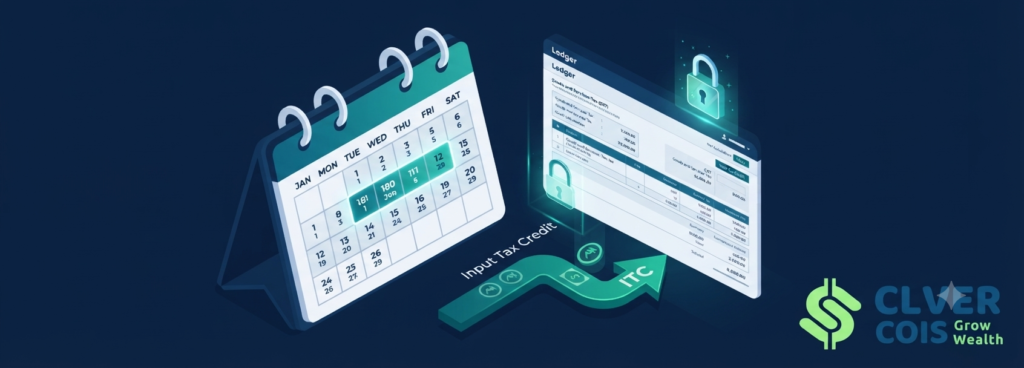
The 180-Day Payment Rule: Reversal of ITC for Unpaid Invoices under Section 16(2)
Introduction: The Hidden Cash Flow Trap in GST Compliance
The Goods and Services Tax (GST) regime was introduced with the promise of transforming India into a unified market, streamlining supply chains, and establishing a seamless flow of Input Tax Credit (ITC). However, underneath the promise of seamless credit lies a web of stringent conditions. One of the most critical—and frequently overlooked—compliance obligations is the 180-day payment rule governed by the second proviso to Section 16(2) of the CGST Act, 2017.
For businesses juggling working capital, credit cycles, and vendor negotiations, failing to track payment timelines can trigger heavy financial penalties. If you claim ITC on an invoice but fail to settle the dues with your supplier within 180 days, the law mandates the reversal of that credit along with applicable interest.
This guide breaks down everything businesses, finance professionals, and tax consultants need to know about Section 16(2), Rule 37 mechanics, interest calculations, and strategies to protect your cash flow.
Understanding Section 16(2): The Legal Framework
To claim Input Tax Credit under GST, a registered taxpayer must satisfy several baseline conditions outlined under Section 16(2). These include holding a valid tax invoice, receiving the goods or services, ensuring the supplier has filed their returns and paid taxes, and furnishing the return.
However, the second proviso to Section 16(2) introduces a performance-based condition:
“Where a recipient fails to pay to the supplier of goods or services or both, the amount towards the value of supply along with tax payable thereon within a period of 180 days from the date of issue of an invoice by the supplier, an amount equal to the input tax credit availed by the recipient shall be added to his output tax liability, along with interest thereon.”
Core Elements of the Rule:
-
Time Trigger: The 180-day countdown begins strictly from the date of issue of the invoice by the supplier—not the date of receipt of goods, not the date of recording in books, and not the date of claiming ITC.
-
Dual Component Coverage: The payment must cover both the value of the supply and the tax payable thereon. Paying only the tax component while leaving the principal value unpaid still triggers a proportionate or full reversal requirement.
-
Inclusion of Input Services: This rule applies equally to goods, capital goods (where applicable under specific contexts), and input services.
Rule 37 of CGST Rules: Mechanics of Reversal and Re-availment
While Section 16(2) establishes the mandate, Rule 37 of the CGST Rules outlines the operational mechanics of how this reversal must be carried out in your electronic returns.
Step 1: Adding to Output Tax Liability
When the 180-day mark passes without full payment to the vendor, the matching ITC amount must be reversed by adding it to your output tax liability in Table 4(B)(2) (“Others”) of GSTR-3B for the tax period in which the 180-day limit expires.
Step 2: Mandatory Interest Liability
Reversing the credit is only half the battle. Under Section 50 of the CGST Act, you are legally liable to pay interest at 18% per annum.
-
Interest Period: Calculated from the date the ITC was originally availed (the date of filing the GSTR-3B where credit was claimed) up to the date the reversal amount is actually paid.
-
Payment Mode: Interest must be paid using cash via the Electronic Cash Ledger (Form DRC-03). You cannot utilize your input tax credit balance to offset this interest liability.
Step 3: Re-availment Upon Payment
The silver lining under the law is that this reversal is not permanent loss. Once you eventually make the payment to your supplier, you are legally permitted to re-avail the ITC.
-
You can re-claim the credit in Table 4(A)(5) and report it in Table 4(D)(1) of the GSTR-3B for the month in which the payment is finally settled.
-
Crucially, there is currently no time limit prescribed under the law for re-claiming this credit (unlike the standard November 30 deadline for regular annual ITC claims), provided the initial transaction and invoice were authentic.
Practical Illustration & Calculation Example
To understand how the 180-day rule impacts day-to-day accounting, let’s review a practical scenario:
-
Invoice Date: November 20, 2025
-
Transaction Value: ₹20,00,000 + GST @ 18% (₹3,60,000) = Total ₹23,60,000
-
ITC Claimed: ₹3,60,000 claimed in GSTR-3B for November 2025.
-
Payment Status: Due to a delayed project milestone, the buyer fails to clear the dues within 180 days.
-
180th Day Expiry: May 19, 2026.
Compliance Action Required in May 2026 Return:
-
ITC Reversal: ₹3,60,000 is reported as an addition to output tax liability in Table 4(B)(2) of GSTR-3B.
-
Interest Calculation: Assuming the reversal and payment of interest happen on May 20, 2026 (spanning 182 days from date of availment):
$$\text{Interest} = \text{ITC Amount} \times 18\% \times \left(\frac{\text{Days}}{365}\right)$$$$\text{Interest} = ₹3,60,000 \times 0.18 \times \left(\frac{182}{365}\right) = ₹32,257$$This ₹32,257 must be paid in cash via DRC-03.
-
Re-claiming Later: If the buyer settles the invoice in August 2026, the ₹3,60,000 ITC can be safely re-availed in the August GSTR-3B filing.
Partial Payments and Proportional Reversal
Businesses rarely operate in rigid all-or-nothing terms. What happens if you make a partial payment within the 180-day window?
As per the provisions, the reversal applies proportionately to the unpaid portion of the total invoice value (inclusive of tax).
-
For instance, if you clear 70% of an invoice within 180 days but leave 30% unpaid, you are only required to reverse 30% of the ITC claimed, accompanied by interest calculated strictly on that reversed portion.
Interplay Between the 180-Day Rule and MSME 45-Day Payment Rules
In recent corporate compliance updates, tax professionals must navigate a dual-pressure ecosystem:
-
The Income Tax Act (Section 43B(h)): Designed to protect Micro and Small Enterprises (MSMEs), this rule mandates that payments to registered MSME vendors must be cleared within 45 days (or 15 days if no written agreement exists). Failure to do so results in the disallowance of the business expense for that financial year.
-
The GST 180-Day Rule: Focuses on indirect tax credits and applies to all suppliers regardless of their MSME registration status.
Strategic Takeaway: While GST gives you a 6-month (180-day) cushion to retain your input tax credits, dealing with MSME vendors requires a much tighter 45-day turnaround to protect your direct tax deductions.
Common Compliance Pitfalls to Avoid
-
Ignoring the Invoice Date Baseline: Measuring 180 days from the date of goods receipt or accounting entry instead of the official invoice date.
-
Forgetting the Interest Component: Reversing the principal ITC in GSTR-3B but neglecting to pay the 18% per annum interest via cash ledger, triggering automated tax notices.
-
Using Credit Ledger for Interest: Attempting to offset the 18% interest liability using existing ITC balances instead of making cash payouts through DRC-03.
-
Failing to Track Vendor Ledgers Systematically: Relying on manual spreadsheets rather than automated ERP triggers to flag invoices nearing the 150/180-day threshold.
Best Practices for Seamless ERP Tracking & Mitigation
-
Automated Aging Reports: Configure your accounting software (Tally, SAP, Zoho, etc.) to run automated accounts payable aging reports categorized by GST invoice dates.
-
Proactive Vendor Reconciliation: Synchronize your GSTR-2B filing data with purchase registers monthly to flag pending payments before the 180-day window closes.
-
Cash Flow Alignment: Factor the 180-day threshold into corporate credit policies, ensuring working capital is prioritized for invoices where heavy ITC is at stake.
Conclusion
The 180-day payment rule under Section 16(2) is a potent reminder that tax compliance is deeply intertwined with financial operations. While reversing credit and paying 18% interest can sting, proactive tracking and automated workflows can completely eliminate these avoidable cash flow leakages. Stay ahead of your timelines, protect your input tax credits, and secure your enterprise bottom line.
Disclaimer: This article is for informational purposes only and does not constitute professional legal or tax advice. For tailored corporate tax strategies, consult a certified tax professional.
Need expert assistance with multi-state GST audits, automated ITC reconciliation, or government scheme consultancy? Partner with industry specialists to safeguard your business growth.
- Phone: +91 77389 59862
- Email: client@clevercoins.org
- Address: Ideal Market, Mumbra, Thane-400612





