GST on Petroleum Products – Future Inclusion?
A Comprehensive Analysis of Constitutional Mandates, Revenue Dynamics, Corporate Impact, and Consumer Realities
Introduction
The Goods and Services Tax (GST), launched on July 1, 2017, was heralded as India’s biggest tax reform, aiming to streamline indirect taxation under a unified principle: “One Nation, One Tax.” However, nearly a decade later, the ultimate promise of this framework remains partially unfulfilled. When you pull up to a gas station anywhere in India, the price you pay for petrol or diesel is governed by a patchwork of pre-GST levies—namely Central Excise Duty and State Value Added Tax (VAT).
This raises a crucial question for policymakers, corporate leaders, and consumers: Will petroleum products ever be fully integrated into the GST regime?
The debate surrounding the GST on petroleum products is not merely a matter of administrative restructuring; it represents a high-stakes fiscal tug-of-war between the Central Government and State leadership. While commercial fleets, manufacturing units, and logistics operators face non-creditable fuel costs that inflate supply chains, state finance ministers rely heavily on petrol and diesel VAT as one of their primary sources of independent revenue.
This article breaks down the legal foundation, current tax burdens, price impact scenarios, corporate benefits, state fiscal fears, and potential paths forward for including petroleum under GST.
The Legal and Constitutional Framework
To understand why fuel sits outside the standard GST tax brackets, one must first look at the constitutional machinery that created the regime.
                   CONSTITUTION (101ST AMENDMENT) ACT, 2016
                                     │
                    ┌────────────────┴────────────────┐
                    ▼                                 ▼
             ARTICLE 279A(5)                     SECTION 9(2)
      Empowers GST Council to recommend         Deffers GST levy on 5 core
       effective date for 5 fuels               petroleum items until notified
The Constitutional Provision: Article 279A(5)
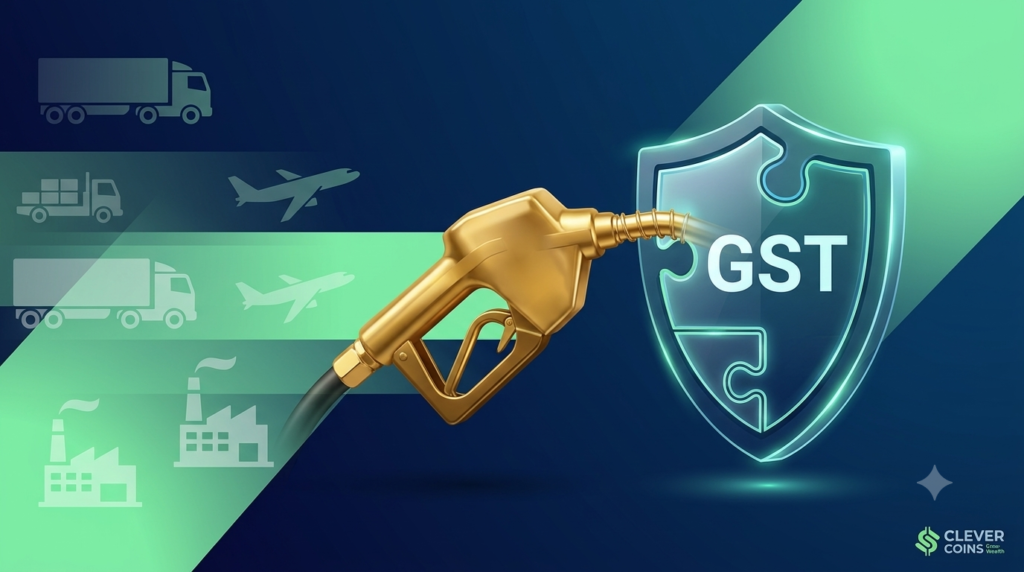
Under the Constitution (101st Amendment) Act, 2016, petroleum products were not permanently excluded from GST. Instead, Article 279A(5) specifically states that GST will be levied on five core petroleum items starting from a date recommended by the GST Council.
Section 9(2) of the CGST Act
This constitutional mandate is reinforced by Section 9(2) of the Central Goods and Services Tax (CGST) Act, 2017. The provision explicitlydefers the levy of CGST on five specified petroleum products until the Government formally notifies an effective date based on Council recommendations.
The Excluded Five vs. Included Derivatives
The exclusion applies strictly to five primary energy inputs:
Petroleum Crude
Motor Spirit (Petrol)
High-Speed Diesel (HSD)
Aviation Turbine Fuel (ATF)
Natural Gas
Many secondary derivatives are already taxed under GST. Liquefied Petroleum Gas (LPG) for domestic use is taxed at 5%, commercial LPG at 18%, Compressed Natural Gas (CNG) at 5%, and industrial lubricants/furnace oils at standard rates.
| Product Category | Current Tax System | Applicable Tax Rates | Input Tax Credit (ITC) Available? |
| Petrol (Motor Spirit) | Central Excise + State VAT | Excise (Rs 3/L) + VAT (15%–40%) | No (Outside GST) |
| High-Speed Diesel | Central Excise + State VAT | Excise (Rs 0/L) + VAT (15%–35%) | No (Outside GST) |
| Aviation Turbine Fuel (ATF) | Central Excise + State VAT | Excise (11%) + Variable State VAT | No (Outside GST) |
| Natural Gas | Central Excise + State VAT | Excise (14%) + Variable State VAT | No (Outside GST) |
| Petroleum Crude | OID Act / Excise Duties | Variable Duty Structures | No (Outside GST) |
| Domestic LPG | GST Regime | 5% GST | Yes (For eligible entities) |
| Engine Oils & Lubricants | GST Regime | 18% GST | Yes (Standard business credit) |
Understanding the Current Tax Structure
To appreciate why retail pump prices vary widely across Indian state borders, we need to trace how petrol and diesel are priced from refinery to pump.
┌─────────────────────────────────────────────────────────────┐
│ 1. Base Price (Refinery Gate Price + Freight)              │
└──────────────────────────────┬──────────────────────────────┘
                               │
                               ▼
┌─────────────────────────────────────────────────────────────┐
│ 2. + Central Excise Duty (Fixed amount per litre)           │
└──────────────────────────────┬──────────────────────────────┘
                               │
                               ▼
┌─────────────────────────────────────────────────────────────┐
│ 3. + Dealer Commission (Fixed margin paid to retailers)    │
└──────────────────────────────┬──────────────────────────────┘
                               │
                               ▼
┌─────────────────────────────────────────────────────────────┐
│ 4. + State VAT (Ad-valorem % applied to Base + Excise)      │
└──────────────────────────────┬──────────────────────────────┘
                               │
                               ▼
┌─────────────────────────────────────────────────────────────┐
│ 5. = Final Retail Pump Price                               │
└─────────────────────────────────────────────────────────────┘
The Cascading Effect (Tax-on-Tax)
Because State VAT is calculated on an ad-valorem basis (a percentage) applied after Central Excise Duty and dealer commissions are added to the base price, consumers pay tax on top of tax.
For example, if the base price of petrol is ₹60 per litre and Central Excise is added, the State VAT percentage is calculated on that combined higher total rather than the underlying product value alone.
State Price Disparities
Since each state sets its own VAT rates independently—ranging from approximately 15% to over 39% plus additional cesses—retail petrol prices routinely fluctuate by ₹10 to ₹15 per litre across state borders. A truck driving from Delhi to Mumbai pays significantly different fuel costs simply by crossing state boundaries.
Why States Oppose Inclusion: The Fiscal Federalism Standoff
The reluctance to bring fuel under GST is not driven by technical issues; it is rooted in state fiscal survival.
                     STATE FINANCIAL DEPENDENCE ON FUEL
                                     │
           ┌─────────────────────────┴─────────────────────────┐
           ▼                                                   ▼
     AUTONOMOUS LEVY                                     REVENUE SHARE
States retain 100% control over                     Petroleum VAT accounts for
VAT rates to cover emergency spending               11%–17% of total state tax revenue
Loss of Revenue Autonomy: Petroleum VAT and alcohol duties are the two remaining tax handles over which states retain exclusive pricing authority. During unexpected economic shocks or public health emergencies, raising fuel VAT offers state finance departments an immediate source of liquidity.
Proportionate Tax Revenue: Official figures show that petroleum taxes account for 11% to 17% of total state tax revenues in major economies like Maharashtra, Gujarat, Tamil Nadu, Uttar Pradesh, and Karnataka.
Distrust in Compensation Mechanisms: With the end of the formal 5-year GST Compensation Guarantee, states are hesitant to surrender their cash-flowing tax handles in exchange for shared pool disbursements.
Mathematical Price Projections: What Happens Under GST?
What would happen at the pump if petroleum products were brought under GST? The outcome depends entirely on the tax rate chosen by the GST Council.
Let’s model three scenarios based on a hypothetical Refinery Base Price + Freight of ₹60 per litre and a Dealer Commission of ₹3.80 per litre (Total Pre-Tax Base = ₹63.80/L).
  Current Price Structure (~₹103.97/L)
  ████████████████████ Base Price (₹60.00)
  █ Excise Duty (₹3.00)
  █ Commission (₹3.70)
  ██████ VAT & Surcharges (₹37.27)

  18% Standard GST Rate Scenario (~₹75.28/L)
  ████████████████████ Base Price (₹60.00)
  █ Commission (₹3.80)
  ███ GST 18% (₹11.48)

  28% Peak GST Rate Scenario (~₹81.66/L)
  ████████████████████ Base Price (₹60.00)
  █ Commission (₹3.80)
  █████ GST 28% (₹17.86)

  40% Special Fuel Slab Scenario (~₹89.32/L)
  ████████████████████ Base Price (₹60.00)
  █ Commission (₹3.80)
  ████████ GST 40% (₹25.52)
Scenario A: Standard 18% GST Slab
Pre-Tax Price: ₹63.80
18% GST: ₹11.48
Estimated Pump Price: ~₹75.28 / Litre
Impact: A massive drop in fuel prices for consumers. However, this rate would create an immediate, unmanageable revenue deficit for both Central and State budgets, making it unlikely without additional cesses.
Scenario B: Peak 28% GST Slab
Pre-Tax Price: ₹63.80
28% GST: ₹17.86
Estimated Pump Price: ~₹81.66 / Litre
Impact: A significant price reduction of ₹15 to ₹22 per litre from current national averages.
Scenario C: Special 40% High-Tax Slab (With Cess)
Pre-Tax Price: ₹63.80
40% Combined GST Rate: ₹25.52
Estimated Pump Price: ~₹89.32 / Litre
Impact: Retail pump prices settle into an affordable range of ₹88–₹92 nationwide while maintaining a predictable revenue stream for public finances.
Macroeconomic and Industry-Specific Impact
Bringing fuel into the GST net extends far beyond individual savings at the pump; it fundamentally restructures operational economics across key sectors.
                     CHAIN REACTION OF FUEL INCLUSION IN GST
                                     │
           ┌─────────────────────────┼─────────────────────────┐
           ▼                         ▼                         ▼
   LOGISTICS & FLEETS        MANUFACTURING             AIRLINES (ATF)
Input Tax Credit unlocked;  Cascading costs removed;  Flight ticket prices drop;
freight costs decrease      production costs fall     travel demand increases
1. Logistics and Transportation
Freight transport relies heavily on diesel. Because fuel expenses are currently exempt from Input Tax Credit (ITC), fleet owners treat fuel as a non-recoverable operational cost. Unlocking ITC would allow logistics firms to offset fuel GST against output liabilities on freight services, lowering transport overheads.
2. Manufacturing and Supply Chain Costs
From industrial generators to heavy machinery, diesel powers factory production. Under the current dual system, tax paid on fuel cannot be claimed as an input credit against finished goods. Bringing diesel into GST removes this embedded tax, making Indian manufactured exports more competitive globally.
3. Aviation Sector (Aviation Turbine Fuel)
Aviation Turbine Fuel (ATF) accounts for 35% to 40% of an airline’s total operating expenses. Transitioning ATF into a transparent GST bracket with full ITC claimability would lower operational costs for domestic carriers, reducing airfares and boosting passenger demand.
4. Inflation Control
Fuel costs directly influence consumer price index (CPI) calculations. Lower freight charges translate to cheaper daily goods, vegetables, and consumer products across wholesale and retail markets.
Strategic Roadmap: How Inclusion Could Happen
The GST Council is unlikely to transition all five fuel products simultaneously. Instead, policy analysts expect a phased rollout designed to balance revenue needs.
PHASED ROLLOUT STRATEGY FOR PETROLEUM PRODUCTS
Phase 1: Low-Impact Inputs  ---> Natural Gas & Aviation Turbine Fuel (ATF)
Phase 2: B2B Commercial Fuel ---> High-Speed Diesel (HSD)
Phase 3: High-Volume Consumer---> Motor Spirit (Petrol) & Crude Oil
Phase 1: Natural Gas and ATF
Rationale: Natural gas is primarily consumed by industrial plants, fertilizer units, and city gas networks, while ATF is used by airlines.
Fiscal Friction: Relatively low compared to retail petrol and diesel. Moving these two items first establishes a clean administrative framework with minimal revenue disruption.
Phase 2: High-Speed Diesel (HSD)
Rationale: Diesel is the primary commercial fuel used in logistics, agriculture, and manufacturing.
Fiscal Friction: Medium-to-High. Allowing B2B input tax credits on diesel provides an immediate economic boost to supply chains.
Phase 3: Petrol and Crude Oil
Rationale: Motor spirit serves retail personal transport and generates significant tax revenues.
Fiscal Friction: Highest. This phase requires a finalized dual-rate GST framework and an agreed revenue-sharing mechanism between the Centre and States.
Conclusion: The Horizon Ahead
Including petroleum products under GST remains a crucial step toward fully realizing India’s unified tax vision. While the legal mechanism exists under Article 279A(5), the political and fiscal trade-offs require careful coordination.
As logistics costs continue to impact global supply chain competitiveness, the argument for structural reform grows stronger. By adopting a phased rollout—starting with Natural Gas and ATF before moving to Diesel and Petrol—the GST Council can protect public revenues while providing tax clarity for Indian businesses and consumers.
- Phone: +91 77389 59862
- Email: client@clevercoins.org
- Address: Ideal Market, Mumbra, Thane-400612