GSTR-10 – Final Return on GST Cancellation: Everything You Must Know in 2026
When a business decides to wind down, restructure, or voluntarily surrenders its GST registration — or when the GST officer cancels a registration suo motu — the journey does not simply end with cancellation. Indian GST law mandates one final, critical compliance step: the filing of GSTR-10, also known as the Final Return.
GSTR-10 is not just a formality. It is the last legal obligation that a cancelled GST registrant must fulfil — a comprehensive declaration of all assets (inputs, semi-finished goods, finished goods, and capital assets) held as on the date of cancellation. Failure to file it correctly, or at all, can result in penalties of up to ₹20,000 and sustained tax liability with interest at 18% per annum on unrecovered Input Tax Credit (ITC).
This guide — fully updated for 2026 — is your definitive reference for understanding, preparing, and filing GSTR-10 without stress. Whether you are a business owner, a Chartered Accountant, a GST practitioner, or a compliance officer, this article covers every angle of GSTR-10 in plain, actionable language.
1. What Is GSTR-10? Definition and Legal Basis
GSTR-10 is a one-time return that must be filed by every registered taxpayer whose GST registration has been cancelled or surrendered. It is prescribed under Section 45 of the Central Goods and Services Tax (CGST) Act, 2017, read with Rule 81 of the CGST Rules, 2017.
Unlike periodic returns (GSTR-1, GSTR-3B), GSTR-10 is filed only once — after the effective date of cancellation. It serves as a closing statement that accounts for all taxable goods and capital assets held by the taxpayer on the date their registration ceased, ensuring that any Input Tax Credit availed on those assets is reversed and the tax liability is discharged before the taxpayer formally exits the GST system.
Legal Provisions Governing GSTR-10
- Section 45, CGST Act 2017: Mandates filing of a final return by every person whose registration is cancelled.
- Rule 81, CGST Rules 2017: Prescribes the format, time limit, and procedure for filing GSTR-10.
- Section 29, CGST Act 2017: Deals with cancellation of GST registration — the trigger event for GSTR-10.
- Section 73/74, CGST Act 2017: Governs assessment and demand of tax — applicable where GSTR-10 is not filed.
- Notification No. 08/2023 – Central Tax (Amnesty Scheme): Provided one-time waiver of late fees for GSTR-10 filers who had missed the deadline.
2. Who Is Required to File GSTR-10?
Every registered taxpayer whose GST registration has been cancelled or surrendered is legally obligated to file GSTR-10. This includes all types of cancellation scenarios:
Mandatory Filers of GSTR-10
- Businesses that voluntarily apply for cancellation of GST registration (e.g., business closure, sale of business, restructuring).
- Businesses whose GST registration has been cancelled by the tax officer due to non-compliance, non-filing of returns, or fraud.
- Partnership firms dissolved due to retirement or death of a partner.
- Proprietorship concerns where the proprietor passes away or discontinues business.
- Companies wound up under the Insolvency and Bankruptcy Code (IBC) or Companies Act, 2013.
- Businesses that have migrated to the Composition Scheme from Regular Registration (note: different treatment may apply).
- Exporters or SEZ units whose registration is cancelled.
Who Is EXEMPT from Filing GSTR-10?
- Taxpayers who have converted from Regular to Composition scheme are NOT required to file GSTR-10 for this conversion.
- Input Service Distributors (ISDs), Non-Resident Taxable Persons, and TDS/TCS deductors whose registrations are cancelled follow specific return provisions and do not file GSTR-10.
- Taxpayers whose registration was cancelled and then revoked (reinstated) — they continue with their regular return obligations as if cancellation never occurred.
3. Due Date for Filing GSTR-10 in 2026
The due date for filing GSTR-10 is a critical compliance parameter. Missing it triggers automatic late fee accumulation, which can be substantial.
Statutory Time Limit
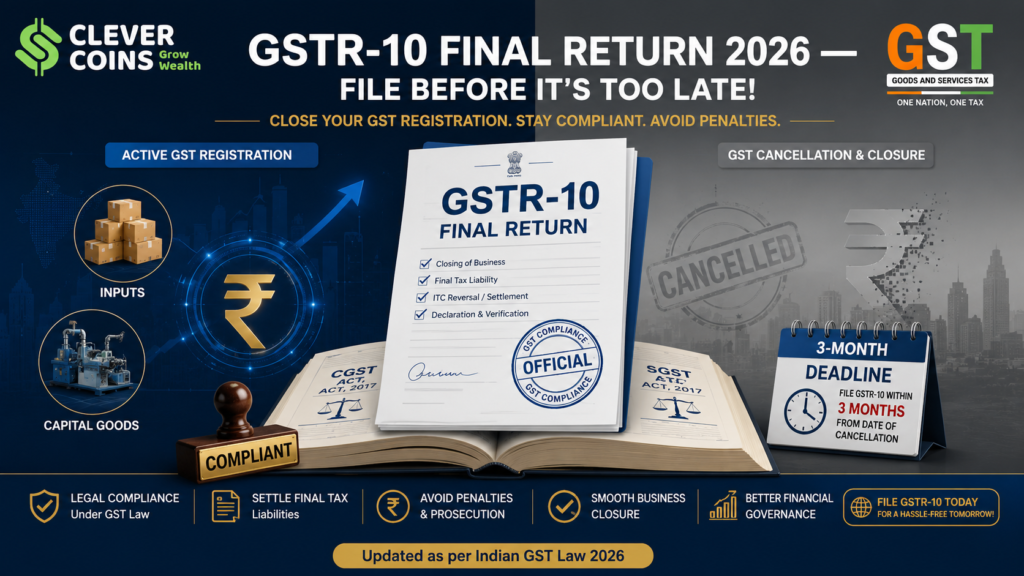
As per Section 45 and Rule 81 of the CGST Act/Rules, GSTR-10 must be filed within THREE MONTHS from the date of order of cancellation OR the date of cancellation — whichever is later.
Example: If your GST registration was cancelled (effective date) on 15th February 2026 and the cancellation order was issued on 28th February 2026, then GSTR-10 must be filed by 31st May 2026 (3 months from the later date, i.e., 28th February 2026).
Key Points About the Due Date
- The ‘3-month’ period is calculated from the ORDER date of cancellation, not necessarily the effective date specified in the cancellation application.
- If the taxpayer applied for voluntary cancellation and the order was delayed by the GST officer, the clock starts from the order date — providing some relief.
- There is no provision for automatic extension of the GSTR-10 due date. Any extension must be specifically notified by the GST Council/CBIC.
- CBIC has in the past issued special extensions — e.g., Amnesty Scheme under Notification No. 08/2023 CT extended the deadline for historical defaulters up to 31st August 2023 with waived/reduced late fees. Similar schemes may be announced in future GST Councils — monitor CBIC notifications at cbic.gov.in.
4. Late Fee and Penalty for Not Filing GSTR-10: 2026 Update
The consequences of not filing GSTR-10 on time are severe and automatic under GST law. Here is the complete penalty structure as applicable in 2026:
Scenario | Late Fee Per Day | Max Cap | Effective From |
CGST – Delay in Filing GSTR-10 | ₹200 per day | ₹10,000 | GST Amendment Act 2023 |
SGST – Delay in Filing GSTR-10 | ₹200 per day | ₹10,000 | GST Amendment Act 2023 |
Combined Late Fee (CGST+SGST) | ₹400 per day | ₹20,000 | As applicable |
Amnesty Scheme (if availed) | Reduced / Nil | As notified | GST Council Notifications |
Tax Liability on unreversed ITC | Interest @ 18% p.a. | No cap | Section 50 CGST Act |
Important Note: In addition to the late fee capped at ₹20,000 (CGST + SGST combined), the taxpayer also faces interest liability at 18% per annum under Section 50 of the CGST Act on any tax amount that remains unpaid (particularly on ITC that should have been reversed but was not). There is no cap on interest — it continues to accrue daily until the amount is paid.
Consequences Beyond Late Fee
- The cancelled taxpayer cannot obtain a No Objection Certificate (NOC) or clearance for future GST registrations until GSTR-10 is filed and dues are cleared.
- Tax officers can initiate Best Judgment Assessment under Section 62 of the CGST Act and raise a demand based on their estimates if GSTR-10 is not filed.
- Directors of companies and partners of firms can face personal liability for GST dues if GSTR-10 obligations remain unmet during winding up.
- GSTIN-linked bank accounts may be subject to garnishee notices from tax authorities if outstanding GSTR-10 dues are established.
5. Format and Key Fields of GSTR-10: Detailed Breakdown
GSTR-10 is a structured return available on the GST portal (www.gst.gov.in). Its format has been designed to capture a complete picture of taxable assets held at the time of cancellation. Below is a detailed explanation of each section:
Table / Field | Description | Action Required |
Part I – Basic Details | GSTIN, Legal/Trade Name, cancellation date, ARN of cancellation order | Auto-populated; verify accuracy |
Table 1 – Particulars of Taxpayer | Name, address, email, mobile, effective date of cancellation | Review and confirm |
Table 2 – Details of inputs held | Stock of inputs in hand on cancellation date | Report qty & taxable value; reverse ITC |
Table 3 – Capital goods / Plant & Machinery | Capital assets held as on cancellation date | Higher of ITC or 5% per quarter rule applies |
Table 4 – Tax payable | Auto-computed tax payable on reversed ITC (CGST, SGST, IGST, Cess) | Pay via DRC-03 or use available credit in ECL |
Table 5 – Verification | Authorised signatory details and declaration | Digital signature or EVC mandatory |
Understanding Table 2: Inputs and Input Services in Stock
This is the most critical table in GSTR-10. You must report all inputs (raw materials, trading goods, packing materials) that you hold as stock-in-hand on the effective date of cancellation, on which ITC was previously availed. The ITC attributable to this stock must be reversed and paid back to the government. The value to be reported is the taxable value of the goods, not the tax amount — the system auto-computes the tax payable based on the rates applicable.
Understanding Table 3: Capital Goods and Plant & Machinery
For capital goods, the ITC reversal is calculated using the special rule under Section 18(6) of the CGST Act read with Rule 44(6) of the CGST Rules. The amount to be paid is the HIGHER of:
- The ITC availed on the capital goods proportionate to their remaining useful life (reduced by 5% per quarter from the date of purchase), OR
- The tax payable on the transaction value (market value) of the capital goods as on the date of cancellation.
Example: A machinery was purchased for ₹10,00,000 with ITC availed of ₹1,80,000 (18% GST). The machinery is 6 quarters old. Remaining ITC = ₹1,80,000 – (6 × 5% × ₹1,80,000) = ₹1,80,000 – ₹54,000 = ₹1,26,000. If the current market value of the machine is ₹4,00,000, tax thereon at 18% = ₹72,000. Since ₹1,26,000 > ₹72,000, the taxpayer must reverse ₹1,26,000.
6. Step-by-Step Process to File GSTR-10 on the GST Portal
Filing GSTR-10 is a fully online process on the official GST portal. Follow these steps carefully for error-free submission:
Step-by-Step Filing Guide
- Log in to the GST Portal: Visit www.gst.gov.in and log in using your GSTIN credentials (username and password). Your cancellation should already be processed and visible in your dashboard.
- Navigate to GSTR-10: Go to Services > Returns > Final Return (GSTR-10). The return period will correspond to the cancellation period.
- Verify Pre-Populated Data: Part I (basic details including GSTIN, legal name, cancellation effective date, and ARN of cancellation order) will be auto-populated from your registration records. Verify every field carefully.
- Fill in Table 2 – Inputs in Stock: Enter details of all inputs (goods) held as on the cancellation date. For each item, enter: Description, UQC (unit quantity code), Quantity, Taxable Value, and applicable Tax Rate. The system will compute the ITC to be reversed.
- Fill in Table 3 – Capital Goods: Enter details of all capital goods, plant, and machinery held. Apply the higher-of rule (residual ITC vs. tax on market value) and enter the payable amount. Attach documentary evidence of market valuation where applicable.
- Review Tax Payable (Table 4): The system auto-generates the total tax payable (CGST, SGST, IGST, Cess) based on Tables 2 and 3. Cross-check this with your internal calculation.
- Pay Outstanding Tax Liability: If there is tax payable, pay it using the Electronic Cash Ledger (ECL) via challan (Form GST PMT-06). You may also use available balance in the Electronic Credit Ledger (ECL) for ITC — but since ITC is being reversed, typically cash payment is required.
- File Verification (Table 5): The authorised signatory must verify the return. Individuals can use EVC (Electronic Verification Code sent on registered mobile/email). Companies and LLPs must use a Digital Signature Certificate (DSC).
- Submit and Download ARN: After successful filing, an Acknowledgement Reference Number (ARN) is generated. Download and save the GSTR-10 acknowledgement for your records. This is proof of compliance.
Documents to Keep Ready Before Filing
- Copy of GST cancellation order (REG-19 form) issued by the officer.
- Stock statement as on the date of cancellation — physically verified and approved by management.
- Purchase invoices for all capital goods on which ITC was availed.
- Calculation worksheet for capital goods ITC reversal (using 5% per quarter methodology).
- Market valuation report for capital goods if applicable.
- Electronic Cash Ledger balance — ensure sufficient balance for tax payment.
- Digital Signature Certificate (DSC) for companies and LLPs.
7. ITC Reversal in GSTR-10: Detailed Rules and Calculations
Input Tax Credit reversal is the core compliance obligation in GSTR-10. This section provides an exhaustive guide to ITC reversal rules as applicable in 2026.
What ITC Must Be Reversed?
- ITC on inputs (raw materials, consumables, trading stock) that are in stock on the cancellation date and on which ITC was previously availed.
- ITC on semi-finished goods and work-in-progress inventory.
- ITC on finished goods inventory held on the cancellation date.
- ITC on capital goods — calculated using the proportionate residual life method or market value method, whichever results in higher tax payable.
- ITC on any inputs for which returns were filed but the goods are still in possession.
What ITC Need NOT Be Reversed?
- ITC on inputs that were already used up entirely in the manufacture of taxable goods (zero stock).
- ITC on inputs that were used to provide taxable services (consumed, not in stock).
- ITC on capital goods that are fully depreciated (zero book value) and where the residual ITC is nil.
- ITC that was already reversed in prior GSTR-3B filings due to exempt supply or other reversals.
ITC Reversal Computation – Illustrative Example
Scenario: A trader, Rajesh Enterprises, cancels its GST registration effective 31st March 2026. On that date, it holds:
- Stock of goods: ₹5,00,000 (taxable value) with ITC availed at 18% = ₹90,000 (CGST ₹45,000 + SGST ₹45,000).
- One delivery van purchased 10 quarters ago: ITC availed = ₹1,80,000. Residual ITC = ₹1,80,000 – (10 × 5% × ₹1,80,000) = ₹1,80,000 – ₹90,000 = ₹90,000. Current market value of van = ₹3,50,000; tax thereon at 18% = ₹63,000. Higher of ₹90,000 and ₹63,000 = ₹90,000 to be reversed.
Total ITC to reverse: ₹90,000 (stock) + ₹90,000 (van) = ₹1,80,000. This ₹1,80,000 must be paid by Rajesh Enterprises via GSTR-10 before the registration closure is complete.
8. Common Mistakes to Avoid While Filing GSTR-10
Even experienced taxpayers and their advisors make errors in GSTR-10 that can result in additional notices, interest demands, and compliance complications. Here are the most frequent pitfalls:
Mistake 1: Underreporting Stock
Many taxpayers report only goods physically present in the warehouse and miss goods in transit, goods with job workers, or goods sent on consignment that have not yet been sold. Under Section 143 of the CGST Act, goods sent to a job worker must be brought back or supplied within 1 year (inputs) or 3 years (capital goods) — any goods outside this window and not returned must also be included in GSTR-10 stock calculations.
Mistake 2: Incorrect Capital Goods Calculation
Applying the 5% per quarter reduction on the original ITC without checking whether the market value method results in a higher tax — and paying the lower amount — is a common and costly error. Always compute both, compare, and pay the higher.
Mistake 3: Not Filing on Time Due to Unawareness
Many small businesses are unaware that even after receiving the cancellation order, a final return obligation exists. The cancellation of registration does NOT automatically close all compliance obligations. GSTR-10 must still be filed within 3 months of the cancellation order date.
Mistake 4: Not Paying Tax Before Filing
GSTR-10 cannot be submitted if the tax liability arising from ITC reversal has not been paid. Ensure that the Electronic Cash Ledger has sufficient balance before attempting to file.
Mistake 5: Incorrect GSTIN/Period Selection
For businesses that had multiple GST registrations (e.g., in multiple states), GSTR-10 must be filed separately for each GSTIN that is being cancelled. Filing for one state and assuming the others are covered is a serious compliance error.
Mistake 6: Ignoring IGST on Interstate Stock
If goods held in stock were procured from another state (IGST paid), the reversal must correctly reflect IGST rather than splitting into CGST + SGST. The portal auto-populates this to some extent, but manual verification is critical.
9. GSTR-10 and the Amnesty Scheme: 2023 History and 2026 Outlook
A significant number of taxpayers across India failed to file GSTR-10 after their GST cancellations — either due to unawareness, operational challenges, or disputes with the tax department. Recognising this, the GST Council has historically offered amnesty schemes.
Amnesty Scheme 2023 – Key Details
- Notification No. 08/2023 – Central Tax, dated 31st March 2023, provided a one-time amnesty for taxpayers who had not filed GSTR-10 by the prescribed due date.
- Under the scheme, if GSTR-10 was filed between 1st April 2023 and 31st August 2023, the late fee was capped at a significantly reduced amount — maximum ₹1,000 (₹500 CGST + ₹500 SGST) irrespective of the delay period.
- Normal late fee (₹200/day up to ₹20,000) was completely waived for this period.
- Thousands of businesses across India took advantage of this window to regularise their GSTR-10 filing.
2026 Outlook: Will a New Amnesty Scheme Come?
As of 2026, no new amnesty scheme specifically for GSTR-10 has been announced. However, the GST Council periodically reviews compliance data and may announce relief packages. Taxpayers who have pending GSTR-10 obligations should NOT wait for an amnesty scheme — the cost of delay (₹400/day in late fee plus 18% interest) makes immediate filing the most prudent course. Monitor the CBIC website (cbic.gov.in) and official GST Council press releases for any new notifications.
10. GSTR-10 vs Other GST Returns: Key Differences
To put GSTR-10 in context within the broader GST return ecosystem, here is how it differs from the returns most taxpayers are familiar with:
GSTR-10 vs GSTR-3B
- GSTR-3B is a monthly/quarterly summary return filed by active registered taxpayers. GSTR-10 is a one-time final return filed only on cancellation.
- GSTR-3B captures ongoing output tax liability and ITC for the return period. GSTR-10 captures only the closing stock and capital assets at the time of exit.
- GSTR-3B can be revised through subsequent amendments. GSTR-10 is a terminal filing with no revision mechanism — errors require a rectification notice approach.
GSTR-10 vs GSTR-9 (Annual Return)
- GSTR-9 is filed annually by regular taxpayers for an entire financial year. GSTR-10 is filed only upon cancellation, covering the period from the last filed return to the cancellation date.
- A cancelled taxpayer must file all pending GSTR-1 and GSTR-3B returns up to the cancellation date BEFORE filing GSTR-10. GSTR-10 cannot be filed if prior returns are pending.
- GSTR-9 reconciles annual figures. GSTR-10 focuses specifically on asset position at closure.
GSTR-10 vs GSTR-9C (Audit/Reconciliation)
- GSTR-9C is a reconciliation statement (with audit certification for turnover above ₹5 crore). GSTR-10 has no parallel audit requirement — it is self-certified by the taxpayer/authorised signatory.
11. Special Situations and Edge Cases in GSTR-10
Case 1: Business Sold as a Going Concern
When a business is sold as a going concern (transfer of entire business including assets, liabilities, and employees), the GST treatment is different. CBIC has clarified that the transfer of a going concern as a whole is exempt from GST. In this case, the acquiring entity typically takes over the GSTIN or registers separately. The transferor’s GSTR-10 may reflect nil or minimal stock if all assets have been transferred to the buyer, and ITC reversal may be mitigated.
Case 2: Death of Proprietor
Upon the death of a sole proprietor, the legal heir must apply for cancellation of the deceased’s GSTIN. The legal heir is responsible for filing GSTR-10 on behalf of the deceased estate. All pending returns and the final GSTR-10 must be filed, with dues cleared from the estate. The legal heir should obtain a succession certificate or legal heirship certificate before interacting with the GST portal.
Case 3: Company Under Insolvency
When a company enters the Corporate Insolvency Resolution Process (CIRP) under the Insolvency and Bankruptcy Code (IBC) and its GST registration is ultimately cancelled post-liquidation, the Insolvency Resolution Professional (IRP) or Liquidator is responsible for filing GSTR-10. GST dues during insolvency have specific priority in the waterfall mechanism under IBC — they rank after secured creditors and workman dues.
Case 4: Suo Motu Cancellation by Officer
If the GST officer cancels a taxpayer’s registration suo motu (on their own, due to non-filing, fake registration, etc.), the taxpayer may apply for revocation within the prescribed period. If revocation is successful, GSTR-10 obligation is extinguished. If the taxpayer does NOT apply for revocation, GSTR-10 becomes mandatory. The 3-month GSTR-10 deadline runs from the cancellation ORDER date even in suo motu cases.
Case 5: Stock Held With Job Workers
Goods sent to job workers for processing/manufacturing that are still with the job worker on the date of cancellation must be included in GSTR-10 stock declarations. The taxpayer (principal) is responsible for accounting for such goods — even though they are physically off-site. The valuation is based on the cost of the goods (inputs) at the time they were sent to the job worker.
12. Frequently Asked Questions (FAQs) on GSTR-10 in 2026
Q1: Can I file GSTR-10 after the 3-month deadline?
Yes, you can still file GSTR-10 after the deadline, but late fees will apply. As of 2026, the late fee is ₹200 per day (CGST) + ₹200 per day (SGST) = ₹400 per day total, capped at ₹10,000 (CGST) + ₹10,000 (SGST) = ₹20,000 maximum. The fee cannot be waived without a specific government notification.
Q2: What if I have zero stock on the date of cancellation?
If you genuinely have zero stock — no inputs, no semi-finished goods, no finished goods, and no capital goods on which ITC was availed — you can file a NIL GSTR-10. This is a valid filing and will have no tax liability. Ensure your books clearly support the nil stock position in case of scrutiny.
Q3: What happens if my GSTR-10 has errors after filing?
GSTR-10, once submitted, cannot be revised or amended on the portal. If errors are discovered post-filing, the taxpayer should approach the jurisdictional GST officer with a written request explaining the discrepancy. The officer may initiate an assessment or allow a corrective DRC-03 payment for any underpaid liability. Prevention through careful preparation is the best strategy.
Q4: Do I need to file GSTR-10 if I have already filed all my GSTR-3B returns till the cancellation date?
Yes, absolutely. Filing all GSTR-3B returns up to the cancellation date is a PREREQUISITE for filing GSTR-10 — not a substitute. Even if all periodic returns are current, GSTR-10 is still mandatory to formally close the registration and account for closing stock.
Q5: Can the ITC reversed in GSTR-10 be claimed back in the future?
No. Once ITC is reversed through GSTR-10 and the registration is cancelled, that ITC is permanently lost. If the same business entity later re-registers for GST (e.g., after business revival), it starts fresh — there is no mechanism to reclaim ITC reversed during GSTR-10 of the previous registration.
Q6: Is there any relief for businesses that were non-operational for years before cancellation?
The 2023 Amnesty Scheme provided some relief for long-pending filers with reduced late fees. For ongoing obligations, there is no blanket relief based on non-operation. However, if a business was genuinely dormant (no turnover, no stock, no capital goods with ITC), a NIL GSTR-10 can be filed, and the late fee for NIL returns may be waived or reduced under specific notifications. Monitor CBIC notifications regularly.
13. GSTR-10 Checklist for CAs and GST Practitioners (2026)
This practical checklist is designed for Chartered Accountants and GST practitioners managing GSTR-10 filings for their clients:
Pre-Filing Checklist
- Obtain and review the GST cancellation order (Form REG-19) — confirm the effective date and order date.
- Calculate the GSTR-10 due date (3 months from the later of effective date or order date).
- Verify that all GSTR-1 and GSTR-3B returns are filed up to the cancellation period — GSTR-10 cannot be filed otherwise.
- Conduct a physical stock count as on the cancellation effective date and reconcile with books of accounts.
- Identify all capital goods on which ITC was availed — obtain purchase invoices and compute the residual ITC using the 5% per quarter formula.
- Obtain current market valuation for capital goods to apply the higher-of rule.
- Calculate total ITC reversal — prepare a detailed computation workbook.
- Ensure Electronic Cash Ledger has sufficient balance for the tax payment.
- Obtain DSC (for companies/LLPs) or ensure EVC mobile/email is accessible for proprietors/partners.
Filing Checklist
- Log in to GST portal with the cancelled GSTIN credentials.
- Navigate to GSTR-10 and verify auto-populated fields.
- Enter stock details in Table 2 accurately — verify UQC codes.
- Enter capital goods details in Table 3 with the correct reversal amount (higher of two methods).
- Cross-verify tax liability auto-computed in Table 4 against your workbook.
- Pay any outstanding liability via challan in ECL before filing.
- File with DSC/EVC and download the ARN confirmation.
- Inform the client and file the ARN in your compliance management system.
14. Key Takeaways: GSTR-10 Final Return Summary 2026
- GSTR-10 is a mandatory one-time final return for every taxpayer whose GST registration is cancelled or surrendered — there are NO exceptions.
- It must be filed within 3 months from the date of the cancellation ORDER (not effective date), failing which late fees of up to ₹20,000 apply automatically.
- The core obligation is to declare all closing stock (inputs, WIP, finished goods) and capital goods, and reverse the ITC previously availed on them.
- For capital goods, the reversal is the HIGHER of residual ITC (5% per quarter reduction) or tax on current market value.
- All prior GSTR-1 and GSTR-3B returns MUST be filed before GSTR-10 can be submitted.
- Interest at 18% p.a. applies on unpaid tax liability from ITC reversal — there is no cap on interest unlike the late fee cap.
- A NIL GSTR-10 is valid and permissible if no taxable stock or capital goods (with unreversed ITC) are held at cancellation.
- After filing GSTR-10, the taxpayer has formally exited the GST system — no further GST returns are required for that GSTIN.
- GSTR-10 filed and ARN received = proof of full GST compliance at the time of business closure — retain it permanently for audit and legal purposes.